Creativity &
Inspiration
Creativity:
The generation, development and transformation of ideas
that are both novel and useful for solving problems.
Are ideas the product of creativity?
Quality ideas come
from great quantities
of ideas.
Creativity can be
magical but it is
not magic.
It’s a method for
fi
nding solutions
to problems
Creativity can’t be rushed.
The process although tedious,
slow or even stalled at times,
continues until a solution is
found.
The process of creativity can
engender fear & doubt.
Everyone experiences these
feelings. The best creatives
have a plan for how to cope
and move on.
Creativity in
Advertising Students
Study by Glenn Gri
ffi
n
Beginning students Advanced students
Immediately begin
working on solutions after
receiving a problem
They don’t write down
“bad “ideas
Ultimate goal: create
fi
nished ad
Less likely to accept
problem as it is
presented. Often rede
fi
ne
problem or
fi
nd new one.
They write down even
“bad “ideas. They don’t
pre-judge their own ideas
during the process and
keep better notes.
Ultimate goal: discover
great idea
Studies on
Creativity
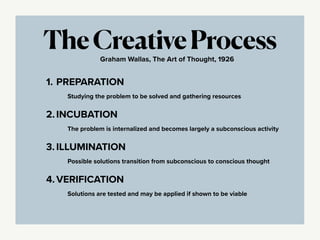
TheCreativeProcess
1. PREPARATION
Studying the problem to be solved and gathering resources
2.INCUBATION
The problem is internalized and becomes largely a subconscious activity
3. ILLUMINATION
Possible solutions transition from subconscious to conscious thought
4.VERIFICATION
Solutions are tested and may be applied if shown to be viable
Graham Wallas, The Art of Thought, 1926
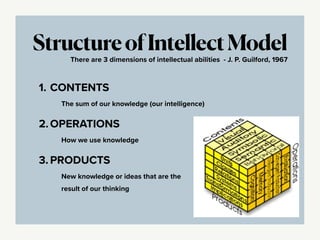
StructureofIntellectModel
1. CONTENTS
The sum of our knowledge (our intelligence)
2.OPERATIONS
How we use knowledge
3. PRODUCTS
New knowledge or ideas that are the
result of our thinking
There are 3 dimensions of intellectual abilities - J. P. Guilford, 1967
Operations:
thinking strategies which can be learned and
practiced (i.e. making lists, sketching mindmaps)
MINDMAPPING
Componential Model
1. PREPARATION
Studying the problem to be solved and gathering resources
2.INCUBATION
The problem is internalized and becomes largely a subconscious activity
3. ILLUMINATION
Possible solutions transition from subconscious to conscious thought
4.VERIFICATION
Solutions are tested and may be applied if shown to be viable
3 factors necessary for creativity to occur - Teresa Amabile
Think about your
own creative process.
Think about the
route you take to
fi
nd
ideas.
Illustrate that process on a piece of
paper. Can your visualization o
ff
er
someone else an understanding of
the process as you experience it?
Some
Examples
What about
AI Art?
DALL·E 2 is a new
AI system that can
create realistic
images and art
from a description
in natural
language.
Midjourney
produces an AI that
creates images from
textual descriptions,
exploring new
mediums of thought
and expanding the
imaginative powers
of the human
species.
Cue up to 17:50 - AI generated video
Creativity Process

Creativity Process

  • 1.
  • 2.
    Creativity: The generation, developmentand transformation of ideas that are both novel and useful for solving problems. Are ideas the product of creativity?
  • 3.
    Quality ideas come fromgreat quantities of ideas.
  • 4.
    Creativity can be magicalbut it is not magic. It’s a method for fi nding solutions to problems
  • 5.
    Creativity can’t berushed. The process although tedious, slow or even stalled at times, continues until a solution is found.
  • 6.
    The process ofcreativity can engender fear & doubt. Everyone experiences these feelings. The best creatives have a plan for how to cope and move on.
  • 7.
  • 8.
    Beginning students Advancedstudents Immediately begin working on solutions after receiving a problem They don’t write down “bad “ideas Ultimate goal: create fi nished ad Less likely to accept problem as it is presented. Often rede fi ne problem or fi nd new one. They write down even “bad “ideas. They don’t pre-judge their own ideas during the process and keep better notes. Ultimate goal: discover great idea
  • 9.
  • 10.
    TheCreativeProcess 1. PREPARATION Studying theproblem to be solved and gathering resources 2.INCUBATION The problem is internalized and becomes largely a subconscious activity 3. ILLUMINATION Possible solutions transition from subconscious to conscious thought 4.VERIFICATION Solutions are tested and may be applied if shown to be viable Graham Wallas, The Art of Thought, 1926
  • 12.
    StructureofIntellectModel 1. CONTENTS The sumof our knowledge (our intelligence) 2.OPERATIONS How we use knowledge 3. PRODUCTS New knowledge or ideas that are the result of our thinking There are 3 dimensions of intellectual abilities - J. P. Guilford, 1967
  • 13.
    Operations: thinking strategies whichcan be learned and practiced (i.e. making lists, sketching mindmaps)
  • 14.
  • 15.
    Componential Model 1. PREPARATION Studyingthe problem to be solved and gathering resources 2.INCUBATION The problem is internalized and becomes largely a subconscious activity 3. ILLUMINATION Possible solutions transition from subconscious to conscious thought 4.VERIFICATION Solutions are tested and may be applied if shown to be viable 3 factors necessary for creativity to occur - Teresa Amabile
  • 18.
    Think about your owncreative process. Think about the route you take to fi nd ideas. Illustrate that process on a piece of paper. Can your visualization o ff er someone else an understanding of the process as you experience it?
  • 19.
  • 20.
  • 22.
    DALL·E 2 isa new AI system that can create realistic images and art from a description in natural language.
  • 23.
    Midjourney produces an AIthat creates images from textual descriptions, exploring new mediums of thought and expanding the imaginative powers of the human species.
  • 25.
    Cue up to17:50 - AI generated video