MS. HEMANGI NARVEKAR
CLINICAL PSYCHOLOGIST AT WORK
CONTENTS
• Introduction
• Creativity
• Innovation
• Difference between Creativity and Innovation
• Benefits of Creativity and Innovation
• Examples of Creativity and Innovation
• Barriers to Creativity and Innovation
• Ways of promoting Creativity and Innovation
• Applications
• Summary
• References
INTRODUCTION
• Creativity is a mental process involving the
generation of new ideas or concepts, or new
associations of the creative mind between
existing ideas or concepts.
• Innovation is about creating value and increasing
efficiency, and therefore growing your business.
• Without innovation, new products, new service and
new ways of doing business would never emerge,
and most organization would be forever stuck doing
the same old things the same old way.
CREATIVITY
• How do we define creativity?
The most frequent answers are “new”, “unique”,
“different”, and “better”.
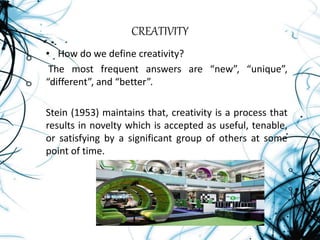
Stein (1953) maintains that, creativity is a process that
results in novelty which is accepted as useful, tenable,
or satisfying by a significant group of others at some
point of time.
• Creativity is the process of bringing something new
into being. Creativity requires passion and
commitment. It brings to our awareness what was
previously hidden and points to new life.
• A product is creative when it is (a) novel and (b)
appropriate. A novel product is original not
predictable. The bigger the concept, and the more
the product stimulates further work and ideas, the
more the product is creative.
Types of creative thinking
REFRAMING: Reframing opens up creative
possibilities by changing our interpretation of an
event, situation, behaviour, person or object.
Reframing isn’t just an intellectual exercise-it
changes the way we feel, which in turn change our
capacity for action.
MIND MAPPING:
Mind mapping sidesteps the problem by
allowing to write ideas down in an
associative and organic pattern. This is
helpful because it involves both words and a
visual layout.
INSIGHT:
An idea that appears in the mind as if from
nowhere, with no immediately preceding
conscious thoughts or effort. An idea pops
into your mind out of the blue.
CREATIVE FLOW:
When you are completely observed in your
work everything seems to fall into place,
and whatever you are working with-ideas,
words, notes or whatever-starts to flow
easily and naturally. For an creative flow
there should be clear goals for every step.
STAGES OF CREATIVITY
• Graham Wallas, one of the psychologists of
early twentieth century, given five stages of
creative thinking, they are:
Preparation
Incubation
Illumination
Evaluation
revision
STAGES OF CREATIVITY
o Preparation: This is the first stage in which the
thinker formulates the problem and collects facts
and materials necessary for the solution.
o Incubation: This is a stage of no solution and
involves a number of emotional and cognitive
complexities. Perhaps, fatigue and too much of
concern with the problem also mount out during
this period.
o Illumination: In this stage a potential solution to
the problem seems to be realized as if from
nowhere. It is about having the insight about the
possible solution.
STAGES OF CREATIVITY
o Evaluation: In this stage the obtained solution is
verified or tested to see if it works. Frequently,
the insight may turn out to be unsatisfactory, and
may need some modification in the strategy of
approaching the problem.
o Revision: Revision is required in the case a
solution which is not satisfactory.
INNOVATION
• Innovation is universally acknowledged as a key to human
development, well-being and indeed survival.
• Organizational innovation has been consistently defined as
the adoption of an idea or behavior that is new to the
organization (Damanpour 1988, et.al).
Innovation at workplace:
• Innovation generally refers to changing or creating more
effective processes, products and ideas, and can
increase the likelihood of a business succeeding.
• Innovation can be viewed as the application of better
solutions that meet new requirements, unarticulated
needs, or existing market needs. It involves the
deliberate application of information and imagination.
• In the organizational context, innovation may be linked
to positive changes in efficiency, productivity, quality,
competitiveness, and market share.
Cont…
• Businesses that innovate create
more efficient work processes and
have better productivity and
performance.
• Thus, innovation can either be a
new product, a new service, a
new technology, or a new
administrative practice that will
help stay ahead of competition as
markets, technologies or trends
shift.
Types of innovations:
• Product innovation:
It consists of changes in product attributes with a
change in how the product is noticed by
consumers.
• Process innovation:
It consists of changes regarding the product or the
service production process and not on the final
product but produces benefits in the production
process, generally increasing the productivity and
reducing costs.
Cont…
• Innovation of business model:
The way product or the service is offered to the market. It
does not necessarily imply changes in the product or even
in the production process but in the way as it is brought
to the market.
• Incremental Innovation:
It reflects small continuous improvements in products or
product lines. It generally represents small improvements
in benefits noticed by the consumer.
• Radical Innovation:
It represents a drastic change in the way that the product
or the service is consumed. It generally, brings a new
paradigm to the market segment that modifies the
existing business model.
STAGES OF INNOVATION
• Stage 1: Idea Generation and Mobilization
The generation stage is the starting line for new ideas.
Successful idea generation should be fueled both by
the pressure to compete and by the freedom to
explore.
• Stage 2: Advocacy and Screening
This stage is the time for weighing an idea’s pros and
cons. Advocacy and screening have to take place at the
same time to weed out ideas that lack potential
without allowing stakeholders to reject ideas
impulsively solely on the basis of their novelty.
STAGES OF INNOVATION
• Stage 3:
Experimentation
The experimentation stage
tests the sustainability of
ideas for a particular
organization at a particular
time — and in a particular
environment.
STAGES OF INNOVATION
• Stage 4: Commercialization
In the commercialization stage, the organization should look
to its customers to verify that the innovation actually solves
their problems and then should analyze the costs and
benefits of rolling out the innovation. An invention is only
considered an innovation [once] it has been commercialized.
• Stage 5: Diffusion and Implementation
The diffusion and implementation stages are “two sides of
the same coin.” Diffusion is the process of gaining final,
companywide acceptance of an innovation, and
implementation is the process of setting up the structures,
maintenance and resources needed to produce it.,
DIFFERENCE BETWEEN
CREATIVITY AND INNOVATION
• Considering the complexity of the concept of creativity, it is necessary
to distinguish the concept of innovation and creativity.
• Kuntz (1988) said innovation is application of new ideas from cited
creativity and believes that innovation can be a new product, new
service or a new way of doing something, but creativity is ability of
creating new ideas and innovative thought.
• In simple words :
Creativity is typically used to refer to the act of producing new ideas,
approaches or actions.
Innovation is the process of both generating and applying such
creative ideas in some specific context.
Creativity
• In a work setting, creativity is the process of
bringing something new into being. Creativity
requires passion and commitment. It brings to
our awareness what was previously hidden and
points to new life.
• Some benefits of creativity in a work setting are…
Better teamwork
and team
bonding:
Creativity at workplace
leads to brainstorming
which in turn enhances
team work and thus lets
the team members bond.
Increased
workplace
engagement and
interaction:
Creativity leads to a
healthy interaction at
workplace between
employees. There is
exchange of ideas and
this promotes helping
nature.
Improved ability
to attract and
retain quality
employees:
Creative work
environment attracts
enthusiastic interns and
lets them showcase
their talent, thereby
retaining the company
standards.
Increased
workplace
problem solving
and productivity:
A creative workplace
provides creative
solutions for problems at
work. Employees are
able to come up with
admirable strategies to
increase productivity of
the company.
Increased staff
morale, fun and
happiness:
A creative workplace helps
in keeping their employees
happy. Only then, the
employees are able to love
their work and be happy
doing it.
Improved
productivity &
reduced costs:
A lot of process
innovation is about
reducing unit costs. This
might be achieved by
improving the
production.
Innovation
• Innovation is simply the process of creating
and implementing a new idea or ideas.
• Some people say creativity has nothing to do
with innovation— that innovation is a
discipline, implying that creativity is not. Well,
it is not entirely true. Creativity is also a
discipline, and a crucial part of the innovation
equation. There is no innovation without
creativity.
• Some benefits of Innovation are…
Better quality:
By definition, better
quality products and
services are more likely
to meet customer needs.
Assuming that they are
effectively marketed,
that should result in
higher sales and profits.
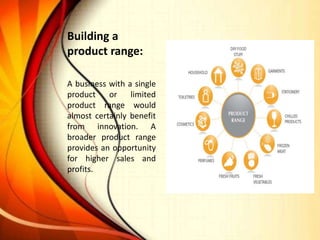
Building a
product range:
A business with a single
product or limited
product range would
almost certainly benefit
from innovation. A
broader product range
provides an opportunity
for higher sales and
profits.
To handle legal
and
environmental
issues:
Innovation might enable
the business to reduce it
carbon emissions, produce
less waste or perhaps
comply with changing
product legislation.
Changes in laws often
force business to innovate
when they might not
otherwise do so.
More added
value:
Effective innovation is a
great way to establish a
unique selling proposition
("USP") for a product –
something which the
customer is prepared to
pay more for and which
helps a business
differentiate itself from
competitors.
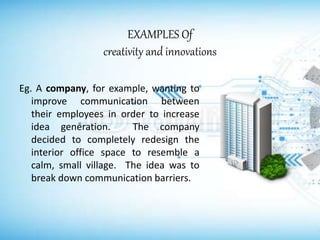
EXAMPLES Of
creativity and innovations
Eg. A company, for example, wanting to
improve communication between
their employees in order to increase
idea generation. The company
decided to completely redesign the
interior office space to resemble a
calm, small village. The idea was to
break down communication barriers.
EXAMPLES Of
creativity and innovations
Eg. The James Cook Hotel Grand
Chancellor is a four star, full services
hotel located in central Wellington. It is
an industry that often suffers from high
staff turnover, the core challenge for
the James Cook Hotel is staff retention.
To cope with the growth in business
and peak periods, cross-training has
enabled staff to be deployed in
different areas. This brings greater
flexibility in staffing, better
communication between workers and
improved service levels for customers.
EXAMPLES Of
creativity and innovations
Eg. The aviation industry experienced a downturn in the early-1990s because
of the worldwide recession and the Gulf War. Many airlines started
focusing on cutting costs, reducing capacity growth, and increasing load
factors. However, customers began to demand better services, which
made the costs rise again.
Actions (Actual Ideas):
 Electronic booking of tickets
services were launched.
 Entertainment systems,
advanced designing of seats
and aircraft interiors were
introduced.
Selgas Cano Architecture Firm
Google
Google
Google
Facebook
Barriers to
Creativity and Innovation
 Lack of motivation and lack of trust
 Judgment
 Playing by the Rules
 Hard Work
 No process
 Misunderstanding
 Negative attitude
WAYS OF ENCOURAGING CREATIVITY AT WORKPLACE
• Creative thinking is essential for any organization to prevent
stagnation and to keep the business moving forward.
Following are some of the ways to encourage creativity among
employees:
 Create a stimulating environment.
Offices that include stimulating
objects such as journals, art, games
and other items – some of which
may not even be directly related to
business – serve as sources of
inspiration.
WAYS OF ENCOURAGING CREATIVITY AT WORKPLACE
 Promote Diversity.
For example, if you are making a team
of people to work on a project, make
sure they come from all different backgrounds.
 Encourage in-person communication and interactions.
Encouraging active mood states amongst co-workers and team
members will improve their creativity and one way to do that is
through interpersonal communication.
WAYS OF ENCOURAGING CREATIVITY AT WORKPLACE
 Provide incentives or rewards.
Tangible motivation will help employees
feel more comfortable and willing to
bring their creative ideas forward.
 Allow some free time.
Not only will this help them flesh out their ideas, but it also gives
them a mental break from their day-to-day responsibilities.
 Think from a new viewpoint.
Employees must be able to see things from different
perspectives.
WAYS OF PROMOTING INNOVATION
AT WORK PLACE
• Innovation can be a catalyst for the growth and success of business,
and helps adapt and grow in the marketplace.
 Give employees a reason to care.
If people aren’t feeling connected to company, there’s little incentive
for them to be innovative.
 Stress the importance of innovation.
Ensure all your employees know that you want to hear their ideas.
WAYS OF PROMOTING INNOVATION
AT WORK PLACE
 Schedule time for brainstorming.
Allocate time for new ideas to emerge. For example, set aside
time for brainstorming, hold regular group workshops and
arrange team days out.
 Encourage Change.
Broadening peoples’ experiences can
be a great way to spark ideas.
WAYS OF PROMOTING INNOVATION
AT WORK PLACE
 Challenge the way staff work.
Encourage employees to keep looking for a new way of
approaching their work.
 Be supportive.
Respond enthusiastically to all ideas and
never make someone offering an idea feel
foolish.
WAYS OF PROMOTING INNOVATION
AT WORK PLACE
 Tolerate mistakes.
A certain amount of risk-taking is
inevitable with innovation.
Allow people to learn from their
mistakes.
 Act on ideas.
Innovation is only worthwhile if it results in action. Provide the
time and resources to develop and implement those ideas worth
acting upon.
WAYS OF PROMOTING INNOVATION
AT WORK PLACE
 Hire people with different perspectives.
Look for those that may have different perspectives, diverse
backgrounds, passions, and capabilities.
 Reward employees.
Rewards can be for individuals or even teams or for the whole
workforce – the important thing is that employees see that you
appreciate their efforts to improve the business.
 Offer training.
Offer training to employees that will
inspire new thoughts and approaches to
the business.
Applications of
Creativity
• Creativity and its importance in a
workplace helps in four main creative
strengths:
1. Fluency: Employees come up with more
than one idea along the same topic or
theme. Simple exercises where
employees are encouraged to come up
with multiple uses for a single ordinary
object are a great way to encourage this
skill.
Applications of
Creativity
2. Flexibility: The same as stated just now, but
with creating multiple ideas across topics
and themes that may or may not be similar.
This helps employees link together possible
ideas.
3. Elaboration: Ability to add more details,
viewpoints, and perspectives to existing
information. Employees see if they can
describe an experience using all of their
senses.
Applications of
Creativity
4. Originality: Coming up with ideas that
are unique and out of the ordinary.
Holding semi-regular brainstorms with
the staff and encouraging them to put
down all of their ideas, not just the ones
that they’re already certain will work.
Applications of Innovation
• There are several reasons why the
generation of new ideas can be critical to
your business's success. Although every
organisation will have its own priorities
and sector-specific issues to balance,
businesses that fail to innovate run the risk
of losing ground to competitors, losing key
staff, or simply operating inefficiently.
• Some applications of innovation are:
Applications of Innovation
1. Responding to trends and competition:
Innovation can help discover what
opportunities exist now, or are likely to
emerge In the future.
2. Make the most of what you already
have: Innovation is not only about
designing a new product or service to sell,
but can also focus on existing business
processes and practices to improve
efficiency, find new customers, cut down
on waste and increase profits.
Applications of Innovation
3. Developing a unique selling point:
Consumers often see innovation as
something that adds value to a
company or to its products. Customers
may even be willing to pay more for
your well-designed, novel and
innovative product or service, rather
than choosing a cheaper, but less
exciting rival.
Applications of Innovation
4. Innovation breaks monotony:
Employees who work on one project for
a very long time often complain of
monotony. They would want to be part
of or contribute to other projects.
Encouraging employees to involve
themselves in projects other than theirs,
gives them an opportunity to showcase
their skills.
SUMMARY
 Creativity is the process of bringing something new into being. In order
to be creative, one needs to be able to view things in new ways or from
a different perspective.
 Innovation is the implementation of a new or significantly improved
product, service or process that creates value for business, government
or society.
 In order for an organization to survive in thrive in these crazy times, it
must develop the ability to innovate. This capability is the critical
capability for organizational survival and flourishing. Businesses that
innovate create more efficient work processes and have better
productivity and performance.
 Creativity and innovation work hand in hand. To reap innovative
outcomes, creativity must first be worked into the workplace and
become established. Innovations, therefore, are the reward of creativity.
The ideas themselves won’t pay the bills, but the successful
implementation of those ideas, that is, “Innovation” will.
REFERENCES
Book References:
• Kirsh, S.J., Duffy, K.G. & Atwater, E. (2015). Psychology for Living:
Adjustment, Growth & Behaviour Today (11th ed.). New Delhi: Dorling
Kindersley (India) Private Limited.
• Newstrom, J. W. (2007). Organizational Behaviour: Human Behaviour at
Work (12th ed.). New Delhi: Tata McGraw-Hill Publishing Company Limited.
• Cropley, D.H. & Cropley, A. J. (2015). The psychology of innovation in
organization. USA: Cambridge University Press.
Journal References:
• Fadaee, A. & Alzahrh, H. O. A. (2014). Explaining the Relationship between
Creativity, Innovation and Entrepreneurship. International Journal of
Economy, Management and Social Sciences, 3(12), 1-4. Retrieved from
54b8b5c8743c08.45839487.pdf
• Hage, J. T. (1999). Organizational innovation and organizational change.
Annual Reviews of Sociology, 25, 597–622.
REFERENCES
Website References:
• Applications of creativity. Retrieved January 27, 2016 from
http://www.allbusiness.com/the-importance-of-creativity-in-the-workplace-24566-
1.html
• Applications of Innovation. Retrieved January 27, 2016 from
https://www.business.qld.gov.au/business/business-improvement/becoming-
innovative-business/why-business-innovation-important
• Engaging your employees in innovation. Retrieved January 27, 2016 from
http://www.business.vic.gov.au/marketing-sales-and-online/growth-innovation-and-
measurement/improving-business-innovation-and-examples
• Examples of Creativity. Retrieved January 27, 2016 from
http://employment.govt.nz/er/bestpractice/productivity/casestudies/list.asp
• How to Encourage More Creativity in the Workplace. Retrieved January 27, 2016 from
https://www.pgi.com/learn/how-encourage-more-creativity-workplace/
• Stages of Innovation. Retrieved January 27, 2016 from
http://sloanreview.mit.edu/article/the-five-stages-of-successful-innovation/
• Ways to Enhance Creativity in a Workforce. Retrieved January 27, 2016 from
http://www.businessdictionary.com/article/657/creativity-and-innovation-in-the-
workplace/
Author acknowledges Ms. Avina,
Ms. Nisha and Ms. Sailee for their
contribution.
THANK YOU

Creativity & Innovation at Work

  • 1.
    MS. HEMANGI NARVEKAR CLINICALPSYCHOLOGIST AT WORK
  • 2.
    CONTENTS • Introduction • Creativity •Innovation • Difference between Creativity and Innovation • Benefits of Creativity and Innovation • Examples of Creativity and Innovation • Barriers to Creativity and Innovation • Ways of promoting Creativity and Innovation • Applications • Summary • References
  • 3.
    INTRODUCTION • Creativity isa mental process involving the generation of new ideas or concepts, or new associations of the creative mind between existing ideas or concepts.
  • 4.
    • Innovation isabout creating value and increasing efficiency, and therefore growing your business. • Without innovation, new products, new service and new ways of doing business would never emerge, and most organization would be forever stuck doing the same old things the same old way.
  • 5.
    CREATIVITY • How dowe define creativity? The most frequent answers are “new”, “unique”, “different”, and “better”. Stein (1953) maintains that, creativity is a process that results in novelty which is accepted as useful, tenable, or satisfying by a significant group of others at some point of time.
  • 6.
    • Creativity isthe process of bringing something new into being. Creativity requires passion and commitment. It brings to our awareness what was previously hidden and points to new life. • A product is creative when it is (a) novel and (b) appropriate. A novel product is original not predictable. The bigger the concept, and the more the product stimulates further work and ideas, the more the product is creative.
  • 7.
    Types of creativethinking REFRAMING: Reframing opens up creative possibilities by changing our interpretation of an event, situation, behaviour, person or object. Reframing isn’t just an intellectual exercise-it changes the way we feel, which in turn change our capacity for action.
  • 8.
    MIND MAPPING: Mind mappingsidesteps the problem by allowing to write ideas down in an associative and organic pattern. This is helpful because it involves both words and a visual layout.
  • 9.
    INSIGHT: An idea thatappears in the mind as if from nowhere, with no immediately preceding conscious thoughts or effort. An idea pops into your mind out of the blue.
  • 10.
    CREATIVE FLOW: When youare completely observed in your work everything seems to fall into place, and whatever you are working with-ideas, words, notes or whatever-starts to flow easily and naturally. For an creative flow there should be clear goals for every step.
  • 11.
    STAGES OF CREATIVITY •Graham Wallas, one of the psychologists of early twentieth century, given five stages of creative thinking, they are: Preparation Incubation Illumination Evaluation revision
  • 12.
    STAGES OF CREATIVITY oPreparation: This is the first stage in which the thinker formulates the problem and collects facts and materials necessary for the solution. o Incubation: This is a stage of no solution and involves a number of emotional and cognitive complexities. Perhaps, fatigue and too much of concern with the problem also mount out during this period. o Illumination: In this stage a potential solution to the problem seems to be realized as if from nowhere. It is about having the insight about the possible solution.
  • 13.
    STAGES OF CREATIVITY oEvaluation: In this stage the obtained solution is verified or tested to see if it works. Frequently, the insight may turn out to be unsatisfactory, and may need some modification in the strategy of approaching the problem. o Revision: Revision is required in the case a solution which is not satisfactory.
  • 15.
    INNOVATION • Innovation isuniversally acknowledged as a key to human development, well-being and indeed survival. • Organizational innovation has been consistently defined as the adoption of an idea or behavior that is new to the organization (Damanpour 1988, et.al).
  • 16.
    Innovation at workplace: •Innovation generally refers to changing or creating more effective processes, products and ideas, and can increase the likelihood of a business succeeding. • Innovation can be viewed as the application of better solutions that meet new requirements, unarticulated needs, or existing market needs. It involves the deliberate application of information and imagination. • In the organizational context, innovation may be linked to positive changes in efficiency, productivity, quality, competitiveness, and market share.
  • 17.
    Cont… • Businesses thatinnovate create more efficient work processes and have better productivity and performance. • Thus, innovation can either be a new product, a new service, a new technology, or a new administrative practice that will help stay ahead of competition as markets, technologies or trends shift.
  • 18.
    Types of innovations: •Product innovation: It consists of changes in product attributes with a change in how the product is noticed by consumers. • Process innovation: It consists of changes regarding the product or the service production process and not on the final product but produces benefits in the production process, generally increasing the productivity and reducing costs.
  • 19.
    Cont… • Innovation ofbusiness model: The way product or the service is offered to the market. It does not necessarily imply changes in the product or even in the production process but in the way as it is brought to the market. • Incremental Innovation: It reflects small continuous improvements in products or product lines. It generally represents small improvements in benefits noticed by the consumer. • Radical Innovation: It represents a drastic change in the way that the product or the service is consumed. It generally, brings a new paradigm to the market segment that modifies the existing business model.
  • 20.
    STAGES OF INNOVATION •Stage 1: Idea Generation and Mobilization The generation stage is the starting line for new ideas. Successful idea generation should be fueled both by the pressure to compete and by the freedom to explore. • Stage 2: Advocacy and Screening This stage is the time for weighing an idea’s pros and cons. Advocacy and screening have to take place at the same time to weed out ideas that lack potential without allowing stakeholders to reject ideas impulsively solely on the basis of their novelty.
  • 21.
    STAGES OF INNOVATION •Stage 3: Experimentation The experimentation stage tests the sustainability of ideas for a particular organization at a particular time — and in a particular environment.
  • 22.
    STAGES OF INNOVATION •Stage 4: Commercialization In the commercialization stage, the organization should look to its customers to verify that the innovation actually solves their problems and then should analyze the costs and benefits of rolling out the innovation. An invention is only considered an innovation [once] it has been commercialized. • Stage 5: Diffusion and Implementation The diffusion and implementation stages are “two sides of the same coin.” Diffusion is the process of gaining final, companywide acceptance of an innovation, and implementation is the process of setting up the structures, maintenance and resources needed to produce it.,
  • 23.
    DIFFERENCE BETWEEN CREATIVITY ANDINNOVATION • Considering the complexity of the concept of creativity, it is necessary to distinguish the concept of innovation and creativity. • Kuntz (1988) said innovation is application of new ideas from cited creativity and believes that innovation can be a new product, new service or a new way of doing something, but creativity is ability of creating new ideas and innovative thought. • In simple words : Creativity is typically used to refer to the act of producing new ideas, approaches or actions. Innovation is the process of both generating and applying such creative ideas in some specific context.
  • 24.
    Creativity • In awork setting, creativity is the process of bringing something new into being. Creativity requires passion and commitment. It brings to our awareness what was previously hidden and points to new life. • Some benefits of creativity in a work setting are…
  • 25.
    Better teamwork and team bonding: Creativityat workplace leads to brainstorming which in turn enhances team work and thus lets the team members bond.
  • 26.
    Increased workplace engagement and interaction: Creativity leadsto a healthy interaction at workplace between employees. There is exchange of ideas and this promotes helping nature.
  • 27.
    Improved ability to attractand retain quality employees: Creative work environment attracts enthusiastic interns and lets them showcase their talent, thereby retaining the company standards.
  • 28.
    Increased workplace problem solving and productivity: Acreative workplace provides creative solutions for problems at work. Employees are able to come up with admirable strategies to increase productivity of the company.
  • 29.
    Increased staff morale, funand happiness: A creative workplace helps in keeping their employees happy. Only then, the employees are able to love their work and be happy doing it.
  • 30.
    Improved productivity & reduced costs: Alot of process innovation is about reducing unit costs. This might be achieved by improving the production.
  • 31.
    Innovation • Innovation issimply the process of creating and implementing a new idea or ideas. • Some people say creativity has nothing to do with innovation— that innovation is a discipline, implying that creativity is not. Well, it is not entirely true. Creativity is also a discipline, and a crucial part of the innovation equation. There is no innovation without creativity. • Some benefits of Innovation are…
  • 32.
    Better quality: By definition,better quality products and services are more likely to meet customer needs. Assuming that they are effectively marketed, that should result in higher sales and profits.
  • 33.
    Building a product range: Abusiness with a single product or limited product range would almost certainly benefit from innovation. A broader product range provides an opportunity for higher sales and profits.
  • 34.
    To handle legal and environmental issues: Innovationmight enable the business to reduce it carbon emissions, produce less waste or perhaps comply with changing product legislation. Changes in laws often force business to innovate when they might not otherwise do so.
  • 35.
    More added value: Effective innovationis a great way to establish a unique selling proposition ("USP") for a product – something which the customer is prepared to pay more for and which helps a business differentiate itself from competitors.
  • 36.
    EXAMPLES Of creativity andinnovations Eg. A company, for example, wanting to improve communication between their employees in order to increase idea generation. The company decided to completely redesign the interior office space to resemble a calm, small village. The idea was to break down communication barriers.
  • 37.
    EXAMPLES Of creativity andinnovations Eg. The James Cook Hotel Grand Chancellor is a four star, full services hotel located in central Wellington. It is an industry that often suffers from high staff turnover, the core challenge for the James Cook Hotel is staff retention. To cope with the growth in business and peak periods, cross-training has enabled staff to be deployed in different areas. This brings greater flexibility in staffing, better communication between workers and improved service levels for customers.
  • 38.
    EXAMPLES Of creativity andinnovations Eg. The aviation industry experienced a downturn in the early-1990s because of the worldwide recession and the Gulf War. Many airlines started focusing on cutting costs, reducing capacity growth, and increasing load factors. However, customers began to demand better services, which made the costs rise again. Actions (Actual Ideas):  Electronic booking of tickets services were launched.  Entertainment systems, advanced designing of seats and aircraft interiors were introduced.
  • 39.
  • 40.
  • 41.
  • 42.
  • 43.
  • 44.
  • 45.
    Barriers to Creativity andInnovation  Lack of motivation and lack of trust  Judgment  Playing by the Rules  Hard Work  No process  Misunderstanding  Negative attitude
  • 46.
    WAYS OF ENCOURAGINGCREATIVITY AT WORKPLACE • Creative thinking is essential for any organization to prevent stagnation and to keep the business moving forward. Following are some of the ways to encourage creativity among employees:  Create a stimulating environment. Offices that include stimulating objects such as journals, art, games and other items – some of which may not even be directly related to business – serve as sources of inspiration.
  • 47.
    WAYS OF ENCOURAGINGCREATIVITY AT WORKPLACE  Promote Diversity. For example, if you are making a team of people to work on a project, make sure they come from all different backgrounds.  Encourage in-person communication and interactions. Encouraging active mood states amongst co-workers and team members will improve their creativity and one way to do that is through interpersonal communication.
  • 48.
    WAYS OF ENCOURAGINGCREATIVITY AT WORKPLACE  Provide incentives or rewards. Tangible motivation will help employees feel more comfortable and willing to bring their creative ideas forward.  Allow some free time. Not only will this help them flesh out their ideas, but it also gives them a mental break from their day-to-day responsibilities.  Think from a new viewpoint. Employees must be able to see things from different perspectives.
  • 49.
    WAYS OF PROMOTINGINNOVATION AT WORK PLACE • Innovation can be a catalyst for the growth and success of business, and helps adapt and grow in the marketplace.  Give employees a reason to care. If people aren’t feeling connected to company, there’s little incentive for them to be innovative.  Stress the importance of innovation. Ensure all your employees know that you want to hear their ideas.
  • 50.
    WAYS OF PROMOTINGINNOVATION AT WORK PLACE  Schedule time for brainstorming. Allocate time for new ideas to emerge. For example, set aside time for brainstorming, hold regular group workshops and arrange team days out.  Encourage Change. Broadening peoples’ experiences can be a great way to spark ideas.
  • 51.
    WAYS OF PROMOTINGINNOVATION AT WORK PLACE  Challenge the way staff work. Encourage employees to keep looking for a new way of approaching their work.  Be supportive. Respond enthusiastically to all ideas and never make someone offering an idea feel foolish.
  • 52.
    WAYS OF PROMOTINGINNOVATION AT WORK PLACE  Tolerate mistakes. A certain amount of risk-taking is inevitable with innovation. Allow people to learn from their mistakes.  Act on ideas. Innovation is only worthwhile if it results in action. Provide the time and resources to develop and implement those ideas worth acting upon.
  • 53.
    WAYS OF PROMOTINGINNOVATION AT WORK PLACE  Hire people with different perspectives. Look for those that may have different perspectives, diverse backgrounds, passions, and capabilities.  Reward employees. Rewards can be for individuals or even teams or for the whole workforce – the important thing is that employees see that you appreciate their efforts to improve the business.  Offer training. Offer training to employees that will inspire new thoughts and approaches to the business.
  • 54.
    Applications of Creativity • Creativityand its importance in a workplace helps in four main creative strengths: 1. Fluency: Employees come up with more than one idea along the same topic or theme. Simple exercises where employees are encouraged to come up with multiple uses for a single ordinary object are a great way to encourage this skill.
  • 55.
    Applications of Creativity 2. Flexibility:The same as stated just now, but with creating multiple ideas across topics and themes that may or may not be similar. This helps employees link together possible ideas. 3. Elaboration: Ability to add more details, viewpoints, and perspectives to existing information. Employees see if they can describe an experience using all of their senses.
  • 56.
    Applications of Creativity 4. Originality:Coming up with ideas that are unique and out of the ordinary. Holding semi-regular brainstorms with the staff and encouraging them to put down all of their ideas, not just the ones that they’re already certain will work.
  • 57.
    Applications of Innovation •There are several reasons why the generation of new ideas can be critical to your business's success. Although every organisation will have its own priorities and sector-specific issues to balance, businesses that fail to innovate run the risk of losing ground to competitors, losing key staff, or simply operating inefficiently. • Some applications of innovation are:
  • 58.
    Applications of Innovation 1.Responding to trends and competition: Innovation can help discover what opportunities exist now, or are likely to emerge In the future. 2. Make the most of what you already have: Innovation is not only about designing a new product or service to sell, but can also focus on existing business processes and practices to improve efficiency, find new customers, cut down on waste and increase profits.
  • 59.
    Applications of Innovation 3.Developing a unique selling point: Consumers often see innovation as something that adds value to a company or to its products. Customers may even be willing to pay more for your well-designed, novel and innovative product or service, rather than choosing a cheaper, but less exciting rival.
  • 60.
    Applications of Innovation 4.Innovation breaks monotony: Employees who work on one project for a very long time often complain of monotony. They would want to be part of or contribute to other projects. Encouraging employees to involve themselves in projects other than theirs, gives them an opportunity to showcase their skills.
  • 61.
    SUMMARY  Creativity isthe process of bringing something new into being. In order to be creative, one needs to be able to view things in new ways or from a different perspective.  Innovation is the implementation of a new or significantly improved product, service or process that creates value for business, government or society.  In order for an organization to survive in thrive in these crazy times, it must develop the ability to innovate. This capability is the critical capability for organizational survival and flourishing. Businesses that innovate create more efficient work processes and have better productivity and performance.  Creativity and innovation work hand in hand. To reap innovative outcomes, creativity must first be worked into the workplace and become established. Innovations, therefore, are the reward of creativity. The ideas themselves won’t pay the bills, but the successful implementation of those ideas, that is, “Innovation” will.
  • 62.
    REFERENCES Book References: • Kirsh,S.J., Duffy, K.G. & Atwater, E. (2015). Psychology for Living: Adjustment, Growth & Behaviour Today (11th ed.). New Delhi: Dorling Kindersley (India) Private Limited. • Newstrom, J. W. (2007). Organizational Behaviour: Human Behaviour at Work (12th ed.). New Delhi: Tata McGraw-Hill Publishing Company Limited. • Cropley, D.H. & Cropley, A. J. (2015). The psychology of innovation in organization. USA: Cambridge University Press. Journal References: • Fadaee, A. & Alzahrh, H. O. A. (2014). Explaining the Relationship between Creativity, Innovation and Entrepreneurship. International Journal of Economy, Management and Social Sciences, 3(12), 1-4. Retrieved from 54b8b5c8743c08.45839487.pdf • Hage, J. T. (1999). Organizational innovation and organizational change. Annual Reviews of Sociology, 25, 597–622.
  • 63.
    REFERENCES Website References: • Applicationsof creativity. Retrieved January 27, 2016 from http://www.allbusiness.com/the-importance-of-creativity-in-the-workplace-24566- 1.html • Applications of Innovation. Retrieved January 27, 2016 from https://www.business.qld.gov.au/business/business-improvement/becoming- innovative-business/why-business-innovation-important • Engaging your employees in innovation. Retrieved January 27, 2016 from http://www.business.vic.gov.au/marketing-sales-and-online/growth-innovation-and- measurement/improving-business-innovation-and-examples • Examples of Creativity. Retrieved January 27, 2016 from http://employment.govt.nz/er/bestpractice/productivity/casestudies/list.asp • How to Encourage More Creativity in the Workplace. Retrieved January 27, 2016 from https://www.pgi.com/learn/how-encourage-more-creativity-workplace/ • Stages of Innovation. Retrieved January 27, 2016 from http://sloanreview.mit.edu/article/the-five-stages-of-successful-innovation/ • Ways to Enhance Creativity in a Workforce. Retrieved January 27, 2016 from http://www.businessdictionary.com/article/657/creativity-and-innovation-in-the- workplace/
  • 64.
    Author acknowledges Ms.Avina, Ms. Nisha and Ms. Sailee for their contribution. THANK YOU