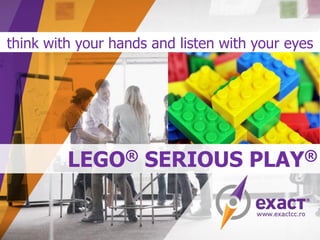
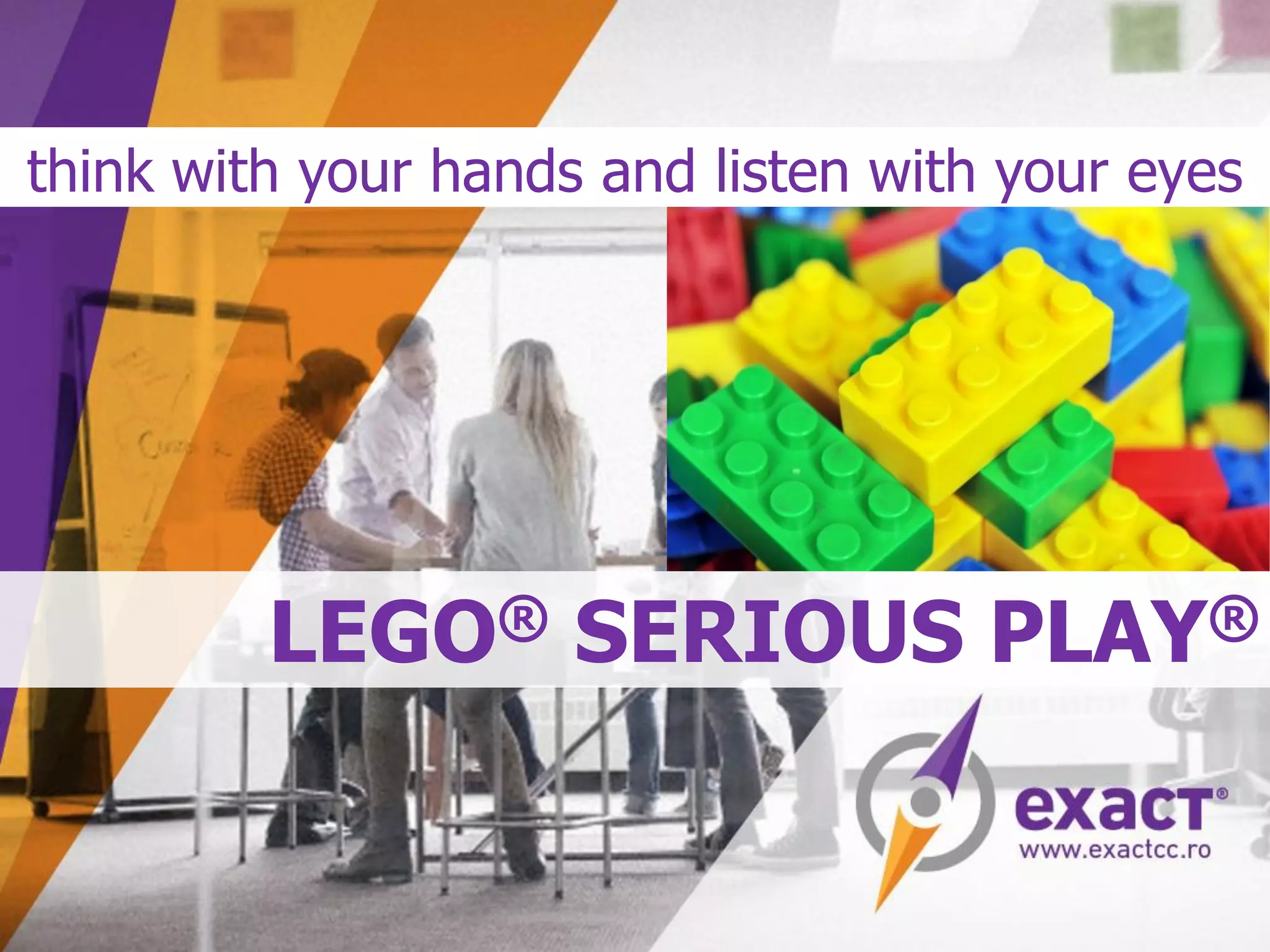

LEGO® SERIOUS PLAY®
think with your hands and listen with your eyes
"You can learn more about a person in an hour of play
than you can from a lifetime of conversation"
Plato
LEGO® SERIOUS PLAY®
Imagine what we get from playing 4 hours!
What is LEGO® SERIOUS PLAY®?
A concept developed by Johan Roos and
Victor Bart (professors at Switzerland`s
Institute for Management Development)
and Kjeld Kristiansen (the leader of The
Lego Group)
A tool for efficient training, business or HR
actions
A methodology for efficient results
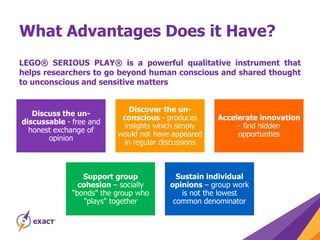
What Advantages Does it Have?
LEGO® SERIOUS PLAY® is a powerful qualitative instrument that
helps researchers to go beyond human conscious and shared thought
to unconscious and sensitive matters
Discuss the un-
discussable - free and
honest exchange of
opinion
Discover the un-
conscious - produces
insights which simply
would not have appeared
in regular discussions
Accelerate innovation
- find hidden
opportunties
Support group
cohesion – socially
"bonds" the group who
"plays" together
Sustain individual
opinions – group work
is not the lowest
common denominator
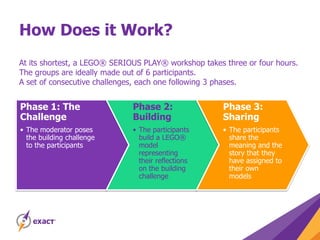
How Does it Work?
At its shortest, a LEGO® SERIOUS PLAY® workshop takes three or four hours.
The groups are ideally made out of 6 participants.
A set of consecutive challenges, each one following 3 phases.
Phase 1: The
Challenge
• The moderator poses
the building challenge
to the participants
Phase 2:
Building
• The participants
build a LEGO®
model
representing
their reflections
on the building
challenge
Phase 3:
Sharing
• The participants
share the
meaning and the
story that they
have assigned to
their own
models
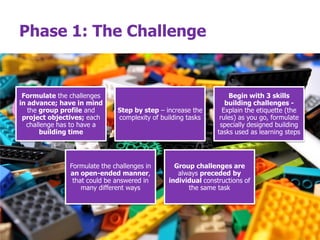
Phase 1: The Challenge
Formulate the challenges
in advance; have in mind
the group profile and
project objectives; each
challenge has to have a
building time
Step by step – increase the
complexity of building tasks
Begin with 3 skills
building challenges -
Explain the etiquette (the
rules) as you go, formulate
specially designed building
tasks used as learning steps
Formulate the challenges in
an open-ended manner,
that could be answered in
many different ways
Group challenges are
always preceded by
individual constructions of
the same task
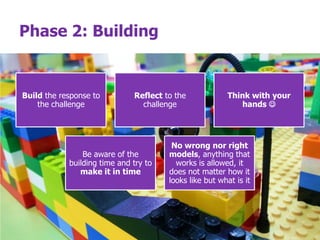
Phase 2: Building
Build the response to
the challenge
Reflect to the
challenge
Think with your
hands 
Be aware of the
building time and try to
make it in time
No wrong nor right
models, anything that
works is allowed, it
does not matter how it
looks like but what is it
Phase 3: Sharing
SHARING
• One at a time, participants
share with the others the
story behind their model;
• The moderator plays an
important part here by
asking questions &
facilitating the discussion;
• Questions are meant to
make participants
reflect more and more
and share as much detail as
possible
RULES
• Everybody shares,
everybody listens,
anyone can ask
questions;
• Ask questions about the
model not about the
creator;
• Aim at finding out many
details about the model and
never ask respondent why
did they wanted to build
that model as such
Thank you!
Your Contact
Stefan Andrei, Marketing Manager
Tel.: 0745.388.986;
E-mail: stefan.andrei@exactcc.ro

Presentation LSP - Lego® Serious Play®

  • 1.
    LEGO® SERIOUS PLAY® thinkwith your hands and listen with your eyes
  • 2.
    "You can learnmore about a person in an hour of play than you can from a lifetime of conversation" Plato LEGO® SERIOUS PLAY® Imagine what we get from playing 4 hours!
  • 3.
    What is LEGO®SERIOUS PLAY®? A concept developed by Johan Roos and Victor Bart (professors at Switzerland`s Institute for Management Development) and Kjeld Kristiansen (the leader of The Lego Group) A tool for efficient training, business or HR actions A methodology for efficient results
  • 4.
    What Advantages Doesit Have? LEGO® SERIOUS PLAY® is a powerful qualitative instrument that helps researchers to go beyond human conscious and shared thought to unconscious and sensitive matters Discuss the un- discussable - free and honest exchange of opinion Discover the un- conscious - produces insights which simply would not have appeared in regular discussions Accelerate innovation - find hidden opportunties Support group cohesion – socially "bonds" the group who "plays" together Sustain individual opinions – group work is not the lowest common denominator
  • 5.
    How Does itWork? At its shortest, a LEGO® SERIOUS PLAY® workshop takes three or four hours. The groups are ideally made out of 6 participants. A set of consecutive challenges, each one following 3 phases. Phase 1: The Challenge • The moderator poses the building challenge to the participants Phase 2: Building • The participants build a LEGO® model representing their reflections on the building challenge Phase 3: Sharing • The participants share the meaning and the story that they have assigned to their own models
  • 6.
    Phase 1: TheChallenge Formulate the challenges in advance; have in mind the group profile and project objectives; each challenge has to have a building time Step by step – increase the complexity of building tasks Begin with 3 skills building challenges - Explain the etiquette (the rules) as you go, formulate specially designed building tasks used as learning steps Formulate the challenges in an open-ended manner, that could be answered in many different ways Group challenges are always preceded by individual constructions of the same task
  • 7.
    Phase 2: Building Buildthe response to the challenge Reflect to the challenge Think with your hands  Be aware of the building time and try to make it in time No wrong nor right models, anything that works is allowed, it does not matter how it looks like but what is it
  • 8.
    Phase 3: Sharing SHARING •One at a time, participants share with the others the story behind their model; • The moderator plays an important part here by asking questions & facilitating the discussion; • Questions are meant to make participants reflect more and more and share as much detail as possible RULES • Everybody shares, everybody listens, anyone can ask questions; • Ask questions about the model not about the creator; • Aim at finding out many details about the model and never ask respondent why did they wanted to build that model as such
  • 9.
    Thank you! Your Contact StefanAndrei, Marketing Manager Tel.: 0745.388.986; E-mail: stefan.andrei@exactcc.ro