
Creeping Woman
This Photo by Unknown author is licensed under CC BY-NC-ND.
About me
Denise Nielsen
@denielsen
St. Lawrence College
Communications, Ethics,
Critical Thinking
Giving students agency to express themselves
creatively yields rewards. This interactive session
will highlight some of the creative projects that can
be integrated into classrooms, will offer an
opportunity for sharing success stories, and will
provide participants with ideas and a couple of
hands-on activities to try in their own classes.
At the end of this session, participants will be able
to
• list the benefits of creativity to support learning
• identify a variety of creative approaches to
activities and assessments
• discuss challenges of assessing creativity
• participate in a creative learning experience
Creative
Classrooms
Approaches
Activities
Assessments
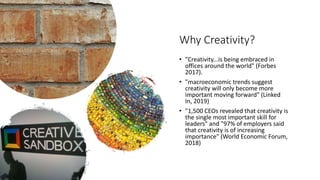
Why Creativity?
• "Creativity...is being embraced in
offices around the world" (Forbes
2017).
• "macroeconomic trends suggest
creativity will only become more
important moving forward" (Linked
In, 2019)
• "1,500 CEOs revealed that creativity is
the single most important skill for
leaders" and "97% of employers said
that creativity is of increasing
importance" (World Economic Forum,
2018)
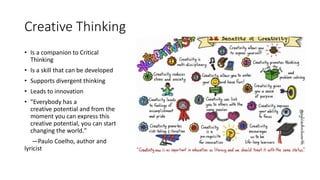
Creative Thinking
• Is a companion to Critical
Thinking
• Is a skill that can be developed
• Supports divergent thinking
• Leads to innovation
• "Everybody has a
creative potential and from the
moment you can express this
creative potential, you can start
changing the world."
—Paulo Coelho, author and
lyricist
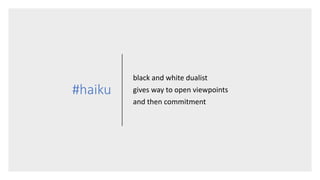
#haiku
black and white dualist
gives way to open viewpoints
and then commitment
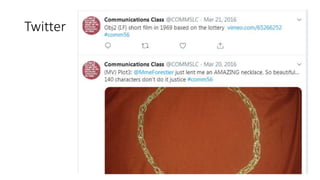
Twitter
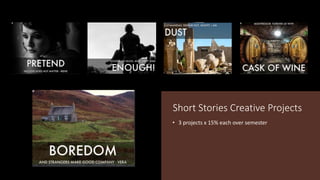
Short Stories Creative Projects
• 3 projects x 15% each over semester
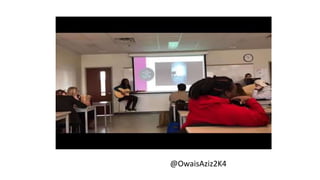
@OwaisAziz2K4
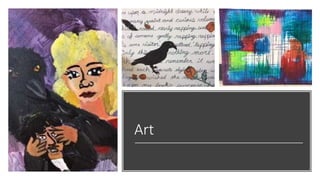
Art
Improv
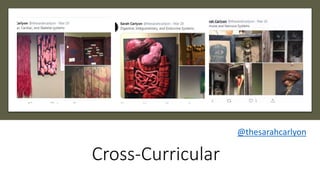
Cross-Curricular
@thesarahcarlyon
How?
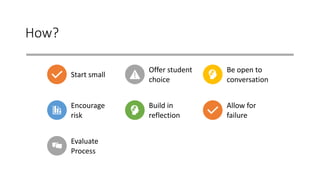
How?
Start small
Offer student
choice
Be open to
conversation
Encourage
risk
Build in
reflection
Allow for
failure
Evaluate
Process
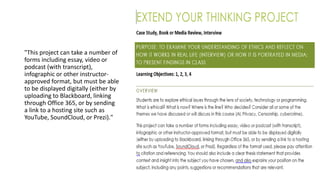
"This project can take a number of
forms including essay, video or
podcast (with transcript),
infographic or other instructor-
approved format, but must be able
to be displayed digitally (either by
uploading to Blackboard, linking
through Office 365, or by sending
a link to a hosting site such as
YouTube, SoundCloud, or Prezi)."
• Meeting course learning objectives
• Lack of clear direction for students
• How do I grade?
This Photo by Unknown author is licensed under CC BY-NC-ND.
• Start with an in class activity – no graded to encourage risk-taking
• Make a face out of material in your backpack and post to twitter/instagram
with a hashtag
• Build something
• Design thinking
• Demonstrate your learning with Improv/sketch/haiku, video clips)
• Creative ways to review for tests (games)
• Include creativity as part of an assignment
For bigger projects
• Scaffold
• Build time into class for
discussion/workshops/
assistance
• Don't be afraid to learn
together – model trial and
error
• Get students involved in the
process
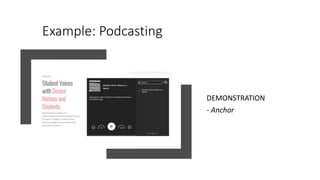
Example: Podcasting
DEMONSTRATION
- Anchor
Interim/Final Reflection
• Explain what you have accomplished so far and
describe your individual process for planning,
researching and writing this assignment
• Identify areas where you struggled.
• Identify what you have found most interesting
about the process (so far).
• What changes (if any) have you had to make to
your original project idea?
• What help do you need to complete this
project?
• In eight panels, take notes or
sketch (or both) what you have
learned today.
• Not sure how?
• 1 Title
• 2-3 Why
• 4-5 Favourite Examples
• 6-7 How You Might Start
• 8 EndThis Photo by Unknown author is licensed under CC BY-SA-NC.
Personal Reflection
1. What creative projects have
you tried?
2. Based on today's presentation,
what would you like to try?
This Photo by Unknown author is licensed under CC BY-SA-NC.
Small Group Discussion
Takeaways
• Offer choice…student agency
• Start small
• Walk through
• Be willing to take risks
• Involve students
• Meta cognitive reflection….what
worked what didn’t, what students
liked.
• Marks for process when possible –
especially when taking big risks
This Photo by Unknown author is licensed under CC BY-NC-ND.

Creative classrooms

  • 1.
    Creeping Woman This Photoby Unknown author is licensed under CC BY-NC-ND.
  • 2.
    About me Denise Nielsen @denielsen St.Lawrence College Communications, Ethics, Critical Thinking
  • 3.
    Giving students agencyto express themselves creatively yields rewards. This interactive session will highlight some of the creative projects that can be integrated into classrooms, will offer an opportunity for sharing success stories, and will provide participants with ideas and a couple of hands-on activities to try in their own classes. At the end of this session, participants will be able to • list the benefits of creativity to support learning • identify a variety of creative approaches to activities and assessments • discuss challenges of assessing creativity • participate in a creative learning experience Creative Classrooms Approaches Activities Assessments
  • 4.
    Why Creativity? • "Creativity...isbeing embraced in offices around the world" (Forbes 2017). • "macroeconomic trends suggest creativity will only become more important moving forward" (Linked In, 2019) • "1,500 CEOs revealed that creativity is the single most important skill for leaders" and "97% of employers said that creativity is of increasing importance" (World Economic Forum, 2018)
  • 5.
    Creative Thinking • Isa companion to Critical Thinking • Is a skill that can be developed • Supports divergent thinking • Leads to innovation • "Everybody has a creative potential and from the moment you can express this creative potential, you can start changing the world." —Paulo Coelho, author and lyricist
  • 7.
    #haiku black and whitedualist gives way to open viewpoints and then commitment
  • 8.
  • 9.
    Short Stories CreativeProjects • 3 projects x 15% each over semester
  • 10.
  • 11.
  • 13.
  • 14.
  • 15.
  • 16.
    How? Start small Offer student choice Beopen to conversation Encourage risk Build in reflection Allow for failure Evaluate Process
  • 17.
    "This project cantake a number of forms including essay, video or podcast (with transcript), infographic or other instructor- approved format, but must be able to be displayed digitally (either by uploading to Blackboard, linking through Office 365, or by sending a link to a hosting site such as YouTube, SoundCloud, or Prezi)."
  • 18.
    • Meeting courselearning objectives • Lack of clear direction for students • How do I grade? This Photo by Unknown author is licensed under CC BY-NC-ND.
  • 19.
    • Start withan in class activity – no graded to encourage risk-taking • Make a face out of material in your backpack and post to twitter/instagram with a hashtag • Build something • Design thinking • Demonstrate your learning with Improv/sketch/haiku, video clips) • Creative ways to review for tests (games) • Include creativity as part of an assignment
  • 20.
    For bigger projects •Scaffold • Build time into class for discussion/workshops/ assistance • Don't be afraid to learn together – model trial and error • Get students involved in the process
  • 21.
  • 22.
    Interim/Final Reflection • Explainwhat you have accomplished so far and describe your individual process for planning, researching and writing this assignment • Identify areas where you struggled. • Identify what you have found most interesting about the process (so far). • What changes (if any) have you had to make to your original project idea? • What help do you need to complete this project?
  • 23.
    • In eightpanels, take notes or sketch (or both) what you have learned today. • Not sure how? • 1 Title • 2-3 Why • 4-5 Favourite Examples • 6-7 How You Might Start • 8 EndThis Photo by Unknown author is licensed under CC BY-SA-NC. Personal Reflection
  • 24.
    1. What creativeprojects have you tried? 2. Based on today's presentation, what would you like to try? This Photo by Unknown author is licensed under CC BY-SA-NC. Small Group Discussion
  • 25.
    Takeaways • Offer choice…studentagency • Start small • Walk through • Be willing to take risks • Involve students • Meta cognitive reflection….what worked what didn’t, what students liked. • Marks for process when possible – especially when taking big risks
  • 26.
    This Photo byUnknown author is licensed under CC BY-NC-ND.

Editor's Notes

  • #5 Acccording to Forbes "Creativity used to be a term reserved for alternative professions and hobbies. Today, it is being embraced in offices around the world with some of the top companies cultivating it from within.Google is a strong supporter of creativity in the workplace, creating a “20%” program that gives its developers permission to spend 20% of their work hours on a creative project of their own. This way of thinking has caught on and has made its way into many workplaces, giving companies new ideas and strategies to grow their business." https://www.forbes.com/sites/forbescoachescouncil/2017/12/21/15-ways-leaders-can-promote-creativity-in-the-workplace/#2d8bb8b958ef  Recently at LinkedIn Learning, using the power of our Economic Graph, we determined the skills companies need most. And there was a bit of a surprise at the very top of the list: creativity. Technically, creativity is the second-most in-demand skill in the world, with cloud computing at the top. But cloud computing is a hard skill, which means it applies to only a section of the workforce and doesn’t have the staying power a soft skill has. Conversely, learning how to think more creatively will benefit you the rest of your career. And, macroeconomic trends suggest creativity will only become more important moving forward. https://learning.linkedin.com/blog/top-skills/why-creativity-is-the-most-important-skill-in-the-world  World Economic forum in 2018 claims creativity is the next big thinkg for business "A recent IBM study of 1,500 CEOs revealed that creativity is the single most important skill for leaders. In a workforce preparedness study conducted by the Conference Board, 97% of employers said that creativity is of increasing importance. As robots and artificial intelligence transform the economy, creativity resists automation. The creative economy, like the industrial and information revolutions before it, has the potential to unleash global growth by making organizations more effective and more innovative. Grade 7-8 day – creativity begins literally in the sandbox – or from the dust of bricks/ Its about thinking differently, outside the box. Brilliant dazzling cretivity – how do we harness support encourage it
  • #6 Visual  by Sylvia Duckworth Creative thinking (a companion to critical thinking) is an invaluable skill for college students. It’s  important because it helps you look at problems and situations from a fresh perspective. Creating thinking is a way to develop novel or unorthodox solutions that do not depend wholly on past or current solutions. Yet our educational system focuses on teaching students “convergent thinking” — how to solve problems that have one correct answer (already known), instead of teaching students “divergent thinking” — how to come up with multiple solutions to open-ended, unscripted problems. It is these types of open-ended and complex problems they will face as they pursue future careers. https://www.edsurge.com/news/2019-05-10-this-neuroscientist-wants-to-know-your-brain-on-art-and-how-it-improves-learning  One person who has closely watched, and even shaped, the coevolution of neurosciences with education is Mariale Hardiman, vice dean of academic affairs at the Johns Hopkins School of Education. The education professor is also the co-founder and director of Johns Hopkins’ Neuro-Education Initiative, a center that aims to bring together research on learning and neuroscience, teaching and education. She speaks about brain targeted learing and incorporating the arts because it helps reinforce content, and has other benefits " [that are] well documented, like student engagement, creative thinking and problem solving"
  • #7 https://www.youtube.com/watch?v=cnc-sStLP9k http://www.laurenstringer.com/uploads/2/5/6/4/25641572/make_a_six-page_book_out_of_one_sheet_of_paper.pdf  Can range form the complex – in this case a trailer that formed part of a final assessment to demonstrate learning and to ionclude on a portfoilio
  • #8 To  the truly simple – an in class haiku distilling what we have learnind (here the cognitive  development of college students from dualism, through relativism and commitmnet) into an elegant 5-7-5 syllable poem You can do the same with tweets actually... for a thesis or for a class discussion. Another tool to use
  • #10 Creative Projects (10% each) Students will create three creative projects this semester based on their own interests and the short stories read in class. These may include, but are not limited to, paintings, photography, podcasts, video, short stories and poetry, screenplays. These projects may be partially completed as in class activities. Assignments of a creative nature that can be submitted digitally (ie: plays, stories, poetry, photograph projects, video or podcast) should be submitted as a document or a link (for podcasts, video) via Blackboard. Artistic projects (paintings, drawings, sculpture) that cannot be submitted electronically should be brought to class. Please make arrangements with the professor. Week 4 – Creative Options (DUE DATE: Sun., Feb. 7, 2016)  Write  a screenplay or poem or story based on one of the themes discussed in weeks 1-3 Turn one of the stories/poems we have read in weeks 1-3 into a play or poem or turn a poem into a story or play Write a story or poem inspired by one of the stories/poems we have read in weeks 1-3 Paint/Draw a picture of one of the stories/poems we have read in weeks 1-3 Create a podcast, video, slide show that retells in a creative way one of the stories/poems we have read in weeks 1-3 Creative use of social media instagram or twitter to retell one of the stories/poems we have read in weeks 1-3 (please use #comm56)    Ideas from former students  For this project, a student used the idea of the Selfie to depict the selfish, vain, appearance-oriented Mme Loisel from The Necklace. The student retold the story of The Necklace using Instagram with the hashtag, #mylifeisruined A student summed up the major characters discussed with a series of images accompanied by 6 word sentences (see image, right) A student retold a story using Twitter Numerous students have painted or drawn pictures for me – visit me in my office to see a selection. Usually, students who choose this also submit a short paragraph explaining why they picked a specific scene and its relevance overall If you write a story, or a poem, or a screenplay, please follow conventions (ie: quotation marks around dialogue, starting new lines of dialogue from a different character in a new paragraph, having proper stage directions in playwriting.) There are online resources, but please see me if you have any questions Combinations are encouraged. IE: You could write a poem and turn it into a video with images and music
  • #11 Muscles in body  (Biology) Also another one Here is video of another assignment/assessment, where students have to create Drug Commercial to memorize drugs in Pharmacology. 
  • #12 1. mood and psychology of education – how mood affects learning – a presentation with one group member painting as the discussion unfolded 2. Poe The Raven in a literatiure class. Part of a fuller presentation 3. special one – by a non-communicative, anxious student, limited verbally and with some cognitive limitations. SHe had accomodations. I actually created the art project as an option for her because I  had heard it was her passion. Breakthrough later in term – a video – an analysis. Also this – the highwayman... Art allows studnets to express in multiple ways and the depth can be really quite extraordinary.
  • #13 https://www.amazon.ca/Lawrence-River-Mohammad-Masoum-Vakily-ebook/dp/B01EXAFCP0?ie=UTF8&keywords=st%20lawrence%20river&qid=1461969391&ref_=sr_1_4&s=books&sr=1-4
  • #14 1.Five Headed Monster. We’re going to demonstrate this one. Five Volunteersè need to be willing to step in and correct any misconceptions as you go along. 1.What is your name? 2.How do Learning Objectives guide a course? 3.What are some practical applications we can use in class to demonstrate to students how learning is linked to LO’s 4.Can you explain the value of linking learning objectives with our assessments. Video – get out of doors – something real about video
  • #15 Sarah Carlyon A brag post: my #PreHealthBrockville students and the #FineArts students rocked their cross-curricular project this year! So proud of everyone! 
  • #18 Example
  • #22 https://voiced.ca/student-voices-whats-in-a-name/ FEBRUARY 23, 2019 BY DENISE NIELSEN Podcast: A creative exploration of diversity  I have two classes of 1st semester communications students. Multiple programs, diverse backgrounds. Many international students. It’s not the first time I’ve had this mix and I was keen to find a way to better integrate students so they were less culturally isolated. I also used to teach a cultural communications course and was interested in the idea of promoting cultural diversity and inclusivity among the student body. But how? We started by introducing ourselves and the meanings of our names. I put students into groups and made them learn not only how to pronounce each other’s names but to hear and understand the stories behind each person’s name. This personalized the activity. Gradually, barriers lowered.  Then we read some articles on names including this one from Elamin Abdelmahmoud (Twitter: @elamin88)   and this CBC article. ‪We used these to read, analyze, find supporting quotes, write and respond – typical communications class material. And as students got comfortable with each other we started connecting ideas and having more in depth discussions. Students developed themes and explored them in conversations and discussions with each other.‬ This project gave us an opportunity to talk about audience and the difference between communicating privately and publicly. And how to share our voices authentically. ‬ Right about then, I explained we would create a podcast. Student led. Student created.  I’d spent time contemplating this. It seemed an ideal method of communicating our thoughts in a way that was more inclusive. Students nervous about writing got engaged in the process, and although we drafted outlines and introductions, there was not the same level of fear around the writing. Students worked collaboratively to storyboard around themes and essential questions that the students themselves developed themselves from their research.  We then spent class time recording (voice memo), interviewing, and producing a series of combined files . And I spent ohhhh, way more time editing than I actually had (I used to be a book editor… you’d think I’d know that editing ALWAYS takes longer than you expect!)
  • #23 For longer projects marks for process