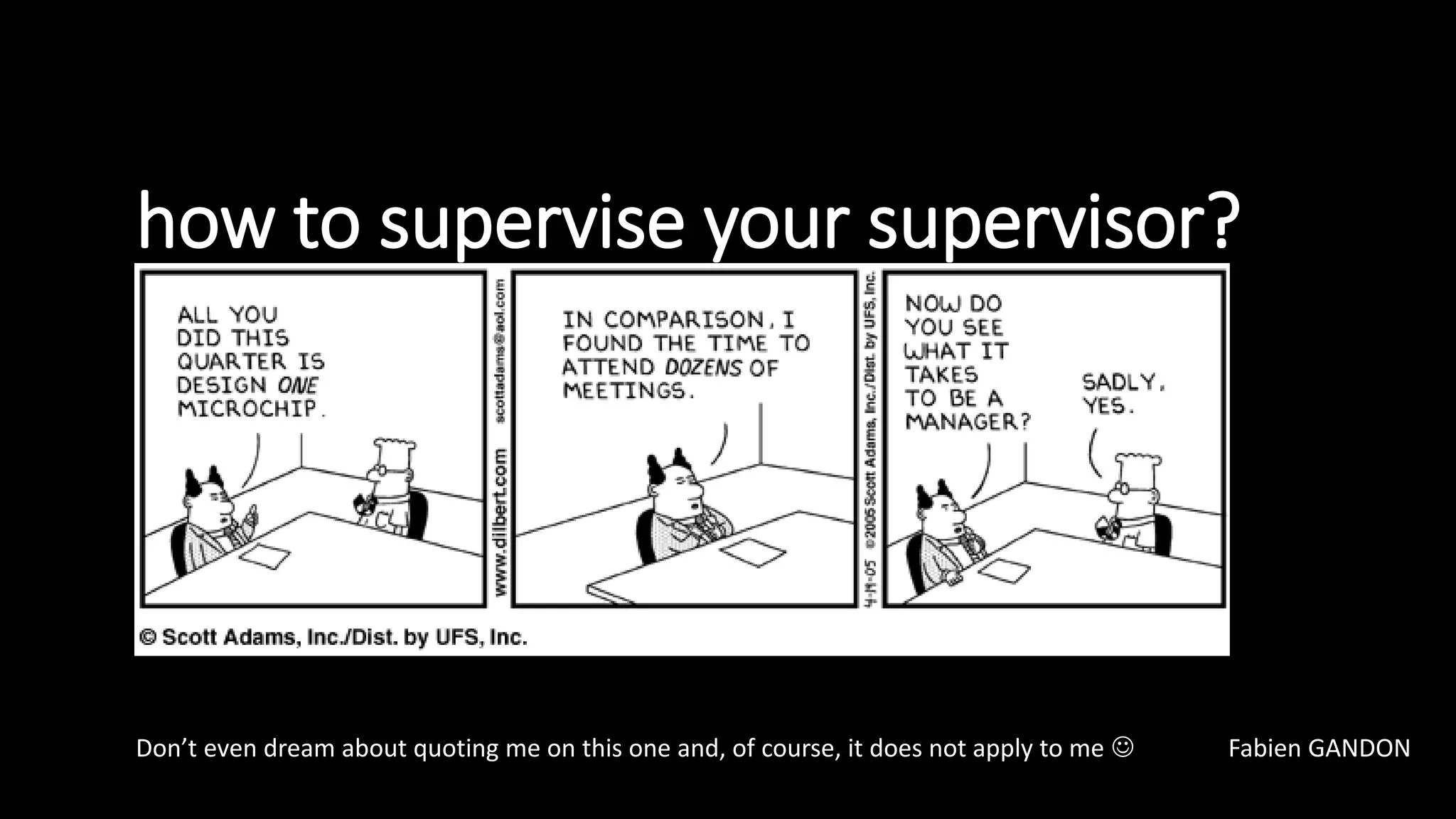
how to supervise your supervisor?
Don’t even dream about quoting me on this one and, of course, it does not apply to me  Fabien GANDON
do I really want to do this?
• why did it have to be me?
• do I really want to do that?
• am I so far from research now?
• how many enemies can I make in less than 1 hour?
• can I survive this presentation?
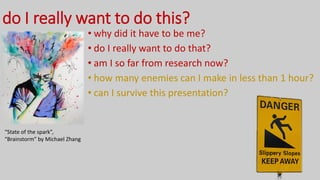
“State of the spark”,
“Brainstorm” by Michael Zhang
Largely based on…
• “Managing your Supervisor” by Toby Walsh
and…
• Things I wish I knew when I started my PhD
http://betweenarock.co.uk/phd-musings/things-i-wish-i-knew-when-i-started-my-phd/
• How can PhD students establish good relationships with their advisors
https://www.quora.com/How-can-PhD-students-establish-good-relationships-with-their-advisors
• 10 truths a PhD supervisor will never tell you
https://www.timeshighereducation.com/features/10-truths-a-phd-supervisor-will-never-tell-you/2005513.article
• Ten types of PhD supervisor relationships – which is yours?
http://theconversation.com/ten-types-of-phd-supervisor-relationships-which-is-yours-52967
• Researcher’s Bible, Alan Bundy et al.
http://homepages.inf.ed.ac.uk/bundy/how-tos/resbible.html
• PhD problems
https://www.findaphd.com/advice/doing/phd-problems.aspx
• Effective PhD supervision
http://rozenbergquarterly.com/effective-phd-supervision-chapter-5-the-relationship-between-phd-candidate-and-supervisor/
• http://www.theguardian.com/higher-education-network/2014/dec/29/phd-supervisor-university-research-tips-relationship-work
• http://www.otago.ac.nz/study/phd/handbook/otago001978.html
Spirit of the presentation
Not too serious
“it goes without saying,
but it goes better when you say it”
- an old math prof. of mine.
Take it with a grain of salt or, better, a grain of sugar.
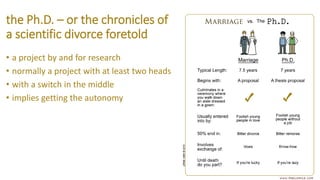
the Ph.D. – or the chronicles of
a scientific divorce foretold
• a project by and for research
• normally a project with at least two heads
• with a switch in the middle
• implies getting the autonomy
decide who is your main supervisor at the beginning
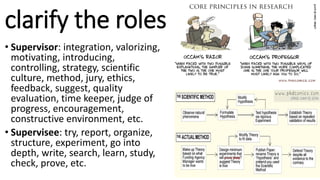
clarify the roles
• Supervisor: integration, valorizing,
motivating, introducing,
controlling, strategy, scientific
culture, method, jury, ethics,
feedback, suggest, quality
evaluation, time keeper, judge of
progress, encouragement,
constructive environment, etc.
• Supervisee: try, report, organize,
structure, experiment, go into
depth, write, search, learn, study,
check, prove, etc.
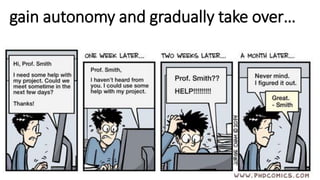
gain autonomy and gradually take over…
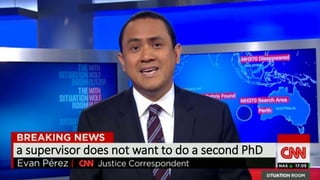
a supervisor does not want to do a second PhD
Understanding your supervisor
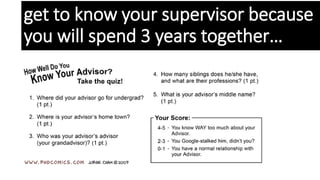
get to know your supervisor because
you will spend 3 years together…
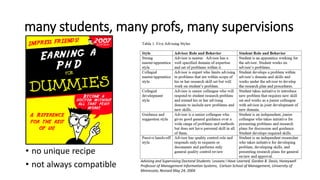
many students, many profs, many supervisions
• no unique recipe
• not always compatible
Advising and Supervising Doctoral Students: Lessons I Have Learned, Gordon B. Davis, Honeywell
Professor of Management Information Systems, Carlson School of Management, University of
Minnesota, Revised May 24, 2004
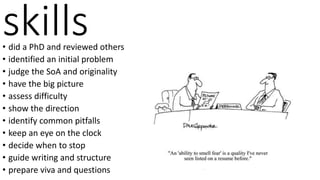
skills• did a PhD and reviewed others
• identified an initial problem
• judge the SoA and originality
• have the big picture
• assess difficulty
• show the direction
• identify common pitfalls
• keep an eye on the clock
• decide when to stop
• guide writing and structure
• prepare viva and questions
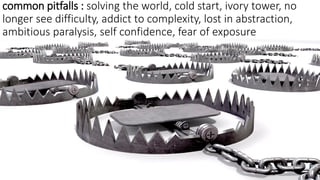
common pitfalls : solving the world, cold start, ivory tower, no
longer see difficulty, addict to complexity, lost in abstraction,
ambitious paralysis, self confidence, fear of exposure
• not the money
• give back do
academia
• not the money
• create legacy
• not the money
• augment output
• not the money
• build a network,
trend, etc.
• make a change
• not the money
Hates
• students who quit or finish late
• waste time, resources, grants, etc.
• spend time to correct spelling mistakes
• have the feeling to preach in the
wilderness
• to have his ego hurt
(he already gets many opportunities)
• <add_yours_here/>
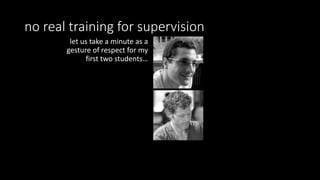
no real training for supervision
let us take a minute as a
gesture of respect for my
first two students…
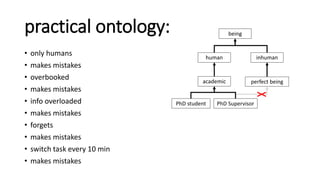
practical ontology:
• only humans
• makes mistakes
• overbooked
• makes mistakes
• info overloaded
• makes mistakes
• forgets
• makes mistakes
• switch task every 10 min
• makes mistakes
being
human inhuman
perfect beingacademic
PhD student PhD Supervisor
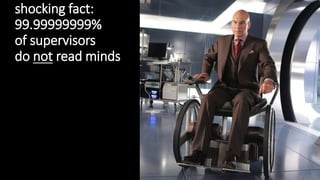
shocking fact:
99.99999999%
of supervisors
do not read minds
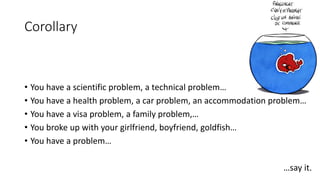
Corollary
• You have a scientific problem, a technical problem…
• You have a health problem, a car problem, an accommodation problem…
• You have a visa problem, a family problem,…
• You broke up with your girlfriend, boyfriend, goldfish…
• You have a problem…
…say it.
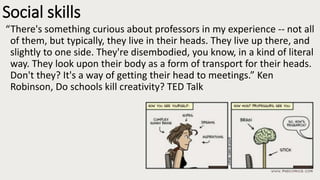
Social skills
“There's something curious about professors in my experience -- not all
of them, but typically, they live in their heads. They live up there, and
slightly to one side. They're disembodied, you know, in a kind of literal
way. They look upon their body as a form of transport for their heads.
Don't they? It's a way of getting their head to meetings.” Ken
Robinson, Do schools kill creativity? TED Talk
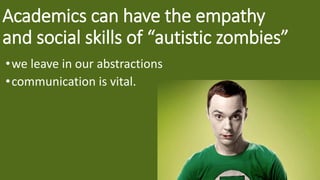
Academics can have the empathy
and social skills of “autistic zombies”
•we leave in our abstractions
•communication is vital.
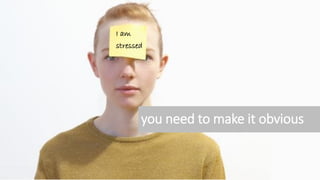
you need to make it obvious
I am
stressed
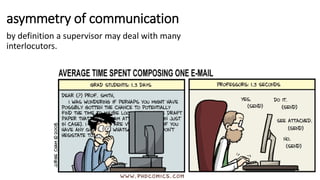
asymmetry of communication
by definition a supervisor may deal with many
interlocutors.
don’t be scared
despite everything supervisors
want you to succeed
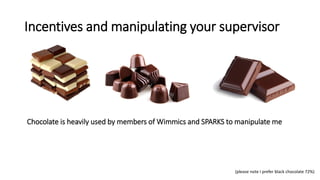
Incentives and manipulating your supervisor
(please note I prefer black chocolate 72%)
Chocolate is heavily used by members of Wimmics and SPARKS to manipulate me
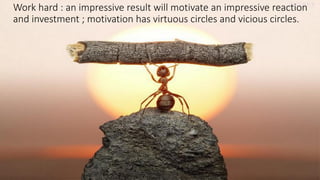
Work hard : an impressive result will motivate an impressive reaction
and investment ; motivation has virtuous circles and vicious circles.
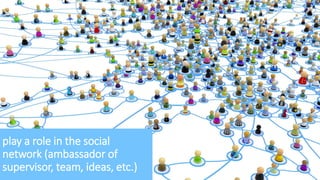
play a role in the social
network (ambassador of
supervisor, team, ideas, etc.)
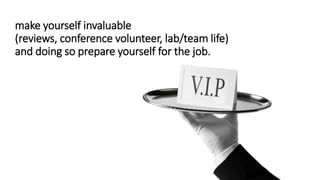
make yourself invaluable
(reviews, conference volunteer, lab/team life)
and doing so prepare yourself for the job.
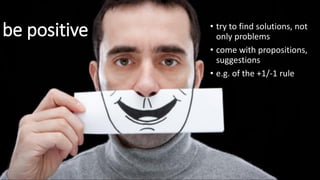
be positive • try to find solutions, not
only problems
• come with propositions,
suggestions
• e.g. of the +1/-1 rule
your best friend for your
career: it’s good for
him too.
• say what you want to do next
(industry, academia,
goat-cheese,…)
• experience other labs
(and report back)
• link with teammates,
visiting prof, PhD juries…
• organizing events gives
visibility
• learn about all possible
jobs (e.g. patents)
“Online or invisible”
help us help you: make it easy to
point to you, introduce you, talks
about you, reference you, etc.
1. Have a decent Web page
2. Maintain the f*** HAL
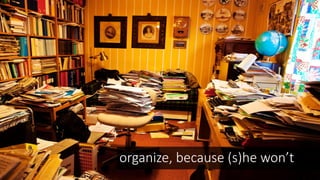
organize, because (s)he won’t
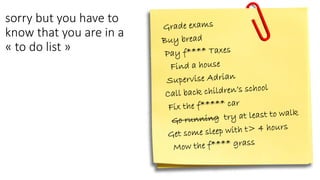
sorry but you have to
know that you are in a
« to do list »
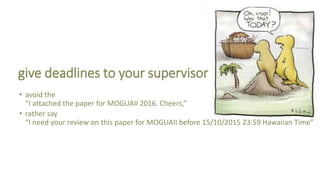
give deadlines to your supervisor
• avoid the
“I attached the paper for MOGUAII 2016. Cheers,”
• rather say
“I need your review on this paper for MOGUAII before 15/10/2015 23:59 Hawaiian Time”
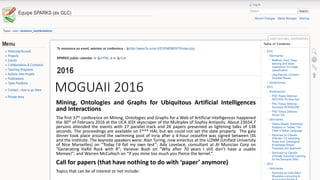
MOGUAII 2016
Mining, Ontologies and Graphs for Ubiquitous Artificial Intelligences
and Interactions
The first 37th conference on Mining, Ontologies and Graphs for a Web of Artificial Intelligences happened
the 30th of February 2016 at the UCA JEDI skyscraper of the Multiplex of Sophia Antipolis. About 23654.7
persons attended the events with 27 parallel track and 2K papers presented as lightning talks of 138
seconds. The proceedings are available on F*** HAL but we could not set the date properly. The gala
dinner took place around the swimming pool of Inria after a 4-hour ceasefire was signed between I3S
and the institute. The keynote speakers were: Alan Turing, now emeritus at the U2NM (Unified University
of Nice Marseilles) on “Today I’d fail my own test”; Ada Lovelace, consultant at AI Musician Corp on
“Generating HaRd Rock with R”; Vanevar Bush on “Why after 70 years I still don’t have a usable
Memex!”; and Warren McCulloch on “If you mine too much you Pierce the kernel.”.
Call for papers (that have nothing to do with ‘paper’ anymore)
Topics that can be of interest or not include:
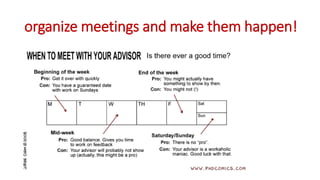
organize meetings and make them happen!
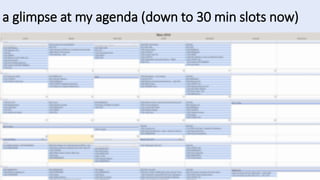
a glimpse at my agenda (down to 30 min slots now)
at the meeting remind your supervisor of the previous episodes
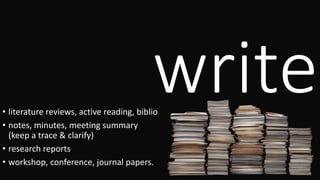
• literature reviews, active reading, biblio
• notes, minutes, meeting summary
(keep a trace & clarify)
• research reports
• workshop, conference, journal papers.
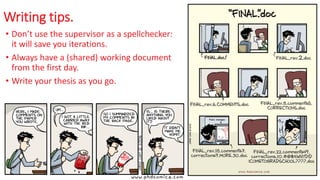
Writing tips.
• Don’t use the supervisor as a spellchecker:
it will save you iterations.
• Always have a (shared) working document
from the first day.
• Write your thesis as you go.
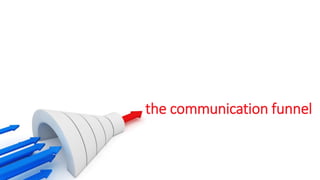
the communication funnel
That’ all folks.

How to supervise your supervisor?

  • 1.
    how to superviseyour supervisor? Don’t even dream about quoting me on this one and, of course, it does not apply to me  Fabien GANDON
  • 2.
    do I reallywant to do this? • why did it have to be me? • do I really want to do that? • am I so far from research now? • how many enemies can I make in less than 1 hour? • can I survive this presentation? “State of the spark”, “Brainstorm” by Michael Zhang
  • 3.
    Largely based on… •“Managing your Supervisor” by Toby Walsh and… • Things I wish I knew when I started my PhD http://betweenarock.co.uk/phd-musings/things-i-wish-i-knew-when-i-started-my-phd/ • How can PhD students establish good relationships with their advisors https://www.quora.com/How-can-PhD-students-establish-good-relationships-with-their-advisors • 10 truths a PhD supervisor will never tell you https://www.timeshighereducation.com/features/10-truths-a-phd-supervisor-will-never-tell-you/2005513.article • Ten types of PhD supervisor relationships – which is yours? http://theconversation.com/ten-types-of-phd-supervisor-relationships-which-is-yours-52967 • Researcher’s Bible, Alan Bundy et al. http://homepages.inf.ed.ac.uk/bundy/how-tos/resbible.html • PhD problems https://www.findaphd.com/advice/doing/phd-problems.aspx • Effective PhD supervision http://rozenbergquarterly.com/effective-phd-supervision-chapter-5-the-relationship-between-phd-candidate-and-supervisor/ • http://www.theguardian.com/higher-education-network/2014/dec/29/phd-supervisor-university-research-tips-relationship-work • http://www.otago.ac.nz/study/phd/handbook/otago001978.html
  • 4.
    Spirit of thepresentation Not too serious “it goes without saying, but it goes better when you say it” - an old math prof. of mine. Take it with a grain of salt or, better, a grain of sugar.
  • 5.
    the Ph.D. –or the chronicles of a scientific divorce foretold • a project by and for research • normally a project with at least two heads • with a switch in the middle • implies getting the autonomy
  • 6.
    decide who isyour main supervisor at the beginning
  • 7.
    clarify the roles •Supervisor: integration, valorizing, motivating, introducing, controlling, strategy, scientific culture, method, jury, ethics, feedback, suggest, quality evaluation, time keeper, judge of progress, encouragement, constructive environment, etc. • Supervisee: try, report, organize, structure, experiment, go into depth, write, search, learn, study, check, prove, etc.
  • 8.
    gain autonomy andgradually take over…
  • 9.
    a supervisor doesnot want to do a second PhD
  • 10.
  • 11.
    get to knowyour supervisor because you will spend 3 years together…
  • 12.
    many students, manyprofs, many supervisions • no unique recipe • not always compatible Advising and Supervising Doctoral Students: Lessons I Have Learned, Gordon B. Davis, Honeywell Professor of Management Information Systems, Carlson School of Management, University of Minnesota, Revised May 24, 2004
  • 14.
    skills• did aPhD and reviewed others • identified an initial problem • judge the SoA and originality • have the big picture • assess difficulty • show the direction • identify common pitfalls • keep an eye on the clock • decide when to stop • guide writing and structure • prepare viva and questions
  • 15.
    common pitfalls :solving the world, cold start, ivory tower, no longer see difficulty, addict to complexity, lost in abstraction, ambitious paralysis, self confidence, fear of exposure
  • 16.
    • not themoney • give back do academia • not the money • create legacy • not the money • augment output • not the money • build a network, trend, etc. • make a change • not the money
  • 17.
    Hates • students whoquit or finish late • waste time, resources, grants, etc. • spend time to correct spelling mistakes • have the feeling to preach in the wilderness • to have his ego hurt (he already gets many opportunities) • <add_yours_here/>
  • 18.
    no real trainingfor supervision let us take a minute as a gesture of respect for my first two students…
  • 19.
    practical ontology: • onlyhumans • makes mistakes • overbooked • makes mistakes • info overloaded • makes mistakes • forgets • makes mistakes • switch task every 10 min • makes mistakes being human inhuman perfect beingacademic PhD student PhD Supervisor
  • 20.
  • 21.
    Corollary • You havea scientific problem, a technical problem… • You have a health problem, a car problem, an accommodation problem… • You have a visa problem, a family problem,… • You broke up with your girlfriend, boyfriend, goldfish… • You have a problem… …say it.
  • 22.
    Social skills “There's somethingcurious about professors in my experience -- not all of them, but typically, they live in their heads. They live up there, and slightly to one side. They're disembodied, you know, in a kind of literal way. They look upon their body as a form of transport for their heads. Don't they? It's a way of getting their head to meetings.” Ken Robinson, Do schools kill creativity? TED Talk
  • 23.
    Academics can havethe empathy and social skills of “autistic zombies” •we leave in our abstractions •communication is vital.
  • 24.
    you need tomake it obvious I am stressed
  • 25.
    asymmetry of communication bydefinition a supervisor may deal with many interlocutors.
  • 26.
    don’t be scared despiteeverything supervisors want you to succeed
  • 27.
    Incentives and manipulatingyour supervisor (please note I prefer black chocolate 72%) Chocolate is heavily used by members of Wimmics and SPARKS to manipulate me
  • 28.
    Work hard :an impressive result will motivate an impressive reaction and investment ; motivation has virtuous circles and vicious circles.
  • 29.
    play a rolein the social network (ambassador of supervisor, team, ideas, etc.)
  • 30.
    make yourself invaluable (reviews,conference volunteer, lab/team life) and doing so prepare yourself for the job.
  • 31.
    be positive •try to find solutions, not only problems • come with propositions, suggestions • e.g. of the +1/-1 rule
  • 32.
    your best friendfor your career: it’s good for him too. • say what you want to do next (industry, academia, goat-cheese,…) • experience other labs (and report back) • link with teammates, visiting prof, PhD juries… • organizing events gives visibility • learn about all possible jobs (e.g. patents)
  • 33.
    “Online or invisible” helpus help you: make it easy to point to you, introduce you, talks about you, reference you, etc. 1. Have a decent Web page 2. Maintain the f*** HAL
  • 34.
  • 35.
    sorry but youhave to know that you are in a « to do list »
  • 36.
    give deadlines toyour supervisor • avoid the “I attached the paper for MOGUAII 2016. Cheers,” • rather say “I need your review on this paper for MOGUAII before 15/10/2015 23:59 Hawaiian Time”
  • 37.
    MOGUAII 2016 Mining, Ontologiesand Graphs for Ubiquitous Artificial Intelligences and Interactions The first 37th conference on Mining, Ontologies and Graphs for a Web of Artificial Intelligences happened the 30th of February 2016 at the UCA JEDI skyscraper of the Multiplex of Sophia Antipolis. About 23654.7 persons attended the events with 27 parallel track and 2K papers presented as lightning talks of 138 seconds. The proceedings are available on F*** HAL but we could not set the date properly. The gala dinner took place around the swimming pool of Inria after a 4-hour ceasefire was signed between I3S and the institute. The keynote speakers were: Alan Turing, now emeritus at the U2NM (Unified University of Nice Marseilles) on “Today I’d fail my own test”; Ada Lovelace, consultant at AI Musician Corp on “Generating HaRd Rock with R”; Vanevar Bush on “Why after 70 years I still don’t have a usable Memex!”; and Warren McCulloch on “If you mine too much you Pierce the kernel.”. Call for papers (that have nothing to do with ‘paper’ anymore) Topics that can be of interest or not include:
  • 38.
    organize meetings andmake them happen!
  • 39.
    a glimpse atmy agenda (down to 30 min slots now)
  • 40.
    at the meetingremind your supervisor of the previous episodes
  • 41.
    • literature reviews,active reading, biblio • notes, minutes, meeting summary (keep a trace & clarify) • research reports • workshop, conference, journal papers.
  • 42.
    Writing tips. • Don’tuse the supervisor as a spellchecker: it will save you iterations. • Always have a (shared) working document from the first day. • Write your thesis as you go.
  • 43.
  • 44.