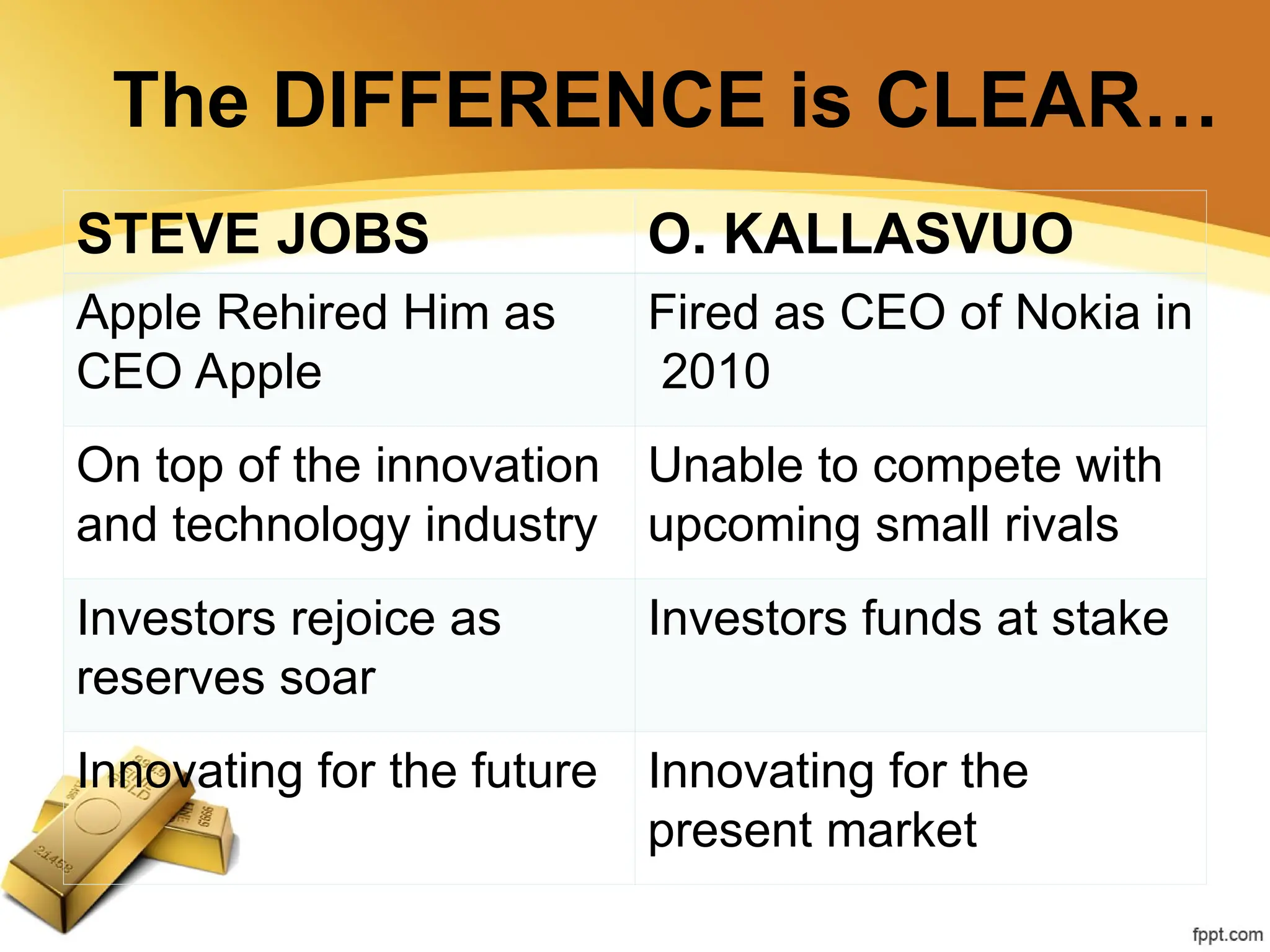
The DIFFERENCE isCLEAR…
STEVE JOBS O. KALLASVUO
Apple Rehired Him as
CEO Apple
Fired as CEO of Nokia in
2010
On top of the innovation
and technology industry
Unable to compete with
upcoming small rivals
Investors rejoice as
reserves soar
Investors funds at stake
Innovating for the future Innovating for the
present market
4.
Topic Objectives
Participantsshould have been acquainted with
The importance of innovation to new ventures and
large established firms
Idea generation and opportunity identification.
Tools for organizing and managing innovation within
existing firms
5.
What is Innovation?
PeterDrucker Tool used by
entrepreneurs to exploit
change as an opportunity
Is a discipline that can be
learnt and practiced
6.
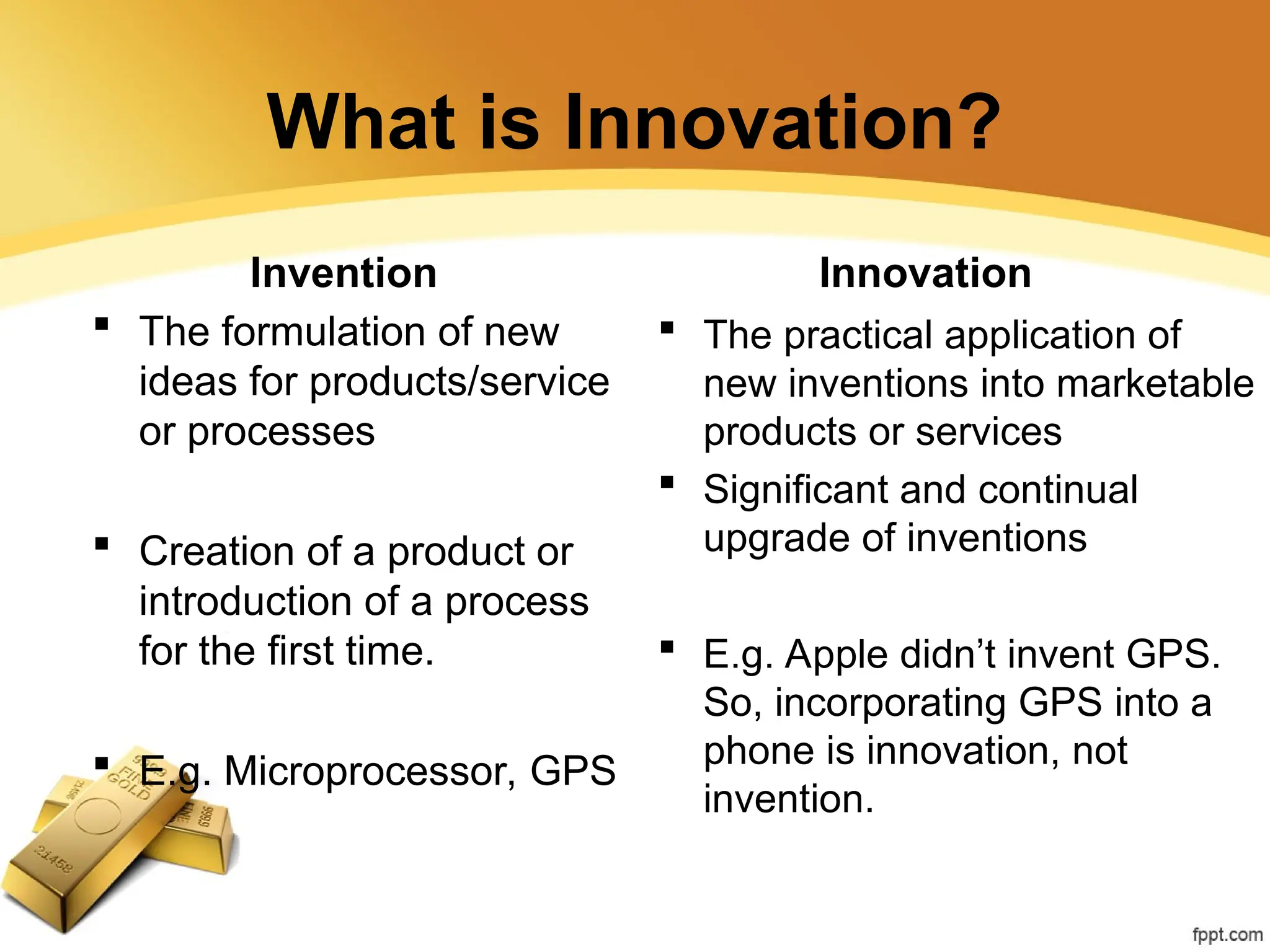
What is Innovation?
Invention
The formulation of new
ideas for products/service
or processes
Creation of a product or
introduction of a process
for the first time.
E.g. Microprocessor, GPS
Innovation
The practical application of
new inventions into marketable
products or services
Significant and continual
upgrade of inventions
E.g. Apple didn’t invent GPS.
So, incorporating GPS into a
phone is innovation, not
invention.
7.
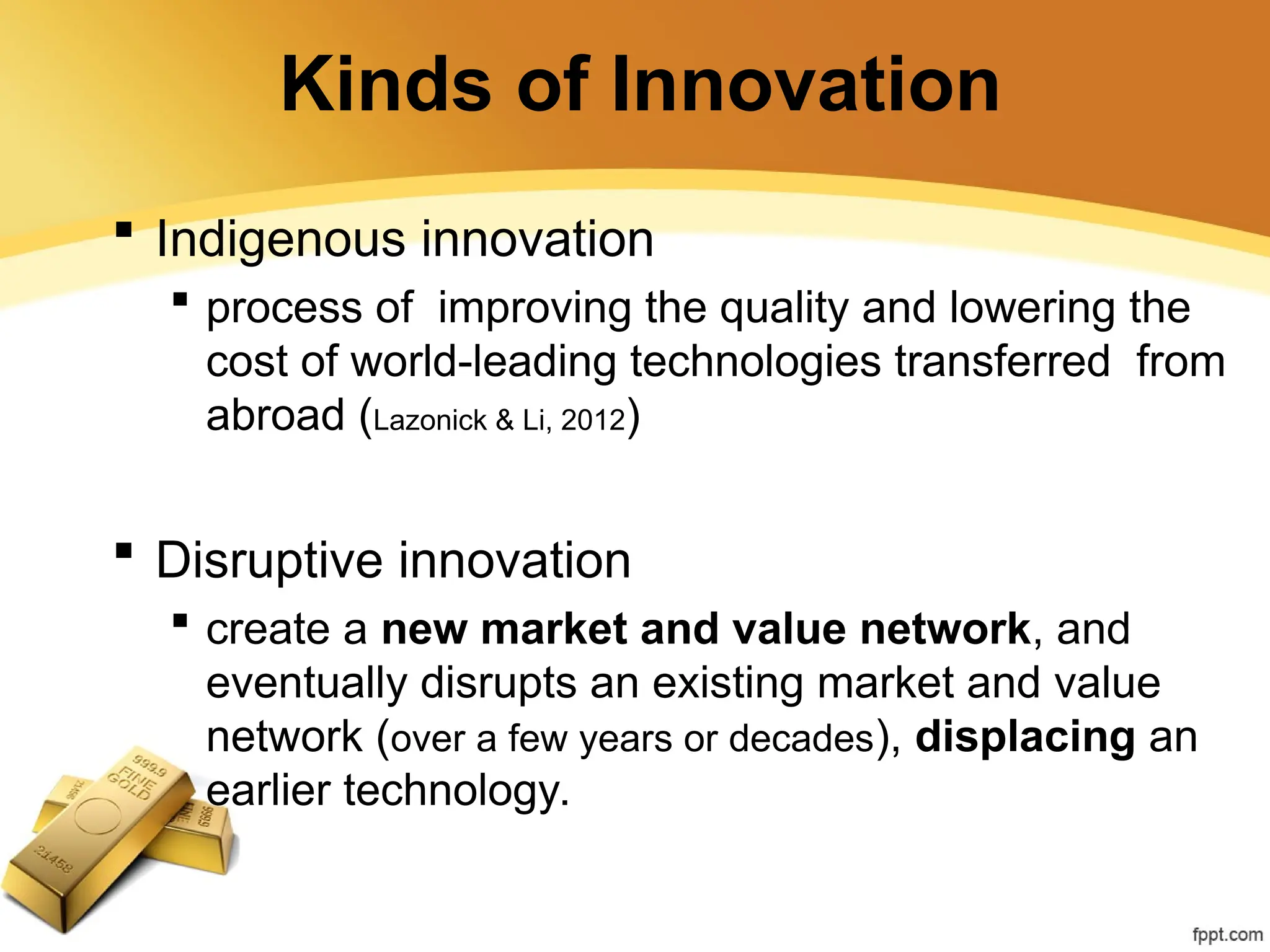
Kinds of Innovation
Indigenous innovation
process of improving the quality and lowering the
cost of world-leading technologies transferred from
abroad (Lazonick & Li, 2012)
Disruptive innovation
create a new market and value network, and
eventually disrupts an existing market and value
network (over a few years or decades), displacing an
earlier technology.
8.
Kinds of Innovation
Systematic innovation
A set of interconnected innovations, where each is
dependent on the other, with innovation both in the
parts of the system and in the ways that they interact.
Social innovation
new solutions that simultaneously meet a social
need (more efficiently and effectively than existing
solutions) and lead to new or improved capabilities,
assets and/or relationships.
9.
Kinds of Innovation
Many important innovations are a by product
of accidents—the key is to be prepared for
the unexpected.
Innovation cannot always be planned—
accidents happen.
Be prepared to recognize serendipitous
opportunity.
Understand the nature of breakthrough
inventions in your industry and plan accordingly.
10.
What forms caninnovation take?
Process (new biotechnology procedures)
Product (Bt cotton)
Mechanical tractors, cars
Chemical pesticides
Biological seed varieties.
Managerial IPM, extra pay for work, overtime.
Institutional patents, banks, stock market,
11.
Examples of InnovativeActivity
(Schumpter)
Developing new products and services
Developing new methods of production
Identifying new markets
Discovering new sources of supply
Developing new organisational forms
12.
Why innovation?
Itis a necessity in today’s global business setting
It is the ultimate source of competitive advantage
It is required take greater advantage of new
markets and opportunities during boom times
It is required to maintain and grow existing
business during downward cycles
13.
What are thebenefits of innovation?
Product/Service Innovation
First mover advantage
Higher prices and
profitability
Added value
Opportunity to build early
customer loyalty
Enhanced reputation as an
innovative company
Public Relations
Increased market share
Process Innovation
Reduced costs
Improved quality
More responsive
customer service
Greater flexibility
14.
What is Entrepreneurship?
Shifting economic resources out of an
area of lower and into an area of higher
productivity and greater yield.
A commitment to making a positive and
enormous difference
15.
What is InnovativeEntrepreneurship?
Aiming at leadership if not at dominance of a
new market or industry
Taking something just created by somebody
else and improving upon it.
Taking what the market leader considers its
strengths and turns those strengths into the
very weaknesses that defeat it (e.g. Apple Inc.)
16.
• Converting anexisting product or service
into something new by changing its utility,
value and economic characteristics.
An entrepreneur is one who reorganizes
economic activity in an innovative and
valuable way. - Joseph Schumpeter
What is Innovative Entrepreneurship?
18.
Generating Ideas…which way?
Inside-outApproach Outside-in Approach
A.k.a “idea generation”
Identify your most
promising skills
Use skills as
foundation for a
business
A.k.a “Opportunity
recognition”
What need in the
market is not filled?
Use environmental
scanning
Searching for trends
that can become
opportunities
19.
Sources of Innovation– P.Drucker
1. The unexpected
The unexpected success, failure or outside event.
2. The incongruity
between reality and what “ought to be.”
3. Innovation based on process need
4. Changes in industry/market structure
that catches everyone unawares.
5. Demographics– population changes
6. Changes in perception, mood and meaning
7. New knowledge, scientific and non-scientific.
Organizational Entrepreneurship
Suchis concerned with:
The discovery of profitable opportunities
The exploitation of profitable opportunities
Firms that encourage entrepreneurship are:
Risk takers
Committed to innovation
Proactive in creating opportunities
Not waiting to respond to opportunities created by
others
22.
Promoting Workplace Innovation
Employees are
encouraged to think &
work differently
What to do to deliver
more value to
clients/customers?
Innovation can come
from anyone/place
Collaboration rocks
Organize around
employee interests.
Leaders are involved
Celebrate innovative
ideas
23.
Stakeholders in Innovation
Universities
Entrepreneurs, start-
ups & venture
capitalists
Existing corporations
Potential technology
adopters
Government regulators
Environmental & other
special interest
organizations
Consumers
Bill Gates has said “your
most unhappy customers
are your greatest of
learning” ….for product
improvement
24.
7 Principles ofInnovation –Steve Jobs
1. Do what you love. NICHE
2. Put a dent in the universe. IMPACT
3. Kick-start your brain. INSPIRATION
4. Sell dreams, not products. IDEAS
5. Say no to 1,000 things. FOCUS
6. Create insanely great expectations QUALITY
7. Master the message EXPERTISE
25.
In conclusion...
Innovativeentrepreneurs
Have a keen eye for identifying and analyzing
opportunities, within and outside firm, industry
and in the external environment.
Innovate for the present and future
Understand that timing is everything.
Recognize that one can make a big difference
by taking incremental steps
Editor's Notes
#6 See:
http://www.forbes.com/sites/timworstall/2014/04/20/using-apples-iphone-to-explain-the-difference-between-invention-and-innovation/
http://www.tutor2u.net/business/production/invention-and-innovation.htm
http://www.pbs.org/idealab/2012/03/the-difference-between-invention-and-innovation086/
GPS: Global Positioning System
#7 William Lazonick and Yin Li (2012) China’s Path to Indigenous Innovation
#8 See: http://ec.europa.eu/enterprise/policies/innovation/files/social-innovation/systemic-innovation-report_en.pdf
new solutions (products, services, models, markets, processes etc.) that simultaneously meet a social need (more efficiently and effectively than existing solutions) and lead to new or improved capabilities, assets and/or relationships.
SIE : Systematic Innovation
Further reading: http://ec.europa.eu/enterprise/policies/innovation/files/social-innovation/systemic-innovation-report_en.pdf
#9 See: Sarah Jane Gilbert . The Accidental Innovator
http://hbswk.hbs.edu/item/5441.html
#19 See more: http://teten.com/blog/2010/01/13/peter-drucker-on-the-seven-sources-of-systematic-innovation-2/
#24 He, Steve Jobs, created innovative products and experiences by following these













![Innovation[2]](https://cdn.slidesharecdn.com/ss_thumbnails/innovation2-161114161656-thumbnail.jpg?width=640&height=640&fit=bounds)


