Leadership Café
Design Thinking - Entrepreneurship &
Innovation
What is Thinking….
• To solve an existing problem / situation
• To improve product, service or experience
• Reduce the operating costs
• Change the methods of work
Thinking is a response or a reaction to a thought or an experience
Why Think…?
Does Traditional Problem Solving lead to Innovation …
Probably No
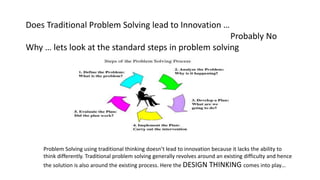
Why … lets look at the standard steps in problem solving
Problem Solving using traditional thinking doesn’t lead to innovation because it lacks the ability to
think differently. Traditional problem solving generally revolves around an existing difficulty and hence
the solution is also around the existing process. Here the DESIGN THINKING comes into play…
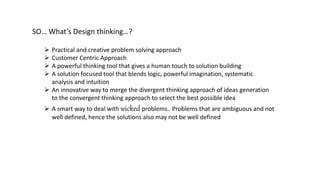
SO… What’s Design thinking…?
 Practical and creative problem solving approach
 Customer Centric Approach
 A powerful thinking tool that gives a human touch to solution building
 A solution focused tool that blends logic, powerful imagination, systematic
analysis and intuition
 An innovative way to merge the divergent thinking approach of ideas generation
to the convergent thinking approach to select the best possible idea
 A smart way to deal with wicked problems.. Problems that are ambiguous and not
well defined, hence the solutions also may not be well defined
How does Design Thinking work…
Empathize
Define &
Re-define
problem
Ideate Prototype
Test &
Implement
Learn &
Finetune
Inspire Create Implement
Lets have a closer look at all the steps…
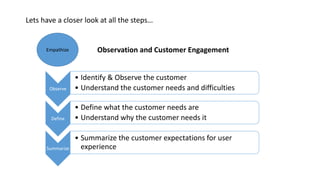
Empathize Observation and Customer Engagement
Observe
• Identify & Observe the customer
• Understand the customer needs and difficulties
Define
• Define what the customer needs are
• Understand why the customer needs it
Summarize
• Summarize the customer expectations for user
experience
Define &
Re-define
problem
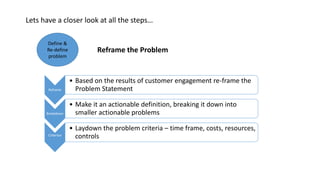
Reframe the Problem
Reframe
• Based on the results of customer engagement re-frame the
Problem Statement
Breakdown
• Make it an actionable definition, breaking it down into
smaller actionable problems
Criterion
• Laydown the problem criteria – time frame, costs, resources,
controls
Lets have a closer look at all the steps…
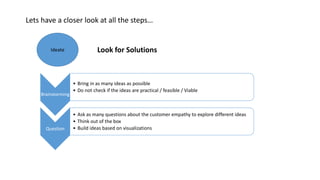
Ideate Look for Solutions
Brainstorming
• Bring in as many ideas as possible
• Do not check if the ideas are practical / feasible / Viable
Question
• Ask as many questions about the customer empathy to explore different ideas
• Think out of the box
• Build ideas based on visualizations
Lets have a closer look at all the steps…
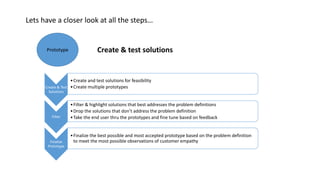
Prototype Create & test solutions
Create & Test
Solutions
•Create and test solutions for feasibility
•Create multiple prototypes
Filter
•Filter & highlight solutions that best addresses the problem definitions
•Drop the solutions that don’t address the problem definition
•Take the end user thru the prototypes and fine tune based on feedback
Finalize
Prototype
•Finalize the best possible and most accepted prototype based on the problem definition
to meet the most possible observations of customer empathy
Lets have a closer look at all the steps…
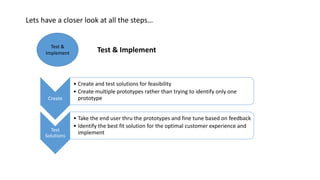
Test &
Implement Test & Implement
Create
• Create and test solutions for feasibility
• Create multiple prototypes rather than trying to identify only one
prototype
Test
Solutions
• Take the end user thru the prototypes and fine tune based on feedback
• Identify the best fit solution for the optimal customer experience and
implement
Lets have a closer look at all the steps…
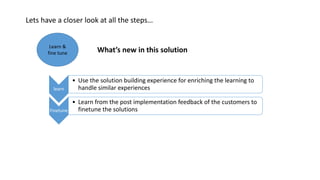
Learn &
fine tune What’s new in this solution
learn
• Use the solution building experience for enriching the learning to
handle similar experiences
Finetune
• Learn from the post implementation feedback of the customers to
finetune the solutions
Lets have a closer look at all the steps…
Why Design Thinking …?
How does it support innovation and Entrepreneurship??
 The world is changing, changing fast and is getting more and more customer focused
 Design thinking is useful for all types of customers – internal / external to any organization
 Design thinking is useful even when there is no apparent problem to be solved, just to
enhance the customer experiences, improve processes etc. this helps to improve
efficiencies
 The approach proves useful even when the definitive problems are not identified
 Helps tackle situations here the data is insufficient or ambiguous
 Live cases where Design thinking has changed the world
 Apple:- when they launched the iPod it was highly user centric device and
completely changed the way music was heard. They focused on the consumer’s
needs to hear lots of music hence focused on creating a new user friendly devise
with scalable music storage capacity rather than making a better walk-man
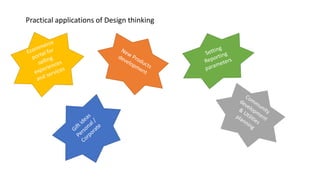
Practical applications of Design thinking
!!! Thank You !!!

Design Thinking - Entrepreneurship & Innovation

  • 1.
    Leadership Café Design Thinking- Entrepreneurship & Innovation
  • 2.
    What is Thinking…. •To solve an existing problem / situation • To improve product, service or experience • Reduce the operating costs • Change the methods of work Thinking is a response or a reaction to a thought or an experience Why Think…?
  • 3.
    Does Traditional ProblemSolving lead to Innovation … Probably No Why … lets look at the standard steps in problem solving Problem Solving using traditional thinking doesn’t lead to innovation because it lacks the ability to think differently. Traditional problem solving generally revolves around an existing difficulty and hence the solution is also around the existing process. Here the DESIGN THINKING comes into play…
  • 4.
    SO… What’s Designthinking…?  Practical and creative problem solving approach  Customer Centric Approach  A powerful thinking tool that gives a human touch to solution building  A solution focused tool that blends logic, powerful imagination, systematic analysis and intuition  An innovative way to merge the divergent thinking approach of ideas generation to the convergent thinking approach to select the best possible idea  A smart way to deal with wicked problems.. Problems that are ambiguous and not well defined, hence the solutions also may not be well defined
  • 5.
    How does DesignThinking work… Empathize Define & Re-define problem Ideate Prototype Test & Implement Learn & Finetune Inspire Create Implement
  • 6.
    Lets have acloser look at all the steps… Empathize Observation and Customer Engagement Observe • Identify & Observe the customer • Understand the customer needs and difficulties Define • Define what the customer needs are • Understand why the customer needs it Summarize • Summarize the customer expectations for user experience
  • 7.
    Define & Re-define problem Reframe theProblem Reframe • Based on the results of customer engagement re-frame the Problem Statement Breakdown • Make it an actionable definition, breaking it down into smaller actionable problems Criterion • Laydown the problem criteria – time frame, costs, resources, controls Lets have a closer look at all the steps…
  • 8.
    Ideate Look forSolutions Brainstorming • Bring in as many ideas as possible • Do not check if the ideas are practical / feasible / Viable Question • Ask as many questions about the customer empathy to explore different ideas • Think out of the box • Build ideas based on visualizations Lets have a closer look at all the steps…
  • 9.
    Prototype Create &test solutions Create & Test Solutions •Create and test solutions for feasibility •Create multiple prototypes Filter •Filter & highlight solutions that best addresses the problem definitions •Drop the solutions that don’t address the problem definition •Take the end user thru the prototypes and fine tune based on feedback Finalize Prototype •Finalize the best possible and most accepted prototype based on the problem definition to meet the most possible observations of customer empathy Lets have a closer look at all the steps…
  • 10.
    Test & Implement Test& Implement Create • Create and test solutions for feasibility • Create multiple prototypes rather than trying to identify only one prototype Test Solutions • Take the end user thru the prototypes and fine tune based on feedback • Identify the best fit solution for the optimal customer experience and implement Lets have a closer look at all the steps…
  • 11.
    Learn & fine tuneWhat’s new in this solution learn • Use the solution building experience for enriching the learning to handle similar experiences Finetune • Learn from the post implementation feedback of the customers to finetune the solutions Lets have a closer look at all the steps…
  • 12.
    Why Design Thinking…? How does it support innovation and Entrepreneurship??  The world is changing, changing fast and is getting more and more customer focused  Design thinking is useful for all types of customers – internal / external to any organization  Design thinking is useful even when there is no apparent problem to be solved, just to enhance the customer experiences, improve processes etc. this helps to improve efficiencies  The approach proves useful even when the definitive problems are not identified  Helps tackle situations here the data is insufficient or ambiguous  Live cases where Design thinking has changed the world  Apple:- when they launched the iPod it was highly user centric device and completely changed the way music was heard. They focused on the consumer’s needs to hear lots of music hence focused on creating a new user friendly devise with scalable music storage capacity rather than making a better walk-man
  • 13.
  • 14.