Identifications Mention
Cranial Nerves
Nucleus Branches
Supplying Attachment
Prepared By AbdulRahman AlTokhy Reviewed By Dr. Ahmed
CRANIAL NERVES
Cranial Nerve
Nucleus
- Deep origin –
M = Motor| P = Parasym. | S = Sensory| T = Taste
Exit from Brainstem
- Attachment -
Branches / Divisions Area of Distribution
- Supplying -
Oculomotor
(III)
- Motor Nucleus (M)
- Edinger Westphal Nucleus (P)
Midbrain
from interpeduncular
fossa.
- Superior division.
- Inferior division.
All Extra-ocular Muscles EXCEPT
Superior oblique & Lateral rectus Ms.
Trochlear
(IV)
- Motor Nucleus (M)
Midbrain
Dorsally,
below inferior
colliculus.
- Superior oblique (SO).
Trigeminal
(V)
- Motor Nucleus. (M)
- Main Sensory Nucleus (S)
- Spinal Nucleus Of Trigeminal(S)
- Mesencephalic Nucleus (S)
Pons
Ventral surface.
V1-Ophthalmic division.
- Lacrimal N.
- Frontal N.
- Nasociliary N.
Sensory to:
Lacrimal gland, upper eyelid,
Skin of forehead, &
Sensory branch to ciliary gangilion.
V2-Maxillary division.
- Cranial branches.
- Pterygopalatine fossa branches.
- Infra-orbital branches.
Sensory to:
Meninges,
Upper teeth, molars
Lower eyelid, Nose & Upper lip.
V3- Mandibular division.
- Motor branches.
- Auriculo-temporal N.
- Lingual N.
- Inferior alveolar N.
Temporalis, masseter, medial & lateral
ptyrgoid Ms.
General sensation of Ant. 2⁄3 of tongue
Sensation to Lower teeth.
Abducent
(VI)
- Motor Nucleus (M)
Pons
Medial part of lower
border between it &
Pyramid of Medulla
Oblongata.
- Lateral rectus (LR).
Facial
(VII)
- Motor Nucleus(M)
- Parasympathetic Nuclei(P)
- Nucleus Solitarius (T)
- Spinal Nucleus Of Trigeminal(S)
Pons
Cerebello-pontine
angle
Intracranial branches:
- Greater petrosal N.
- Nerve to stapedius.
- Chorda tympani.
Submandibular, Sublingual,
Lacrimal, Palate, Pharynx & Nose
glands.
Stapedius M.
Taste sensation of Ant. 2⁄3 of
tongue.
Extracranial branches:
- Temporal branch.
- Zygomatic branch.
- Buccal branch.
- Marginal mandibular branch.
- Cervical branches.
Face & scalp Ms.
Platysma M.
Posterior belly of digastric M.
Stylohyoid M.
Vestibulocochlear
(VIII)
- 4 Vestibular nuclei (S)
- 2 Cochlear nuclei (S)
Pons
Cerebello-pontine
angle
- Vestibular division.
- Cochlear division.
Sensory to Inner ear (hearing) &
Vestibular apparatus (balance).
Glossopharyngeal
(IX)
- Nucleus Ambiguous(M)
- Inferior Salivatory Nucleus(P)
- Nucleus Solitarius (T)
- Spinal Nucleus Of Trigeminal(S)
Medulla
oblongata
At posterolateral
sulcus
- Tympanic branch. Share in tympanic plexus.
- Meningeal branch. Sensory to Meninges.
- Lingual branch.
General & Taste sensations of
Post. 1⁄3 of tongue.
- Pharyngeal branch. Oropharynx sensation.
- Muscular branch. Stylopharyngeus M.
- Tonsillar branch. Palatine tonsil.
- Carotid branch. Carotid sinus & body.
Vagus
(X)
- Nucleus Ambiguous(M)
- Dorsal vagal nucleus(P)
- Nucleus Solitarius (T)
- Spinal Nucleus of Trigeminal(S)
Medulla
oblongata
At posterolateral
sulcus
Sup. Vagal Ganglion:
- Meningeal N.
- Auricular N.
Sensory to Meninges,
& ear structures.
Inf. Vagal Ganglion:
- Pharyngeal N.
- Superior laryngeal N.
- Carotid N.
Muscles of palate , pharynx & larynx
(Except Stylopharyngeus & Tensor Palatine),
Most post. taste sensation,
Cricothyroid M., carotid sinus & body.
Neck & thorax branches:
- Cardiac N.s
- Rt & Lt recurrent laryngeal N.
- Pulmonary, Cardiac &
Esophageal branches.
Smooth muscles of thorax & abdomen .
Sensation from viscera .
Accessory
(XI)
- Nucleus Ambiguous(M)
- Spinal Accessory Nucleus(M)
Medulla
oblongata
At posterolateral
sulcus
Cranial Part.
Muscles of palate , pharynx & larynx.
(Except Stylopharyngeus & Tensor Palatine)
Spinal Part. Supplies Sternomastoid & Trapezius Ms.
Hypoglossal
(XII)
- Motor Nucleus(M)
Medulla
oblongata
At anterolateral
sulcus.
1st group fibers.
- C1 Fibers -
Meninges, Thyrohyoid & Geniohyoid Ms
& form upper root of Ansa cervicalis.
2nd group fibers.
- Hypoglossal Fibers -
Styloglossus, Hyoglossus & Genioglossus Ms.
All intrinsic Muscles.
All tongue Muscles except Palatoglossus
supplied by Vagaus .
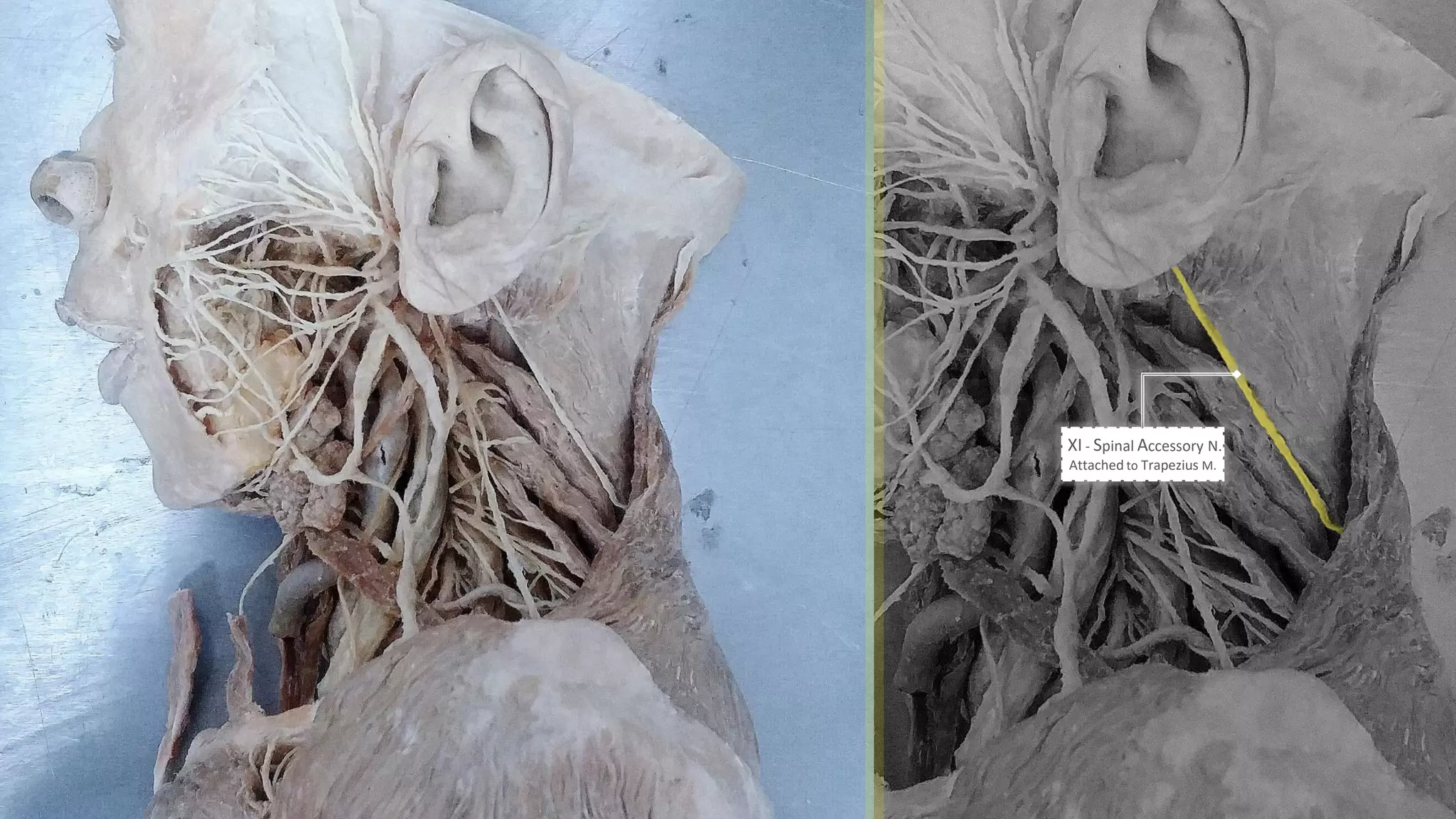
XI - Spinal Accessory N.
Attached to Trapezius M.
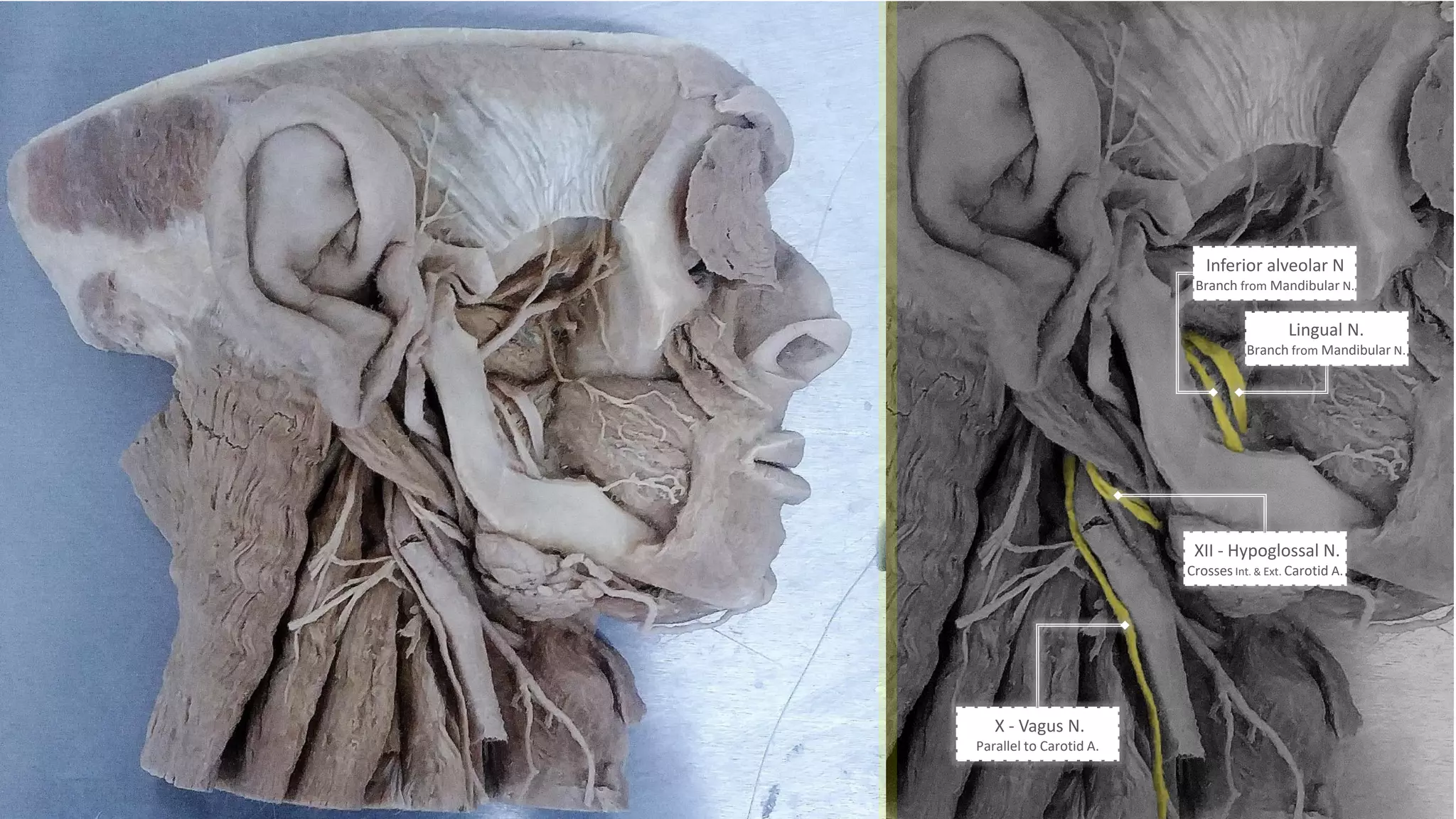
Lingual N.
Branch from Mandibular N.
X - Vagus N.
Parallel to Carotid A.
XII - Hypoglossal N.
Crosses Int. & Ext. Carotid A.
Inferior alveolar N
Branch from Mandibular N.
Ophthalmic division.
V – Trigeminal N.
Maxillary division.
Mandibular division.
Lingual N.
Inferior alveolar N
XI - Spinal Accessory N.
VII – Facial N.
X – Vagus N.
X - Vagus
XII- Hypoglossal
XI - Accessory
IX - Glossopharyngeal
VII - Facial
VIII - Vestibulocochlear
VI - Abducent
V - Trigeminal
III - Oculomotor
II - Optic
Ventral Surface
Dorsal Surface
IV - Trochlear

Cranial nerves summary

  • 1.
    Identifications Mention Cranial Nerves NucleusBranches Supplying Attachment Prepared By AbdulRahman AlTokhy Reviewed By Dr. Ahmed CRANIAL NERVES
  • 2.
    Cranial Nerve Nucleus - Deeporigin – M = Motor| P = Parasym. | S = Sensory| T = Taste Exit from Brainstem - Attachment - Branches / Divisions Area of Distribution - Supplying - Oculomotor (III) - Motor Nucleus (M) - Edinger Westphal Nucleus (P) Midbrain from interpeduncular fossa. - Superior division. - Inferior division. All Extra-ocular Muscles EXCEPT Superior oblique & Lateral rectus Ms. Trochlear (IV) - Motor Nucleus (M) Midbrain Dorsally, below inferior colliculus. - Superior oblique (SO). Trigeminal (V) - Motor Nucleus. (M) - Main Sensory Nucleus (S) - Spinal Nucleus Of Trigeminal(S) - Mesencephalic Nucleus (S) Pons Ventral surface. V1-Ophthalmic division. - Lacrimal N. - Frontal N. - Nasociliary N. Sensory to: Lacrimal gland, upper eyelid, Skin of forehead, & Sensory branch to ciliary gangilion. V2-Maxillary division. - Cranial branches. - Pterygopalatine fossa branches. - Infra-orbital branches. Sensory to: Meninges, Upper teeth, molars Lower eyelid, Nose & Upper lip. V3- Mandibular division. - Motor branches. - Auriculo-temporal N. - Lingual N. - Inferior alveolar N. Temporalis, masseter, medial & lateral ptyrgoid Ms. General sensation of Ant. 2⁄3 of tongue Sensation to Lower teeth. Abducent (VI) - Motor Nucleus (M) Pons Medial part of lower border between it & Pyramid of Medulla Oblongata. - Lateral rectus (LR).
  • 3.
    Facial (VII) - Motor Nucleus(M) -Parasympathetic Nuclei(P) - Nucleus Solitarius (T) - Spinal Nucleus Of Trigeminal(S) Pons Cerebello-pontine angle Intracranial branches: - Greater petrosal N. - Nerve to stapedius. - Chorda tympani. Submandibular, Sublingual, Lacrimal, Palate, Pharynx & Nose glands. Stapedius M. Taste sensation of Ant. 2⁄3 of tongue. Extracranial branches: - Temporal branch. - Zygomatic branch. - Buccal branch. - Marginal mandibular branch. - Cervical branches. Face & scalp Ms. Platysma M. Posterior belly of digastric M. Stylohyoid M. Vestibulocochlear (VIII) - 4 Vestibular nuclei (S) - 2 Cochlear nuclei (S) Pons Cerebello-pontine angle - Vestibular division. - Cochlear division. Sensory to Inner ear (hearing) & Vestibular apparatus (balance). Glossopharyngeal (IX) - Nucleus Ambiguous(M) - Inferior Salivatory Nucleus(P) - Nucleus Solitarius (T) - Spinal Nucleus Of Trigeminal(S) Medulla oblongata At posterolateral sulcus - Tympanic branch. Share in tympanic plexus. - Meningeal branch. Sensory to Meninges. - Lingual branch. General & Taste sensations of Post. 1⁄3 of tongue. - Pharyngeal branch. Oropharynx sensation. - Muscular branch. Stylopharyngeus M. - Tonsillar branch. Palatine tonsil. - Carotid branch. Carotid sinus & body.
  • 4.
    Vagus (X) - Nucleus Ambiguous(M) -Dorsal vagal nucleus(P) - Nucleus Solitarius (T) - Spinal Nucleus of Trigeminal(S) Medulla oblongata At posterolateral sulcus Sup. Vagal Ganglion: - Meningeal N. - Auricular N. Sensory to Meninges, & ear structures. Inf. Vagal Ganglion: - Pharyngeal N. - Superior laryngeal N. - Carotid N. Muscles of palate , pharynx & larynx (Except Stylopharyngeus & Tensor Palatine), Most post. taste sensation, Cricothyroid M., carotid sinus & body. Neck & thorax branches: - Cardiac N.s - Rt & Lt recurrent laryngeal N. - Pulmonary, Cardiac & Esophageal branches. Smooth muscles of thorax & abdomen . Sensation from viscera . Accessory (XI) - Nucleus Ambiguous(M) - Spinal Accessory Nucleus(M) Medulla oblongata At posterolateral sulcus Cranial Part. Muscles of palate , pharynx & larynx. (Except Stylopharyngeus & Tensor Palatine) Spinal Part. Supplies Sternomastoid & Trapezius Ms. Hypoglossal (XII) - Motor Nucleus(M) Medulla oblongata At anterolateral sulcus. 1st group fibers. - C1 Fibers - Meninges, Thyrohyoid & Geniohyoid Ms & form upper root of Ansa cervicalis. 2nd group fibers. - Hypoglossal Fibers - Styloglossus, Hyoglossus & Genioglossus Ms. All intrinsic Muscles. All tongue Muscles except Palatoglossus supplied by Vagaus .
  • 5.
    XI - SpinalAccessory N. Attached to Trapezius M.
  • 6.
    Lingual N. Branch fromMandibular N. X - Vagus N. Parallel to Carotid A. XII - Hypoglossal N. Crosses Int. & Ext. Carotid A. Inferior alveolar N Branch from Mandibular N.
  • 7.
    Ophthalmic division. V –Trigeminal N. Maxillary division. Mandibular division. Lingual N. Inferior alveolar N XI - Spinal Accessory N. VII – Facial N. X – Vagus N.
  • 8.
    X - Vagus XII-Hypoglossal XI - Accessory IX - Glossopharyngeal VII - Facial VIII - Vestibulocochlear VI - Abducent V - Trigeminal III - Oculomotor II - Optic Ventral Surface
  • 9.