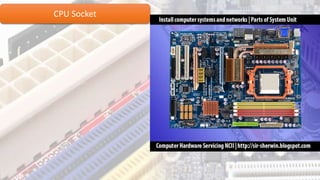
CPU Socket
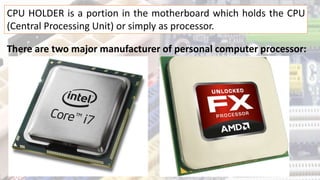
CPU HOLDER is a portion in the motherboard which holds the CPU
(Central Processing Unit) or simply as processor.
There are two major manufacturer of personal computer processor:
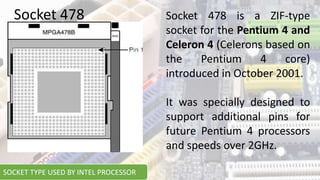
Socket 478 Socket 478 is a ZIF-type
socket for the Pentium 4 and
Celeron 4 (Celerons based on
the Pentium 4 core)
introduced in October 2001.
It was specially designed to
support additional pins for
future Pentium 4 processors
and speeds over 2GHz.
SOCKET TYPE USED BY INTEL PROCESSOR
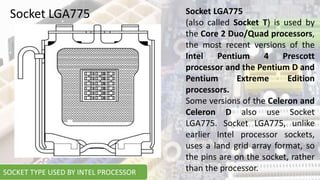
Socket LGA775
(also called Socket T) is used by
the Core 2 Duo/Quad processors,
the most recent versions of the
Intel Pentium 4 Prescott
processor and the Pentium D and
Pentium Extreme Edition
processors.
Some versions of the Celeron and
Celeron D also use Socket
LGA775. Socket LGA775, unlike
earlier Intel processor sockets,
uses a land grid array format, so
the pins are on the socket, rather
than the processor.
Socket LGA775
SOCKET TYPE USED BY INTEL PROCESSOR
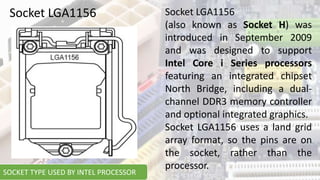
Socket LGA1156 Socket LGA1156
(also known as Socket H) was
introduced in September 2009
and was designed to support
Intel Core i Series processors
featuring an integrated chipset
North Bridge, including a dual-
channel DDR3 memory controller
and optional integrated graphics.
Socket LGA1156 uses a land grid
array format, so the pins are on
the socket, rather than the
processor.
SOCKET TYPE USED BY INTEL PROCESSOR
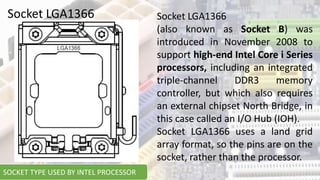
Socket LGA1366 Socket LGA1366
(also known as Socket B) was
introduced in November 2008 to
support high-end Intel Core i Series
processors, including an integrated
triple-channel DDR3 memory
controller, but which also requires
an external chipset North Bridge, in
this case called an I/O Hub (IOH).
Socket LGA1366 uses a land grid
array format, so the pins are on the
socket, rather than the processor.
SOCKET TYPE USED BY INTEL PROCESSOR
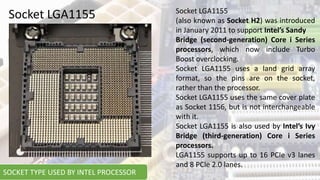
Socket LGA1155 Socket LGA1155
(also known as Socket H2) was introduced
in January 2011 to support Intel’s Sandy
Bridge (second-generation) Core i Series
processors, which now include Turbo
Boost overclocking.
Socket LGA1155 uses a land grid array
format, so the pins are on the socket,
rather than the processor.
Socket LGA1155 uses the same cover plate
as Socket 1156, but is not interchangeable
with it.
Socket LGA1155 is also used by Intel’s Ivy
Bridge (third-generation) Core i Series
processors.
LGA1155 supports up to 16 PCIe v3 lanes
and 8 PCIe 2.0 lanes.
SOCKET TYPE USED BY INTEL PROCESSOR
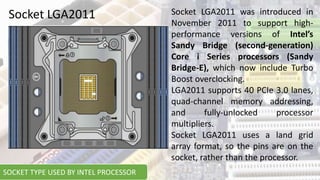
Socket LGA2011 Socket LGA2011 was introduced in
November 2011 to support high-
performance versions of Intel’s
Sandy Bridge (second-generation)
Core i Series processors (Sandy
Bridge-E), which now include Turbo
Boost overclocking.
LGA2011 supports 40 PCIe 3.0 lanes,
quad-channel memory addressing,
and fully-unlocked processor
multipliers.
Socket LGA2011 uses a land grid
array format, so the pins are on the
socket, rather than the processor.
SOCKET TYPE USED BY INTEL PROCESSOR
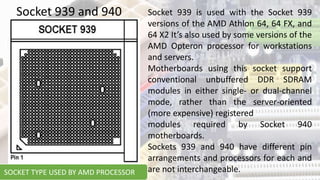
Socket 939 and 940 Socket 939 is used with the Socket 939
versions of the AMD Athlon 64, 64 FX, and
64 X2 It’s also used by some versions of the
AMD Opteron processor for workstations
and servers.
Motherboards using this socket support
conventional unbuffered DDR SDRAM
modules in either single- or dual-channel
mode, rather than the server-oriented
(more expensive) registered
modules required by Socket 940
motherboards.
Sockets 939 and 940 have different pin
arrangements and processors for each and
are not interchangeable.
SOCKET TYPE USED BY AMD PROCESSOR
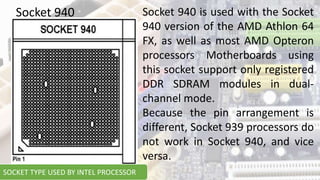
Socket 940 is used with the Socket
940 version of the AMD Athlon 64
FX, as well as most AMD Opteron
processors Motherboards using
this socket support only registered
DDR SDRAM modules in dual-
channel mode.
Because the pin arrangement is
different, Socket 939 processors do
not work in Socket 940, and vice
versa.
Socket 940
SOCKET TYPE USED BY INTEL PROCESSOR
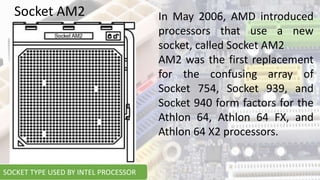
In May 2006, AMD introduced
processors that use a new
socket, called Socket AM2
AM2 was the first replacement
for the confusing array of
Socket 754, Socket 939, and
Socket 940 form factors for the
Athlon 64, Athlon 64 FX, and
Athlon 64 X2 processors.
Socket AM2
SOCKET TYPE USED BY INTEL PROCESSOR
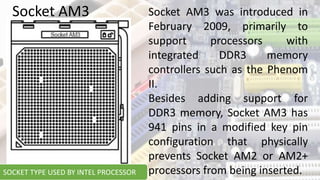
Socket AM3 was introduced in
February 2009, primarily to
support processors with
integrated DDR3 memory
controllers such as the Phenom
II.
Besides adding support for
DDR3 memory, Socket AM3 has
941 pins in a modified key pin
configuration that physically
prevents Socket AM2 or AM2+
processors from being inserted.
Socket AM3
SOCKET TYPE USED BY INTEL PROCESSOR
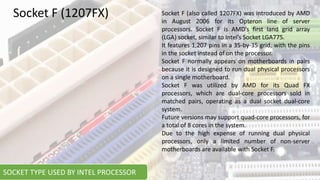
Socket F (also called 1207FX) was introduced by AMD
in August 2006 for its Opteron line of server
processors. Socket F is AMD’s first land grid array
(LGA) socket, similar to Intel’s Socket LGA775.
It features 1,207 pins in a 35-by-35 grid, with the pins
in the socket instead of on the processor.
Socket F normally appears on motherboards in pairs
because it is designed to run dual physical processors
on a single motherboard.
Socket F was utilized by AMD for its Quad FX
processors, which are dual-core processors sold in
matched pairs, operating as a dual socket dual-core
system.
Future versions may support quad-core processors, for
a total of 8 cores in the system.
Due to the high expense of running dual physical
processors, only a limited number of non-server
motherboards are available with Socket F.
Socket F (1207FX)
SOCKET TYPE USED BY INTEL PROCESSOR
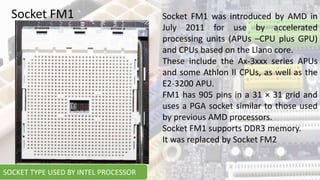
Socket FM1 was introduced by AMD in
July 2011 for use by accelerated
processing units (APUs –CPU plus GPU)
and CPUs based on the Llano core.
These include the Ax-3xxx series APUs
and some Athlon II CPUs, as well as the
E2-3200 APU.
FM1 has 905 pins in a 31 × 31 grid and
uses a PGA socket similar to those used
by previous AMD processors.
Socket FM1 supports DDR3 memory.
It was replaced by Socket FM2
Socket FM1
SOCKET TYPE USED BY INTEL PROCESSOR
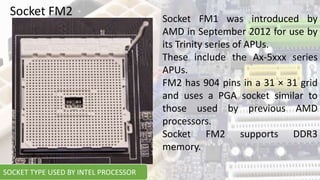
Socket FM1 was introduced by
AMD in September 2012 for use by
its Trinity series of APUs.
These include the Ax-5xxx series
APUs.
FM2 has 904 pins in a 31 × 31 grid
and uses a PGA socket similar to
those used by previous AMD
processors.
Socket FM2 supports DDR3
memory.
Socket FM2
SOCKET TYPE USED BY INTEL PROCESSOR
cpu socket.pptx
cpu socket.pptx
cpu socket.pptx
cpu socket.pptx
cpu socket.pptx
cpu socket.pptx

cpu socket.pptx

  • 1.
  • 2.
    CPU HOLDER isa portion in the motherboard which holds the CPU (Central Processing Unit) or simply as processor. There are two major manufacturer of personal computer processor:
  • 3.
    Socket 478 Socket478 is a ZIF-type socket for the Pentium 4 and Celeron 4 (Celerons based on the Pentium 4 core) introduced in October 2001. It was specially designed to support additional pins for future Pentium 4 processors and speeds over 2GHz. SOCKET TYPE USED BY INTEL PROCESSOR
  • 4.
    Socket LGA775 (also calledSocket T) is used by the Core 2 Duo/Quad processors, the most recent versions of the Intel Pentium 4 Prescott processor and the Pentium D and Pentium Extreme Edition processors. Some versions of the Celeron and Celeron D also use Socket LGA775. Socket LGA775, unlike earlier Intel processor sockets, uses a land grid array format, so the pins are on the socket, rather than the processor. Socket LGA775 SOCKET TYPE USED BY INTEL PROCESSOR
  • 5.
    Socket LGA1156 SocketLGA1156 (also known as Socket H) was introduced in September 2009 and was designed to support Intel Core i Series processors featuring an integrated chipset North Bridge, including a dual- channel DDR3 memory controller and optional integrated graphics. Socket LGA1156 uses a land grid array format, so the pins are on the socket, rather than the processor. SOCKET TYPE USED BY INTEL PROCESSOR
  • 6.
    Socket LGA1366 SocketLGA1366 (also known as Socket B) was introduced in November 2008 to support high-end Intel Core i Series processors, including an integrated triple-channel DDR3 memory controller, but which also requires an external chipset North Bridge, in this case called an I/O Hub (IOH). Socket LGA1366 uses a land grid array format, so the pins are on the socket, rather than the processor. SOCKET TYPE USED BY INTEL PROCESSOR
  • 7.
    Socket LGA1155 SocketLGA1155 (also known as Socket H2) was introduced in January 2011 to support Intel’s Sandy Bridge (second-generation) Core i Series processors, which now include Turbo Boost overclocking. Socket LGA1155 uses a land grid array format, so the pins are on the socket, rather than the processor. Socket LGA1155 uses the same cover plate as Socket 1156, but is not interchangeable with it. Socket LGA1155 is also used by Intel’s Ivy Bridge (third-generation) Core i Series processors. LGA1155 supports up to 16 PCIe v3 lanes and 8 PCIe 2.0 lanes. SOCKET TYPE USED BY INTEL PROCESSOR
  • 8.
    Socket LGA2011 SocketLGA2011 was introduced in November 2011 to support high- performance versions of Intel’s Sandy Bridge (second-generation) Core i Series processors (Sandy Bridge-E), which now include Turbo Boost overclocking. LGA2011 supports 40 PCIe 3.0 lanes, quad-channel memory addressing, and fully-unlocked processor multipliers. Socket LGA2011 uses a land grid array format, so the pins are on the socket, rather than the processor. SOCKET TYPE USED BY INTEL PROCESSOR
  • 9.
    Socket 939 and940 Socket 939 is used with the Socket 939 versions of the AMD Athlon 64, 64 FX, and 64 X2 It’s also used by some versions of the AMD Opteron processor for workstations and servers. Motherboards using this socket support conventional unbuffered DDR SDRAM modules in either single- or dual-channel mode, rather than the server-oriented (more expensive) registered modules required by Socket 940 motherboards. Sockets 939 and 940 have different pin arrangements and processors for each and are not interchangeable. SOCKET TYPE USED BY AMD PROCESSOR
  • 10.
    Socket 940 isused with the Socket 940 version of the AMD Athlon 64 FX, as well as most AMD Opteron processors Motherboards using this socket support only registered DDR SDRAM modules in dual- channel mode. Because the pin arrangement is different, Socket 939 processors do not work in Socket 940, and vice versa. Socket 940 SOCKET TYPE USED BY INTEL PROCESSOR
  • 11.
    In May 2006,AMD introduced processors that use a new socket, called Socket AM2 AM2 was the first replacement for the confusing array of Socket 754, Socket 939, and Socket 940 form factors for the Athlon 64, Athlon 64 FX, and Athlon 64 X2 processors. Socket AM2 SOCKET TYPE USED BY INTEL PROCESSOR
  • 12.
    Socket AM3 wasintroduced in February 2009, primarily to support processors with integrated DDR3 memory controllers such as the Phenom II. Besides adding support for DDR3 memory, Socket AM3 has 941 pins in a modified key pin configuration that physically prevents Socket AM2 or AM2+ processors from being inserted. Socket AM3 SOCKET TYPE USED BY INTEL PROCESSOR
  • 13.
    Socket F (alsocalled 1207FX) was introduced by AMD in August 2006 for its Opteron line of server processors. Socket F is AMD’s first land grid array (LGA) socket, similar to Intel’s Socket LGA775. It features 1,207 pins in a 35-by-35 grid, with the pins in the socket instead of on the processor. Socket F normally appears on motherboards in pairs because it is designed to run dual physical processors on a single motherboard. Socket F was utilized by AMD for its Quad FX processors, which are dual-core processors sold in matched pairs, operating as a dual socket dual-core system. Future versions may support quad-core processors, for a total of 8 cores in the system. Due to the high expense of running dual physical processors, only a limited number of non-server motherboards are available with Socket F. Socket F (1207FX) SOCKET TYPE USED BY INTEL PROCESSOR
  • 14.
    Socket FM1 wasintroduced by AMD in July 2011 for use by accelerated processing units (APUs –CPU plus GPU) and CPUs based on the Llano core. These include the Ax-3xxx series APUs and some Athlon II CPUs, as well as the E2-3200 APU. FM1 has 905 pins in a 31 × 31 grid and uses a PGA socket similar to those used by previous AMD processors. Socket FM1 supports DDR3 memory. It was replaced by Socket FM2 Socket FM1 SOCKET TYPE USED BY INTEL PROCESSOR
  • 15.
    Socket FM1 wasintroduced by AMD in September 2012 for use by its Trinity series of APUs. These include the Ax-5xxx series APUs. FM2 has 904 pins in a 31 × 31 grid and uses a PGA socket similar to those used by previous AMD processors. Socket FM2 supports DDR3 memory. Socket FM2 SOCKET TYPE USED BY INTEL PROCESSOR