CENTRAL PROCESSING UNIT
Introduction It is the brain of the computer Functions of CPU Manages the startup process Controls the flow of data, input and output operations Loads program instruction and data into memory and carries out the processing of data Manages file and disk operations such as saving, retrieving, deleting files and formatting disks.
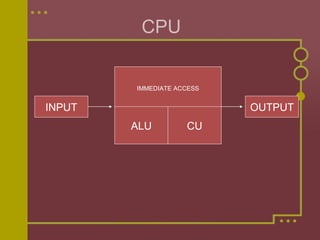
Components of CPU CPU consists of ALU - Arithmetic Logic Unit Control Unit Immediate Access Store The entire CPU is built on a single silicon chip called microchip and also known as Microprocessor.
CPU INPUT OUTPUT IMMEDIATE ACCESS ALU CU
Arithmetic Logic Unit Where the computer processes data either by manipulating it or acting upon it. Consists of: Arithmetic Part - Performs the calculations on the data e.g. 3 +2 = 5 Logic Part - Deals with logic and comparisons. e.g. works out if one value is greater, less than or equal to another
Control Unit CU main jobs: Monitors all the operations of the computer system Making sure that all parts of the computer do their jobs according to the instructions and in a proper sequence. e.g. When you want to print, the CU will keep a check that the instruction are sent to the printer correctly. Controls the flow of data within the CPU
Immediate Access Store Holds the data and programs at the instant by the CU It is also the working space of the computer. The processor brings all the program and data to the memory unit before processing To make sure all operations are performed in a proper sequence, the CPU uses the help of a clock The clock is a device that synchronizes all the activities of a CPU, it ticks millions of times every second.
Speed of a Computer Measured in hertz (Hz) One Hz means One tick per second or One cycle per second One kilohertz (kHz) means 1000 cycles per second and One megahertz (mHz) means One million cycles per second 1mHz allows 1 million sets of activities to be completed per second
Speed of a Computer The Computer power of a computer is determined by the Microprocessor type and its clock speed Research activity. Find out some microprocessor models and its speed produced. Don’t forget the year it’s introduced. e.g. Pentium - Very high speed (66mHz) - 1993

Cpu

  • 1.
  • 2.
    Introduction It isthe brain of the computer Functions of CPU Manages the startup process Controls the flow of data, input and output operations Loads program instruction and data into memory and carries out the processing of data Manages file and disk operations such as saving, retrieving, deleting files and formatting disks.
  • 3.
    Components of CPUCPU consists of ALU - Arithmetic Logic Unit Control Unit Immediate Access Store The entire CPU is built on a single silicon chip called microchip and also known as Microprocessor.
  • 4.
    CPU INPUT OUTPUTIMMEDIATE ACCESS ALU CU
  • 5.
    Arithmetic Logic UnitWhere the computer processes data either by manipulating it or acting upon it. Consists of: Arithmetic Part - Performs the calculations on the data e.g. 3 +2 = 5 Logic Part - Deals with logic and comparisons. e.g. works out if one value is greater, less than or equal to another
  • 6.
    Control Unit CUmain jobs: Monitors all the operations of the computer system Making sure that all parts of the computer do their jobs according to the instructions and in a proper sequence. e.g. When you want to print, the CU will keep a check that the instruction are sent to the printer correctly. Controls the flow of data within the CPU
  • 7.
    Immediate Access StoreHolds the data and programs at the instant by the CU It is also the working space of the computer. The processor brings all the program and data to the memory unit before processing To make sure all operations are performed in a proper sequence, the CPU uses the help of a clock The clock is a device that synchronizes all the activities of a CPU, it ticks millions of times every second.
  • 8.
    Speed of aComputer Measured in hertz (Hz) One Hz means One tick per second or One cycle per second One kilohertz (kHz) means 1000 cycles per second and One megahertz (mHz) means One million cycles per second 1mHz allows 1 million sets of activities to be completed per second
  • 9.
    Speed of aComputer The Computer power of a computer is determined by the Microprocessor type and its clock speed Research activity. Find out some microprocessor models and its speed produced. Don’t forget the year it’s introduced. e.g. Pentium - Very high speed (66mHz) - 1993