BASIC LIFE SUPPORT
(BLS)
MODERATOR- DR SAKSHI
PRESENTER- DR MALLIKA
INTRODUCTION :
• CPR is an emergency lifesaving procedure performed when the heart stops beating.
• CPR and emergency cardiac care should be considered any time an individual cannot adequately
oxygenate or perfuse vital organs following cardiac or respiratory arrest.
• Combines chest compressions often with artificial ventilation to manually preserve intact brain
function until further measures are taken to restore spontaneous blood circulation and breathing .
• To support life by the means of hemodynamics through chain of activities.
• To prevent irreversible cerebral damage from anoxia.
• Sudden cessation of mechanical activity of heart with some or no electrical activity.
• Cessation of normal circulation of blood due to failure of heart to contract effectively.
• May be reversible by rapid intervention but will lead to death in its absence .
BASIC LIFE SUPPORT
• CPR is a spectrum from recognizing cardiac arrest to BLS to ACLS to post cardiac
arrest care.
• BLS is the foundation of saving lives after cardiac arrest.
• It can be provided by trained medical personnel, including medical technicians,
paramedics and qualified bystanders.
• Include psychomotor skills to perform high-quality CPR, using an AED and relieving
an obstructed airway.
• BLS is the primary medical aid provided in an emergency medical situation.
• Objective is not to “Treat” but to buy some valuable time until the emergency medical
team arrives.
REVERSIBLE CAUSES OF SUDDEN CARDIAC ARREST:
5 H’s
• Hypovolemia
• Hypoxia
• Hydrogen ion (acidosis)
• Hypo/Hyperkalemia
• Hypothermia
5 T’s
• Tension pneumothorax
• Tamponade, cardiac
• Toxins
• Thrombosis, pulmonary
• Thrombosis, cardiac
WHEN TO GIVE CPR ?
• BLS is needed when the individual :
• Unconscious
• Not breathing
• Abnormal pulse rate
WHEN NOT TO GIVE CPR ?
• Neither the scene nor the victim and the rescuer is safe
• Patient has already developed rigor mortis
• Patient has normal pulse and breathing
AHA CHAIN OF SURVIVAL FOR ADULTS
SCENE SIZE - UP :
• Is it safe? Is immediate danger involved ?
• What is the nature of illness or mechanism of injury?
• How many patients are involved?
• Is anyone else available for help?
• What is your initial impression?
DO NOT MOVE THE VICTIM UNTIL CPR GIVEN AND QUALITY HELP ARRIVES ,UNLESS SCENE DICTATES OTHERWISE.
Gentle head tilt
Locate trachea and thyroid cartilage
Feel the carotid pulse for 5-10 seconds
SEQUENCES
• C-COMPRESSION A-AIRWAY B-BREATHING
WHY C-A-B ?
• To emphasize the simplest but the utmost important step
• To increase survival rate in sudden cardiac arrest.
• Patient’s blood stays oxygenated for 4-6 mins after last breath but circulation should be restarted at the
earliest.
• Rescue breathing almost always delays chest compression
Use the heel of one hand on the lower half of
the sternum in the middle of the chest (nipple
line)
Put your other hand on top of the first hand
Straighten your arms and press straight down
Compressions should be 2 to 2.4” (5 to 6
cm) into the person’s chest and at a rate of
100 to 120 compressions per minute.
Give time to ventilate adequately/ allow chest
rise
HIGH QUALITY CPR ADULTS :
Push hard ( 2 inches -5cm and fast 100-
120/min)
Allow complete chest recoil .
Minimise interruptions in compressions
Avoid excessive ventilation
Change compressor every 2 mins
If no advanced airway ,30:2 compression-
ventilation ratio.
After 30 compressions, stop compressions and open the airway by tilting the head and lifting
the chin
a. Put your hand on the person’s forehead and tilt the head back.
b. Lift the person’s jaw by placing your index and middle fingers on the lower jaw; lift up.
c. Do not perform the head-tilt/chin-lift maneuver if you suspect the person may have a neck injury.
In that case, the jaw-thrust is used.
d. For the jaw-thrust maneuver, grasp the angles of the lower jaw and lift it with both hands, moving
the jaw forward. If their lips are closed, open the lower lip using your thumb
Give a breath while watching the chest rise. Repeat while
giving a second breath. Breaths should be delivered over one
second.
Resume chest compressions.
Switch quickly between compressions and rescue breaths to
minimize interruptions in chest compressions
Seal the mask against the person’s face by placing four fingers of
one hand across the top of the mask and the thumb of the other
hand along the bottom edge of the mask
Using the fingers of your hand on the bottom of the mask, open
the airway using the head-tilt/chin-lift maneuver.
Press firmly around the edges of the mask and ventilate by
delivering a breath over one second as you watch the person’s
chest rise
• AED is portable electronic device that automatically analyses the patients rhythm and
can provide defibrillation, an electrical shock that may help the heart to re-establish a
perfusing rhythm
• AED is an integral component of BLS protocol.
• Early defibrillation has been re-emphasised in all updates
• AED deliver defibrillation to specific 2 shockable dysrhythmias
( Vfib and Vtach)
• Be sure to move the person and yourself to a safe place before using the AED.
• Electricity and water can be lethal when combined.
• Ensure that the person is not wet (quickly wipe dry) or in close proximity to
• water before using the AED. It is safe to use an AED if the person is lying in the snow.
• If the person has an implanted device, such as a pacemaker, you will see a bulge over their chest.
• Place the defibrillator pads as close to the correct position as possible without being directly over the
• device.
• For persons with medication patches, remove the patch, wipe the skin dry, and apply the AED pad.
Retrieve the AED . Turn on the AED. Expose the person’s chest .Open the AED pads
Apply one pad on upper right chest above the breast.
Apply the second pad on lower left chest below the armpit.
Ensure the wires are attached to the AED box
Move away from the person. Stop CPR.
Clear the person to make sure no one is touching any part of the victim.
Let AED analyze the rhythm.
If AED message reads “Check Electrodes,” then:
a. Ensure electrodes make good contact.
b. If chest is hairy, pull off pad and replace it.
If AED message reads “Shock,”
a. Be sure the person is “clear” by making sure no one is
touching them.
b. Press and hold the “shock” button until the AED delivers
the shock.
Resume CPR for two minutes starting with chest
compressions
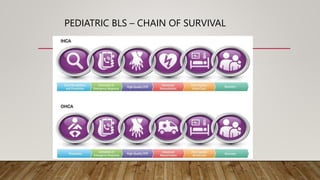
PEDIATRIC BLS – CHAIN OF SURVIVAL
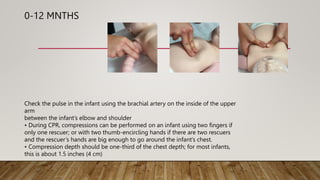
0-12 MNTHS
Check the pulse in the infant using the brachial artery on the inside of the upper
arm
between the infant’s elbow and shoulder
• During CPR, compressions can be performed on an infant using two fingers if
only one rescuer; or with two thumb-encircling hands if there are two rescuers
and the rescuer’s hands are big enough to go around the infant’s chest.
• Compression depth should be one-third of the chest depth; for most infants,
this is about 1.5 inches (4 cm)
• Tap the heel of their foot and talk loudly at the infant to determine if they are
responsive.
• Assess if they are breathing while simultaneously checking for the infant’s brachial pulse
for 5 but no more than 10 seconds. If the infant does not respond and is not breathing
(only gasping), yell for help.
• If you cannot feel a pulse (or if you are unsure), begin CPR by doing 30 compressions
followed by two breaths. If you can feel a pulse but the rate is less than 60 beats per
minute, begin CPR. This rate is too slow for an infant.
• To perform CPR on an infant, do the following:
a. Be sure the infant is face-up on a hard surface.
b. Using two fingers, perform compressions in the centre of the infant’s chest; do not press
on the end of the sternum as this can cause injury to the infant.
c. Compression depth should be about 1.5 inches (4 cm) and 100-120 compressions per
minute.
• Perform CPR for about two minutes (using cycles of 30 compressions and two breaths).
PEDIATRIC HIGH QUALITY CPR
Push hard (>1/3 rd of anteroposterior diameter of chest)and fast 100-
120/min
Allow complete chest recoil .
Minimise interruptions in compressions
Avoid excessive ventilation
Change compressor every 2 mins
If 2 rescuers,15:2 compression-ventilation ratio.
If advanced airway, provide continuous compressions and give a breath
every 2-3 seconds
Apply one pad on the upper right chest above the breast.
For infants, apply on front of chest
b. Apply the second pad on lower left chest below the
armpit.
For infants, apply second pad to back
AIRWAY MANAGEMENT
ADULTS AND OLDER CHILDREN MOUTH-TO-MOUTH
Do not give breaths too rapidly or too forcefully. Doing this may cause air to be forced into the
stomach, resulting in distention and less room for lung expansion. It may also cause vomiting.
To deliver mouth-to-mouth breaths, do the following:
1. Open the airway using the head-tilt/chin-lift maneuver
2. Pinch the person’s nose closed with your hand on the person’s head
3. Create a seal when using your lips to surround the person’s mouth
4. Blow into the person’s mouth for one full second and watch for the chest to rise
Tilt the victim’s head further back if the chest does not rise.
5. Give an additional breath for over one second.
6. If you cannot see the chest rise in two breaths, continue giving chest compressions
INFANTS MOUTH-TO-MOUTH/NOSE
• When performing rescue breathing on an infant, the rescuer should cover the infant’s mouth
and nose when possible and do the following:
• Open the airway using the head-tilt/chin-lift maneuver
• Be sure not to hyper-extend the neck. Aim for a neutral position.
• Create a seal using your lips to surround the infant’s nose and mouth
• Gently blow into the infant’s nose and mouth for one second Keep in mind that an infant’s
lungs are smaller than an adult’s and need a smaller volume of air. Watch for the infant’s chest
to rise. If you cannot see the chest rise, re-adjust the tilt of their head
CHOKING IN ADULTS AND
CHILDREN
ABDOMINAL THRUSTS/ HEIMLICH MANEUVER
These steps should only be used when a person is responsive and older than one
year of age.
1. Stand behind the responsive person. Wrap your
arms around their waist under their ribcage.
2. Put the side of your fist above the person’s navel in
the middle of their belly. Do not press on the lower
part of the sternum
3. With your other hand, hold the first fist and press
forcefully into the person’s abdomen and up
toward their chest
4. Continue performing these thrusts until the obstruction
is relieved or until the person becomes
unresponsive.
Perform chest thrust instead of abdominal thrust in pregnant women.
BACK BLOWS AND CHEST THRUSTS IN INFANTS
In a choking but responsive infant less than one year old
1. Hold the infant in your lap.
2. Put their face down and their head lower than their chest; they should be resting
on your forearm. Put your forearm on your thigh
3. Support the infant’s head and neck with your hand and be sure to avoid putting pressure on
their throat.
4. Using the heel of your free hand, deliver five back blows between the infant’s shoulder blades
5. Using both hands and arms, turn the infant face up so they are now resting on your other
arm;
this arm should now be resting on your thigh
6. Using the fingers of your free hand, provide up to five quick downward chest thrusts over the
lower half of the breastbone. Perform one thrust every second.
7. If the obstruction is not relieved, turn the infant face down on your other forearm and repeat
the process
8. Continue doing these steps until the infant begins to breathe or becomes unresponsive.
THANK YOU!

Basic Life Support presentation new.pptx

  • 1.
    BASIC LIFE SUPPORT (BLS) MODERATOR-DR SAKSHI PRESENTER- DR MALLIKA
  • 2.
    INTRODUCTION : • CPRis an emergency lifesaving procedure performed when the heart stops beating. • CPR and emergency cardiac care should be considered any time an individual cannot adequately oxygenate or perfuse vital organs following cardiac or respiratory arrest. • Combines chest compressions often with artificial ventilation to manually preserve intact brain function until further measures are taken to restore spontaneous blood circulation and breathing . • To support life by the means of hemodynamics through chain of activities. • To prevent irreversible cerebral damage from anoxia.
  • 3.
    • Sudden cessationof mechanical activity of heart with some or no electrical activity. • Cessation of normal circulation of blood due to failure of heart to contract effectively. • May be reversible by rapid intervention but will lead to death in its absence .
  • 4.
    BASIC LIFE SUPPORT •CPR is a spectrum from recognizing cardiac arrest to BLS to ACLS to post cardiac arrest care. • BLS is the foundation of saving lives after cardiac arrest. • It can be provided by trained medical personnel, including medical technicians, paramedics and qualified bystanders. • Include psychomotor skills to perform high-quality CPR, using an AED and relieving an obstructed airway. • BLS is the primary medical aid provided in an emergency medical situation. • Objective is not to “Treat” but to buy some valuable time until the emergency medical team arrives.
  • 5.
    REVERSIBLE CAUSES OFSUDDEN CARDIAC ARREST: 5 H’s • Hypovolemia • Hypoxia • Hydrogen ion (acidosis) • Hypo/Hyperkalemia • Hypothermia 5 T’s • Tension pneumothorax • Tamponade, cardiac • Toxins • Thrombosis, pulmonary • Thrombosis, cardiac
  • 6.
    WHEN TO GIVECPR ? • BLS is needed when the individual : • Unconscious • Not breathing • Abnormal pulse rate WHEN NOT TO GIVE CPR ? • Neither the scene nor the victim and the rescuer is safe • Patient has already developed rigor mortis • Patient has normal pulse and breathing
  • 7.
    AHA CHAIN OFSURVIVAL FOR ADULTS
  • 9.
    SCENE SIZE -UP : • Is it safe? Is immediate danger involved ? • What is the nature of illness or mechanism of injury? • How many patients are involved? • Is anyone else available for help? • What is your initial impression? DO NOT MOVE THE VICTIM UNTIL CPR GIVEN AND QUALITY HELP ARRIVES ,UNLESS SCENE DICTATES OTHERWISE.
  • 11.
    Gentle head tilt Locatetrachea and thyroid cartilage Feel the carotid pulse for 5-10 seconds
  • 13.
    SEQUENCES • C-COMPRESSION A-AIRWAYB-BREATHING WHY C-A-B ? • To emphasize the simplest but the utmost important step • To increase survival rate in sudden cardiac arrest. • Patient’s blood stays oxygenated for 4-6 mins after last breath but circulation should be restarted at the earliest. • Rescue breathing almost always delays chest compression
  • 14.
    Use the heelof one hand on the lower half of the sternum in the middle of the chest (nipple line) Put your other hand on top of the first hand Straighten your arms and press straight down Compressions should be 2 to 2.4” (5 to 6 cm) into the person’s chest and at a rate of 100 to 120 compressions per minute. Give time to ventilate adequately/ allow chest rise
  • 15.
    HIGH QUALITY CPRADULTS : Push hard ( 2 inches -5cm and fast 100- 120/min) Allow complete chest recoil . Minimise interruptions in compressions Avoid excessive ventilation Change compressor every 2 mins If no advanced airway ,30:2 compression- ventilation ratio.
  • 16.
    After 30 compressions,stop compressions and open the airway by tilting the head and lifting the chin a. Put your hand on the person’s forehead and tilt the head back. b. Lift the person’s jaw by placing your index and middle fingers on the lower jaw; lift up. c. Do not perform the head-tilt/chin-lift maneuver if you suspect the person may have a neck injury. In that case, the jaw-thrust is used. d. For the jaw-thrust maneuver, grasp the angles of the lower jaw and lift it with both hands, moving the jaw forward. If their lips are closed, open the lower lip using your thumb
  • 17.
    Give a breathwhile watching the chest rise. Repeat while giving a second breath. Breaths should be delivered over one second. Resume chest compressions. Switch quickly between compressions and rescue breaths to minimize interruptions in chest compressions Seal the mask against the person’s face by placing four fingers of one hand across the top of the mask and the thumb of the other hand along the bottom edge of the mask Using the fingers of your hand on the bottom of the mask, open the airway using the head-tilt/chin-lift maneuver. Press firmly around the edges of the mask and ventilate by delivering a breath over one second as you watch the person’s chest rise
  • 18.
    • AED isportable electronic device that automatically analyses the patients rhythm and can provide defibrillation, an electrical shock that may help the heart to re-establish a perfusing rhythm • AED is an integral component of BLS protocol. • Early defibrillation has been re-emphasised in all updates • AED deliver defibrillation to specific 2 shockable dysrhythmias ( Vfib and Vtach)
  • 19.
    • Be sureto move the person and yourself to a safe place before using the AED. • Electricity and water can be lethal when combined. • Ensure that the person is not wet (quickly wipe dry) or in close proximity to • water before using the AED. It is safe to use an AED if the person is lying in the snow. • If the person has an implanted device, such as a pacemaker, you will see a bulge over their chest. • Place the defibrillator pads as close to the correct position as possible without being directly over the • device. • For persons with medication patches, remove the patch, wipe the skin dry, and apply the AED pad.
  • 20.
    Retrieve the AED. Turn on the AED. Expose the person’s chest .Open the AED pads Apply one pad on upper right chest above the breast. Apply the second pad on lower left chest below the armpit. Ensure the wires are attached to the AED box Move away from the person. Stop CPR. Clear the person to make sure no one is touching any part of the victim.
  • 21.
    Let AED analyzethe rhythm. If AED message reads “Check Electrodes,” then: a. Ensure electrodes make good contact. b. If chest is hairy, pull off pad and replace it. If AED message reads “Shock,” a. Be sure the person is “clear” by making sure no one is touching them. b. Press and hold the “shock” button until the AED delivers the shock. Resume CPR for two minutes starting with chest compressions
  • 25.
    PEDIATRIC BLS –CHAIN OF SURVIVAL
  • 27.
    0-12 MNTHS Check thepulse in the infant using the brachial artery on the inside of the upper arm between the infant’s elbow and shoulder • During CPR, compressions can be performed on an infant using two fingers if only one rescuer; or with two thumb-encircling hands if there are two rescuers and the rescuer’s hands are big enough to go around the infant’s chest. • Compression depth should be one-third of the chest depth; for most infants, this is about 1.5 inches (4 cm)
  • 29.
    • Tap theheel of their foot and talk loudly at the infant to determine if they are responsive. • Assess if they are breathing while simultaneously checking for the infant’s brachial pulse for 5 but no more than 10 seconds. If the infant does not respond and is not breathing (only gasping), yell for help. • If you cannot feel a pulse (or if you are unsure), begin CPR by doing 30 compressions followed by two breaths. If you can feel a pulse but the rate is less than 60 beats per minute, begin CPR. This rate is too slow for an infant. • To perform CPR on an infant, do the following: a. Be sure the infant is face-up on a hard surface. b. Using two fingers, perform compressions in the centre of the infant’s chest; do not press on the end of the sternum as this can cause injury to the infant. c. Compression depth should be about 1.5 inches (4 cm) and 100-120 compressions per minute. • Perform CPR for about two minutes (using cycles of 30 compressions and two breaths).
  • 30.
    PEDIATRIC HIGH QUALITYCPR Push hard (>1/3 rd of anteroposterior diameter of chest)and fast 100- 120/min Allow complete chest recoil . Minimise interruptions in compressions Avoid excessive ventilation Change compressor every 2 mins If 2 rescuers,15:2 compression-ventilation ratio. If advanced airway, provide continuous compressions and give a breath every 2-3 seconds
  • 31.
    Apply one padon the upper right chest above the breast. For infants, apply on front of chest b. Apply the second pad on lower left chest below the armpit. For infants, apply second pad to back
  • 32.
  • 33.
    ADULTS AND OLDERCHILDREN MOUTH-TO-MOUTH Do not give breaths too rapidly or too forcefully. Doing this may cause air to be forced into the stomach, resulting in distention and less room for lung expansion. It may also cause vomiting. To deliver mouth-to-mouth breaths, do the following: 1. Open the airway using the head-tilt/chin-lift maneuver 2. Pinch the person’s nose closed with your hand on the person’s head 3. Create a seal when using your lips to surround the person’s mouth 4. Blow into the person’s mouth for one full second and watch for the chest to rise Tilt the victim’s head further back if the chest does not rise. 5. Give an additional breath for over one second. 6. If you cannot see the chest rise in two breaths, continue giving chest compressions
  • 34.
    INFANTS MOUTH-TO-MOUTH/NOSE • Whenperforming rescue breathing on an infant, the rescuer should cover the infant’s mouth and nose when possible and do the following: • Open the airway using the head-tilt/chin-lift maneuver • Be sure not to hyper-extend the neck. Aim for a neutral position. • Create a seal using your lips to surround the infant’s nose and mouth • Gently blow into the infant’s nose and mouth for one second Keep in mind that an infant’s lungs are smaller than an adult’s and need a smaller volume of air. Watch for the infant’s chest to rise. If you cannot see the chest rise, re-adjust the tilt of their head
  • 35.
    CHOKING IN ADULTSAND CHILDREN
  • 36.
    ABDOMINAL THRUSTS/ HEIMLICHMANEUVER These steps should only be used when a person is responsive and older than one year of age. 1. Stand behind the responsive person. Wrap your arms around their waist under their ribcage. 2. Put the side of your fist above the person’s navel in the middle of their belly. Do not press on the lower part of the sternum 3. With your other hand, hold the first fist and press forcefully into the person’s abdomen and up toward their chest 4. Continue performing these thrusts until the obstruction is relieved or until the person becomes unresponsive. Perform chest thrust instead of abdominal thrust in pregnant women.
  • 37.
    BACK BLOWS ANDCHEST THRUSTS IN INFANTS In a choking but responsive infant less than one year old 1. Hold the infant in your lap. 2. Put their face down and their head lower than their chest; they should be resting on your forearm. Put your forearm on your thigh 3. Support the infant’s head and neck with your hand and be sure to avoid putting pressure on their throat. 4. Using the heel of your free hand, deliver five back blows between the infant’s shoulder blades 5. Using both hands and arms, turn the infant face up so they are now resting on your other arm; this arm should now be resting on your thigh 6. Using the fingers of your free hand, provide up to five quick downward chest thrusts over the lower half of the breastbone. Perform one thrust every second. 7. If the obstruction is not relieved, turn the infant face down on your other forearm and repeat the process 8. Continue doing these steps until the infant begins to breathe or becomes unresponsive.
  • 42.

Editor's Notes

  • #27 Brachial art R or L?