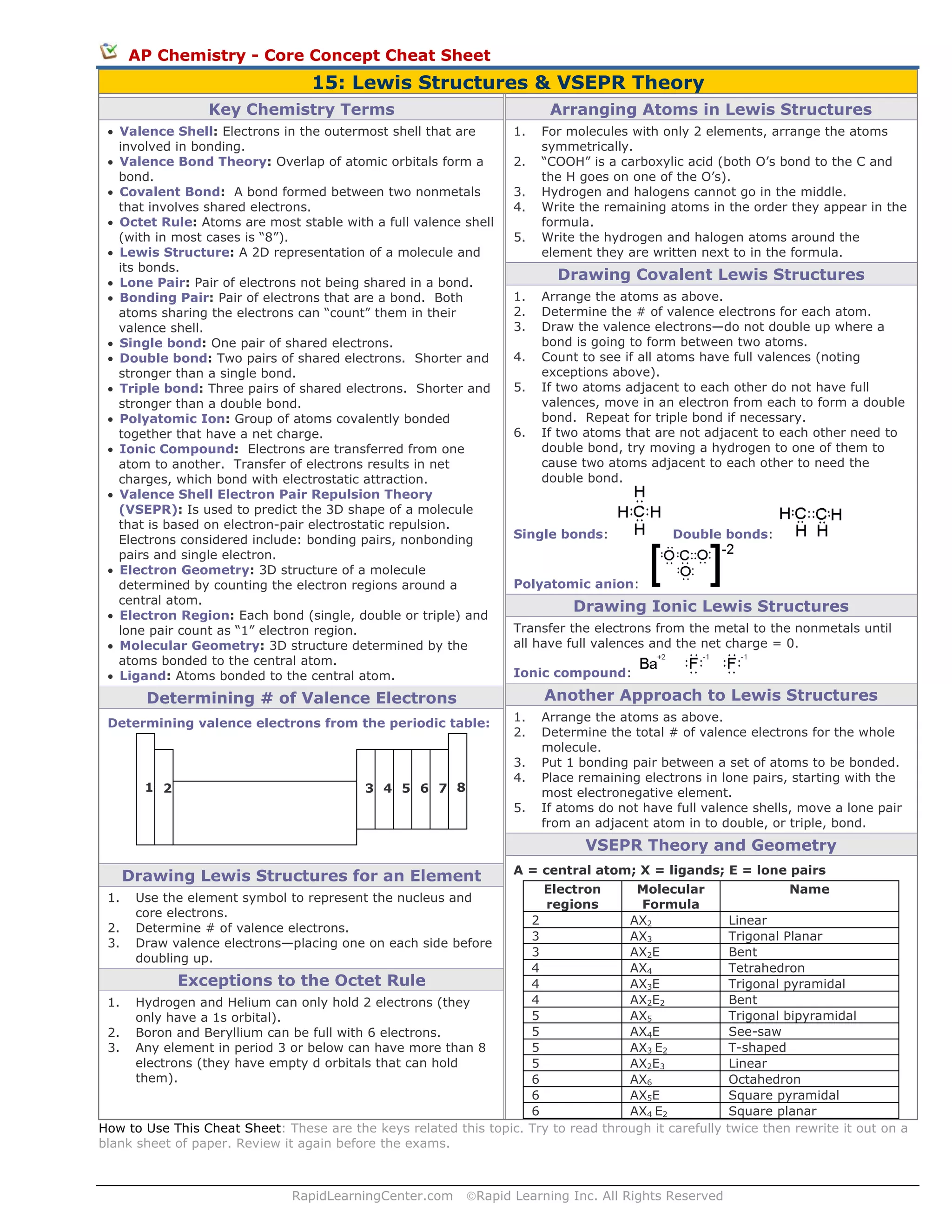
AP Chemistry - Core Concept Cheat Sheet

15: Lewis Structures & VSEPR Theory
Key Chemistry Terms

Arranging Atoms in Lewis Structures

• Valence Shell: Electrons in the outermost shell that are
involved in bonding.
• Valence Bond Theory: Overlap of atomic orbitals form a
bond.
• Covalent Bond: A bond formed between two nonmetals
that involves shared electrons.
• Octet Rule: Atoms are most stable with a full valence shell
(with in most cases is “8”).
• Lewis Structure: A 2D representation of a molecule and
its bonds.
• Lone Pair: Pair of electrons not being shared in a bond.
• Bonding Pair: Pair of electrons that are a bond. Both
atoms sharing the electrons can “count” them in their
valence shell.
• Single bond: One pair of shared electrons.
• Double bond: Two pairs of shared electrons. Shorter and
stronger than a single bond.
• Triple bond: Three pairs of shared electrons. Shorter and
stronger than a double bond.
• Polyatomic Ion: Group of atoms covalently bonded
together that have a net charge.
• Ionic Compound: Electrons are transferred from one
atom to another. Transfer of electrons results in net
charges, which bond with electrostatic attraction.
• Valence Shell Electron Pair Repulsion Theory
(VSEPR): Is used to predict the 3D shape of a molecule
that is based on electron-pair electrostatic repulsion.
Electrons considered include: bonding pairs, nonbonding
pairs and single electron.
• Electron Geometry: 3D structure of a molecule
determined by counting the electron regions around a
central atom.
• Electron Region: Each bond (single, double or triple) and
lone pair count as “1” electron region.
• Molecular Geometry: 3D structure determined by the
atoms bonded to the central atom.
• Ligand: Atoms bonded to the central atom.

1.
2.
3.
4.
5.

Drawing Covalent Lewis Structures
1.
2.
3.
4.
5.
6.

Arrange the atoms as above.
Determine the # of valence electrons for each atom.
Draw the valence electrons—do not double up where a
bond is going to form between two atoms.
Count to see if all atoms have full valences (noting
exceptions above).
If two atoms adjacent to each other do not have full
valences, move in an electron from each to form a double
bond. Repeat for triple bond if necessary.
If two atoms that are not adjacent to each other need to
double bond, try moving a hydrogen to one of them to
cause two atoms adjacent to each other to need the
double bond.

Single bonds:

Double bonds:

Polyatomic anion:

Drawing Ionic Lewis Structures
Transfer the electrons from the metal to the nonmetals until
all have full valences and the net charge = 0.
Ionic compound:

Another Approach to Lewis Structures

Determining # of Valence Electrons
Determining valence electrons from the periodic table:

1 2

For molecules with only 2 elements, arrange the atoms
symmetrically.
“COOH” is a carboxylic acid (both O’s bond to the C and
the H goes on one of the O’s).
Hydrogen and halogens cannot go in the middle.
Write the remaining atoms in the order they appear in the
formula.
Write the hydrogen and halogen atoms around the
element they are written next to in the formula.

1.
2.
3.
4.

3 4 5 6 7 8

5.

Arrange the atoms as above.
Determine the total # of valence electrons for the whole
molecule.
Put 1 bonding pair between a set of atoms to be bonded.
Place remaining electrons in lone pairs, starting with the
most electronegative element.
If atoms do not have full valence shells, move a lone pair
from an adjacent atom in to double, or triple, bond.

VSEPR Theory and Geometry
Drawing Lewis Structures for an Element

A = central atom; X = ligands; E = lone pairs

Molecular
Formula
2
AX2
2.
3
AX3
3.
3
AX2E
4
AX4
Exceptions to the Octet Rule
4
AX3E
4
AX2E2
1. Hydrogen and Helium can only hold 2 electrons (they
5
AX5
only have a 1s orbital).
5
AX4E
2. Boron and Beryllium can be full with 6 electrons.
5
AX3 E2
3. Any element in period 3 or below can have more than 8
electrons (they have empty d orbitals that can hold
5
AX2E3
them).
6
AX6
6
AX5E
6
AX4 E2
How to Use This Cheat Sheet: These are the keys related this topic. Try to read through it carefully
blank sheet of paper. Review it again before the exams.
1.

Use the element symbol to represent the nucleus and
core electrons.
Determine # of valence electrons.
Draw valence electrons—placing one on each side before
doubling up.

RapidLearningCenter.com

Electron
regions

©Rapid Learning Inc. All Rights Reserved

Name
Linear
Trigonal Planar
Bent
Tetrahedron
Trigonal pyramidal
Bent
Trigonal bipyramidal
See-saw
T-shaped
Linear
Octahedron
Square pyramidal
Square planar
twice then rewrite it out on a

Lewis structuresvsepr theory cheat sheet

  • 1.
    AP Chemistry -Core Concept Cheat Sheet 15: Lewis Structures & VSEPR Theory Key Chemistry Terms Arranging Atoms in Lewis Structures • Valence Shell: Electrons in the outermost shell that are involved in bonding. • Valence Bond Theory: Overlap of atomic orbitals form a bond. • Covalent Bond: A bond formed between two nonmetals that involves shared electrons. • Octet Rule: Atoms are most stable with a full valence shell (with in most cases is “8”). • Lewis Structure: A 2D representation of a molecule and its bonds. • Lone Pair: Pair of electrons not being shared in a bond. • Bonding Pair: Pair of electrons that are a bond. Both atoms sharing the electrons can “count” them in their valence shell. • Single bond: One pair of shared electrons. • Double bond: Two pairs of shared electrons. Shorter and stronger than a single bond. • Triple bond: Three pairs of shared electrons. Shorter and stronger than a double bond. • Polyatomic Ion: Group of atoms covalently bonded together that have a net charge. • Ionic Compound: Electrons are transferred from one atom to another. Transfer of electrons results in net charges, which bond with electrostatic attraction. • Valence Shell Electron Pair Repulsion Theory (VSEPR): Is used to predict the 3D shape of a molecule that is based on electron-pair electrostatic repulsion. Electrons considered include: bonding pairs, nonbonding pairs and single electron. • Electron Geometry: 3D structure of a molecule determined by counting the electron regions around a central atom. • Electron Region: Each bond (single, double or triple) and lone pair count as “1” electron region. • Molecular Geometry: 3D structure determined by the atoms bonded to the central atom. • Ligand: Atoms bonded to the central atom. 1. 2. 3. 4. 5. Drawing Covalent Lewis Structures 1. 2. 3. 4. 5. 6. Arrange the atoms as above. Determine the # of valence electrons for each atom. Draw the valence electrons—do not double up where a bond is going to form between two atoms. Count to see if all atoms have full valences (noting exceptions above). If two atoms adjacent to each other do not have full valences, move in an electron from each to form a double bond. Repeat for triple bond if necessary. If two atoms that are not adjacent to each other need to double bond, try moving a hydrogen to one of them to cause two atoms adjacent to each other to need the double bond. Single bonds: Double bonds: Polyatomic anion: Drawing Ionic Lewis Structures Transfer the electrons from the metal to the nonmetals until all have full valences and the net charge = 0. Ionic compound: Another Approach to Lewis Structures Determining # of Valence Electrons Determining valence electrons from the periodic table: 1 2 For molecules with only 2 elements, arrange the atoms symmetrically. “COOH” is a carboxylic acid (both O’s bond to the C and the H goes on one of the O’s). Hydrogen and halogens cannot go in the middle. Write the remaining atoms in the order they appear in the formula. Write the hydrogen and halogen atoms around the element they are written next to in the formula. 1. 2. 3. 4. 3 4 5 6 7 8 5. Arrange the atoms as above. Determine the total # of valence electrons for the whole molecule. Put 1 bonding pair between a set of atoms to be bonded. Place remaining electrons in lone pairs, starting with the most electronegative element. If atoms do not have full valence shells, move a lone pair from an adjacent atom in to double, or triple, bond. VSEPR Theory and Geometry Drawing Lewis Structures for an Element A = central atom; X = ligands; E = lone pairs Molecular Formula 2 AX2 2. 3 AX3 3. 3 AX2E 4 AX4 Exceptions to the Octet Rule 4 AX3E 4 AX2E2 1. Hydrogen and Helium can only hold 2 electrons (they 5 AX5 only have a 1s orbital). 5 AX4E 2. Boron and Beryllium can be full with 6 electrons. 5 AX3 E2 3. Any element in period 3 or below can have more than 8 electrons (they have empty d orbitals that can hold 5 AX2E3 them). 6 AX6 6 AX5E 6 AX4 E2 How to Use This Cheat Sheet: These are the keys related this topic. Try to read through it carefully blank sheet of paper. Review it again before the exams. 1. Use the element symbol to represent the nucleus and core electrons. Determine # of valence electrons. Draw valence electrons—placing one on each side before doubling up. RapidLearningCenter.com Electron regions ©Rapid Learning Inc. All Rights Reserved Name Linear Trigonal Planar Bent Tetrahedron Trigonal pyramidal Bent Trigonal bipyramidal See-saw T-shaped Linear Octahedron Square pyramidal Square planar twice then rewrite it out on a