




Preparedby:
Redouane Ouaaziz
Soad Elbassite
Module: Teaching methods
and approaches
Trainer: Ahmed Atlagh
NATURAL APPROACH
Briefly intoduced
Overview
Aims
Theories of language
Principles
Roles of Teacher & Learner
Materials/ activities
Techniques
Advs/ Disadvs
Video
DEFINITION
Is a language teaching approach
which claims that language learning is a
reproduction of the way humans
naturally acquire their native language.
OVERVIEW
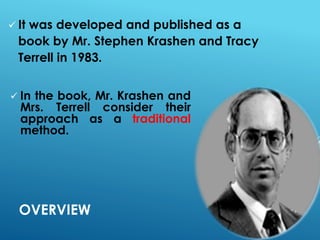
 It was developed and published as a
book by Mr. Stephen Krashen and Tracy
Terrell in 1983.
 In the book, Mr. Krashen and
Mrs. Terrell consider their
approach as a traditional
method.
OVERVIEW
Natural Approach
believes that adults
can still acquire
second languages.
The ability of
language acquisition
does not disappear
as we grow up.
Adults also acquire
language by
following the
principles of
Universal Grammar.
OVERVIEW
The difference between adult and
children acquisition skill is that
adults have two things to follow
when they learn foreign language:
Acquisition and learning. But,
children only acquire the
languages.
AIMS
To help adults in learning the foreign
language naturally.
The learner will be able to pick up the
grammar by themselves when they are
ready.
THEORIES
The Acquisition-Learning hypothesis
The learner has two ways of learning
the second language, which are the
acquired system and the learned
system.
THEORIES
The monitor hypothesis
When the learner can check and correct
language output.
THEORIES
The Natural Order
hypothesis
 When people acquire
language by using
grammatical
structures in a
predictable order.
THEORIES
The input hypothesis
 People aquire language best
when they are given input slightly
beyond their current level i+1.
The Affective Filter hypothesis
Three states are to be identified:
Motivation: learners with high motivation
generally do better.
Self-confidence: learners with self-
confidence and a good self-image tend to
be more successful.
Anxiety: Low personal anxiety and low
classroom anxiety are more conducive to
second language acquisition.
THEORIES
PRINCIPLES
"Focus of instruction is on communication rather than
its form.“
"Speech production comes slowly and is never
forced.“
"Early speech goes through natural stages
(yes or no response, one- word answers, lists of words,
short phrases, complete sentences.)"
TEACHER´S ROLE
Act as an authority in the class
Imitate the first language learning process
Creatively instruct students to do activities
that benefit the language learning.
LEARNER´S ROLE
 Pre-production stage: learners
participate in the language activity
without having to respond.
 Early-production stage: learners answer
questions, with single words and short
phrases.
 Speech-emergent stage: learners
involve themselves in role plays, games
and other activities.
NSTRUCTIONAL MATERIALS
Make classroom activities as meaningful as
possible and promote comprehension, and
The primary aim of materials is to promote
comprehension and communication.
Pictures and other visual aids are essential,
because they supply the content for
communication
Materials come from the world of realia rather
than from textbooks.
ACTIVITIES
For beginners:
Pointing, handing objects, writing or drawing ,
standing, walking, sitting down
For advanced learners:
Like listening and reading tasks that learners
order pictures, follow written instruction or
maps.
TECHNIQUES
 pictures, objects
 Mime/ commands
 Body language
 Audio-visual aids
 Memorizing games
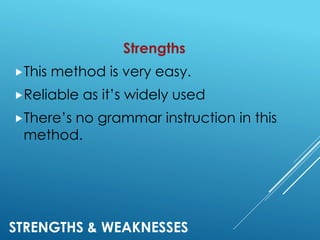
STRENGTHS & WEAKNESSES
Strengths
This method is very easy.
Reliable as it’s widely used
There’s no grammar instruction in this
method.
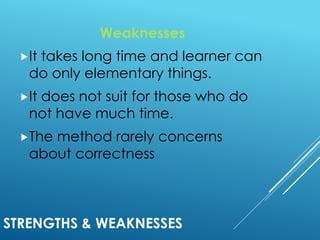
STRENGTHS & WEAKNESSES
Weaknesses
It takes long time and learner can
do only elementary things.
It does not suit for those who do
not have much time.
The method rarely concerns
about correctness
Don’t forget to
watch the
video!

The natural approach

  • 1.
    Preparedby: Redouane Ouaaziz Soad Elbassite Module:Teaching methods and approaches Trainer: Ahmed Atlagh
  • 2.
    NATURAL APPROACH Briefly intoduced Overview Aims Theoriesof language Principles Roles of Teacher & Learner Materials/ activities Techniques Advs/ Disadvs Video
  • 3.
    DEFINITION Is a languageteaching approach which claims that language learning is a reproduction of the way humans naturally acquire their native language.
  • 4.
    OVERVIEW  It wasdeveloped and published as a book by Mr. Stephen Krashen and Tracy Terrell in 1983.  In the book, Mr. Krashen and Mrs. Terrell consider their approach as a traditional method.
  • 5.
    OVERVIEW Natural Approach believes thatadults can still acquire second languages. The ability of language acquisition does not disappear as we grow up. Adults also acquire language by following the principles of Universal Grammar.
  • 6.
    OVERVIEW The difference betweenadult and children acquisition skill is that adults have two things to follow when they learn foreign language: Acquisition and learning. But, children only acquire the languages.
  • 7.
    AIMS To help adultsin learning the foreign language naturally. The learner will be able to pick up the grammar by themselves when they are ready.
  • 8.
    THEORIES The Acquisition-Learning hypothesis Thelearner has two ways of learning the second language, which are the acquired system and the learned system.
  • 9.
    THEORIES The monitor hypothesis Whenthe learner can check and correct language output.
  • 10.
    THEORIES The Natural Order hypothesis When people acquire language by using grammatical structures in a predictable order.
  • 11.
    THEORIES The input hypothesis People aquire language best when they are given input slightly beyond their current level i+1.
  • 12.
    The Affective Filterhypothesis Three states are to be identified: Motivation: learners with high motivation generally do better. Self-confidence: learners with self- confidence and a good self-image tend to be more successful. Anxiety: Low personal anxiety and low classroom anxiety are more conducive to second language acquisition. THEORIES
  • 13.
    PRINCIPLES "Focus of instructionis on communication rather than its form.“ "Speech production comes slowly and is never forced.“ "Early speech goes through natural stages (yes or no response, one- word answers, lists of words, short phrases, complete sentences.)"
  • 14.
    TEACHER´S ROLE Act asan authority in the class Imitate the first language learning process Creatively instruct students to do activities that benefit the language learning.
  • 15.
    LEARNER´S ROLE  Pre-productionstage: learners participate in the language activity without having to respond.  Early-production stage: learners answer questions, with single words and short phrases.  Speech-emergent stage: learners involve themselves in role plays, games and other activities.
  • 16.
    NSTRUCTIONAL MATERIALS Make classroomactivities as meaningful as possible and promote comprehension, and The primary aim of materials is to promote comprehension and communication. Pictures and other visual aids are essential, because they supply the content for communication Materials come from the world of realia rather than from textbooks.
  • 17.
    ACTIVITIES For beginners: Pointing, handingobjects, writing or drawing , standing, walking, sitting down For advanced learners: Like listening and reading tasks that learners order pictures, follow written instruction or maps.
  • 18.
    TECHNIQUES  pictures, objects Mime/ commands  Body language  Audio-visual aids  Memorizing games
  • 19.
    STRENGTHS & WEAKNESSES Strengths Thismethod is very easy. Reliable as it’s widely used There’s no grammar instruction in this method.
  • 20.
    STRENGTHS & WEAKNESSES Weaknesses Ittakes long time and learner can do only elementary things. It does not suit for those who do not have much time. The method rarely concerns about correctness
  • 22.