WHAT ISA “COURSE DESIGN”?
It is the process by which the raw data about a learning need are
interpreted to produce an integrated series of teaching-learning
experiences.
Who decides on the courses offered at primary and secondary schools?
Ministry of Education
Civil Organizations
Other Educational Institutions
OBJECTIVE:
To provide the students with the skills, knowledge and attitudes to achieve the
graduate outcomes stated in the educational policy.
Designing an EnglishCourse
Designing an English Course
A complex Process
Assumptions made about the nature of
language learning
General Aims of Education
5.
The following questionsshould be
The following questions should be
taken into consideration:
taken into consideration:
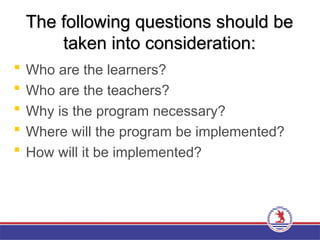
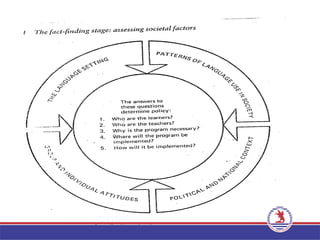
Who are the learners?
Who are the teachers?
Why is the program necessary?
Where will the program be implemented?
How will it be implemented?
7.
The Language Setting
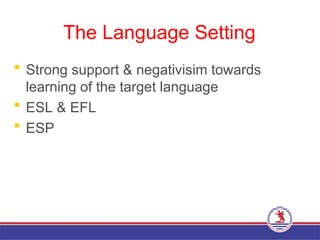
Strong support & negativisim towards
learning of the target language
ESL & EFL
ESP
8.
Patterns of languageuse in society
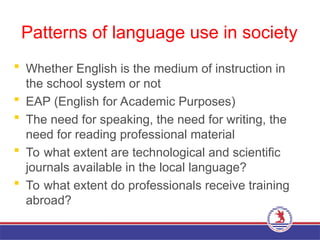
Whether English is the medium of instruction in
the school system or not
EAP (English for Academic Purposes)
The need for speaking, the need for writing, the
need for reading professional material
To what extent are technological and scientific
journals available in the local language?
To what extent do professionals receive training
abroad?
9.
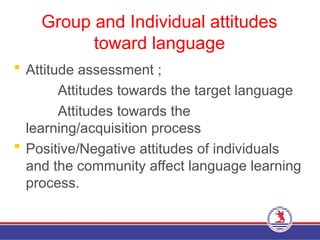
Group and Individualattitudes
toward language
Attitude assessment ;
Attitudes towards the target language
Attitudes towards the
learning/acquisition process
Positive/Negative attitudes of individuals
and the community affect language learning
process.
10.
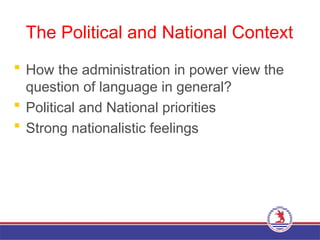
The Political andNational Context
How the administration in power view the
question of language in general?
Political and National priorities
Strong nationalistic feelings
11.
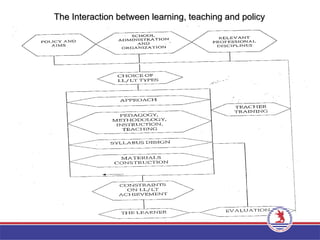
The Interaction betweenlearning, teaching and policy
The Interaction between learning, teaching and policy
12.
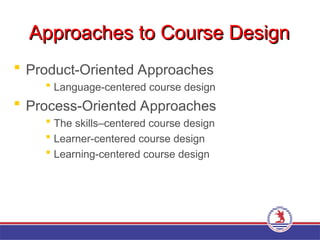
Approaches to CourseDesign
Approaches to Course Design
Product-Oriented Approaches
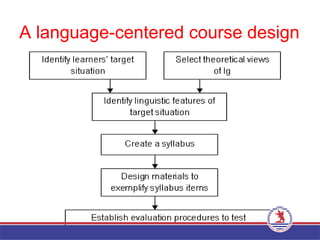
Language-centered course design
Process-Oriented Approaches
The skills–centered course design
Learner-centered course design
Learning-centered course design
13.
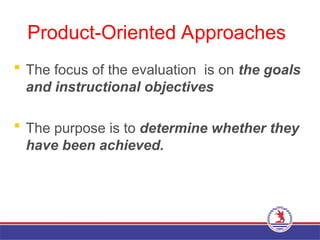
Product-Oriented Approaches
Thefocus of the evaluation is on the goals
and instructional objectives
The purpose is to determine whether they
have been achieved.
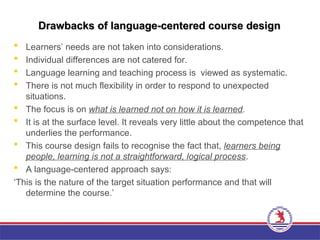
Drawbacks of language-centeredcourse design
Drawbacks of language-centered course design
Learners’ needs are not taken into considerations.
Individual differences are not catered for.
Language learning and teaching process is viewed as systematic.
There is not much flexibility in order to respond to unexpected
situations.
The focus is on what is learned not on how it is learned.
It is at the surface level. It reveals very little about the competence that
underlies the performance.
This course design fails to recognise the fact that, learners being
people, learning is not a straightforward, logical process.
A language-centered approach says:
‘This is the nature of the target situation performance and that will
determine the course.’
16.
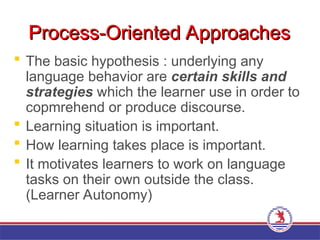
Process-Oriented Approaches
Process-Oriented Approaches
The basic hypothesis : underlying any
language behavior are certain skills and
strategies which the learner use in order to
copmrehend or produce discourse.
Learning situation is important.
How learning takes place is important.
It motivates learners to work on language
tasks on their own outside the class.
(Learner Autonomy)
17.
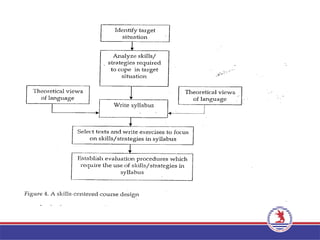
The skills-centered coursedesign
The skills-centered course design
The focus is on
The focus is on skills and strategies
skills and strategies the students need to
the students need to
cope in the
cope in the target situation.
Its aim is not to provide a specified corpus of linguistic
knowledge but to make the learners into better processors
of information.
This model takes the learner more into account:
– it reviews language in terms of how the mind of the
learner processes it rather than as an entity in itself
– it tries to build on the positive factors that the learners
bring to the course (previous knowledge), rather than
just on the negative idea of ‘lacks’.
Better than the language-centered model.
18.
Drawbacks
Drawbacks
It islinear and it predicts what the learner
may need in target situation.
There is not enough flexibility to cope with
unexpected situations.
Individual differences are not catered for.
20.
Learner-centered course design
Learner-centeredcourse design
The learner is active and fully involved in the preparation
and implementation of the syllabus.
The learner designs the course her/himself together with
the teacher.
The learner is highly motivated.
Drawbacks
Practically, it does not seem possible.
The teacher has to prepare everything in short
notice.
The learner can not take responsibility due to
the lack of enough experience and knowledge.
21.
Learning-centered course design
Learning-centeredcourse design
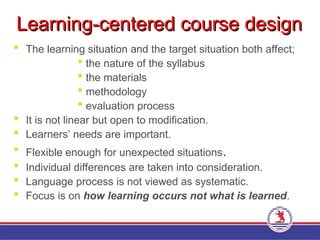
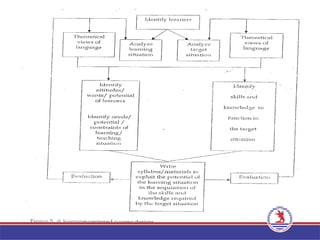
The learning situation and the target situation both affect;
the nature of the syllabus
the materials
methodology
evaluation process
It is not linear but open to modification.
Learners’ needs are important.
Flexible enough for unexpected situations.
Individual differences are taken into consideration.
Language process is not viewed as systematic.
Focus is on how learning occurs not what is learned.
23.
This
This model
model has2
has 2 implications
implications:
:
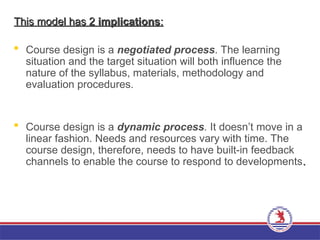
Course design is a negotiated process. The learning
situation and the target situation will both influence the
nature of the syllabus, materials, methodology and
evaluation procedures.
Course design is a dynamic process. It doesn’t move in a
linear fashion. Needs and resources vary with time. The
course design, therefore, needs to have built-in feedback
channels to enable the course to respond to developments.
.
24.
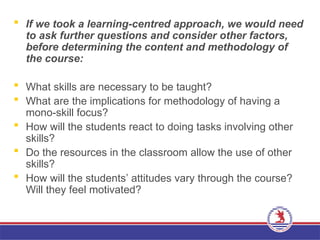
If wetook a learning-centred approach, we would need
to ask further questions and consider other factors,
before determining the content and methodology of
the course:
What skills are necessary to be taught?
What are the implications for methodology of having a
mono-skill focus?
How will the students react to doing tasks involving other
skills?
Do the resources in the classroom allow the use of other
skills?
How will the students’ attitudes vary through the course?
Will they feel motivated?
25.
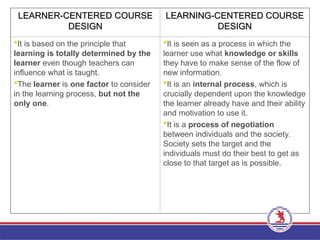
LEARNER-CENTERED
LEARNER-CENTERED COURSE
COURSE
DESIGN
DESIGN
LEARNING-CENTERED
LEARNING-CENTERED COURSE
COURSE
DESIGN
DESIGN
Itis based on the principle that
learning is totally determined by the
learner even though teachers can
influence what is taught.
The learner is one factor to consider
in the learning process, but not the
only one.
It is seen as a process in which the
learner use what knowledge or skills
they have to make sense of the flow of
new information.
It is an internal process, which is
crucially dependent upon the knowledge
the learner already have and their ability
and motivation to use it.
It is a process of negotiation
between individuals and the society.
Society sets the target and the
individuals must do their best to get as
close to that target as is possible.
26.
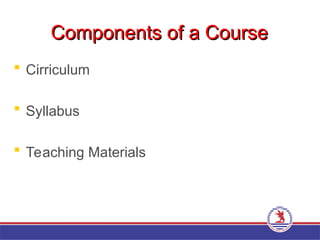
Components of aCourse
Components of a Course
Cirriculum
Syllabus
Teaching Materials
27.
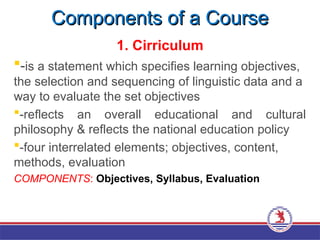
Components of aCourse
Components of a Course
1. Cirriculum
-is a statement which specifies learning objectives,
the selection and sequencing of linguistic data and a
way to evaluate the set objectives
-reflects an overall educational and cultural
philosophy & reflects the national education policy
-four interrelated elements; objectives, content,
methods, evaluation
COMPONENTS: Objectives, Syllabus, Evaluation
28.
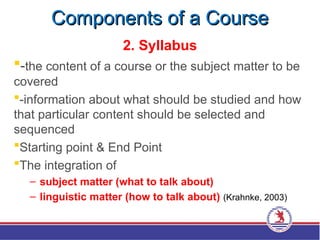
Components of aCourse
Components of a Course
2. Syllabus
-the content of a course or the subject matter to be
covered
-information about what should be studied and how
that particular content should be selected and
sequenced
Starting point & End Point
The integration of
– subject matter (what to talk about)
– linguistic matter (how to talk about) (Krahnke, 2003)
29.
Components of aCourse
Components of a Course
3. Teaching Materials
3. Teaching Materials
Course materials
Supplementary materials
– Teacher’s book, workbook, audio cds, video
cds, etc.
Additional materials
– Posters, flipcharts, flash cards, puppet theatres,
sample exam sheets, etc.
30.
Materials
Books(Printed materials)
Visuals
Audio
Authentic Materials
Why do teachers prefer using published course books?
– written by experienced and well-qualified teachers.
– carefully tested in pilot studies
– guarantee a degree of consistency
– continuity between grade levels
– best use of time in the classroom
– bring the real world into artificial classroom situation
– a general picture for students
– a solid resource for students
31.
Some disadvantagesof published course
Some disadvantages of published course
books
books
written for mass sales.
target an average group of learners.
rarely meet all the expectations of the school and the
teacher.
rarely answer all the needs of a particular group of
learners or address their interests.
32.
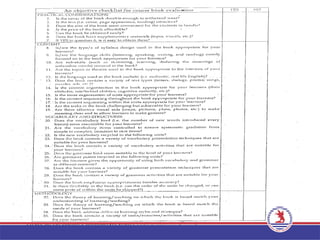
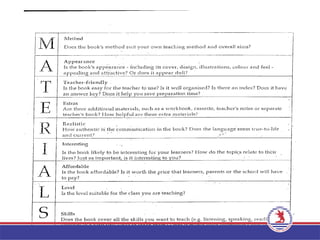
Course Book EvaluationProcess
Course Book Evaluation Process
– Initial Evaluation (scanning its preface, contents
and abstract)
– Detailed Evaluation (evaluation forms)
– In-use Evaluation (actual classroom situation)
35.
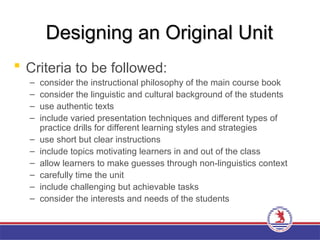
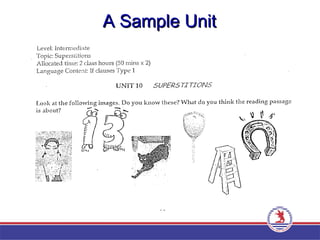
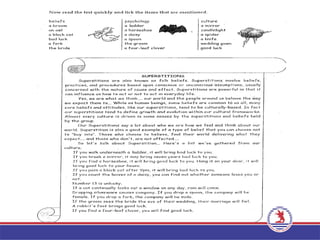
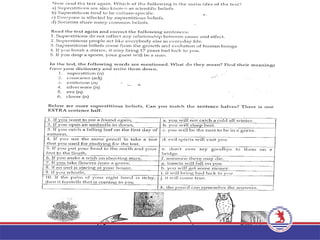
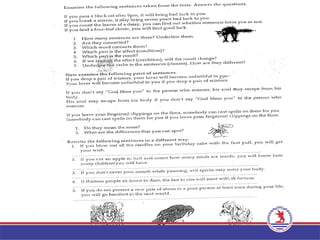
Designing an OriginalUnit
Designing an Original Unit
Criteria to be followed:
– consider the instructional philosophy of the main course book
– consider the linguistic and cultural background of the students
– use authentic texts
– include varied presentation techniques and different types of
practice drills for different learning styles and strategies
– use short but clear instructions
– include topics motivating learners in and out of the class
– allow learners to make guesses through non-linguistics context
– carefully time the unit
– include challenging but achievable tasks
– consider the interests and needs of the students
36.
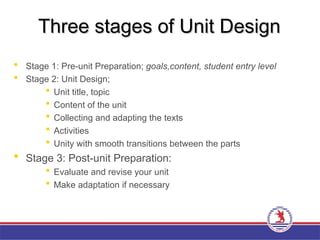
Three stages ofUnit Design
Three stages of Unit Design
Stage 1: Pre-unit Preparation; goals,content, student entry level
Stage 2: Unit Design;
Unit title, topic
Content of the unit
Collecting and adapting the texts
Activities
Unity with smooth transitions between the parts
Stage 3: Post-unit Preparation:
Evaluate and revise your unit
Make adaptation if necessary
REFERENCES
REFERENCES
Brown, J.D. (1995).TheElements of Language Curriculum, Boston: Thomson Publishing
Dubin, F. & Olshtain, E. (1986). Course Design: Developing Programs and materials for
language learning. USA: Cambridge University Press
Tanner, R & Green,C (1998). Tasks for teacher education. Longman.