1. go, going, went, gone
2. put up with, kick the bucket, dog in the
manger
• Lexeme:
A lexeme is an abstract unit that roughly corresponds
to a set of words that are different forms of "the same
word".
For example, the English word forms run, runs, ran and
running are forms of the same lexeme.
‘Police officer’ and ‘cop’
have different connotations, but similar
denotations
Other examples:
brat and child
toilet and rest room
country town and regional centre
underprivileged area and slum
mutt and dog
doctor and quack
Connotation
• Emotional and imaginative
association surrounding a word; the
meaning given to a word through its
use in a society or culture
Sense Relations
the sense of desk is more closely related to
that of table than to chair.
the sense of desk is more different from that
of chair than from table.
the sense of desk is included in the sense of
furniture, or the sense of furniture includes
that of desk.
1. Sameness Relation
2. Oppositeness Relation
3. Inclusiveness Relation
Sameness Relation
1. Synonymy
• Synonymy refers to the sameness or close similarity
of meaning.
• Words that are close in meaning are called
synonyms.
• English borrowed a lot of words from other
languages. That’s why we find in English pairs of
words bearing the same meaning.
buy and purchase, world and universe, brotherly and
fraternal.
Style:
Little Tom__________ a toy bear.
The word ‘buy’ is more appropriate
than the word ‘purchase’
Stylistic Synonyms
Words having the same meaning
may differ in style, or degree of
formality .
Old man, daddy, dad, father, male
parent
Connotations:
"I'm thrifty. You are economical.
And he is stingy".
Collaborator and accomplice
Words that bear the same
meaning but express different
emotions
to like – to admire – to love – to
adore – to worship
Dialectal differences
"Autumn" is British while "fall" is
American.
The British live in “flats" and take the
"tube".
Dialectal synonyms – synonyms
used in different regional dialects.
Lift elevator
luggage baggage
petrol gasoline
Collocational synonyms
• Some synonyms differ in their collocation, i.e.
in the words they go together with.
• Accuse, charge, rebuke are followed by
different prepositions:
• accuse of, charge with, rebuke for
Semantically different synonyms
• These are synonyms that differ slightly in what they
mean.
• Compare:
• amaze – suggests confusion and bewilderment
• astound suggest difficulty in believing
Polysemy
• Polysemy happens when one and the same word may
have more than one meaning.
• Historically speaking, polysemy can be understood as
the growth and development of or change in the
meaning of words.
draw 1. ‘cause to move in a certain direction’,
2. ‘produce a picture
POLYSEMY
• Polysemy – is the ability of a word to possess
several meanings or lexico-semantic variants
(LSV), e.g. bright means “shining” and
“intelligent”.
• Monosemantic word - a word having only
one meaning;
• Polysemantic word - a word having several
meanings
The word table has 7 meanings:
• 1) a piece of furniture
• 2) all the people seated at a table
• 3) the food that is put on the table
• 4) a thin flat piece of stone, metal, wood, etc.
• 5) orderly arrangements of facts, figures, etc.
• 6) part of a machine tool on which the work is put to
be operated on
• 7) a level area, a plateau
Homonymy
• Homonymy refers to the phenomenon
that words having different meanings
have the same form, i.e. different words
are identical in sound or spelling, or in
both.
Types of Homonymy
• Homophones – when two words are
identical in sound.
• rain/reign night/knight
piece/peace
Homographs – when two words
are identical in spelling.
bow v./bow n.
tear v./tear. n.
lead v./lead n.
Complete homonyms – when two words are identical in
both sound and spelling.
fast adj./fast v.
scale n./scale v.
Antonymy
Antonymy is the name for
oppositeness relation.
Words that are opposite in meaning
are antonyms
There are three main sub-types:
gradable antonymy,
complementary antonymy, and
converse antonymy.
Gradable Antonymy
good: bad, long: short, big: small
It has three characteristics
1. They are gradable. That is, the members of a
pair differ in terms of degree.
The denial of one is not necessarily the assertion
of the other.
Something which is not "good" is not
necessarily "bad” it may be "average”
They can be modified by "very"
The intermediate degrees may be
lexicalized.
The size which is neither big nor
small is medium
between hot and cold, there are
warm and cool
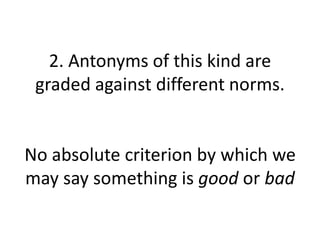
2. Antonyms of this kind are
graded against different norms.
No absolute criterion by which we
may say something is good or bad
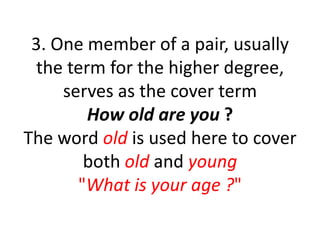
3. One member of a pair, usually
the term for the higher degree,
serves as the cover term
How old are you ?
The word old is used here to cover
both old and young
"What is your age ?"
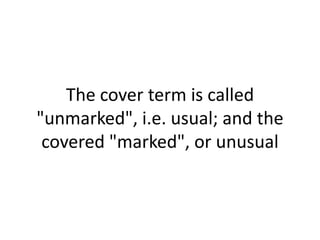
The cover term is called
"unmarked", i.e. usual; and the
covered "marked", or unusual
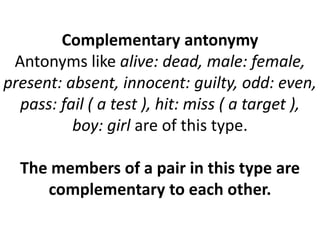
Complementary antonymy
Antonyms like alive: dead, male: female,
present: absent, innocent: guilty, odd: even,
pass: fail ( a test ), hit: miss ( a target ),
boy: girl are of this type.
The members of a pair in this type are
complementary to each other.
The assertion of one means the denial
of the other, the denial of one also
means the assertion of the other.
Not only He is alive means "He is not
dead", He is not alive also means "He
is dead".
Adjectives in this type cannot be
modified by "very".
One cannot say somebody is very alive
or very dead.
(3) Converse antonymy
Pairs of words like buy: sell, lend:
borrow, give: receive, parent: child,
husband: wife, host: guest, employer:
employee, teacher :student, above :
below, before : after
belong to this type of antonymy
This is a special type of antonymy in
that the members of a pair do not
constitute a positive-negative
opposition. They show the reversal of a
relationship between two entities
X buys something from Y means the
same as Y sells something to X
Sense relations

Sense relations

  • 1.
    1. go, going,went, gone 2. put up with, kick the bucket, dog in the manger
  • 2.
    • Lexeme: A lexemeis an abstract unit that roughly corresponds to a set of words that are different forms of "the same word". For example, the English word forms run, runs, ran and running are forms of the same lexeme.
  • 3.
    ‘Police officer’ and‘cop’ have different connotations, but similar denotations Other examples: brat and child toilet and rest room country town and regional centre underprivileged area and slum mutt and dog doctor and quack
  • 4.
    Connotation • Emotional andimaginative association surrounding a word; the meaning given to a word through its use in a society or culture
  • 5.
    Sense Relations the senseof desk is more closely related to that of table than to chair. the sense of desk is more different from that of chair than from table. the sense of desk is included in the sense of furniture, or the sense of furniture includes that of desk.
  • 6.
    1. Sameness Relation 2.Oppositeness Relation 3. Inclusiveness Relation
  • 7.
    Sameness Relation 1. Synonymy •Synonymy refers to the sameness or close similarity of meaning. • Words that are close in meaning are called synonyms. • English borrowed a lot of words from other languages. That’s why we find in English pairs of words bearing the same meaning. buy and purchase, world and universe, brotherly and fraternal.
  • 8.
    Style: Little Tom__________ atoy bear. The word ‘buy’ is more appropriate than the word ‘purchase’
  • 9.
    Stylistic Synonyms Words havingthe same meaning may differ in style, or degree of formality . Old man, daddy, dad, father, male parent
  • 10.
    Connotations: "I'm thrifty. Youare economical. And he is stingy". Collaborator and accomplice
  • 11.
    Words that bearthe same meaning but express different emotions to like – to admire – to love – to adore – to worship
  • 12.
    Dialectal differences "Autumn" isBritish while "fall" is American. The British live in “flats" and take the "tube".
  • 13.
    Dialectal synonyms –synonyms used in different regional dialects. Lift elevator luggage baggage petrol gasoline
  • 14.
    Collocational synonyms • Somesynonyms differ in their collocation, i.e. in the words they go together with. • Accuse, charge, rebuke are followed by different prepositions: • accuse of, charge with, rebuke for
  • 15.
    Semantically different synonyms •These are synonyms that differ slightly in what they mean. • Compare: • amaze – suggests confusion and bewilderment • astound suggest difficulty in believing
  • 16.
    Polysemy • Polysemy happenswhen one and the same word may have more than one meaning. • Historically speaking, polysemy can be understood as the growth and development of or change in the meaning of words. draw 1. ‘cause to move in a certain direction’, 2. ‘produce a picture
  • 17.
    POLYSEMY • Polysemy –is the ability of a word to possess several meanings or lexico-semantic variants (LSV), e.g. bright means “shining” and “intelligent”. • Monosemantic word - a word having only one meaning; • Polysemantic word - a word having several meanings
  • 18.
    The word tablehas 7 meanings: • 1) a piece of furniture • 2) all the people seated at a table • 3) the food that is put on the table • 4) a thin flat piece of stone, metal, wood, etc. • 5) orderly arrangements of facts, figures, etc. • 6) part of a machine tool on which the work is put to be operated on • 7) a level area, a plateau
  • 19.
    Homonymy • Homonymy refersto the phenomenon that words having different meanings have the same form, i.e. different words are identical in sound or spelling, or in both.
  • 20.
    Types of Homonymy •Homophones – when two words are identical in sound. • rain/reign night/knight piece/peace
  • 21.
    Homographs – whentwo words are identical in spelling. bow v./bow n. tear v./tear. n. lead v./lead n.
  • 22.
    Complete homonyms –when two words are identical in both sound and spelling. fast adj./fast v. scale n./scale v.
  • 23.
    Antonymy Antonymy is thename for oppositeness relation. Words that are opposite in meaning are antonyms
  • 24.
    There are threemain sub-types: gradable antonymy, complementary antonymy, and converse antonymy.
  • 25.
    Gradable Antonymy good: bad,long: short, big: small It has three characteristics
  • 26.
    1. They aregradable. That is, the members of a pair differ in terms of degree. The denial of one is not necessarily the assertion of the other. Something which is not "good" is not necessarily "bad” it may be "average” They can be modified by "very"
  • 27.
    The intermediate degreesmay be lexicalized. The size which is neither big nor small is medium between hot and cold, there are warm and cool
  • 28.
    2. Antonyms ofthis kind are graded against different norms. No absolute criterion by which we may say something is good or bad
  • 29.
    3. One memberof a pair, usually the term for the higher degree, serves as the cover term How old are you ? The word old is used here to cover both old and young "What is your age ?"
  • 30.
    The cover termis called "unmarked", i.e. usual; and the covered "marked", or unusual
  • 31.
    Complementary antonymy Antonyms likealive: dead, male: female, present: absent, innocent: guilty, odd: even, pass: fail ( a test ), hit: miss ( a target ), boy: girl are of this type. The members of a pair in this type are complementary to each other.
  • 32.
    The assertion ofone means the denial of the other, the denial of one also means the assertion of the other. Not only He is alive means "He is not dead", He is not alive also means "He is dead".
  • 33.
    Adjectives in thistype cannot be modified by "very". One cannot say somebody is very alive or very dead.
  • 34.
    (3) Converse antonymy Pairsof words like buy: sell, lend: borrow, give: receive, parent: child, husband: wife, host: guest, employer: employee, teacher :student, above : below, before : after belong to this type of antonymy
  • 35.
    This is aspecial type of antonymy in that the members of a pair do not constitute a positive-negative opposition. They show the reversal of a relationship between two entities X buys something from Y means the same as Y sells something to X