CHAPTER 6: MODALITY
(Interpersonal meaning)
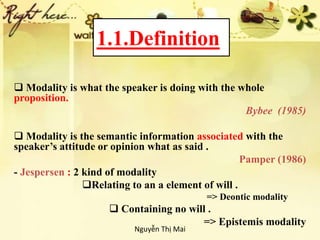
1.1.Definition
 Modality is what the speaker is doing with the whole
proposition.
Bybee (1985)
 Modality is the semantic information associated with the
speaker’s attitude or opinion what as said .
Pamper (1986)
- Jespersen : 2 kind of modality
Relating to an a element of will .
=> Deontic modality
 Containing no will .
=> Epistemis modality
Nguyễn Thị Mai
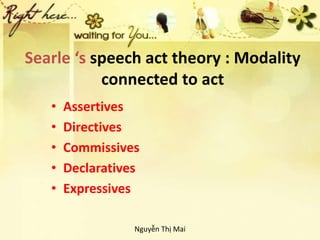
Searle ‘s speech act theory : Modality
connected to act
• Assertives
• Directives
• Commissives
• Declaratives
• Expressives
Nguyễn Thị Mai
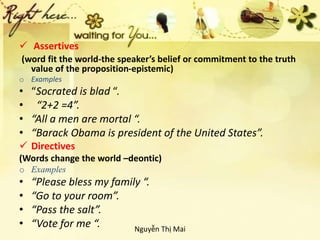
 Assertives
(word fit the world-the speaker’s belief or commitment to the truth
value of the proposition-epistemic)
o Examples
• “Socrated is blad “.
• “2+2 =4”.
• “All a men are mortal “.
• “Barack Obama is president of the United States”.
 Directives
(Words change the world –deontic)
o Examples
• “Please bless my family “.
• “Go to your room”.
• “Pass the salt”.
• “Vote for me “. Nguyễn Thị Mai
Commissives
(word change the world-hearer- oriented- denontic )
Examples
“ I promise to exercise everyday “.
“I solemnly swear to truth “.
“I will be there at 9 o’clock “.
 Declaratives
(Words change the world –epistemic)
o Examples
“I now pronounce you husband and wife”.
“I promise to come and see you”.
Nguyễn Thị Mai
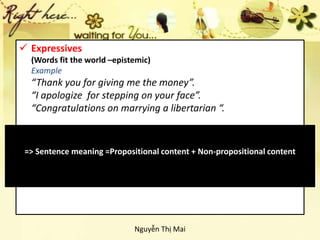
 Expressives
(Words fit the world –epistemic)
Example
“Thank you for giving me the money”.
“I apologize for stepping on your face”.
“Congratulations on marrying a libertarian “.
=> Sentence meaning =Propositional content + Non-propositional content
Nguyễn Thị Mai
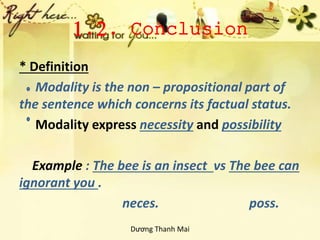
1.2. Conclusion
* Definition
Modality is the non – propositional part of
the sentence which concerns its factual status.
Modality express necessity and possibility
Example : The bee is an insect vs The bee can
ignorant you .
neces. poss.
Dương Thanh Mai
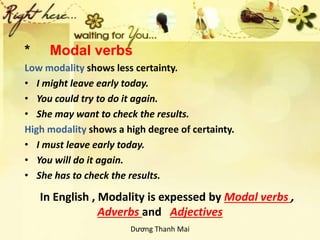
In English , Modality is expessed by Modal verbs ,
Adverbs and Adjectives
* Modal verbs
Low modality shows less certainty.
• I might leave early today.
• You could try to do it again.
• She may want to check the results.
High modality shows a high degree of certainty.
• I must leave early today.
• You will do it again.
• She has to check the results.
Dương Thanh Mai
* Adverbs ( perhaps , possibly , possible , sometimes ,
certainly , definitely , …..)
• Example
I could possibly go , perhaps I will go .
Another example
She certainly didn’t feel any different .
* Adjectives ( possible , probable , obligatory ,
necessary , required, determined , likely , …. )
Example
It is the most likely event to occur .
Dương Thanh Mai
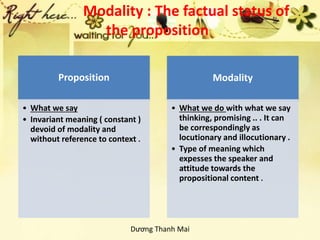
Modality : The factual status of
the proposition
Proposition
• What we say
• Invariant meaning ( constant )
devoid of modality and
without reference to context .
Modality
• What we do with what we say
thinking, promising .. . It can
be correspondingly as
locutionary and illocutionary .
• Type of meaning which
expesses the speaker and
attitude towards the
propositional content .
Dương Thanh Mai
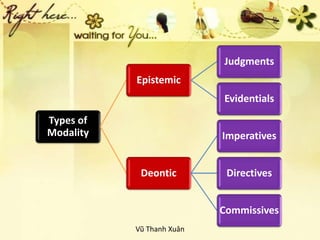
Types of
Modality
Epistemic
Judgments
Evidentials
Deontic
Imperatives
Directives
Commissives
Vũ Thanh Xuân
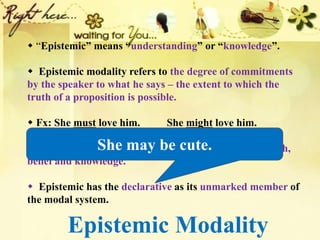
Epistemic Modality
 “Epistemic” means “understanding” or “knowledge”.
 Epistemic modality refers to the degree of commitments
by the speaker to what he says – the extent to which the
truth of a proposition is possible.
 Fx: She must love him. ____ She might love him.
 Epistemic is possibility-based and concerned with truth,
belief and knowledge.
 Epistemic has the declarative as its unmarked member of
the modal system.
She may be cute.
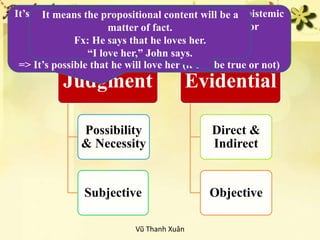
Judgment
Possibility
& Necessity
Subjective
Evidential
Direct &
Indirect
Objective
Vũ Thanh Xuân
It’s about the speaker’s qualification of his or her epistemic
commitment. It concerns his beliefs, attitudes or
knowledge.
Fx: I think he will love her.
=> It’s possible that he will love her (it can be true or not)
It means the propositional content will be a
matter of fact.
Fx: He says that he loves her.
“I love her,” John says.
Deontic Modality
 Deontic contains an element of will, concerning with
actions rather than with belief, knowledge and truth.
 Deontic is necessity-based/ obligation- based.
 Fx: You need to leave now => You will leave. (You are
obligated to leave now)
It is necessary that you come in time. => You will
come in time (It’s necessary for you to come in time)
 Expression: Verbs & Adjectives
• Come in!
Imperatives
• You must do exercises everyday.
Directives
• I promise that I will help you.
Commissives (Declaratives)
speech acts are to cause the hearer to
take a particular action, e.g. requests,
commands and advices
speech acts that commit a
speaker to some future actions,
e.g. promises and swears
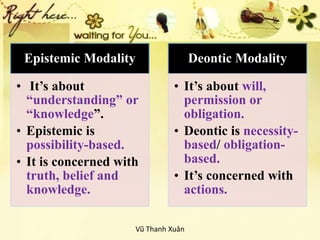
Epistemic Modality
• It’s about
“understanding” or
“knowledge”.
• Epistemic is
possibility-based.
• It is concerned with
truth, belief and
knowledge.
Deontic Modality
• It’s about will,
permission or
obligation.
• Deontic is necessity-
based/ obligation-
based.
• It’s concerned with
actions.
Vũ Thanh Xuân
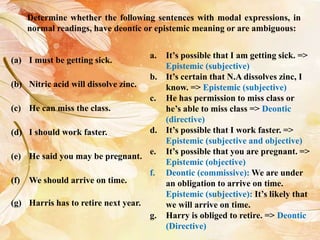
(a) I must be getting sick.
(b) Nitric acid will dissolve zinc.
(c) He can miss the class.
(d) I should work faster.
(e) He said you may be pregnant.
(f) We should arrive on time.
(g) Harris has to retire next year.
Determine whether the following sentences with modal expressions, in
normal readings, have deontic or epistemic meaning or are ambiguous:
a. It’s possible that I am getting sick. =>
Epistemic (subjective)
b. It’s certain that N.A dissolves zinc, I
know. => Epistemic (subjective)
c. He has permission to miss class or
he’s able to miss class => Deontic
(directive)
d. It’s possible that I work faster. =>
Epistemic (subjective and objective)
e. It’s possible that you are pregnant. =>
Epistemic (objective)
f. Deontic (commissive): We are under
an obligation to arrive on time.
Epistemic (subjective): It’s likely that
we will arrive on time.
g. Harry is obliged to retire. => Deontic
(Directive)
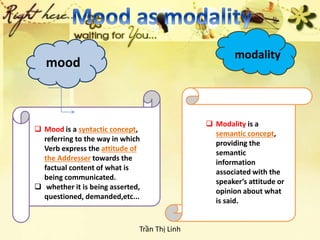
mood
modality
 Mood is a syntactic concept,
referring to the way in which
Verb express the attitude of
the Addresser towards the
factual content of what is
being communicated.
 whether it is being asserted,
questioned, demanded,etc...
 Modality is a
semantic concept,
providing the
semantic
information
associated with the
speaker’s attitude or
opinion about what
is said.
Trần Thị Linh
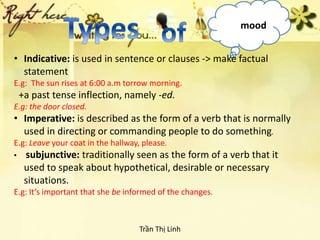
mood
• Indicative: is used in sentence or clauses -> make factual
statement
E.g: The sun rises at 6:00 a.m torrow morning.
+a past tense inflection, namely -ed.
E.g: the door closed.
• Imperative: is described as the form of a verb that is normally
used in directing or commanding people to do something.
E.g: Leave your coat in the hallway, please.
• subjunctive: traditionally seen as the form of a verb that it
used to speak about hypothetical, desirable or necessary
situations.
E.g: It’s important that she be informed of the changes.
Trần Thị Linh
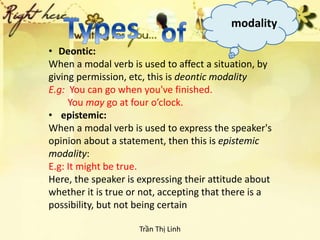
modality
• Deontic:
When a modal verb is used to affect a situation, by
giving permission, etc, this is deontic modality
E.g: You can go when you've finished.
You may go at four o’clock.
• epistemic:
When a modal verb is used to express the speaker's
opinion about a statement, then this is epistemic
modality:
E.g: It might be true.
Here, the speaker is expressing their attitude about
whether it is true or not, accepting that there is a
possibility, but not being certain
Trần Thị Linh
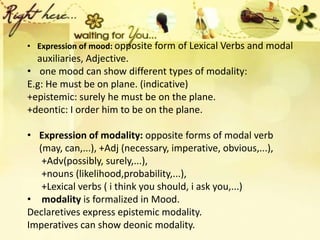
• Expression of mood: opposite form of Lexical Verbs and modal
auxiliaries, Adjective.
• one mood can show different types of modality:
E.g: He must be on plane. (indicative)
+epistemic: surely he must be on the plane.
+deontic: I order him to be on the plane.
• Expression of modality: opposite forms of modal verb
(may, can,...), +Adj (necessary, imperative, obvious,...),
+Adv(possibly, surely,...),
+nouns (likelihood,probability,...),
+Lexical verbs ( i think you should, i ask you,...)
• modality is formalized in Mood.
Declaretives express epistemic modality.
Imperatives can show deonic modality.
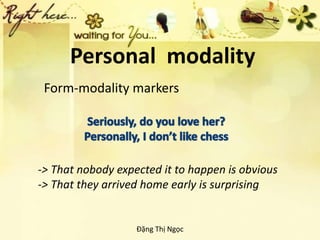
Personal modality
Form-modality markers
-> That nobody expected it to happen is obvious
-> That they arrived home early is surprising
Đặng Thị Ngọc
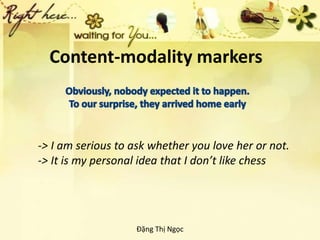
Content-modality markers
-> I am serious to ask whether you love her or not.
-> It is my personal idea that I don’t like chess
Đặng Thị Ngọc
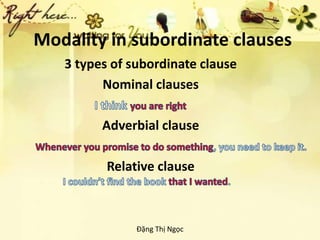
Modality in subordinate clauses
3 types of subordinate clause
Nominal clauses
Adverbial clause
Relative clause
Đặng Thị Ngọc
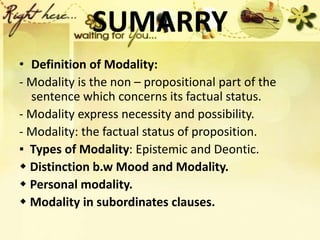
SUMARRY
• Definition of Modality:
- Modality is the non – propositional part of the
sentence which concerns its factual status.
- Modality express necessity and possibility.
- Modality: the factual status of proposition.
▪ Types of Modality: Epistemic and Deontic.
 Distinction b.w Mood and Modality.
 Personal modality.
 Modality in subordinates clauses.
THANK YOU
FOR
ENJOYING!

Modality

  • 1.
  • 2.
    1.1.Definition  Modality iswhat the speaker is doing with the whole proposition. Bybee (1985)  Modality is the semantic information associated with the speaker’s attitude or opinion what as said . Pamper (1986) - Jespersen : 2 kind of modality Relating to an a element of will . => Deontic modality  Containing no will . => Epistemis modality Nguyễn Thị Mai
  • 3.
    Searle ‘s speechact theory : Modality connected to act • Assertives • Directives • Commissives • Declaratives • Expressives Nguyễn Thị Mai
  • 4.
     Assertives (word fitthe world-the speaker’s belief or commitment to the truth value of the proposition-epistemic) o Examples • “Socrated is blad “. • “2+2 =4”. • “All a men are mortal “. • “Barack Obama is president of the United States”.  Directives (Words change the world –deontic) o Examples • “Please bless my family “. • “Go to your room”. • “Pass the salt”. • “Vote for me “. Nguyễn Thị Mai
  • 5.
    Commissives (word change theworld-hearer- oriented- denontic ) Examples “ I promise to exercise everyday “. “I solemnly swear to truth “. “I will be there at 9 o’clock “.  Declaratives (Words change the world –epistemic) o Examples “I now pronounce you husband and wife”. “I promise to come and see you”. Nguyễn Thị Mai
  • 6.
     Expressives (Words fitthe world –epistemic) Example “Thank you for giving me the money”. “I apologize for stepping on your face”. “Congratulations on marrying a libertarian “. => Sentence meaning =Propositional content + Non-propositional content Nguyễn Thị Mai
  • 7.
    1.2. Conclusion * Definition Modalityis the non – propositional part of the sentence which concerns its factual status. Modality express necessity and possibility Example : The bee is an insect vs The bee can ignorant you . neces. poss. Dương Thanh Mai
  • 8.
    In English ,Modality is expessed by Modal verbs , Adverbs and Adjectives * Modal verbs Low modality shows less certainty. • I might leave early today. • You could try to do it again. • She may want to check the results. High modality shows a high degree of certainty. • I must leave early today. • You will do it again. • She has to check the results. Dương Thanh Mai
  • 9.
    * Adverbs (perhaps , possibly , possible , sometimes , certainly , definitely , …..) • Example I could possibly go , perhaps I will go . Another example She certainly didn’t feel any different . * Adjectives ( possible , probable , obligatory , necessary , required, determined , likely , …. ) Example It is the most likely event to occur . Dương Thanh Mai
  • 10.
    Modality : Thefactual status of the proposition Proposition • What we say • Invariant meaning ( constant ) devoid of modality and without reference to context . Modality • What we do with what we say thinking, promising .. . It can be correspondingly as locutionary and illocutionary . • Type of meaning which expesses the speaker and attitude towards the propositional content . Dương Thanh Mai
  • 11.
  • 12.
    Epistemic Modality  “Epistemic”means “understanding” or “knowledge”.  Epistemic modality refers to the degree of commitments by the speaker to what he says – the extent to which the truth of a proposition is possible.  Fx: She must love him. ____ She might love him.  Epistemic is possibility-based and concerned with truth, belief and knowledge.  Epistemic has the declarative as its unmarked member of the modal system. She may be cute.
  • 13.
    Judgment Possibility & Necessity Subjective Evidential Direct & Indirect Objective VũThanh Xuân It’s about the speaker’s qualification of his or her epistemic commitment. It concerns his beliefs, attitudes or knowledge. Fx: I think he will love her. => It’s possible that he will love her (it can be true or not) It means the propositional content will be a matter of fact. Fx: He says that he loves her. “I love her,” John says.
  • 14.
    Deontic Modality  Deonticcontains an element of will, concerning with actions rather than with belief, knowledge and truth.  Deontic is necessity-based/ obligation- based.  Fx: You need to leave now => You will leave. (You are obligated to leave now) It is necessary that you come in time. => You will come in time (It’s necessary for you to come in time)  Expression: Verbs & Adjectives
  • 15.
    • Come in! Imperatives •You must do exercises everyday. Directives • I promise that I will help you. Commissives (Declaratives) speech acts are to cause the hearer to take a particular action, e.g. requests, commands and advices speech acts that commit a speaker to some future actions, e.g. promises and swears
  • 16.
    Epistemic Modality • It’sabout “understanding” or “knowledge”. • Epistemic is possibility-based. • It is concerned with truth, belief and knowledge. Deontic Modality • It’s about will, permission or obligation. • Deontic is necessity- based/ obligation- based. • It’s concerned with actions. Vũ Thanh Xuân
  • 17.
    (a) I mustbe getting sick. (b) Nitric acid will dissolve zinc. (c) He can miss the class. (d) I should work faster. (e) He said you may be pregnant. (f) We should arrive on time. (g) Harris has to retire next year. Determine whether the following sentences with modal expressions, in normal readings, have deontic or epistemic meaning or are ambiguous: a. It’s possible that I am getting sick. => Epistemic (subjective) b. It’s certain that N.A dissolves zinc, I know. => Epistemic (subjective) c. He has permission to miss class or he’s able to miss class => Deontic (directive) d. It’s possible that I work faster. => Epistemic (subjective and objective) e. It’s possible that you are pregnant. => Epistemic (objective) f. Deontic (commissive): We are under an obligation to arrive on time. Epistemic (subjective): It’s likely that we will arrive on time. g. Harry is obliged to retire. => Deontic (Directive)
  • 18.
    mood modality  Mood isa syntactic concept, referring to the way in which Verb express the attitude of the Addresser towards the factual content of what is being communicated.  whether it is being asserted, questioned, demanded,etc...  Modality is a semantic concept, providing the semantic information associated with the speaker’s attitude or opinion about what is said. Trần Thị Linh
  • 19.
    mood • Indicative: isused in sentence or clauses -> make factual statement E.g: The sun rises at 6:00 a.m torrow morning. +a past tense inflection, namely -ed. E.g: the door closed. • Imperative: is described as the form of a verb that is normally used in directing or commanding people to do something. E.g: Leave your coat in the hallway, please. • subjunctive: traditionally seen as the form of a verb that it used to speak about hypothetical, desirable or necessary situations. E.g: It’s important that she be informed of the changes. Trần Thị Linh
  • 20.
    modality • Deontic: When amodal verb is used to affect a situation, by giving permission, etc, this is deontic modality E.g: You can go when you've finished. You may go at four o’clock. • epistemic: When a modal verb is used to express the speaker's opinion about a statement, then this is epistemic modality: E.g: It might be true. Here, the speaker is expressing their attitude about whether it is true or not, accepting that there is a possibility, but not being certain Trần Thị Linh
  • 21.
    • Expression ofmood: opposite form of Lexical Verbs and modal auxiliaries, Adjective. • one mood can show different types of modality: E.g: He must be on plane. (indicative) +epistemic: surely he must be on the plane. +deontic: I order him to be on the plane. • Expression of modality: opposite forms of modal verb (may, can,...), +Adj (necessary, imperative, obvious,...), +Adv(possibly, surely,...), +nouns (likelihood,probability,...), +Lexical verbs ( i think you should, i ask you,...) • modality is formalized in Mood. Declaretives express epistemic modality. Imperatives can show deonic modality.
  • 22.
    Personal modality Form-modality markers ->That nobody expected it to happen is obvious -> That they arrived home early is surprising Đặng Thị Ngọc
  • 23.
    Content-modality markers -> Iam serious to ask whether you love her or not. -> It is my personal idea that I don’t like chess Đặng Thị Ngọc
  • 24.
    Modality in subordinateclauses 3 types of subordinate clause Nominal clauses Adverbial clause Relative clause Đặng Thị Ngọc
  • 25.
    SUMARRY • Definition ofModality: - Modality is the non – propositional part of the sentence which concerns its factual status. - Modality express necessity and possibility. - Modality: the factual status of proposition. ▪ Types of Modality: Epistemic and Deontic.  Distinction b.w Mood and Modality.  Personal modality.  Modality in subordinates clauses.
  • 26.