COURSE PLANNING
Nirmala Roberts
India
We shall learn…
❋ Meaning of Course Planning
❋ Purpose of Course Planning
❋ Principles of Course Planning
❋ Structure & content of Course Planning
❋ Organizing learning experiences
❋ Developing Course Schedule
❋ Course policy and Schedule
❋ Teacher’s role in Course Planning
COURSE
❋A complete series of studies leading to graduation or a degree.
❋A unit of teaching that typically lasts one academic term
❋A combination of various but interrelated units
Eg.
★ BSc, diploma, vocational, certificate, integrated UG + PG) or
★ I Yr BSc (N), II Yr BSc (N)………
Where does ‘Course’ figure in the educational
process?
Curriculum, Course and Syllabus
❋ Curriculum – A sum total of conditional/ selected experiences planned for a
defined group of students, with guidelines for teaching and learning, to attain the
educational objectives (= societal, institutional, instructional)
❋ Course – A complete series of studies leading to a graduation/ degree
❋ Syllabus - Summary of topics covered or units to be taught in a particular
subject.
❋ Unit - An academic module which forms part of the course of study
❋ Lesson - A structured period of time where learning is intended to occur.
Curriculum, Course and Syllabus
Designed for a program offered by the
university and approved by the UGC
Prepared in accordance with the
Curriculum guidelines by an apex body
Prepared by expert faculties following
the Curriculum and Course
Prepared by expert teachers in the
institution acc to the Course guidelines
Prepared by respective subject teachers
according to Unit Plan
COURSE PLANNING
❋ Determining the intended learning outcomes, assessments, content
and instructional tasks required to effectively teach a course.
❋ Serves as a guide for the teacher and students - for useful learning
and purposeful activities.
❋ Needs to be continually refined
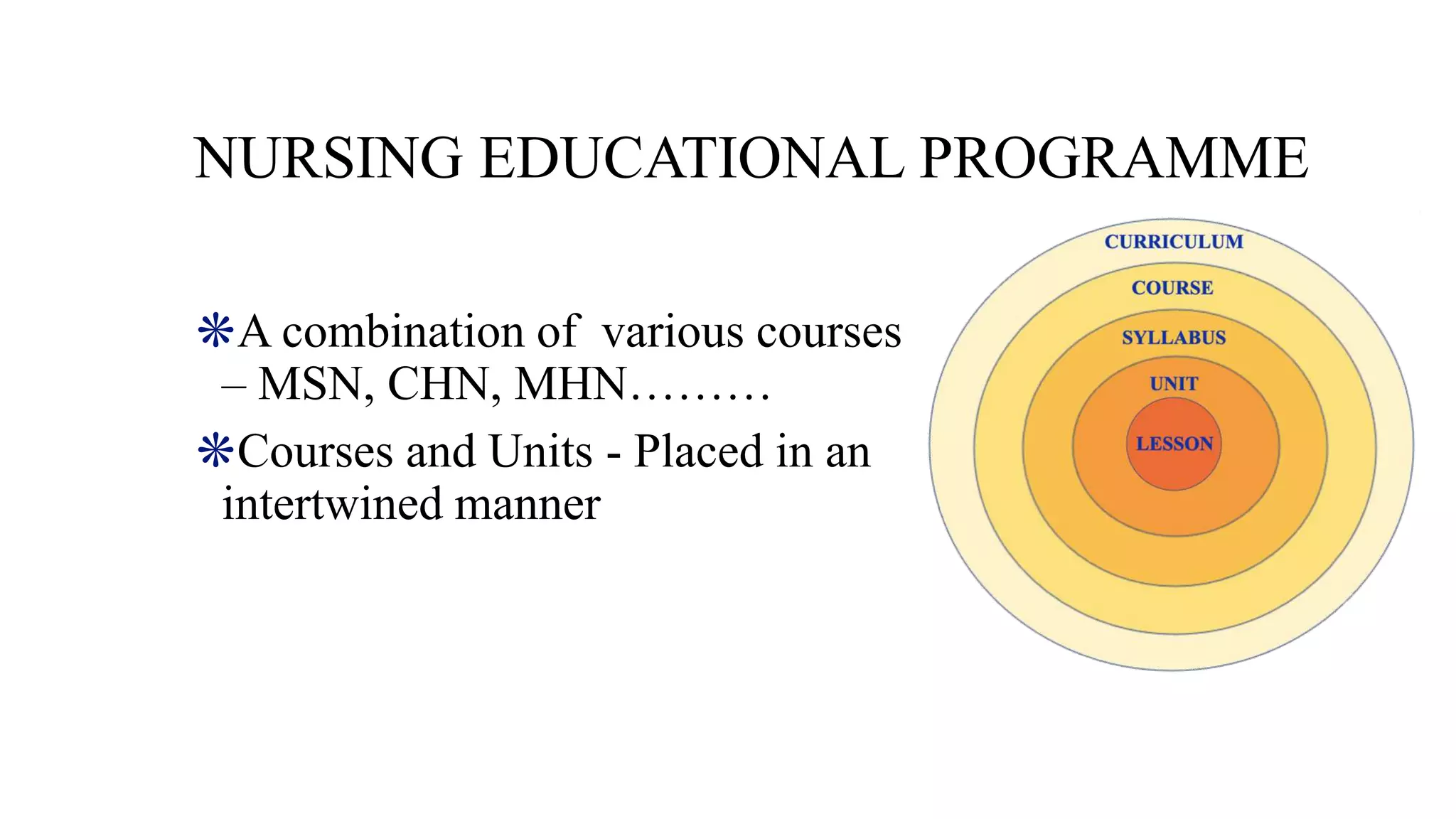
NURSING EDUCATIONAL PROGRAMME
❋A combination of various courses
– MSN, CHN, MHN………
❋Courses and Units - Placed in an
intertwined manner
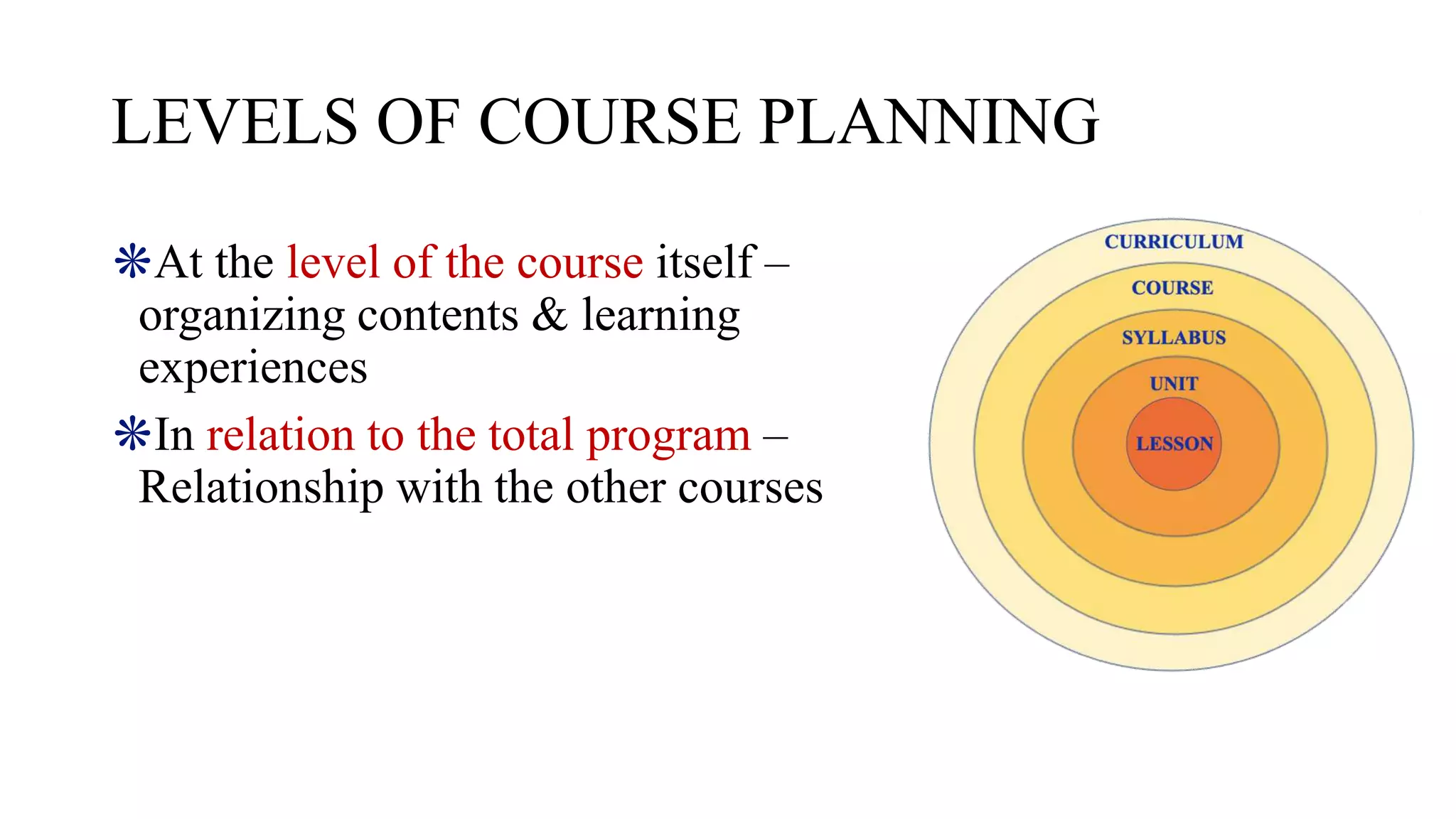
LEVELS OF COURSE PLANNING
❋At the level of the course itself –
organizing contents & learning
experiences
❋In relation to the total program –
Relationship with the other courses
PURPOSE OF COURSE PLANNING
❋ To map out learning activities in a coherent, logical way,
in order to help students understand, learn and practice
concepts and skills ...
❋ Ensure autonomy & stability
❋ Support the curriculum process
❋ Promote utilization of resources
❋ Bring about improvements
PRINCIPLES OF COURSE PLANNING…
1. Statement of objectives in behavioural & achievable terms
2. Appropriate content selection for the course
3. Organize the content focusing on students rather than subject matter
4. Allow for individual differences and according to the level of students
5. Establish sequence (follow maxims of teaching)
6. Ensure logical and psychological continuity
…PRINCIPLES OF COURSE PLANNING
7. Make it student centered & student friendly (individual
differences, PS/ PBL)
8. Avoid overlapping/ repetition
9. Principle of integration (horizontal & vertical)
10.Weightage to core curriculum (Use of nursing process)
11.Unity curriculum – Merging of closely related subjects
12.Variety, innovation & flexibility of T-L methods
STRUCTURE OF COURSE PLAN
❋ Choice of topics
❋ Organization & sequence of course content.
Two kinds of planning are involved
1.Knowledge & understanding - Identifying the elements
and the specific learning to be organized.
2.Specific content & teaching and learning activities -
Focus on learners’ overall expected development
CONTENT OF COURSE PLAN
❋ Behavioral objectives
❋ Placement of the course acc to level of learners
❋ Statement of time allotted – theory & practical
❋ Organization of content into units and topics
❋ Brief course description
❋ Description of experience in detail (eg. clinical exp)
❋ Details of resource materials and T-L methods
❋ Details of formative & summative evaluation
❋ Ratio between internal and university examination
❋ References for the course subjects
❋ Plan of learning activities for students - assignments
❋ Mention place, length of experience, experience records,
observations, procedures, plan for rotation with field experiences,
supervised and guided practice.
Content of Course Plan – IV Yr BSc Nursing
DETERMINE COURSE CONTENT
❋ Select the major topics - Refer current literature
❋ Refine list of topics acc to course goals & vice versa.
❋ Arrange topics in a logical order …..of teaching
❋ Develop teaching methods and tools – Appropriate &
consistent .. use of technology.. ..variety
❋ State means of evaluation
❋ Selection of texts/ course readers
ORGANIZING LEARNING EXPERIENCES
❋ Discussion by concerned teaching & administrative faculty
❋ Appropriate scheme of organization & smooth implementation
i.e continuity, sequence and integrity.
❋ Inclusion of the basic units
❋ Developing a flexible plan
❋ Include specific activities for each course
DEFINE COURSE POLICIES
❋Grading - Assignments, papers, exams, class participation..
❋Dealing with issues – Attendance/ late coming/ rescheduling
of exams.
❋Academic integrity - Preventing and responding to
plagiarism and cheating.
❋Review with students at the beginning of term
DEVELOP THE COURSE SCHEDULE
Prepare academic calendars
Pace the classes, assignments, tests,
exams…other activities, vacations
WRITE THE COURSE SYLLABUS
❋At a minimum, the syllabus should
contain –
★Course title, time, and location;
prerequisites; required texts and other
materials; course topics; major assignments
and exams; course policies on grading,
academic integrity, attendance, and late
work; and contact information for instructor
REFINE THE COURSE DESIGN
❋ Course planning is a continual process.
❋ Revision – At Societal/ Institutional/
Instructional level
❋ Important – Teach core concepts and
critical- thinking skills.
TEACHERS ROLE IN COURSE
PLANNING…
Varies– acc to abilities, back ground, teaching skills.
❋ Determine objectives of subject matter
❋ Plan carefully
❋ Ensure progression, reinforcement
❋ Avoid gaps and non-productive repetition
❋ Maintain +ve attitude toward students; teaching and learning
…TEACHERS ROLE IN
COURSE PLANNING
❋ Update knowledge and skills
❋ Composition of learner's group
❋ Develop insight & sound ideas about teaching – learning
❋ Select appropriate materials and learning activities
❋ Arrange the teaching and learning environment
❋ Help to move students toward their goal
QUESTIONS…
❋ What is a ‘Course’ and what is ‘Course Planning’?
❋ Structure and Levels of a Course?
❋ Principles to follow when planning a Course?
❋ Elements of Course Planning?
❋ What does the Course Syllabus contain?
❋ Course policy?
❋ Course schedule?
❋ Teacher’s role in Course Planning?

Course Planning NR pptx

  • 1.
  • 2.
    We shall learn… ❋Meaning of Course Planning ❋ Purpose of Course Planning ❋ Principles of Course Planning ❋ Structure & content of Course Planning ❋ Organizing learning experiences ❋ Developing Course Schedule ❋ Course policy and Schedule ❋ Teacher’s role in Course Planning
  • 3.
    COURSE ❋A complete seriesof studies leading to graduation or a degree. ❋A unit of teaching that typically lasts one academic term ❋A combination of various but interrelated units Eg. ★ BSc, diploma, vocational, certificate, integrated UG + PG) or ★ I Yr BSc (N), II Yr BSc (N)………
  • 4.
    Where does ‘Course’figure in the educational process?
  • 5.
    Curriculum, Course andSyllabus ❋ Curriculum – A sum total of conditional/ selected experiences planned for a defined group of students, with guidelines for teaching and learning, to attain the educational objectives (= societal, institutional, instructional) ❋ Course – A complete series of studies leading to a graduation/ degree ❋ Syllabus - Summary of topics covered or units to be taught in a particular subject. ❋ Unit - An academic module which forms part of the course of study ❋ Lesson - A structured period of time where learning is intended to occur.
  • 6.
    Curriculum, Course andSyllabus Designed for a program offered by the university and approved by the UGC Prepared in accordance with the Curriculum guidelines by an apex body Prepared by expert faculties following the Curriculum and Course Prepared by expert teachers in the institution acc to the Course guidelines Prepared by respective subject teachers according to Unit Plan
  • 7.
    COURSE PLANNING ❋ Determiningthe intended learning outcomes, assessments, content and instructional tasks required to effectively teach a course. ❋ Serves as a guide for the teacher and students - for useful learning and purposeful activities. ❋ Needs to be continually refined
  • 8.
    NURSING EDUCATIONAL PROGRAMME ❋Acombination of various courses – MSN, CHN, MHN……… ❋Courses and Units - Placed in an intertwined manner
  • 9.
    LEVELS OF COURSEPLANNING ❋At the level of the course itself – organizing contents & learning experiences ❋In relation to the total program – Relationship with the other courses
  • 10.
    PURPOSE OF COURSEPLANNING ❋ To map out learning activities in a coherent, logical way, in order to help students understand, learn and practice concepts and skills ... ❋ Ensure autonomy & stability ❋ Support the curriculum process ❋ Promote utilization of resources ❋ Bring about improvements
  • 11.
    PRINCIPLES OF COURSEPLANNING… 1. Statement of objectives in behavioural & achievable terms 2. Appropriate content selection for the course 3. Organize the content focusing on students rather than subject matter 4. Allow for individual differences and according to the level of students 5. Establish sequence (follow maxims of teaching) 6. Ensure logical and psychological continuity
  • 12.
    …PRINCIPLES OF COURSEPLANNING 7. Make it student centered & student friendly (individual differences, PS/ PBL) 8. Avoid overlapping/ repetition 9. Principle of integration (horizontal & vertical) 10.Weightage to core curriculum (Use of nursing process) 11.Unity curriculum – Merging of closely related subjects 12.Variety, innovation & flexibility of T-L methods
  • 13.
    STRUCTURE OF COURSEPLAN ❋ Choice of topics ❋ Organization & sequence of course content. Two kinds of planning are involved 1.Knowledge & understanding - Identifying the elements and the specific learning to be organized. 2.Specific content & teaching and learning activities - Focus on learners’ overall expected development
  • 14.
    CONTENT OF COURSEPLAN ❋ Behavioral objectives ❋ Placement of the course acc to level of learners ❋ Statement of time allotted – theory & practical ❋ Organization of content into units and topics ❋ Brief course description ❋ Description of experience in detail (eg. clinical exp) ❋ Details of resource materials and T-L methods
  • 15.
    ❋ Details offormative & summative evaluation ❋ Ratio between internal and university examination ❋ References for the course subjects ❋ Plan of learning activities for students - assignments ❋ Mention place, length of experience, experience records, observations, procedures, plan for rotation with field experiences, supervised and guided practice.
  • 16.
    Content of CoursePlan – IV Yr BSc Nursing
  • 20.
    DETERMINE COURSE CONTENT ❋Select the major topics - Refer current literature ❋ Refine list of topics acc to course goals & vice versa. ❋ Arrange topics in a logical order …..of teaching ❋ Develop teaching methods and tools – Appropriate & consistent .. use of technology.. ..variety ❋ State means of evaluation ❋ Selection of texts/ course readers
  • 21.
    ORGANIZING LEARNING EXPERIENCES ❋Discussion by concerned teaching & administrative faculty ❋ Appropriate scheme of organization & smooth implementation i.e continuity, sequence and integrity. ❋ Inclusion of the basic units ❋ Developing a flexible plan ❋ Include specific activities for each course
  • 22.
    DEFINE COURSE POLICIES ❋Grading- Assignments, papers, exams, class participation.. ❋Dealing with issues – Attendance/ late coming/ rescheduling of exams. ❋Academic integrity - Preventing and responding to plagiarism and cheating. ❋Review with students at the beginning of term
  • 23.
    DEVELOP THE COURSESCHEDULE Prepare academic calendars Pace the classes, assignments, tests, exams…other activities, vacations
  • 24.
    WRITE THE COURSESYLLABUS ❋At a minimum, the syllabus should contain – ★Course title, time, and location; prerequisites; required texts and other materials; course topics; major assignments and exams; course policies on grading, academic integrity, attendance, and late work; and contact information for instructor
  • 25.
    REFINE THE COURSEDESIGN ❋ Course planning is a continual process. ❋ Revision – At Societal/ Institutional/ Instructional level ❋ Important – Teach core concepts and critical- thinking skills.
  • 26.
    TEACHERS ROLE INCOURSE PLANNING… Varies– acc to abilities, back ground, teaching skills. ❋ Determine objectives of subject matter ❋ Plan carefully ❋ Ensure progression, reinforcement ❋ Avoid gaps and non-productive repetition ❋ Maintain +ve attitude toward students; teaching and learning
  • 27.
    …TEACHERS ROLE IN COURSEPLANNING ❋ Update knowledge and skills ❋ Composition of learner's group ❋ Develop insight & sound ideas about teaching – learning ❋ Select appropriate materials and learning activities ❋ Arrange the teaching and learning environment ❋ Help to move students toward their goal
  • 29.
    QUESTIONS… ❋ What isa ‘Course’ and what is ‘Course Planning’? ❋ Structure and Levels of a Course? ❋ Principles to follow when planning a Course? ❋ Elements of Course Planning? ❋ What does the Course Syllabus contain? ❋ Course policy? ❋ Course schedule? ❋ Teacher’s role in Course Planning?