
Course
Development
@codewizacademy
4 Pillars of Learning
• International Commission on education
for 21st Century presented a report to
UNESCO- Learning: The treasure within
1. Learning to know
2. Learning to do
3. Learning to live with each other and
4. Learning to be
Teaching Online
• Conscious Decision
• Not the same as brick room teaching
added with video tutorials or Presentations
• Various Modalities involved in
– Design
– Creation
– Delivery
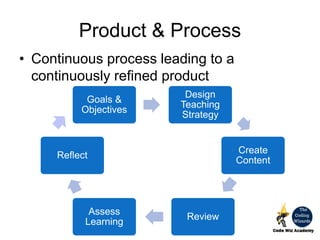
Product & Process
• Continuous process leading to a
continuously refined product
Goals &
Objectives
Design
Teaching
Strategy
Create
Content
Review
Assess
Learning
Reflect
COURSE DEVELOPMENT &
DESIGN
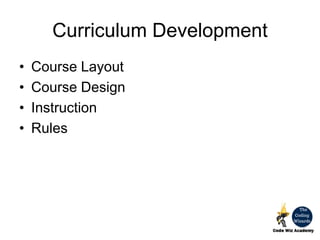
Curriculum Development
• Course Layout
• Course Design
• Instruction
• Rules
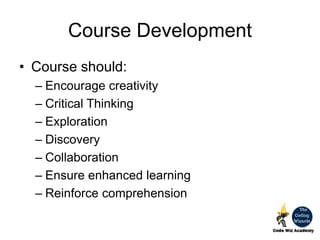
Course Development
• Course should:
– Encourage creativity
– Critical Thinking
– Exploration
– Discovery
– Collaboration
– Ensure enhanced learning
– Reinforce comprehension
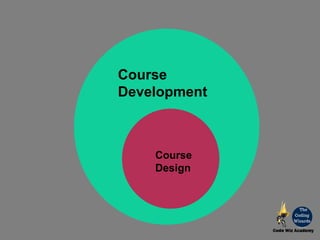
Course
Development
Course
Design
Course Design
• Blueprint
– Course Structure
– Assessment Strategy
• Focus on interactivity of learners
– With each other
– With the material
– With the instructor
Limitations
• Constraints that limit course design and
delivery
– Time
– Space
• Meeting Online
– No geographic boundaries
– Different time zones
– Select and schedule the synchronous
activities carefully
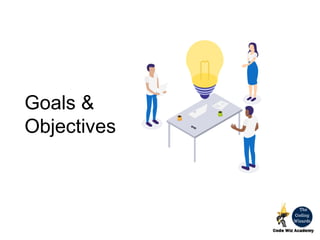
Goals &
Objectives
Literacy-Education-Knowledge
• Literacy
– Ability to read and write
• Education
– Holistic development
– Attributes like: adaptability, behavioural restraint,
politeness in language, social decorum, helping,
respectful to elders, skilled
• Knowledge
– Goal of education is possession of knowledge
– Organized bunch of classified information which
stands graded and qualified both by the
possessor and the dispenser
– Verified information
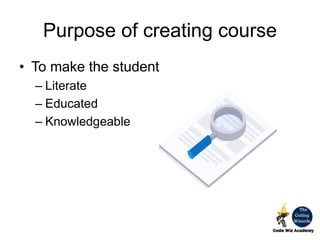
Purpose of creating course
• To make the student
– Literate
– Educated
– Knowledgeable
Foundations
• Philosophy
– "It is essential for
1. Formulating and justifying educational purposes
2. Selecting and organizing knowledge
3. Formulating basic procedures and activities and dealing
with verbal traps (What we see versus what is real)"- Smith
et. Al. (1957)
• Psychology
– For John Dewey- It is the basis for understanding how
the individual learner interacts with persons and
objects in the environment and the quality of
interaction determines the amount and type of
learning.
• Sociology
– Society's culture is maintained and transmitted to
next generation by educational system.
Aim
• "An aim implies an orderly and ordered
activity, one in which the order consists in
the progressive completing of a process."
• John Dewey (1916)
• Communicate well-thought-out aims
An aim kept in mind without putting
necessary effort to realise the
same,
is a mere speculation without any
real significance.
Defining Goal
• Broad statements based on purpose and
requirement
• Broad goals can be realized through
general objectives
• How you as an instructor would help
achieve the various goals.
• Goal of having this course
– Knowledge-based goals
– Skills-based goals
– Affective goals
Defining Objectives
• 2 Functions
• Bridge the gap between broad goals for
educations and activities for teachers and
learners.
– What has to be achieved gets clear
• They guide the curriculum planning activity
at a particular level.
Objectives
• Course Objectives- Broad Objectives
– Focus on student understanding
– Higher level thinking skills
– Number: 3-4
• Module Objectives- Specific Objectives
– Skills developed
– Knowledge Gained
– Number: 8-12
• Instructional Objective- Activity/Instruction
based
Course Objective
• Defines
– Behaviour
– Skill
– Action
• Measurable by assessment
• Foundation of the Course
• Everything in course should ensure achievement
of course objectives
– Teaching strategy
– Activities
– Resources
– Planning
– Scheduling....
Good Course Objectives
• Should be
– Specific
– Measurable
– Learner's perspective
• Start with: By the end of the course, students
will be able to:
– Action verb for specific action to be taken by students
– Knowledge students are expected to acquire or
construct
– Set the criterion or level students are expected to
reach to show mastery of knowledge
• Ways to assess students’ learned knowledge. Eg:
MCQ questions cannot be used to assess
creativity and evaluation skills.
Module objectives
• Combination of
– Action Verb
– Knowledge gained
– Criteria to assess
• Related to module
• More in number as compared to course
objectives
• Reflected in the task completion expected
Instructional Objectives
• Specific or immediate outcome as result of an
instruction
• Knowledge gained by the activity
• Progressive changes in cognitive, affective
and psychomotor domain in terms of
– Knowledge
– Comprehension
– Applications
– Skills
– Appreciation
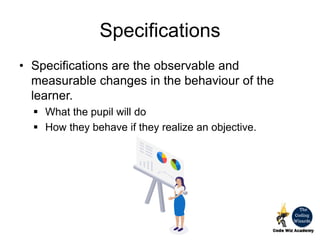
Specifications
• Specifications are the observable and
measurable changes in the behaviour of the
learner.
 What the pupil will do
 How they behave if they realize an objective.
Assessment
• Measures success in the accomplishment of
course goals and learning outcomes
• Versatile
• Varied forms
• Directly proportional to knowledge or skill
learned – If Appropriately Planned
Difference between objective and
assessment
• Course objectives specify:
– What students are being asked to know
• Assessments specify:
– What students need to prove to know
Learning Outcome
• Pedagogically-sound learning outcomes
• Set realistic yet challenging expectations
of learners
• Student Outcome->higher level of
expertise-> sophisticated classroom
assessment techniques
• Measurable outcomes
– Gauge the change or impact the program has
on participants
Needs Assessment
• Organisation
– Independent teacher needs: How are you going
to benefit from this course
• Students
– How will your learner benefit from this course
– What value addition will it have on them
• Teacher
– What is your need for having this course
– What value addition will it have on you
– (addition to portfolio, exp, connectivity,
confidence, exposure, learning of various types)
Keep in touch
For more tutorials and free courses, please
visit:
 https://www.codewizacademy.com/
 https://www.facebook.com/codewizacademy/
 https://www.instagram.com/codewizacademy/

Course development

  • 1.
  • 2.
    4 Pillars ofLearning • International Commission on education for 21st Century presented a report to UNESCO- Learning: The treasure within 1. Learning to know 2. Learning to do 3. Learning to live with each other and 4. Learning to be
  • 3.
    Teaching Online • ConsciousDecision • Not the same as brick room teaching added with video tutorials or Presentations • Various Modalities involved in – Design – Creation – Delivery
  • 4.
    Product & Process •Continuous process leading to a continuously refined product Goals & Objectives Design Teaching Strategy Create Content Review Assess Learning Reflect
  • 5.
  • 6.
    Curriculum Development • CourseLayout • Course Design • Instruction • Rules
  • 7.
    Course Development • Courseshould: – Encourage creativity – Critical Thinking – Exploration – Discovery – Collaboration – Ensure enhanced learning – Reinforce comprehension
  • 8.
  • 9.
    Course Design • Blueprint –Course Structure – Assessment Strategy • Focus on interactivity of learners – With each other – With the material – With the instructor
  • 10.
    Limitations • Constraints thatlimit course design and delivery – Time – Space • Meeting Online – No geographic boundaries – Different time zones – Select and schedule the synchronous activities carefully
  • 11.
  • 12.
    Literacy-Education-Knowledge • Literacy – Abilityto read and write • Education – Holistic development – Attributes like: adaptability, behavioural restraint, politeness in language, social decorum, helping, respectful to elders, skilled • Knowledge – Goal of education is possession of knowledge – Organized bunch of classified information which stands graded and qualified both by the possessor and the dispenser – Verified information
  • 13.
    Purpose of creatingcourse • To make the student – Literate – Educated – Knowledgeable
  • 14.
    Foundations • Philosophy – "Itis essential for 1. Formulating and justifying educational purposes 2. Selecting and organizing knowledge 3. Formulating basic procedures and activities and dealing with verbal traps (What we see versus what is real)"- Smith et. Al. (1957) • Psychology – For John Dewey- It is the basis for understanding how the individual learner interacts with persons and objects in the environment and the quality of interaction determines the amount and type of learning. • Sociology – Society's culture is maintained and transmitted to next generation by educational system.
  • 15.
    Aim • "An aimimplies an orderly and ordered activity, one in which the order consists in the progressive completing of a process." • John Dewey (1916) • Communicate well-thought-out aims
  • 16.
    An aim keptin mind without putting necessary effort to realise the same, is a mere speculation without any real significance.
  • 17.
    Defining Goal • Broadstatements based on purpose and requirement • Broad goals can be realized through general objectives • How you as an instructor would help achieve the various goals. • Goal of having this course – Knowledge-based goals – Skills-based goals – Affective goals
  • 18.
    Defining Objectives • 2Functions • Bridge the gap between broad goals for educations and activities for teachers and learners. – What has to be achieved gets clear • They guide the curriculum planning activity at a particular level.
  • 19.
    Objectives • Course Objectives-Broad Objectives – Focus on student understanding – Higher level thinking skills – Number: 3-4 • Module Objectives- Specific Objectives – Skills developed – Knowledge Gained – Number: 8-12 • Instructional Objective- Activity/Instruction based
  • 20.
    Course Objective • Defines –Behaviour – Skill – Action • Measurable by assessment • Foundation of the Course • Everything in course should ensure achievement of course objectives – Teaching strategy – Activities – Resources – Planning – Scheduling....
  • 21.
    Good Course Objectives •Should be – Specific – Measurable – Learner's perspective • Start with: By the end of the course, students will be able to: – Action verb for specific action to be taken by students – Knowledge students are expected to acquire or construct – Set the criterion or level students are expected to reach to show mastery of knowledge • Ways to assess students’ learned knowledge. Eg: MCQ questions cannot be used to assess creativity and evaluation skills.
  • 22.
    Module objectives • Combinationof – Action Verb – Knowledge gained – Criteria to assess • Related to module • More in number as compared to course objectives • Reflected in the task completion expected
  • 23.
    Instructional Objectives • Specificor immediate outcome as result of an instruction • Knowledge gained by the activity • Progressive changes in cognitive, affective and psychomotor domain in terms of – Knowledge – Comprehension – Applications – Skills – Appreciation
  • 24.
    Specifications • Specifications arethe observable and measurable changes in the behaviour of the learner.  What the pupil will do  How they behave if they realize an objective.
  • 25.
    Assessment • Measures successin the accomplishment of course goals and learning outcomes • Versatile • Varied forms • Directly proportional to knowledge or skill learned – If Appropriately Planned
  • 26.
    Difference between objectiveand assessment • Course objectives specify: – What students are being asked to know • Assessments specify: – What students need to prove to know
  • 27.
    Learning Outcome • Pedagogically-soundlearning outcomes • Set realistic yet challenging expectations of learners • Student Outcome->higher level of expertise-> sophisticated classroom assessment techniques • Measurable outcomes – Gauge the change or impact the program has on participants
  • 28.
    Needs Assessment • Organisation –Independent teacher needs: How are you going to benefit from this course • Students – How will your learner benefit from this course – What value addition will it have on them • Teacher – What is your need for having this course – What value addition will it have on you – (addition to portfolio, exp, connectivity, confidence, exposure, learning of various types)
  • 29.
    Keep in touch Formore tutorials and free courses, please visit:  https://www.codewizacademy.com/  https://www.facebook.com/codewizacademy/  https://www.instagram.com/codewizacademy/