Learning
Process
LEARNING
Defined as a change in an individual’s behavior caused by
experience or self activity.
Can be intentional or unintentional.
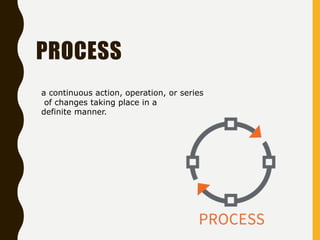
PROCESS
a continuous action, operation, or series
of changes taking place in a
definite manner.
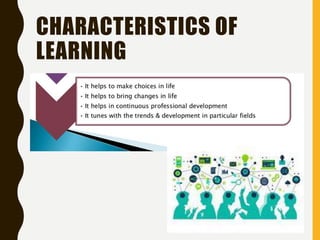
CHARACTERISTICS OF
LEARNING
LAWS OF LEARNING
• Readiness
The basic needs of the learner must be satisfied before he or she is
ready or capable of learning. The instructor can do little to motivate
the learner if these needs have not been met. This means the
learner must want to learn the task being presented and must
possess the requisite knowledge and skill.
• Effect
All learning involves the formation of connections and connections
are strengthened or weakened according to the law of effect.
Responses to a situation that are followed by satisfaction are
strengthened; responses followed by discomfort are weakened,
either strengthening or weakening the connection of learning.
• Exercise
Connections are strengthened with practice and weakened when
practice is discontinued, which reflects the adage “use it or lose it.”
The learner needs to practice what has been learned in order to
understand and remember the learning.
• Intensity
Immediate, exciting, or dramatic learning connected to a real
situation teaches a learner more than a routine or boring
experience.
• Recency
The principle of recency states that things most recently learned
are best remembered. Conversely, the further a learner is removed
in time from a new fact or understanding, the more difficult it is to
remember.
 Rote
 The ability to repeat something back which was
learned, but not understood.
 Understanding
 To comprehend or grasp the nature or meaning of
something.
 Application
 The act of putting something to use that has been
learned and understood.
 Correlation
 Associating what has been learned, understood, and
applied with previous or subsequent learning.

Process of learning

  • 1.
  • 2.
    LEARNING Defined as achange in an individual’s behavior caused by experience or self activity. Can be intentional or unintentional.
  • 3.
    PROCESS a continuous action,operation, or series of changes taking place in a definite manner.
  • 4.
  • 5.
    LAWS OF LEARNING •Readiness The basic needs of the learner must be satisfied before he or she is ready or capable of learning. The instructor can do little to motivate the learner if these needs have not been met. This means the learner must want to learn the task being presented and must possess the requisite knowledge and skill. • Effect All learning involves the formation of connections and connections are strengthened or weakened according to the law of effect. Responses to a situation that are followed by satisfaction are strengthened; responses followed by discomfort are weakened, either strengthening or weakening the connection of learning.
  • 6.
    • Exercise Connections arestrengthened with practice and weakened when practice is discontinued, which reflects the adage “use it or lose it.” The learner needs to practice what has been learned in order to understand and remember the learning. • Intensity Immediate, exciting, or dramatic learning connected to a real situation teaches a learner more than a routine or boring experience. • Recency The principle of recency states that things most recently learned are best remembered. Conversely, the further a learner is removed in time from a new fact or understanding, the more difficult it is to remember.
  • 7.
     Rote  Theability to repeat something back which was learned, but not understood.  Understanding  To comprehend or grasp the nature or meaning of something.  Application  The act of putting something to use that has been learned and understood.  Correlation  Associating what has been learned, understood, and applied with previous or subsequent learning.