

Methodology
@codewizacademy
Taxonomy
• Taxonomies are a scheme of classification
• Educational Taxonomy
– Classification of educational objectives
– Terms used in a framework to classify simple
to complex and from concrete to abstract,
educational goals.
MASLOW
• Needs to be fulfilled to achieve full
potential
• Basic – complex -> Lower – higher
• In Maslow's words: " what a man can be,
a man must be"
– Self Actualization
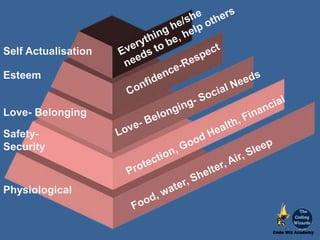
Hierarchy of needs
Physiological
Safety-
Security
Love- Belonging
Esteem
Self Actualisation
Hierarchy of needs
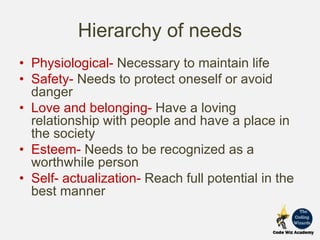
• Physiological- Necessary to maintain life
• Safety- Needs to protect oneself or avoid
danger
• Love and belonging- Have a loving
relationship with people and have a place in
the society
• Esteem- Needs to be recognized as a
worthwhile person
• Self- actualization- Reach full potential in the
best manner
BLOOM
Bloom'’s Taxonomy
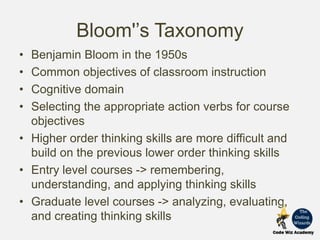
• Benjamin Bloom in the 1950s
• Common objectives of classroom instruction
• Cognitive domain
• Selecting the appropriate action verbs for course
objectives
• Higher order thinking skills are more difficult and
build on the previous lower order thinking skills
• Entry level courses -> remembering,
understanding, and applying thinking skills
• Graduate level courses -> analyzing, evaluating,
and creating thinking skills
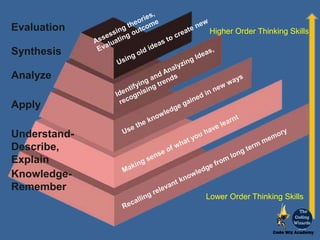
Knowledge-
Remember
Understand-
Describe,
Explain
Apply
Analyze
Synthesis
Evaluation
Lower Order Thinking Skills
Higher Order Thinking Skills
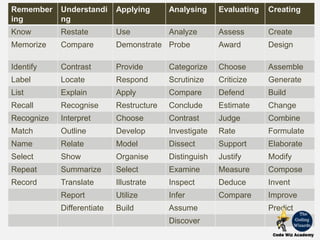
Remember
ing
Understandi
ng
Applying Analysing Evaluating Creating
Know Restate Use Analyze Assess Create
Memorize Compare Demonstrate Probe Award Design
Identify Contrast Provide Categorize Choose Assemble
Label Locate Respond Scrutinize Criticize Generate
List Explain Apply Compare Defend Build
Recall Recognise Restructure Conclude Estimate Change
Recognize Interpret Choose Contrast Judge Combine
Match Outline Develop Investigate Rate Formulate
Name Relate Model Dissect Support Elaborate
Select Show Organise Distinguish Justify Modify
Repeat Summarize Select Examine Measure Compose
Record Translate Illustrate Inspect Deduce Invent
Report Utilize Infer Compare Improve
Differentiate Build Assume Predict
Discover
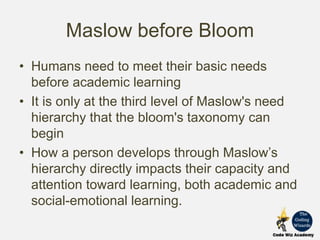
Maslow before Bloom
• Humans need to meet their basic needs
before academic learning
• It is only at the third level of Maslow's need
hierarchy that the bloom's taxonomy can
begin
• How a person develops through Maslow’s
hierarchy directly impacts their capacity and
attention toward learning, both academic and
social-emotional learning.
AFFECTIVE DOMAIN
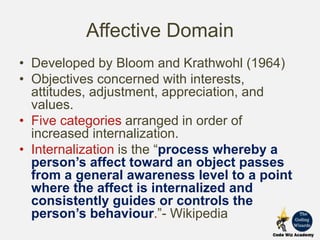
Affective Domain
• Developed by Bloom and Krathwohl (1964)
• Objectives concerned with interests,
attitudes, adjustment, appreciation, and
values.
• Five categories arranged in order of
increased internalization.
• Internalization is the “process whereby a
person’s affect toward an object passes
from a general awareness level to a point
where the affect is internalized and
consistently guides or controls the
person’s behaviour.”- Wikipedia
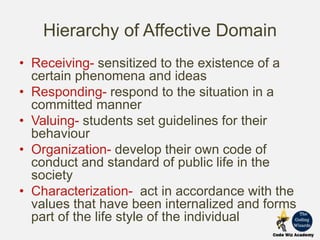
Hierarchy of Affective Domain
• Receiving- sensitized to the existence of a
certain phenomena and ideas
• Responding- respond to the situation in a
committed manner
• Valuing- students set guidelines for their
behaviour
• Organization- develop their own code of
conduct and standard of public life in the
society
• Characterization- act in accordance with the
values that have been internalized and forms
part of the life style of the individual
KNOWLEDGE IS CONSTRUCTED
IT IS NOT TRANSMITTED FROM
TEACHER TO A PASSIVE LEARNER
TEACHING APPROACH
Teaching Approaches for Active
Learning
• Frameworks:
– Inquiry based learning
– High Order Thinking
– Cooperative Learning
– Critical Thinking
– Student Centred Instruction
– Bloom's Taxonomy of Learning Outcome
Approaches
• Aligning content with objectives on the
basis of teaching approach
– Active Learning
– Problem Solving
– Project Based Learning
– Flipped Learning
Active Learning
• Umbrella Term
– Any learning task that puts the responsibility
of learning on the student.
– Passive i.e. Reading, Looking & Listening
– Active i.e. Speak, Say & Do
Problem Based Learning
• Hands on active learning, centre on the
investigation and resolution of real world
problems.
• Related to tacking a problem but not
necessarily include student project
Project Based Learning
• Students have significant control over
– What they wish to produce
– How they want to demonstrate their learning
– How they wish to be evaluated
• Involves complex task and some form of
student presentation and/or creating an
actual product or artefact.
Flipped Learning
• Passive Learning
– Acclimatized with new concepts and terminology
before the live session.
– Ask students to take notes and jot questions for
further consideration.
– Provide worksheets for each video, short quizzes on
video content
• Active Learning
– During live session: Brain storm ideas and discuss
with the instructor and peers
– Learning activities like group work, group discussion
• After Session:
– Check for understanding through higher order
assessment and activities
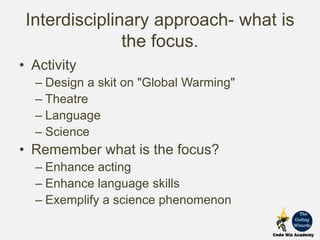
Interdisciplinary approach- what is
the focus.
• Activity
– Design a skit on "Global Warming"
– Theatre
– Language
– Science
• Remember what is the focus?
– Enhance acting
– Enhance language skills
– Exemplify a science phenomenon
Keep in touch
For more tutorials and free courses, please
visit:
 https://www.codewizacademy.com/
 https://www.facebook.com/codewizacademy/
 https://www.instagram.com/codewizacademy/

Taxonomies

  • 1.
  • 2.
    Taxonomy • Taxonomies area scheme of classification • Educational Taxonomy – Classification of educational objectives – Terms used in a framework to classify simple to complex and from concrete to abstract, educational goals.
  • 3.
  • 4.
    • Needs tobe fulfilled to achieve full potential • Basic – complex -> Lower – higher • In Maslow's words: " what a man can be, a man must be" – Self Actualization Hierarchy of needs
  • 5.
  • 6.
    Hierarchy of needs •Physiological- Necessary to maintain life • Safety- Needs to protect oneself or avoid danger • Love and belonging- Have a loving relationship with people and have a place in the society • Esteem- Needs to be recognized as a worthwhile person • Self- actualization- Reach full potential in the best manner
  • 7.
  • 8.
    Bloom'’s Taxonomy • BenjaminBloom in the 1950s • Common objectives of classroom instruction • Cognitive domain • Selecting the appropriate action verbs for course objectives • Higher order thinking skills are more difficult and build on the previous lower order thinking skills • Entry level courses -> remembering, understanding, and applying thinking skills • Graduate level courses -> analyzing, evaluating, and creating thinking skills
  • 9.
  • 10.
    Remember ing Understandi ng Applying Analysing EvaluatingCreating Know Restate Use Analyze Assess Create Memorize Compare Demonstrate Probe Award Design Identify Contrast Provide Categorize Choose Assemble Label Locate Respond Scrutinize Criticize Generate List Explain Apply Compare Defend Build Recall Recognise Restructure Conclude Estimate Change Recognize Interpret Choose Contrast Judge Combine Match Outline Develop Investigate Rate Formulate Name Relate Model Dissect Support Elaborate Select Show Organise Distinguish Justify Modify Repeat Summarize Select Examine Measure Compose Record Translate Illustrate Inspect Deduce Invent Report Utilize Infer Compare Improve Differentiate Build Assume Predict Discover
  • 11.
    Maslow before Bloom •Humans need to meet their basic needs before academic learning • It is only at the third level of Maslow's need hierarchy that the bloom's taxonomy can begin • How a person develops through Maslow’s hierarchy directly impacts their capacity and attention toward learning, both academic and social-emotional learning.
  • 12.
  • 13.
    Affective Domain • Developedby Bloom and Krathwohl (1964) • Objectives concerned with interests, attitudes, adjustment, appreciation, and values. • Five categories arranged in order of increased internalization. • Internalization is the “process whereby a person’s affect toward an object passes from a general awareness level to a point where the affect is internalized and consistently guides or controls the person’s behaviour.”- Wikipedia
  • 14.
    Hierarchy of AffectiveDomain • Receiving- sensitized to the existence of a certain phenomena and ideas • Responding- respond to the situation in a committed manner • Valuing- students set guidelines for their behaviour • Organization- develop their own code of conduct and standard of public life in the society • Characterization- act in accordance with the values that have been internalized and forms part of the life style of the individual
  • 15.
    KNOWLEDGE IS CONSTRUCTED ITIS NOT TRANSMITTED FROM TEACHER TO A PASSIVE LEARNER
  • 16.
  • 17.
    Teaching Approaches forActive Learning • Frameworks: – Inquiry based learning – High Order Thinking – Cooperative Learning – Critical Thinking – Student Centred Instruction – Bloom's Taxonomy of Learning Outcome
  • 18.
    Approaches • Aligning contentwith objectives on the basis of teaching approach – Active Learning – Problem Solving – Project Based Learning – Flipped Learning
  • 19.
    Active Learning • UmbrellaTerm – Any learning task that puts the responsibility of learning on the student. – Passive i.e. Reading, Looking & Listening – Active i.e. Speak, Say & Do
  • 20.
    Problem Based Learning •Hands on active learning, centre on the investigation and resolution of real world problems. • Related to tacking a problem but not necessarily include student project
  • 21.
    Project Based Learning •Students have significant control over – What they wish to produce – How they want to demonstrate their learning – How they wish to be evaluated • Involves complex task and some form of student presentation and/or creating an actual product or artefact.
  • 22.
    Flipped Learning • PassiveLearning – Acclimatized with new concepts and terminology before the live session. – Ask students to take notes and jot questions for further consideration. – Provide worksheets for each video, short quizzes on video content • Active Learning – During live session: Brain storm ideas and discuss with the instructor and peers – Learning activities like group work, group discussion • After Session: – Check for understanding through higher order assessment and activities
  • 23.
    Interdisciplinary approach- whatis the focus. • Activity – Design a skit on "Global Warming" – Theatre – Language – Science • Remember what is the focus? – Enhance acting – Enhance language skills – Exemplify a science phenomenon
  • 24.
    Keep in touch Formore tutorials and free courses, please visit:  https://www.codewizacademy.com/  https://www.facebook.com/codewizacademy/  https://www.instagram.com/codewizacademy/