Course Outline
@codewizacademy
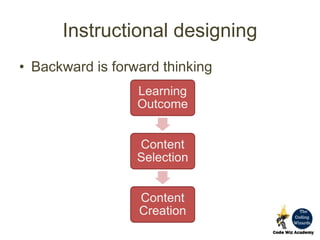
Instructional designing
• Backward is forward thinking
Learning
Outcome
Content
Selection
Content
Creation
Backward Strategy
• Establish a framework or structure for the
course
• Develop and align outcomes and
assessments.
• This includes:
– Writing the course outcomes
– Defining the course structure
– Determining the evaluation strategies
– Writing the unit outcomes
– Defining the unit structure
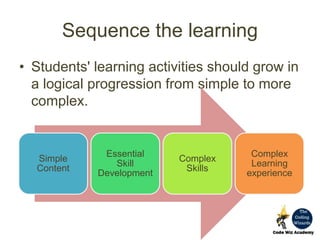
Sequence the learning
• Students' learning activities should grow in
a logical progression from simple to more
complex.
Simple
Content
Essential
Skill
Development
Complex
Skills
Complex
Learning
experience
Designing
• Deciding
– what to teach (content and other skills);
– how to teach ( lecture, demonstration, case
studies, role playing, etc.)
Audience
• Prospective audience
• Learners' technical background
• 2 Strategies
– Existing Audience
• Design and create a course according to them
– Create an audience
• Design and create a course for them
Duration
• Modules
• Time students are expected to invest per
week/per module
– Considering an average student
Course Outline
• What
– Content
– Online materials
– Resources
– Activities
will the course include
Amount of Content
• Considering students will need time to
study
• Choosing the minimum amount of content
for the course for it to be academically
sound
• Allowing students time for activities such
as individual research, assignments or
project work
Student Work Flow
• Instructor must choose about
– how to structure the course
– how to control the student work flow
• Students could do the course more quickly
or more slowly, if they wished.
Course Availability
• Do not have continuous enrolment, or self-
paced instruction
• If you plan to
– Make heavy use of online discussion forums
– Online group work
• However, in courses, such as a math
course, self-paced instruction may be a
better option.
Methodology
Synchronous
• Live Meeting
• Text based chat
• Screen share
• Web Camera
• White Board
Asynchronous
• Lesson Content
• Calendar
• Announcements
• Course Emails
• Discussion Forums
• Quiz/Tests
• Grade Book
• Data for analysis
Synchronous Sessions
• Micro Lectures
– Clear Understanding
– Easy to conduct
– Focus on specific topic
– Specific Objects- Not broad Objectives
– Student leaves the session having learned the
essential knowledge and skills.
Research
• Search for and go through similar courses
on the internet
• After you have set your goals and
objectives. You do not want to teach what
others are teaching.
• Still, it is a good idea to know what is
going on around us.
Task 1- Course Foundation
• Philosophy
• Goals
• Objectives
• Need Assessment
Task 2- Course Outline
• Course Map
• Duration
• Audience
• Title
• Types of content
• Delivery method (Syn/Asyn)
• Number of modules
• Number of topics per module (consistent, 1-2 more or
less acceptable)
• Module Objectives
• Assessment outline
– Topics Wise
– Module wise
– Major Assessment
Keep in touch
For more tutorials and free courses, please
visit:
 https://www.codewizacademy.com/
 https://www.facebook.com/codewizacademy/
 https://www.instagram.com/codewizacademy/

Course outline

  • 1.
  • 2.
    Instructional designing • Backwardis forward thinking Learning Outcome Content Selection Content Creation
  • 3.
    Backward Strategy • Establisha framework or structure for the course • Develop and align outcomes and assessments. • This includes: – Writing the course outcomes – Defining the course structure – Determining the evaluation strategies – Writing the unit outcomes – Defining the unit structure
  • 4.
    Sequence the learning •Students' learning activities should grow in a logical progression from simple to more complex. Simple Content Essential Skill Development Complex Skills Complex Learning experience
  • 5.
    Designing • Deciding – whatto teach (content and other skills); – how to teach ( lecture, demonstration, case studies, role playing, etc.)
  • 6.
    Audience • Prospective audience •Learners' technical background • 2 Strategies – Existing Audience • Design and create a course according to them – Create an audience • Design and create a course for them
  • 7.
    Duration • Modules • Timestudents are expected to invest per week/per module – Considering an average student
  • 8.
    Course Outline • What –Content – Online materials – Resources – Activities will the course include
  • 9.
    Amount of Content •Considering students will need time to study • Choosing the minimum amount of content for the course for it to be academically sound • Allowing students time for activities such as individual research, assignments or project work
  • 10.
    Student Work Flow •Instructor must choose about – how to structure the course – how to control the student work flow • Students could do the course more quickly or more slowly, if they wished.
  • 11.
    Course Availability • Donot have continuous enrolment, or self- paced instruction • If you plan to – Make heavy use of online discussion forums – Online group work • However, in courses, such as a math course, self-paced instruction may be a better option.
  • 12.
    Methodology Synchronous • Live Meeting •Text based chat • Screen share • Web Camera • White Board Asynchronous • Lesson Content • Calendar • Announcements • Course Emails • Discussion Forums • Quiz/Tests • Grade Book • Data for analysis
  • 13.
    Synchronous Sessions • MicroLectures – Clear Understanding – Easy to conduct – Focus on specific topic – Specific Objects- Not broad Objectives – Student leaves the session having learned the essential knowledge and skills.
  • 14.
    Research • Search forand go through similar courses on the internet • After you have set your goals and objectives. You do not want to teach what others are teaching. • Still, it is a good idea to know what is going on around us.
  • 15.
    Task 1- CourseFoundation • Philosophy • Goals • Objectives • Need Assessment
  • 16.
    Task 2- CourseOutline • Course Map • Duration • Audience • Title • Types of content • Delivery method (Syn/Asyn) • Number of modules • Number of topics per module (consistent, 1-2 more or less acceptable) • Module Objectives • Assessment outline – Topics Wise – Module wise – Major Assessment
  • 17.
    Keep in touch Formore tutorials and free courses, please visit:  https://www.codewizacademy.com/  https://www.facebook.com/codewizacademy/  https://www.instagram.com/codewizacademy/