Written By
Department of Pharmacy
University of Rajshahi
Rajshahi-6205, Bangladesh
~~ ~14.~ sn~
~~: o;;...c,9_..06_5..;;.;93:...::.g--------
~Mr~~~I .:» . • _
~,~·Mt 1'4JJ1~; ~(g21'lf~)
1 / 15
Md.
Imran
Nur
Manik
J
~oul~ !0 -t~ mcums: 8'vem doU!__tj·""u.p i;:j .d-Pc.h-ni~~rn. -~ji_W_~i!!:J)-thttJ-5Cl1lJ._
~ -& ~~ curm_llhli- j- rm~ iY>(l/11/)±!'MJ ~. e_1!=~~'-_-~0'0!11 ~
_ 'YM-a~ t~~cwnl oj eh~ ~·,_:-"nrJu.rmJ-d_~ 1p'POrhl_~
- r ,
_./
Couiometrq
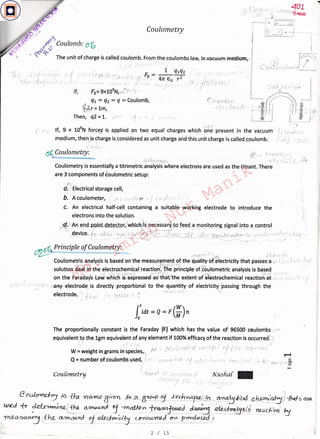
The proportionally constant is the Faraday ~F~ which has the value of 96500 ceulornbs c"".'"'
equivalent-to the lgm equivalent of any element if 100%efficacy of the reaction is occurred.
~- ~{. /' • 1 • ' j ·r · /
1/1- (/i"t. 11 'I J.. (I <7 /}( 0/' I~,
W = weight in grams~n! species,1 1 v' · • · '
Q=numberofcoulombsused,/, - 1.Urr d' 'f clrr I,. /) ''>', . ,. ...,, !,- /(tu•f. ~
I ~
-~""J Jr c- , .. 'r1J ,J Kushal' -
i I// I'... ·l A
cJ7}f3- Principle ofCoulometry: .su ,., ·~;,.tr< -/hr
1
•:t
Coulometric analysis is based on the measur'-1ien~of the tWality-offelectricity that passes-a ~ l c I 
(;(llti/11.' ' l{1r1:.( -/SV.
SOIUtiOn aeaHrl- the electrochemical reactio . he principle of,.coulometric analysis is based
o! ctr (-1 • I!Jn•':~ d d.( f) ~ ....{_~[:_ .-l/1.~~ • · •1
on the Faradays La~1 which is-exprassea-aS'ltha~the extent ot el&trochemical reaction-at '1 • • • · t ! · (
I r t .-;,- • ..:a-Ay-elec;trnde' is directly proportional to the -quaRt+ty-of electrkity/passingthrough the
./ / I J .?:.:
electrode.,/ { ~ r , . 0 _,r- 1 ~ '
j) • ! ,, :
/
I
• r Electrical storage cell,
b. A coulometer, c< r cc n-fc~ { ( ((' · 1/ •
c. An electrical half-cell containing a suitable working electrode to introduce the
electrons into the solution.
detector,/~ necessa @_Jee~ f_!10nitorl!1~~ig~I i(lt_p-~control
,.9-evice.-/, "t.,.J)o 1.Q -Li:» 1
·~ ~ulr:rnd< r r-u'·
' - '
(fh Coulometry: ff i: hen'~'
lr'chyiir11JJ, c:-1 r f;
Coulometry is essentially a titrirnetric-enelvsiswhere electrons are used as the titrant. There
are 3 components ot·@oulometric setup:
t_
·-t
/, : nn/.-
; (II { (
L 1'',,
If, 9 x 10⁹N force/ is applied on two equal charges which 'Gne -present in the vacuum
medium, then lscharge is considered as unit charge and this unit charge is called coulomb./I"' ' -
I
I . t J
If,
( ' ,,(1 -Then, q2 = 1. ,- ,
r
The unit of charge is called coulomb. From the coulombs law, ilhv.a-GYUA'H"l'le~'illm
~ I ' . I
/
' / 1 q1q2 ,.
f ' i ., l"'f1'"' ? Co> .' t ~·,·f.o = 4rr Eo 7
.. ~' jr-:111·.
F0= 9x10⁹N "C- >
q1 = q2 = q = Coulomb,
~r = lm,
,~
<'~· Coulomb: 6f,
, ~'<'O'~
Coulometry
' 401, 1 "I ·rr;r
j, - 9-on:5J
:J/
c· Ebc-h
.'
2 / 15
Md.
Imran
Nur
Manik
-Coulomeiru
I .,,.]
t?D1u(.,..moa» I f I
M , /! .1rn
elf c! r~ () ', ...
Kusha!
-( A,c
the
. . cvncJ.l[ ··r~ .
1 he 11o;u,-:fhus coulometnc methods are those -analyS1s methods which are based on
measurement of.1:he quantity of~l~ctricity,and-the application of the above equation.
~ .
-LJ..aA
A =Atomic weight of the element,
Q =Coulombs of electricity,pa .. Kd -l~11r u h Lt r ~ 1,, -l · • l
n = Valency of the element.
=Weight of the element, cl r -( d ,.,,, -If( (cc f' cl(wl Here,
AQ
W = _n_x_96_5_0_0
) ' ; c.
From this dlscusslon it ;[We"tt-ev.ident-that, if 'o'.'coulombs of electricity have been passed· '.' r• •c J
the solutionlJt~1'weight of the selutien-0Hh~lement1W1'deposite~ will be expressed by
the following equation: l ~ (I) J-
Secondary coulometric anaf.y_sis: (iy-, r1 ,·, ·1<1 r r ~'Lorine-I, , r1 r ,,, ' 1 , r''
The substance
10;.if°czr~~ fz~~~s quantitatively -ffi-st>MicH:t-jVith ~L~i..n~c17~}lrpd 7t(°h., 1 !tr,,.( .f ?
electrolysi . This method is called 'secondary coulometric analysis I ne 'ofThe troduct' rr,{ 11 I
• • (5u} J' c..fr1'1
reacts-Withlhe_s_uhstance...to-be-estim-atecl-anrl-the process is carried11unde~constant
controlled condition ancfa»ri end point indicator is also required.
I[ 00 2.
11 There are two kinds of coulometric analysis:
c ~ . I .!'"ff' ' Ir , c
,. .
Primary coulometricanalysis: "
The substance of interest maybe oxidized or reduced at one of the electrode of the
· J( </ •
electrolytic cell. This analvsis-sirnplv called primary coulometric analysis': In this analysis
the substance reacts at an electrode which is maintained at~constant potential and-/L-
current gradually decreasecsffi€~he substance is removed from the solution.
l / 69. 1.
0-)Here, Nr =Total number of coulombs used to promote the desired reaction,
Nt =Total number of coulombs passed.
100Nr
Current efficiency= --
Nt
n = number of efectro'!)l:l-SM in the reaction.
The fundamental requireme-nt~/:~~ometric analvsis.Is the electrolysis reaction.proceeds
with 100% efficacy.
' I
I Y' ",:,,;
M = molecular weight,
!':; JMtM
3 / 15
Md.
Imran
Nur
Manik
M<l)
coC1l
.......
'{ 1 • •
Kusha! -Coulometrv
In secondary coulometry the substance of interest react quantitatively i-A--soltffiefl. with a
single product of electrolysis.
i <KC
"'d(11'lf r ocLr=r 1:_;1r r: • 1rri'i((}' ','( -{'/ 'r '':t:Jt.
J ·-1 -Secondary-ceulometry'-involves the indirect use of/electron titrantito electrogenarate
ii chemical tltrantsjas indicated by the following equations:
Reduced species, -net'~ oxidised species(titrant)
Yl<Z
Oxidised species, +~e-~ Reduced speciesttitrani)
i : !' /. r : . 11.,.: I ~,, !hr }Jo·lr r· d.-1(/wr.1 r I 17( _Lr Ir I
• , t l
1
I/ r r-r '11 l '· I· · · . ,. ~ 1 " • <
2B·01·12.What doyou mean by primary and secondary coulometry? Qfi...
J.Qo~ 2-
2g.o r"=Pri'marycoulometry: (d/n€cA n11.d Or -b·~a f-t'on)
r J 7 c , ' i ~ I r tt ' I ~- 1' (e1111) t.
"!  Primary coulometry (Rvtedtiostatic coulometry) is carried out by controlling~'the.potential 'of
'-..:.:::-'". ;JIv ~ r:
the working .electrode to limit the half-cell reaction to the one being studie ""1n51electro ysis
-J. c i;erc'YT<C ,, " "-..
current 'i' .being proportional to the bulk concentration C of the substancef '>.{ k
i <X:C!.. WluflD, .L' ( "f.u c ~ LA'IJJ...
(f i = KC I<. = 'Pncpon l' &f'l'ICL ''J o'YI,, "'~ -i:
(j' ~Jrimary .~pulometry is limited to the direct titration of 1¬ 1ect~o~activ~ substances, with
· electrons, f~ll into the redox type of titration:?ct..h9atj M 1 rid-1 ((1 Ir -I ·"_J' , •• / • ' • •
Reduced species, -ne"(titrant) ~ oxidised species
e
Oxidised species, +#(titrant) ~ Reduced species
-~ .
(-!)) The substance of interest may be oxidized or reduced at one of the electrode of the
~ electrolytic cell.
Qg.oy. Sic~i:!arycoufometry: (Irnd.i~-1:: m..d-o~ -f:r'tr>ab"o~ - ~r.., r.;
r: .., 1 l 1 J -, '{'£ .,-1,.. · rt ,,.., a;mp¬ o'*- Clff()pe1TV~il Ct)-- Of>
1.. n · Secondary coulornefrv (arnphostatic coulometry~is frequently referred-tc?fhe''coulometric
titration"which is carried out by"controlting the current'1to the working electrode. The
potential of the working electrode is controlled· indirectly /by maintaining the electrolysis
current ~ta level, where it can never be· limited by .the rate of diffusion of the electroactive
'- - ' ........----- "'"" ~ ·" -ll.£ .
substance: Thus the currentis less than tha)or,.controlled potential analysis.. e ~c.tno~s,·~ ,
4 / 15
Md.
Imran
Nur
Manik
·I I
11r,1,...,uf1J
Xusfia{ -
' '
' I r
1-4-'l-+'"H • I r • •
L-1-li-+-I-+ ' •  • •
~ ..............I.
I


<, .: ,., •--rl ( 1~)
l/{.-/ L c /
AqNC3 Sr uFc r:
Coulometrv
After electrolysis the electrolyte is taken out,
t
j
---~f)
-JL »>:
-~~____________@.o] - 12 Coulometer:
2 g, °61J'-"1iilver Coulometer: ~
It consistsof a platinum or silver vessel which
C, r./ · 1'1
acts as a cathode and OOftuttrttflg-awJ.utiGn--e-f-
g.t<cftJrfl am:4'9-lii (]Yi} .t[(
pure AgN03, aS11electrolyte. At first/:A:gN03 is
._,,Co LU-liiSY'
purified by repeated crystallization from
acidified solution. joUowed ~ fu!)l'cm.
The' ~hl-00.-JigNO(;;[;~~~contain 10-
20gnf$altin 100ml solution.
/) '.)
A rod of pure 'silvef-"'enclosed in a porous
lMl.
supporgacts as-anode.
'*- Oxygen-Hydrogen Coulometer,
.,._ SilverCoulometer,
~ Iodine Coulometer.
There are various types of coulometer:
e.
an b. One of the products n!acts with the-
at sl:lbstanee~5 be estimated and the
precess is carried un~e~ constant
controlled condition aad aR eRd poiRt
im;liGater is also req1.1ired C»JJrW
d. It is a slow process.It is a rapid process.
a. The substance of interest reacts
quantitatively in solution with a single
protfuct of electrolysis. This method is
-~~~ledsecondary coulometric analysis. _/
A<'f'V'- f>t.t1..0S4-u...~'c_ Co<llt>w-..P..~
~wnf CWlll ,j C~vtltJ md'nj .
b. IA--t-his-aAa-1-ys-is-tl=ie--s-tJ bstance reao
eleet1 ode which is maintained
constant potential. ~-te(.,t-r-i•k
c. ln-thi-s-analysis-f)fOees-s-ettffer-rt gradually c. Ifl-this-analysis-process.current-ls-ea=led
decreased since the substance is j '.Ul1d"ei;;constant controlled condition.
removed from the solution.
/. I
( t' '.'
I
f"'
a. The substanceof interest maybe oxidized
or reduced at one of the electrode of the
electrolytic cell. This analysis simply
called primary coulometric analysis.
Primary coulometric analysis
, I 1
c-i'.
j 1)'J 
1)-'1 -~
2 g '07. 12 }IDifference between Primary coulometric analysis and Secondary coulornetric
analysis:
Secondary coulometric analysis l
5 / 15
Md.
Imran
Nur
Manik
(
2. Contra (Stential coulometric a11J1/ysiJ:
. --- - I - . J• I
The substance· being-determined reacts ~i,th 100% efficacy at-working elect~ode-~T-he ,.., J
potential ~wl:i1c~s- controlleaT"'The~;r;.pl~tl~·~~f the reaction can be-~tJi~ed by the
current.'decr~asmf$fctctitally to zero.f,The~~u~t~fA~ ~eactan!)can be
c0-luilafed ~- - -- --.......1
.._-:e:;omp.1¬ tte,c1either from( !_he reading of a coulometerJ or by means of a current tlrne
~ating devise, When the current is theoretically zero then the reaction tends to
-completed.- ~Yr
1-
1,.,
~ / , , , -e er- 1 J " r i. 1 • ~ 'fY'1' 1 ~ / oj
CIJ_ 091o({eneral,pro erties of tn(l)-_,eoulometriclan~sis:
8'th, oj thR . ( C1/l1:j~
1 /' Coulometric techniqueifveJaccurate and precise result tharrother classical method.
@'!Coulo-rnl:fr-..tob. :Oi&;>methocbbecomeJ more accurate,becauset~ectrical cu_rrent can be controlled
and measured with greaiprecessionthan{):oll:Htle-ef-sel~tioo~'aLurn£f r>i'c ~d
6l}hfoulometric techniques are suitable for both (outine and remote analysis. .
Couiometrq _,, 1 ; Xusfia{ -
One of the titrant is produced at electrode which reactswith the ion to be estimated ·
a. P.rll!lQry_C_Q!2stant current GCJulemet:FiG-analy.sf.s-;.
1
The element to be esttmated.undergoes direct reaction to the electrode with 100%
current efficiency.
~ Second a constant current eg.ufometr-tc-anu./- -sis:
I
-
In this techniq ~he s3lution o substance to badetermtned.Is electrolyzed. T~e
- ,JQ,I <2<-.fl?d I r. , • (
completeness of the reaction can be -0.e.ter-m.iRed.:illy the visual indicator and.circult is
then.opened. The amount of electricity is derived from th_~pr<l.d..lJ~Lafa111.pere .and time.
- ;This method is also divided into two parts:
"''- ,
,,,g. Constant current coulometric analysis,
~ WRmwpotential coulometric analysis.
0.011~1ed (ccms-tam.l]'
..l: Constant currentsou/Q_metFiG analysis:
There are two distinct types of coulometric analysis:
-f.o9.J2 5aJ
1 faraday of electricity {96500 coulombs)= 107.88gm of Ag+ ion deposited;
2s·o1·1?.
w·e13hD..d gr'vef) ,1,.I
the vessel }s washed, dried and "'Weigl'lt-ed. The increase/ in weight Jnd~her si!ve-i:-/Yj -i-
deposited/~ow, remaining the value of 96500 coulombs which is also called 1 Faraday of /
electricity ~eposited 107.88gm of Ag;).
The quantity of electricity that is passedthrough the solution can be calculated from the
following relationship:
6 / 15
Md.
Imran
Nur
Manik
Xusfia{ -Coufometry
0g 10 /I Intern qigeneration of the titrants:
' » f ·.  ',
It is possible to estimate thiosulfate with iodine generated internally with Kl at the anode.I .
This titration cell consists of a generator electrode at which the reagent is formed and
second electrode is used to complete the electrical circuit. An excessof Kl is added to the
thiosulfate solution taken in an electrolytic cell ancfronstant current is allowed to pass
thorough the cell. Iodine liberated at the anode reacts with thiosulfate. The titration can be
One titrant react with analyte-itPer-dinarytltTati'Crn-withthe differenee Jnstead of adding the
titrant from a burette, it is quantitatively generated at an electrode. The titrant substance is
generated either internally or externally.
)·
I
. In coulometric titration small quantities of reagent is required.
I I
- r
·canstant'current coulometry or coulometric titration:
1-, . Standard solutions are not required for the coulometric analysis. The titrant is
~----· ~neratec!_.either in~ernall~~xternall~his.fan give accurate and precise result
_ tha~ ot er classical method. , R. ~ +eclirvauu:
l>-lrirtl-rm Qa.f>ILlJ0<., I
b ·.J:i.tf-ant can be carried out-autcrnatlcallv . .L·
1,·,p. je>~" oonrerr_-lr>-t1.J1on of />Uoo ct.me.Pl)
c. Very small quantitieSICan be analyz~;rby coulometrv.
1,
z .· This method becomes ~ acc~i:te because electrical current can be controlled
and measured with great precession thanvolumeofsolution. - -
5.<!J.r· Coulometric techniques are suitable for both routine and remote analysis.
G. :q' Many titration can be performed coulometrically which cannot be performed by the
classicalmethod. e.g.
~ Titration in melted salt medium,
~ Titration of highly hazardous material,
1*. Titration which utilize unstable titrants such as Br, Cl, Ag, Sn, Cr etc. to workout
analysis.
xJ
k
& , .s.r! {,'I 1 =r":': rrf •d .t; I I. err.cl rrn•iu ,
(1.;,/nt1/u·1•.·; f¥>cz_r(l_j c-l}: -fi'fr>qi1cml) <a-n c,), ~.. 1 '••rrm c ·,... .Le;• J
@.~1anytitration can ~~,performed cou!ometricaliy whic~annot be performed by the
classicalmethod. e.g.
. • • • y( cJtr.·..,.-., • •
~ Titration in melted salt fftea: ·~~~(h-,' .i, Q •rl!!!H,i7"~ ( J •., r
~ Titration of highly hazardous material . ,....
'*- Titration;which utilize%nstable1titrants suc.h a~ Bi;_ Cl12,..A~1~Sn~i-Cr~ .1 e-werkout
ana~y.SiS.· 0C'r> .µJ •.<tf..T 1 c r<t - r,
;Q 112cl · t-0r'deU/ I i- " '.: l •
~ Centro] current technique ha~"been-used than controU'ffotential techniqu5 because
~-h¬ -cor:itr:olcur:r.ent-techr:iiqu~is faster.,aAEl--furequires simplej, ift-f.emiatio+:i and #-is
~Qf f ~1'.,..r;,/n•tm(vr4~1
less expensive. lPJ_QI C ( ..../0 tier/ C (u111lYn./ · ./« n ,':l.._,.,, Ca, h{:
,-rl" -n c<? e:« Jo n-n.m1j , , I - '1.:). c 1 ~'
. . ) lh'C6ulometric titration mall qua~tities of reagentis-r-eft·l!"l·i~ <?y lL 1 c» c 1 tno t: I a -ryJ pncr ,·
- ~ nurt,.Uft( 1.00.12
(}}Advantages of coulometry:
7 / 15
Md.
Imran
Nur
Manik
Xusfia{ -·
ft<>--~~ "5PI~'
(HfV'.o~
1 - _0
j - J
Coufometry
0609 Externalgeneration of the titrant:
by the amount of electricity generating iodine, i.e. I = g_.T
_---?' ~~~~~.a c;?oW ~~o~
--~ ~ ~'V·S'..Q.('l.A.. d. 0.e>..S..S
fu~n.o.:-on 12.Ute?.-.vi 0 LJ....
~~n...rucr b °''L
I
performed by adding starch whereby a blue color is obtained. Two electrodes are separated
by a porous compartment. Dissolved 02 removed by passing N2 through it. Current passing
through the cell is maintained within 0.1% by choosing a DC volt source and including
variable resistance to the circuit. The end point can be detected by chemical indicator such
as starch +n-the-titratien-against· a blue color is obtained as soon as all the reducible
substance is exhausted. At the end of titration the amount of thiosulfate can be calculated
8 / 15
Md.
Imran
Nur
Manik
s1'-n I(' r>Pd
G-rloss c{,·sc
Kushal: -
~-:
~
~---,.....,,__.~~-~--~~--<1--_
• • I-L 1-tr>af:,,r a
Cou[ometry
(:-) _
mt---,--1--------- SrTz:lauid f2j{a,r,CJ d..JSC
,
c.. c
.----
1"'
tJ I
('' I
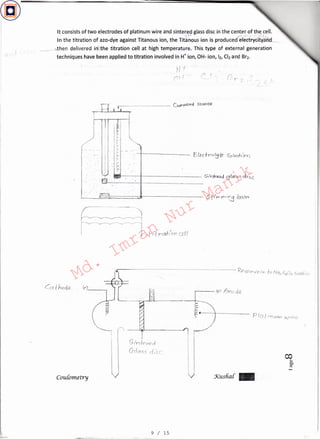
It consistsof two electrodes of platinum wire and sintered glass disc in the center of the cell.
.-/)-* «< ~.,,, ~ .- 1{U
In the titration of azo-dye against Titanous ion, the Tit~nous ion is produced~
~then delivered in-lt:the titration cell .at high temperature. This type of external generation
techniques have been applied to titration involved in H+ ion, OH- ion, Ii, C'2 and Br2.
9 / 15
Md.
Imran
Nur
Manik
,...,
~
8
. Post"'~ orvy.,g_~
It requires a potentiostat and chemical coulometer placed in serieswith working electrode.
The chemical coulometer such as Oxygen-Hydrogen coulometer can be used in the circuit to
measure the quantity of electricity. A schematic diagram of the essential component of the
potentiostat is shown in the figure. Passage of current through the chemical coulometer
liberates the H2 at the cathode and 02 at the anode. Both gases are collected and their total
Couiometrv Xusfia{ -
E..9t.h.......:C. 12-l!.~ f-·======t.____<Mlv::::r:~,
i----t-1'-- ~~] - n '---~-~~
_ . C~+i,,.od.e..
e
S'A~•.oul~.:~·;~
ovv-. cL C2.. C2.C?. .- ,f .R.(l_, f
........... - ....._ .. ,Y.:.•:.,.·,~-·-- ...................... ~._ .... '·.:- •:.~
i-----l ?I ...-----..
Controlled potential coulometric analysis:
a. Unavailability of all possible titrants.
Disadvantages of constant current coulometry:
Advantages ofconstant current coulometry:
( l (;
a. The main advaateges-of-the-censtaat.currentcoulometr-y ever-cenventlonel-titratlotr lie
ln.arees-wberelow concentration or unstable titrants are-tnvolved. - ) , I ' '
b. ·The complete titration can be automated with the ease.
c. Standard solutions are not required.
in classicalvolumetric analysis are eliminated in coulometric analysis.
c. The reagents like Cb, Br2, 12 or Ti are inconvenient as volumetric reagents due to their
instability but in coulometric analysis they undergo reaction immediately after
generation.
J ,.,
r:;ibAdvantages of External generation ofthe titrant:
r
a. Sometimes, the internal generation of titrant interferes with the titration. In that case-it , , r
'
I· N is necessaryto generate the.titrant externally.
/b. Problems associated with preparation, standardization and storage of standard solution
10 / 15
Md.
Imran
Nur
Manik
Kushal' -Cou{ometry
e. Induced backqround current:
This current arisesJwhen' electrode reaction mquce another reaction to take place.
Kinetic as-well-as i~du'cedbackground current~l'thefunction .of electrode reaction and
chemical environment.
d. Kinetic backgroundpJr~ent: )
This current arisesW'henap(cduct of~electrolysis is converted to the other forms. As for
example back to th~tarfing material. Cu2+ H cu+ +-+ Cu.
(-/I I I f l
c. Continuous Faradiac cun;..ent:
tni.s current arises due t5electrolysis some compound of the medium itself. It is the
- --function of the extent of chemical concentration and the controlled electrode potential.
b. Impurity Faradiac current:
) .j .
.~~s current arises from the electrolysis of..impurities,present in the solution. Th~s -is ,., c
minimized bylpurification of the medium.
Background current is -a-ool-let-Uve-tefffl; It refers-to as a current that flows but does not
accompltshedthe desire reaction. The simplest way to minimize the background current is
to utilize ~rge quantity of electroactive ·spade and._g~-~~!..supgQ!!!r:i.g elec_trolyte_;J
- ~(
M / Types of background current: There are 5 types of background current:
a. Charging current:
ii
1- Current require , to change the electrical double laver, existing at the solution-electrode
interface, This may be minimized by adding supporting electrolyte.
I/ i . ,· '
1,.
···l
··'
r
'."l•.,
"'<;
-t,
,,,·
_.,
~g ID/ I Background current:
_eff!ciency.In coulometric analysis, it is desired to attain 100% current efficiency, but the
background current prevents the attainment of current efficiency even when electrolyte
solution is completely free from interfering reactants.
The percentage of total current,that acts to accomplish a particular reaction is called current
- - - - ---- -- - -- ~- - - -
Current efficiency:
volume is measured by determining the volume of liquid displaced. The gas temperature
can be ascertained by providing the water jacket and the thermometer. The total quantity
of the electricity can be measured graphically by measuring the current passing thorough
the cell. The area under the curve that relates these variables yields the desired quantity of
current. Oxygen-Hydrogen coulometer results with an accuracy of ±0.1 % but is is not
accurate in electrolysis less than 10 coulomb. In such microanalysis, the current can be
amplified and more volts should be amplified.
11 / 15
Md.
Imran
Nur
Manik
/
/' Kusha! -Coulometru
c. The end point can be detected either by indicator or bythe potentiostatlc method.
3H20 - Ze" ---7 llz 02 + 2 H30+ (Titrant)
H30+ + B ---7 BH+ + H20
2. Pre~itation and complexometric titration:
a. Coulometrlc precipitation titrations are based on anodically generated Ag+ ion.
b. Mer1:trv_.ions-p~od-ucedat a mercury anode have alsobeen reported.
externally. In case of internal generation the cathode must be separated from the
' l"'l • "' ('
solution in order to.lnterferefrorn the hydroxide ion ·13Foclueedat t-hat-el.ectrndecct I
Coulometric titration of strong
generation at a platinum anode. The generation is possible either internally and
·e· and weak b~e can be performed with H+ ion
b. Base:
1· -' '1-114 -+- n f' - - -
/
I'
Bothweak acid and strong acid can be titrated with a high degree of accuracy using Q_L- • I ,/"i /I { J
.electmgenarated-hydroge.n-ioA.,Thegeneration of hydroxide ion1a~ platinum cathode,
provides the most convenient method. Potentiometric end point or indicator can be
used for this titration.
3H20 + 2e- ---7 H2 + 2 OH- (Titrant)
HA+ OH- ---7 A-+ H20

1. Neutralization reaction:
a. Acid:
coulometry.
e. Amperostatic coulometrv can be employed for the determination of small quantities
with more convenience and accuracy thanl~te~tiostatic coulometry.
(' o'3 Application ofcoulometric titration: ..,./ NP
Q'?1
ess error from background current <~han potentiostatic
/ __..J
during al control current-alectrolvsis.L___ ---r--· - -
b. The 'continuous faradiac curren~ k[Q_etic background currenf andQr:!_duced background
~ -- -- - - - --
.current has a smaller contribution on' control current ~r,;oulometry. These are time
dependedquantities and the electrolysis timeis smaller in amperostatic coulometrv.
c. , Impurity Faradiaccurrent is expected to be of some magnitude4wboth ·arJi;erostatic and
'------- ---potentiostatic coulometry.
-- . ---- --- -
d, ln amperostatic coulometr
I ~1
a.( All types of background current pertain to control current technique to different state. )
1
I Charging current is larger in ~mpefostatlc coulornetrv than the potentiostatic
coulornetrv because of the relatively large variation in generator electrode potential
6R..l!._f:N'i cio-.n.~/ p,,_.:""""""~ I
t)
"JP_yAmpecost~tic=:~try f~ more accu.rate.~~?.n Po~e~1tiostatic coulo1metry
~- I Cf/ c 11 I -r
WAmperostatic coulometry is more accurate than Potentiostatic coulometry because:
12 / 15
Md.
Imran
Nur
Manik
Couiometrq
I
J
i
I
I
I
I
II
3. _lsoniazidE'._ (is6_riic.otinic acid hydrazide) is analyzed by constant current coulometry with
electrically generated bromine.
i ( '•
- ' I
/I I ,
- '
r
f i r • ,.,,
3. Redox titraion:
/
' F
L Controlled potential coulometry has been reported for copper, iron, lead, 02, tin, H202,
ascorbic acid, organic(halc;'}ompound,(6r;;:;ic ~ro}9myound_, ~a,ter,_phenyl mercuric
. v,
ion etc.
,L. -- - -- -
2. The following pharmaceutical compound-lies een studied by the(controllea potential
coulometry: _.,
a._?1.Jnsaturated carbonyl compounds: cart~, hydroMrtisone, prednisone etc.
qo~A~tibiotic~: tet~cteVcline, griseofulyir; oxytetra;ycline. c.JJ)or(_ 1 c r>, v( 1•
n cf:"'!odine compounds~hf~~Jiop~acid, iodochlorohydroxyquinl / o~ ("1 _ r t,
1
d t- !-Jitro compour:ids:ch_loram6henicol, niyd~toin, yv-}-Y) f nn r-..l<•..... _:..--
e~Chloro compounds:_chlcrr~utanol, CH63, tricholorometiazide. J
f(.. Mercurical preservatives: phenyl rr<e;:curic acetate, chtt>ride or nitrate.
'- -
t>d ,· .r
, 11 < ---Eleet.fogenarated bromine has been found to be very much · eful among the oxidizing
J agent The titration of the Arsenic, Antimony and/the H2S ca~ be carried out1electrolytic
/r' <I-co ' •
generation of Br2 or 12• - .>
The coulometric analysis of some oxidizing agent, for example K2Cr207, KMn04 can be 1
. . . . . C Y>'l[Xln//>X,."" ' . . . . . '
earned out by having excess ferric salt m thecgtho :e ~oae~s;,on arrung the oxidizing
agent. k' n .! ( ( ( t I
(:::' t-t !}, (1 ')
Pharmaceutical application of cou/ometry: /-'.b H-,,~ -
Ag+ + er ~ AgCl .!
Ag - e" ~ Ag+ (Titrant)
13 / 15
Md.
Imran
Nur
Manik
Xusfia( -Couiometrq
Amperostat is an instrument by which controlled current is supplied.
tJ6 Amperostat:
Potentiostat is an instrument by which controlled potential is supplied.
61:, Potentiostat:
The name chronopotentiometry is derived from the fact that a constant current is applied to
an electrode and its potential is measured against some reference electrode as a function of
time.
i >KC
Chronopotentiometry which is sometimes called voltammetry at constant current is carried
out controlling the current to the working electrode. The value of the constant current
chosen is greater than the diffuser current of the electroactive species.
Chronopotentiometry:
Voltammetry is an analytical technique in which a constant current is applied to an
electrode.
Voltammetry:
This process is known as electrolysis. It is the basic for the instrumental techniques
coulometry and chronopotentiometry.
a. Mass transfer of the electroactive species to the electrode surface under a
concentration grading.
b. The transfer of the one or more electron to the electroactive species,
c. The removal of the products.
The passage of direct current between a metallic conductor and an electrolytic solution,
cause a chemical reaction to take place at the electrode surface by the following steps:
Electrolysis:
14 / 15
Md.
Imran
Nur
Manik
y
15 / 15
Md.
Imran
Nur
Manik

Coulometry Manik

  • 1.
    Written By Department ofPharmacy University of Rajshahi Rajshahi-6205, Bangladesh
  • 2.
    ~~ ~14.~ sn~ ~~:o;;...c,9_..06_5..;;.;93:...::.g-------- ~Mr~~~I .:» . • _ ~,~·Mt 1'4JJ1~; ~(g21'lf~) 1 / 15 Md. Imran Nur Manik
  • 3.
    J ~oul~ !0 -t~mcums: 8'vem doU!__tj·""u.p i;:j .d-Pc.h-ni~~rn. -~ji_W_~i!!:J)-thttJ-5Cl1lJ._ ~ -& ~~ curm_llhli- j- rm~ iY>(l/11/)±!'MJ ~. e_1!=~~'-_-~0'0!11 ~ _ 'YM-a~ t~~cwnl oj eh~ ~·,_:-"nrJu.rmJ-d_~ 1p'POrhl_~ - r , _./ Couiometrq The proportionally constant is the Faraday ~F~ which has the value of 96500 ceulornbs c"".'"' equivalent-to the lgm equivalent of any element if 100%efficacy of the reaction is occurred. ~- ~{. /' • 1 • ' j ·r · / 1/1- (/i"t. 11 'I J.. (I <7 /}( 0/' I~, W = weight in grams~n! species,1 1 v' · • · ' Q=numberofcoulombsused,/, - 1.Urr d' 'f clrr I,. /) ''>', . ,. ...,, !,- /(tu•f. ~ I ~ -~""J Jr c- , .. 'r1J ,J Kushal' - i I// I'... ·l A cJ7}f3- Principle ofCoulometry: .su ,., ·~;,.tr< -/hr 1 •:t Coulometric analysis is based on the measur'-1ien~of the tWality-offelectricity that passes-a ~ l c I (;(llti/11.' ' l{1r1:.( -/SV. SOIUtiOn aeaHrl- the electrochemical reactio . he principle of,.coulometric analysis is based o! ctr (-1 • I!Jn•':~ d d.( f) ~ ....{_~[:_ .-l/1.~~ • · •1 on the Faradays La~1 which is-exprassea-aS'ltha~the extent ot el&trochemical reaction-at '1 • • • · t ! · ( I r t .-;,- • ..:a-Ay-elec;trnde' is directly proportional to the -quaRt+ty-of electrkity/passingthrough the ./ / I J .?:.: electrode.,/ { ~ r , . 0 _,r- 1 ~ ' j) • ! ,, : / I • r Electrical storage cell, b. A coulometer, c< r cc n-fc~ { ( ((' · 1/ • c. An electrical half-cell containing a suitable working electrode to introduce the electrons into the solution. detector,/~ necessa @_Jee~ f_!10nitorl!1~~ig~I i(lt_p-~control ,.9-evice.-/, "t.,.J)o 1.Q -Li:» 1 ·~ ~ulr:rnd< r r-u'· ' - ' (fh Coulometry: ff i: hen'~' lr'chyiir11JJ, c:-1 r f; Coulometry is essentially a titrirnetric-enelvsiswhere electrons are used as the titrant. There are 3 components ot·@oulometric setup: t_ ·-t /, : nn/.- ; (II { ( L 1'',, If, 9 x 10⁹N force/ is applied on two equal charges which 'Gne -present in the vacuum medium, then lscharge is considered as unit charge and this unit charge is called coulomb./I"' ' - I I . t J If, ( ' ,,(1 -Then, q2 = 1. ,- , r The unit of charge is called coulomb. From the coulombs law, ilhv.a-GYUA'H"l'le~'illm ~ I ' . I / ' / 1 q1q2 ,. f ' i ., l"'f1'"' ? Co> .' t ~·,·f.o = 4rr Eo 7 .. ~' jr-:111·. F0= 9x10⁹N "C- > q1 = q2 = q = Coulomb, ~r = lm, ,~ <'~· Coulomb: 6f, , ~'<'O'~ Coulometry ' 401, 1 "I ·rr;r j, - 9-on:5J :J/ c· Ebc-h .' 2 / 15 Md. Imran Nur Manik
  • 4.
    -Coulomeiru I .,,.] t?D1u(.,..moa» If I M , /! .1rn elf c! r~ () ', ... Kusha! -( A,c the . . cvncJ.l[ ··r~ . 1 he 11o;u,-:fhus coulometnc methods are those -analyS1s methods which are based on measurement of.1:he quantity of~l~ctricity,and-the application of the above equation. ~ . -LJ..aA A =Atomic weight of the element, Q =Coulombs of electricity,pa .. Kd -l~11r u h Lt r ~ 1,, -l · • l n = Valency of the element. =Weight of the element, cl r -( d ,.,,, -If( (cc f' cl(wl Here, AQ W = _n_x_96_5_0_0 ) ' ; c. From this dlscusslon it ;[We"tt-ev.ident-that, if 'o'.'coulombs of electricity have been passed· '.' r• •c J the solutionlJt~1'weight of the selutien-0Hh~lement1W1'deposite~ will be expressed by the following equation: l ~ (I) J- Secondary coulometric anaf.y_sis: (iy-, r1 ,·, ·1<1 r r ~'Lorine-I, , r1 r ,,, ' 1 , r'' The substance 10;.if°czr~~ fz~~~s quantitatively -ffi-st>MicH:t-jVith ~L~i..n~c17~}lrpd 7t(°h., 1 !tr,,.( .f ? electrolysi . This method is called 'secondary coulometric analysis I ne 'ofThe troduct' rr,{ 11 I • • (5u} J' c..fr1'1 reacts-Withlhe_s_uhstance...to-be-estim-atecl-anrl-the process is carried11unde~constant controlled condition ancfa»ri end point indicator is also required. I[ 00 2. 11 There are two kinds of coulometric analysis: c ~ . I .!'"ff' ' Ir , c ,. . Primary coulometricanalysis: " The substance of interest maybe oxidized or reduced at one of the electrode of the · J( </ • electrolytic cell. This analvsis-sirnplv called primary coulometric analysis': In this analysis the substance reacts at an electrode which is maintained at~constant potential and-/L- current gradually decreasecsffi€~he substance is removed from the solution. l / 69. 1. 0-)Here, Nr =Total number of coulombs used to promote the desired reaction, Nt =Total number of coulombs passed. 100Nr Current efficiency= -- Nt n = number of efectro'!)l:l-SM in the reaction. The fundamental requireme-nt~/:~~ometric analvsis.Is the electrolysis reaction.proceeds with 100% efficacy. ' I I Y' ",:,,; M = molecular weight, !':; JMtM 3 / 15 Md. Imran Nur Manik
  • 5.
    M<l) coC1l ....... '{ 1 •• Kusha! -Coulometrv In secondary coulometry the substance of interest react quantitatively i-A--soltffiefl. with a single product of electrolysis. i <KC "'d(11'lf r ocLr=r 1:_;1r r: • 1rri'i((}' ','( -{'/ 'r '':t:Jt. J ·-1 -Secondary-ceulometry'-involves the indirect use of/electron titrantito electrogenarate ii chemical tltrantsjas indicated by the following equations: Reduced species, -net'~ oxidised species(titrant) Yl<Z Oxidised species, +~e-~ Reduced speciesttitrani) i : !' /. r : . 11.,.: I ~,, !hr }Jo·lr r· d.-1(/wr.1 r I 17( _Lr Ir I • , t l 1 I/ r r-r '11 l '· I· · · . ,. ~ 1 " • < 2B·01·12.What doyou mean by primary and secondary coulometry? Qfi... J.Qo~ 2- 2g.o r"=Pri'marycoulometry: (d/n€cA n11.d Or -b·~a f-t'on) r J 7 c , ' i ~ I r tt ' I ~- 1' (e1111) t. "! Primary coulometry (Rvtedtiostatic coulometry) is carried out by controlling~'the.potential 'of '-..:.:::-'". ;JIv ~ r: the working .electrode to limit the half-cell reaction to the one being studie ""1n51electro ysis -J. c i;erc'YT<C ,, " "-.. current 'i' .being proportional to the bulk concentration C of the substancef '>.{ k i <X:C!.. WluflD, .L' ( "f.u c ~ LA'IJJ... (f i = KC I<. = 'Pncpon l' &f'l'ICL ''J o'YI,, "'~ -i: (j' ~Jrimary .~pulometry is limited to the direct titration of 1¬ 1ect~o~activ~ substances, with · electrons, f~ll into the redox type of titration:?ct..h9atj M 1 rid-1 ((1 Ir -I ·"_J' , •• / • ' • • Reduced species, -ne"(titrant) ~ oxidised species e Oxidised species, +#(titrant) ~ Reduced species -~ . (-!)) The substance of interest may be oxidized or reduced at one of the electrode of the ~ electrolytic cell. Qg.oy. Sic~i:!arycoufometry: (Irnd.i~-1:: m..d-o~ -f:r'tr>ab"o~ - ~r.., r.; r: .., 1 l 1 J -, '{'£ .,-1,.. · rt ,,.., a;mp¬ o'*- Clff()pe1TV~il Ct)-- Of> 1.. n · Secondary coulornefrv (arnphostatic coulometry~is frequently referred-tc?fhe''coulometric titration"which is carried out by"controlting the current'1to the working electrode. The potential of the working electrode is controlled· indirectly /by maintaining the electrolysis current ~ta level, where it can never be· limited by .the rate of diffusion of the electroactive '- - ' ........----- "'"" ~ ·" -ll.£ . substance: Thus the currentis less than tha)or,.controlled potential analysis.. e ~c.tno~s,·~ , 4 / 15 Md. Imran Nur Manik
  • 6.
    ·I I 11r,1,...,uf1J Xusfia{ - '' ' I r 1-4-'l-+'"H • I r • • L-1-li-+-I-+ ' • • • ~ ..............I. I <, .: ,., •--rl ( 1~) l/{.-/ L c / AqNC3 Sr uFc r: Coulometrv After electrolysis the electrolyte is taken out, t j ---~f) -JL »>: -~~____________@.o] - 12 Coulometer: 2 g, °61J'-"1iilver Coulometer: ~ It consistsof a platinum or silver vessel which C, r./ · 1'1 acts as a cathode and OOftuttrttflg-awJ.utiGn--e-f- g.t<cftJrfl am:4'9-lii (]Yi} .t[( pure AgN03, aS11electrolyte. At first/:A:gN03 is ._,,Co LU-liiSY' purified by repeated crystallization from acidified solution. joUowed ~ fu!)l'cm. The' ~hl-00.-JigNO(;;[;~~~contain 10- 20gnf$altin 100ml solution. /) '.) A rod of pure 'silvef-"'enclosed in a porous lMl. supporgacts as-anode. '*- Oxygen-Hydrogen Coulometer, .,._ SilverCoulometer, ~ Iodine Coulometer. There are various types of coulometer: e. an b. One of the products n!acts with the- at sl:lbstanee~5 be estimated and the precess is carried un~e~ constant controlled condition aad aR eRd poiRt im;liGater is also req1.1ired C»JJrW d. It is a slow process.It is a rapid process. a. The substance of interest reacts quantitatively in solution with a single protfuct of electrolysis. This method is -~~~ledsecondary coulometric analysis. _/ A<'f'V'- f>t.t1..0S4-u...~'c_ Co<llt>w-..P..~ ~wnf CWlll ,j C~vtltJ md'nj . b. IA--t-his-aAa-1-ys-is-tl=ie--s-tJ bstance reao eleet1 ode which is maintained constant potential. ~-te(.,t-r-i•k c. ln-thi-s-analysis-f)fOees-s-ettffer-rt gradually c. Ifl-this-analysis-process.current-ls-ea=led decreased since the substance is j '.Ul1d"ei;;constant controlled condition. removed from the solution. /. I ( t' '.' I f"' a. The substanceof interest maybe oxidized or reduced at one of the electrode of the electrolytic cell. This analysis simply called primary coulometric analysis. Primary coulometric analysis , I 1 c-i'. j 1)'J 1)-'1 -~ 2 g '07. 12 }IDifference between Primary coulometric analysis and Secondary coulornetric analysis: Secondary coulometric analysis l 5 / 15 Md. Imran Nur Manik
  • 7.
    ( 2. Contra (Stentialcoulometric a11J1/ysiJ: . --- - I - . J• I The substance· being-determined reacts ~i,th 100% efficacy at-working elect~ode-~T-he ,.., J potential ~wl:i1c~s- controlleaT"'The~;r;.pl~tl~·~~f the reaction can be-~tJi~ed by the current.'decr~asmf$fctctitally to zero.f,The~~u~t~fA~ ~eactan!)can be c0-luilafed ~- - -- --.......1 .._-:e:;omp.1¬ tte,c1either from( !_he reading of a coulometerJ or by means of a current tlrne ~ating devise, When the current is theoretically zero then the reaction tends to -completed.- ~Yr 1- 1,., ~ / , , , -e er- 1 J " r i. 1 • ~ 'fY'1' 1 ~ / oj CIJ_ 091o({eneral,pro erties of tn(l)-_,eoulometriclan~sis: 8'th, oj thR . ( C1/l1:j~ 1 /' Coulometric techniqueifveJaccurate and precise result tharrother classical method. @'!Coulo-rnl:fr-..tob. :Oi&;>methocbbecomeJ more accurate,becauset~ectrical cu_rrent can be controlled and measured with greaiprecessionthan{):oll:Htle-ef-sel~tioo~'aLurn£f r>i'c ~d 6l}hfoulometric techniques are suitable for both (outine and remote analysis. . Couiometrq _,, 1 ; Xusfia{ - One of the titrant is produced at electrode which reactswith the ion to be estimated · a. P.rll!lQry_C_Q!2stant current GCJulemet:FiG-analy.sf.s-;. 1 The element to be esttmated.undergoes direct reaction to the electrode with 100% current efficiency. ~ Second a constant current eg.ufometr-tc-anu./- -sis: I - In this techniq ~he s3lution o substance to badetermtned.Is electrolyzed. T~e - ,JQ,I <2<-.fl?d I r. , • ( completeness of the reaction can be -0.e.ter-m.iRed.:illy the visual indicator and.circult is then.opened. The amount of electricity is derived from th_~pr<l.d..lJ~Lafa111.pere .and time. - ;This method is also divided into two parts: "''- , ,,,g. Constant current coulometric analysis, ~ WRmwpotential coulometric analysis. 0.011~1ed (ccms-tam.l]' ..l: Constant currentsou/Q_metFiG analysis: There are two distinct types of coulometric analysis: -f.o9.J2 5aJ 1 faraday of electricity {96500 coulombs)= 107.88gm of Ag+ ion deposited; 2s·o1·1?. w·e13hD..d gr'vef) ,1,.I the vessel }s washed, dried and "'Weigl'lt-ed. The increase/ in weight Jnd~her si!ve-i:-/Yj -i- deposited/~ow, remaining the value of 96500 coulombs which is also called 1 Faraday of / electricity ~eposited 107.88gm of Ag;). The quantity of electricity that is passedthrough the solution can be calculated from the following relationship: 6 / 15 Md. Imran Nur Manik
  • 8.
    Xusfia{ -Coufometry 0g 10/I Intern qigeneration of the titrants: ' » f ·. ', It is possible to estimate thiosulfate with iodine generated internally with Kl at the anode.I . This titration cell consists of a generator electrode at which the reagent is formed and second electrode is used to complete the electrical circuit. An excessof Kl is added to the thiosulfate solution taken in an electrolytic cell ancfronstant current is allowed to pass thorough the cell. Iodine liberated at the anode reacts with thiosulfate. The titration can be One titrant react with analyte-itPer-dinarytltTati'Crn-withthe differenee Jnstead of adding the titrant from a burette, it is quantitatively generated at an electrode. The titrant substance is generated either internally or externally. )· I . In coulometric titration small quantities of reagent is required. I I - r ·canstant'current coulometry or coulometric titration: 1-, . Standard solutions are not required for the coulometric analysis. The titrant is ~----· ~neratec!_.either in~ernall~~xternall~his.fan give accurate and precise result _ tha~ ot er classical method. , R. ~ +eclirvauu: l>-lrirtl-rm Qa.f>ILlJ0<., I b ·.J:i.tf-ant can be carried out-autcrnatlcallv . .L· 1,·,p. je>~" oonrerr_-lr>-t1.J1on of />Uoo ct.me.Pl) c. Very small quantitieSICan be analyz~;rby coulometrv. 1, z .· This method becomes ~ acc~i:te because electrical current can be controlled and measured with great precession thanvolumeofsolution. - - 5.<!J.r· Coulometric techniques are suitable for both routine and remote analysis. G. :q' Many titration can be performed coulometrically which cannot be performed by the classicalmethod. e.g. ~ Titration in melted salt medium, ~ Titration of highly hazardous material, 1*. Titration which utilize unstable titrants such as Br, Cl, Ag, Sn, Cr etc. to workout analysis. xJ k & , .s.r! {,'I 1 =r":': rrf •d .t; I I. err.cl rrn•iu , (1.;,/nt1/u·1•.·; f¥>cz_r(l_j c-l}: -fi'fr>qi1cml) <a-n c,), ~.. 1 '••rrm c ·,... .Le;• J @.~1anytitration can ~~,performed cou!ometricaliy whic~annot be performed by the classicalmethod. e.g. . • • • y( cJtr.·..,.-., • • ~ Titration in melted salt fftea: ·~~~(h-,' .i, Q •rl!!!H,i7"~ ( J •., r ~ Titration of highly hazardous material . ,.... '*- Titration;which utilize%nstable1titrants suc.h a~ Bi;_ Cl12,..A~1~Sn~i-Cr~ .1 e-werkout ana~y.SiS.· 0C'r> .µJ •.<tf..T 1 c r<t - r, ;Q 112cl · t-0r'deU/ I i- " '.: l • ~ Centro] current technique ha~"been-used than controU'ffotential techniqu5 because ~-h¬ -cor:itr:olcur:r.ent-techr:iiqu~is faster.,aAEl--furequires simplej, ift-f.emiatio+:i and #-is ~Qf f ~1'.,..r;,/n•tm(vr4~1 less expensive. lPJ_QI C ( ..../0 tier/ C (u111lYn./ · ./« n ,':l.._,.,, Ca, h{: ,-rl" -n c<? e:« Jo n-n.m1j , , I - '1.:). c 1 ~' . . ) lh'C6ulometric titration mall qua~tities of reagentis-r-eft·l!"l·i~ <?y lL 1 c» c 1 tno t: I a -ryJ pncr ,· - ~ nurt,.Uft( 1.00.12 (}}Advantages of coulometry: 7 / 15 Md. Imran Nur Manik
  • 9.
    Xusfia{ -· ft<>--~~ "5PI~' (HfV'.o~ 1- _0 j - J Coufometry 0609 Externalgeneration of the titrant: by the amount of electricity generating iodine, i.e. I = g_.T _---?' ~~~~~.a c;?oW ~~o~ --~ ~ ~'V·S'..Q.('l.A.. d. 0.e>..S..S fu~n.o.:-on 12.Ute?.-.vi 0 LJ.... ~~n...rucr b °''L I performed by adding starch whereby a blue color is obtained. Two electrodes are separated by a porous compartment. Dissolved 02 removed by passing N2 through it. Current passing through the cell is maintained within 0.1% by choosing a DC volt source and including variable resistance to the circuit. The end point can be detected by chemical indicator such as starch +n-the-titratien-against· a blue color is obtained as soon as all the reducible substance is exhausted. At the end of titration the amount of thiosulfate can be calculated 8 / 15 Md. Imran Nur Manik
  • 10.
    s1'-n I(' r>Pd G-rlossc{,·sc Kushal: - ~-: ~ ~---,.....,,__.~~-~--~~--<1--_ • • I-L 1-tr>af:,,r a Cou[ometry (:-) _ mt---,--1--------- SrTz:lauid f2j{a,r,CJ d..JSC , c.. c .---- 1"' tJ I ('' I It consistsof two electrodes of platinum wire and sintered glass disc in the center of the cell. .-/)-* «< ~.,,, ~ .- 1{U In the titration of azo-dye against Titanous ion, the Tit~nous ion is produced~ ~then delivered in-lt:the titration cell .at high temperature. This type of external generation techniques have been applied to titration involved in H+ ion, OH- ion, Ii, C'2 and Br2. 9 / 15 Md. Imran Nur Manik
  • 11.
    ,..., ~ 8 . Post"'~ orvy.,g_~ Itrequires a potentiostat and chemical coulometer placed in serieswith working electrode. The chemical coulometer such as Oxygen-Hydrogen coulometer can be used in the circuit to measure the quantity of electricity. A schematic diagram of the essential component of the potentiostat is shown in the figure. Passage of current through the chemical coulometer liberates the H2 at the cathode and 02 at the anode. Both gases are collected and their total Couiometrv Xusfia{ - E..9t.h.......:C. 12-l!.~ f-·======t.____<Mlv::::r:~, i----t-1'-- ~~] - n '---~-~~ _ . C~+i,,.od.e.. e S'A~•.oul~.:~·;~ ovv-. cL C2.. C2.C?. .- ,f .R.(l_, f ........... - ....._ .. ,Y.:.•:.,.·,~-·-- ...................... ~._ .... '·.:- •:.~ i-----l ?I ...-----.. Controlled potential coulometric analysis: a. Unavailability of all possible titrants. Disadvantages of constant current coulometry: Advantages ofconstant current coulometry: ( l (; a. The main advaateges-of-the-censtaat.currentcoulometr-y ever-cenventlonel-titratlotr lie ln.arees-wberelow concentration or unstable titrants are-tnvolved. - ) , I ' ' b. ·The complete titration can be automated with the ease. c. Standard solutions are not required. in classicalvolumetric analysis are eliminated in coulometric analysis. c. The reagents like Cb, Br2, 12 or Ti are inconvenient as volumetric reagents due to their instability but in coulometric analysis they undergo reaction immediately after generation. J ,., r:;ibAdvantages of External generation ofthe titrant: r a. Sometimes, the internal generation of titrant interferes with the titration. In that case-it , , r ' I· N is necessaryto generate the.titrant externally. /b. Problems associated with preparation, standardization and storage of standard solution 10 / 15 Md. Imran Nur Manik
  • 12.
    Kushal' -Cou{ometry e. Inducedbackqround current: This current arisesJwhen' electrode reaction mquce another reaction to take place. Kinetic as-well-as i~du'cedbackground current~l'thefunction .of electrode reaction and chemical environment. d. Kinetic backgroundpJr~ent: ) This current arisesW'henap(cduct of~electrolysis is converted to the other forms. As for example back to th~tarfing material. Cu2+ H cu+ +-+ Cu. (-/I I I f l c. Continuous Faradiac cun;..ent: tni.s current arises due t5electrolysis some compound of the medium itself. It is the - --function of the extent of chemical concentration and the controlled electrode potential. b. Impurity Faradiac current: ) .j . .~~s current arises from the electrolysis of..impurities,present in the solution. Th~s -is ,., c minimized bylpurification of the medium. Background current is -a-ool-let-Uve-tefffl; It refers-to as a current that flows but does not accompltshedthe desire reaction. The simplest way to minimize the background current is to utilize ~rge quantity of electroactive ·spade and._g~-~~!..supgQ!!!r:i.g elec_trolyte_;J - ~( M / Types of background current: There are 5 types of background current: a. Charging current: ii 1- Current require , to change the electrical double laver, existing at the solution-electrode interface, This may be minimized by adding supporting electrolyte. I/ i . ,· ' 1,. ···l ··' r '."l•., "'<; -t, ,,,· _., ~g ID/ I Background current: _eff!ciency.In coulometric analysis, it is desired to attain 100% current efficiency, but the background current prevents the attainment of current efficiency even when electrolyte solution is completely free from interfering reactants. The percentage of total current,that acts to accomplish a particular reaction is called current - - - - ---- -- - -- ~- - - - Current efficiency: volume is measured by determining the volume of liquid displaced. The gas temperature can be ascertained by providing the water jacket and the thermometer. The total quantity of the electricity can be measured graphically by measuring the current passing thorough the cell. The area under the curve that relates these variables yields the desired quantity of current. Oxygen-Hydrogen coulometer results with an accuracy of ±0.1 % but is is not accurate in electrolysis less than 10 coulomb. In such microanalysis, the current can be amplified and more volts should be amplified. 11 / 15 Md. Imran Nur Manik
  • 13.
    / /' Kusha! -Coulometru c.The end point can be detected either by indicator or bythe potentiostatlc method. 3H20 - Ze" ---7 llz 02 + 2 H30+ (Titrant) H30+ + B ---7 BH+ + H20 2. Pre~itation and complexometric titration: a. Coulometrlc precipitation titrations are based on anodically generated Ag+ ion. b. Mer1:trv_.ions-p~od-ucedat a mercury anode have alsobeen reported. externally. In case of internal generation the cathode must be separated from the ' l"'l • "' (' solution in order to.lnterferefrorn the hydroxide ion ·13Foclueedat t-hat-el.ectrndecct I Coulometric titration of strong generation at a platinum anode. The generation is possible either internally and ·e· and weak b~e can be performed with H+ ion b. Base: 1· -' '1-114 -+- n f' - - - / I' Bothweak acid and strong acid can be titrated with a high degree of accuracy using Q_L- • I ,/"i /I { J .electmgenarated-hydroge.n-ioA.,Thegeneration of hydroxide ion1a~ platinum cathode, provides the most convenient method. Potentiometric end point or indicator can be used for this titration. 3H20 + 2e- ---7 H2 + 2 OH- (Titrant) HA+ OH- ---7 A-+ H20 1. Neutralization reaction: a. Acid: coulometry. e. Amperostatic coulometrv can be employed for the determination of small quantities with more convenience and accuracy thanl~te~tiostatic coulometry. (' o'3 Application ofcoulometric titration: ..,./ NP Q'?1 ess error from background current <~han potentiostatic / __..J during al control current-alectrolvsis.L___ ---r--· - - b. The 'continuous faradiac curren~ k[Q_etic background currenf andQr:!_duced background ~ -- -- - - - -- .current has a smaller contribution on' control current ~r,;oulometry. These are time dependedquantities and the electrolysis timeis smaller in amperostatic coulometrv. c. , Impurity Faradiaccurrent is expected to be of some magnitude4wboth ·arJi;erostatic and '------- ---potentiostatic coulometry. -- . ---- --- - d, ln amperostatic coulometr I ~1 a.( All types of background current pertain to control current technique to different state. ) 1 I Charging current is larger in ~mpefostatlc coulornetrv than the potentiostatic coulornetrv because of the relatively large variation in generator electrode potential 6R..l!._f:N'i cio-.n.~/ p,,_.:""""""~ I t) "JP_yAmpecost~tic=:~try f~ more accu.rate.~~?.n Po~e~1tiostatic coulo1metry ~- I Cf/ c 11 I -r WAmperostatic coulometry is more accurate than Potentiostatic coulometry because: 12 / 15 Md. Imran Nur Manik
  • 14.
    Couiometrq I J i I I I I II 3. _lsoniazidE'._ (is6_riic.otinicacid hydrazide) is analyzed by constant current coulometry with electrically generated bromine. i ( '• - ' I /I I , - ' r f i r • ,.,, 3. Redox titraion: / ' F L Controlled potential coulometry has been reported for copper, iron, lead, 02, tin, H202, ascorbic acid, organic(halc;'}ompound,(6r;;:;ic ~ro}9myound_, ~a,ter,_phenyl mercuric . v, ion etc. ,L. -- - -- - 2. The following pharmaceutical compound-lies een studied by the(controllea potential coulometry: _., a._?1.Jnsaturated carbonyl compounds: cart~, hydroMrtisone, prednisone etc. qo~A~tibiotic~: tet~cteVcline, griseofulyir; oxytetra;ycline. c.JJ)or(_ 1 c r>, v( 1• n cf:"'!odine compounds~hf~~Jiop~acid, iodochlorohydroxyquinl / o~ ("1 _ r t, 1 d t- !-Jitro compour:ids:ch_loram6henicol, niyd~toin, yv-}-Y) f nn r-..l<•..... _:..-- e~Chloro compounds:_chlcrr~utanol, CH63, tricholorometiazide. J f(.. Mercurical preservatives: phenyl rr<e;:curic acetate, chtt>ride or nitrate. '- - t>d ,· .r , 11 < ---Eleet.fogenarated bromine has been found to be very much · eful among the oxidizing J agent The titration of the Arsenic, Antimony and/the H2S ca~ be carried out1electrolytic /r' <I-co ' • generation of Br2 or 12• - .> The coulometric analysis of some oxidizing agent, for example K2Cr207, KMn04 can be 1 . . . . . C Y>'l[Xln//>X,."" ' . . . . . ' earned out by having excess ferric salt m thecgtho :e ~oae~s;,on arrung the oxidizing agent. k' n .! ( ( ( t I (:::' t-t !}, (1 ') Pharmaceutical application of cou/ometry: /-'.b H-,,~ - Ag+ + er ~ AgCl .! Ag - e" ~ Ag+ (Titrant) 13 / 15 Md. Imran Nur Manik
  • 15.
    Xusfia( -Couiometrq Amperostat isan instrument by which controlled current is supplied. tJ6 Amperostat: Potentiostat is an instrument by which controlled potential is supplied. 61:, Potentiostat: The name chronopotentiometry is derived from the fact that a constant current is applied to an electrode and its potential is measured against some reference electrode as a function of time. i >KC Chronopotentiometry which is sometimes called voltammetry at constant current is carried out controlling the current to the working electrode. The value of the constant current chosen is greater than the diffuser current of the electroactive species. Chronopotentiometry: Voltammetry is an analytical technique in which a constant current is applied to an electrode. Voltammetry: This process is known as electrolysis. It is the basic for the instrumental techniques coulometry and chronopotentiometry. a. Mass transfer of the electroactive species to the electrode surface under a concentration grading. b. The transfer of the one or more electron to the electroactive species, c. The removal of the products. The passage of direct current between a metallic conductor and an electrolytic solution, cause a chemical reaction to take place at the electrode surface by the following steps: Electrolysis: 14 / 15 Md. Imran Nur Manik
  • 16.