Pharmacognosy
Lecturer
Department of Pharmacy, NUB
CELL
Definition:
The cell (from Latin cellula 'small room') is the basic structural,
functional, and biological unit of all known organisms.
➢ A cell is the smallest unit of life.
➢ Cells are the smallest units of life, and hence are
often referred to as the
Cells are called as the structural and functional unit of life because all the
living organisms are made up of cells and also all the functions taking
place inside the body of organisms are performed by cells. Cells provide
the specific conditions, for the occurrence of the metabolic reactions.
M
d
.
I
m
r
a
n
N
u
r
M
a
n
i
k
Cells are of two types: eukaryotic, which contain a nucleus, and prokaryotic, which do
not. Prokaryotes are single-celled organisms, while eukaryotes can be either single-
celled or multicellular.
Structure of the Plant Cell
1. Cells vary in size and
shape.
2. In shape they may be
spherical, oval, polygonal,
rectangular or elongated.
3. The average size of a cell
varies from 10-100 µm.
M
d
.
I
m
r
a
n
N
u
r
M
a
n
i
k
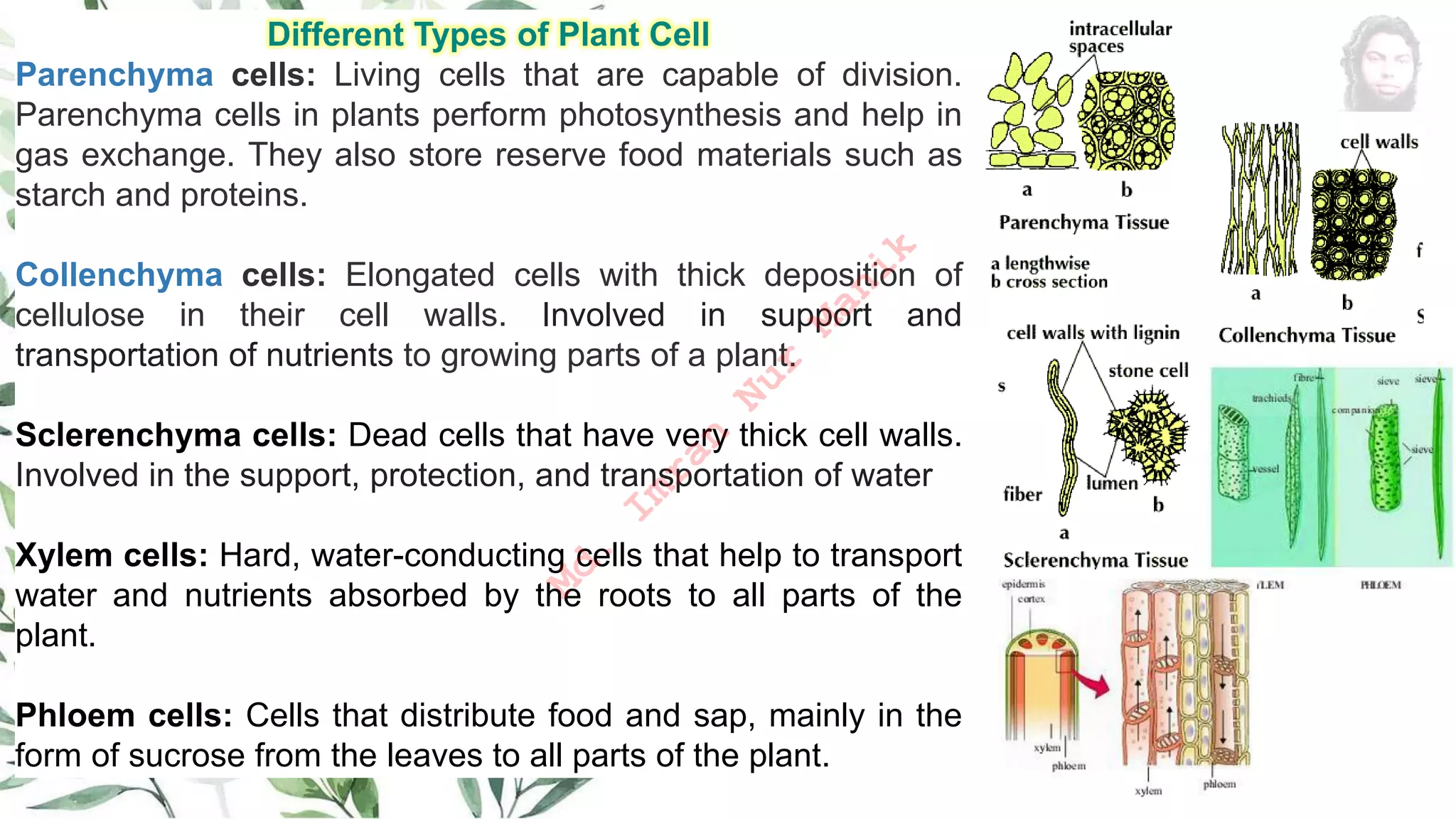
Different Types of Plant Cell
Parenchyma cells: Living cells that are capable of division.
Parenchyma cells in plants perform photosynthesis and help in
gas exchange. They also store reserve food materials such as
starch and proteins.
Collenchyma cells: Elongated cells with thick deposition of
cellulose in their cell walls. Involved in support and
transportation of nutrients to growing parts of a plant.
Sclerenchyma cells: Dead cells that have very thick cell walls.
Involved in the support, protection, and transportation of water
Xylem cells: Hard, water-conducting cells that help to transport
water and nutrients absorbed by the roots to all parts of the
plant.
Phloem cells: Cells that distribute food and sap, mainly in the
form of sucrose from the leaves to all parts of the plant.
M
d
.
I
m
r
a
n
N
u
r
M
a
n
i
k
Plant Cell Versace Animal Cell
M
d
.
I
m
r
a
n
N
u
r
M
a
n
i
k
Feature Plant Cell Animal Cell
Size Usually larger with distinct outlines Usually smaller with less distinct boundaries
Shape Rectangular Spherical
Cell wall Present (made of cellulose) Absent
Cell membrane Present internal to the cell wall Forms the boundary of the cell
Plasmodesmata Present Absent
Cytoplasm Not so dense; thin lining of cytoplasm Denser and more granular
Centrosome Absent Present
Centriole Absent ( except motile cells of lower plant) Present
Vacuoles Large and permanent Small and Temporary
Plastids ( Chloroplast) Present Absent
Lysosomes Rare Present
Storage material Starch Glycogen
Plant Cell Vs. Animal Cell
M
d
.
I
m
r
a
n
N
u
r
M
a
n
i
k
Cell Wall
• It is the outermost covering of the cell having a thickness of 20-80 nm and
encloses the cytoplasm and the vacuole.
• The primary cell wall is a permeable flexible structure and is capable of
elongation.
•Cell walls are made up of carbohydrates such as cellulose, hemicellulose, and pectin
and a complex organic polymer called lignin.
•Provides mechanical strength, support,
and rigidity to the cell
•Builts the shape to the plant
•Allows selective entry of small molecules
inside the cell while preventing large
molecules
•Protects the delicate inner organelles from
outer shock
Function
M
d
.
I
m
r
a
n
N
u
r
M
a
n
i
k
Plastids
Plastids are double-membrane organelles which are
found in the cells of plants and algae.
There are three groups of plastids: Chloroplasts,
Chromoplasts, and Leucoplasts
(a) Chloroplasts: which are green-colored plastids
found in the green parts of plants.
They contain a green pigment called chlorophyll, is
actually a mixture of four different pigments, viz.,
chlorophyll a (blue-black), chlorophyll b (green-black),
carotene (orange-red) and xanthophylls (yellow).
Chlorophyll is essential to the plants for manufacturing
carbohydrate food by the process of photosynthesis.
M
d
.
I
m
r
a
n
N
u
r
M
a
n
i
k
(b) Chromoplast: which are variously colored plastids, found in the colored
portion, which occur mostly in the petals of flowers and in fruits.
which are colorless plastids, found mostly in the storage cells
of roots and underground stems.
•Absorption and conversion of light energy into chemical energy to produce
food in the form of carbohydrate by a process called photosynthesis (Chloroplast)
•Providing defense against infections (Chloroplast)
•Helping in the production of high energy phosphate molecules, ATP (Chloroplast)
•Storing of protein, lipid, and starch (Leucoplasts)
•Synthesizing and storing colored pigments (Chromoplast)
Function
M
d
.
I
m
r
a
n
N
u
r
M
a
n
i
k
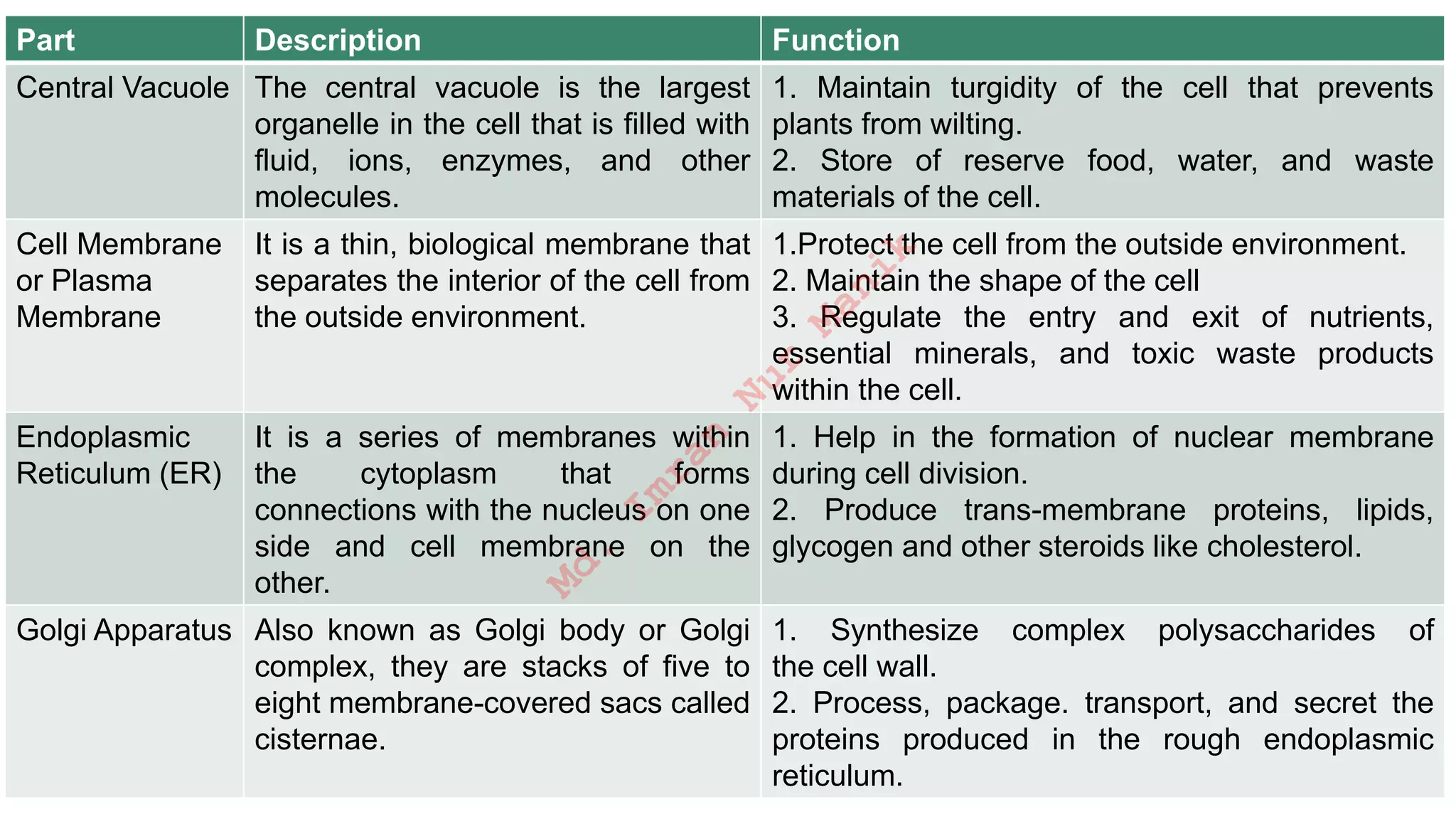
Part Description Function
Central Vacuole The central vacuole is the largest
organelle in the cell that is filled with
fluid, ions, enzymes, and other
molecules.
1. Maintain turgidity of the cell that prevents
plants from wilting.
2. Store of reserve food, water, and waste
materials of the cell.
Cell Membrane
or Plasma
Membrane
It is a thin, biological membrane that
separates the interior of the cell from
the outside environment.
1.Protect the cell from the outside environment.
2. Maintain the shape of the cell
3. Regulate the entry and exit of nutrients,
essential minerals, and toxic waste products
within the cell.
Endoplasmic
Reticulum (ER)
It is a series of membranes within
the cytoplasm that forms
connections with the nucleus on one
side and cell membrane on the
other.
1. Help in the formation of nuclear membrane
during cell division.
2. Produce trans-membrane proteins, lipids,
glycogen and other steroids like cholesterol.
Golgi Apparatus Also known as Golgi body or Golgi
complex, they are stacks of five to
eight membrane-covered sacs called
cisternae.
1. Synthesize complex polysaccharides of
the cell wall.
2. Process, package. transport, and secret the
proteins produced in the rough endoplasmic
reticulum.
M
d
.
I
m
r
a
n
N
u
r
M
a
n
i
k
The cell contents
• Cell contents are refer to
those substances, which are
present in the cell but not
constitute any of its parts or
take any part in its
functions.
• They occur mainly in the
cell vacuole although many
of them are found
distributed in the
cytoplasm.
• The cell contents are
present either food storage
products or by products of
metabolism.
M
d
.
I
m
r
a
n
N
u
r
M
a
n
i
k
PLANT MORPHOLOGY
Morphology (Greek ‘morphe’ meaning “form” and ‘logos’,
meaning “word, study, research”) is the branch of biology that
deals with form, size and structure of various organs of
the living organisms. Plant Morphology is the study of
the external form and the internal structure of plants.
Importance:
Study of the external structure or morphology helps us
to identify and distinguish living organisms.
Knowledge of morphology of plants is also helpful in
the study of various other fields such as-
genetics,
plant breeding,
genetic engineering,
horticulture,
crop protection.
M
d
.
I
m
r
a
n
N
u
r
M
a
n
i
k
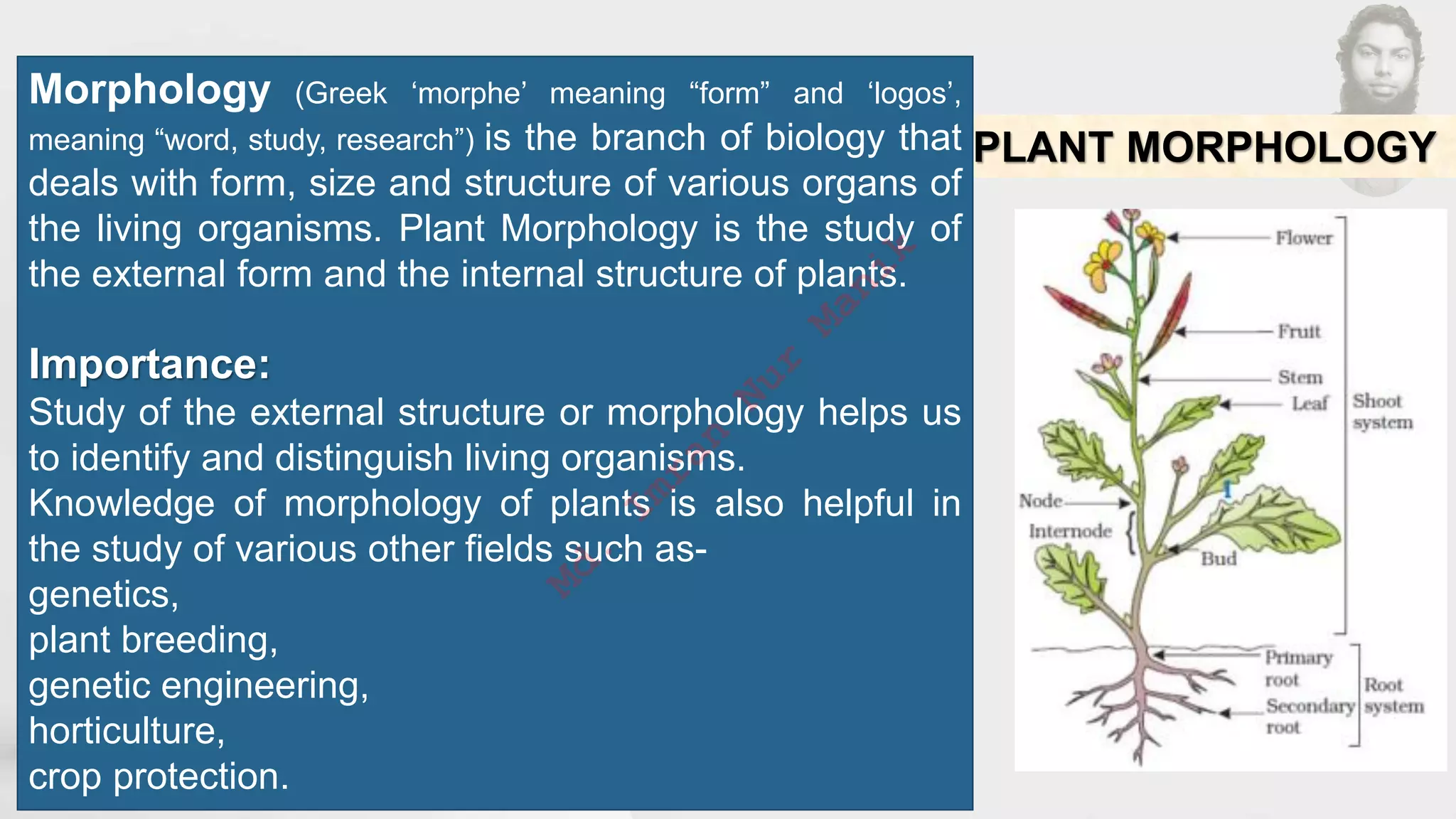
Any common flowering plant consists of a long
cylindrical axis which is differentiated into an
underground root system and an aerial shoot
system.
The root system consists of root and its lateral
branches.
The shoot system has a stem, a system of
branches and leaves.
Root, stem and leaves together constitute the
vegetative organs of the plant body and they
do not take part in the process of reproduction.
The flowering plants on attaining maturity
produce flowers, fruits and seeds. These are
called the reproductive organs of the plant.
M
d
.
I
m
r
a
n
N
u
r
M
a
n
i
k
` Roots anchor the plants in the soil and absorb nutrients and water
that are needed by the rest of the plant. ` Stems support the upper
part of the plant and act as a transport system for nutrients, water,
sugar, and starches. Photosynthesis can occur in the stem of some
plants such as: cacti, celery, asparagus, and bananas. ` Leaves are
the parts of the plant where photosynthesis usually occurs—where
food for the plant is made. The green substance, chlorophyll, captures
light energy and uses it to convert water and carbon dioxide into plant
food and oxygen. ` Flowers are the reproductive part of plants. They
often have showy petals and fragrances to attract pollinators such as
birds, bees, and other insects. Most flowers have four main parts:
petals, stamen (anther and filament), pistil (stigma, style and ovary),
and sepals. After flowers are pollinated and fertilized, they produce
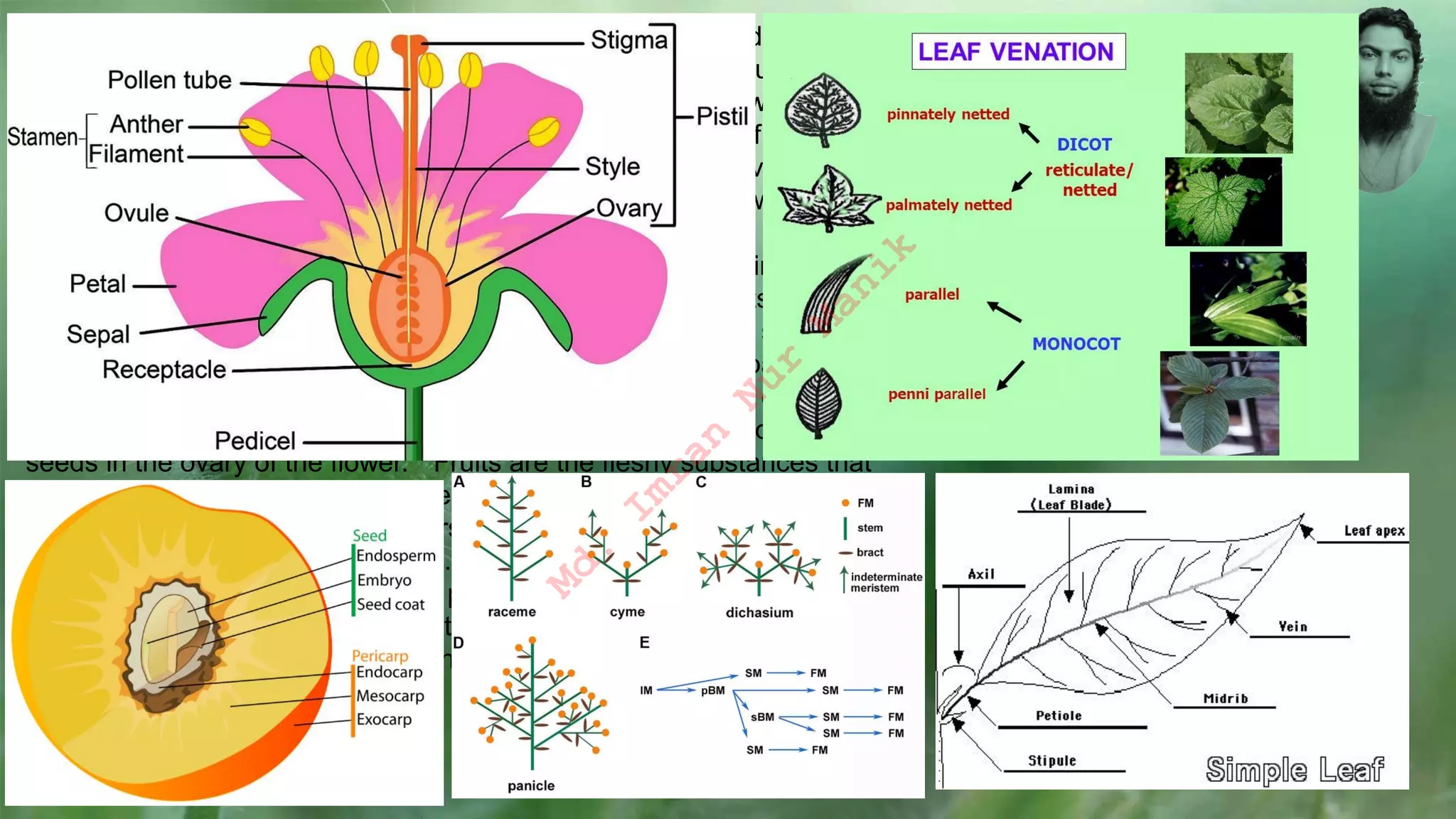
seeds in the ovary of the flower. ` Fruits are the fleshy substances that
usually surround seeds. They protect the seeds and attract animals to
eat them. This helps in seed dispersal. ` Seeds contain plant material
that can develop into another plant. This plant material is called an
embryo. Seeds are covered with a protective seed coat and have one
or two cotyledons. Cotyledons are the food for the baby plant until it
can make its own food from light and are often the first embryonic
leaves of the plant.
M
d
.
I
m
r
a
n
N
u
r
M
a
n
i
k
M
d
.
I
m
r
a
n
N
u
r
M
a
n
i
k

The Plant Cell (Pharmacognosy) MANIK

  • 1.
  • 2.
    CELL Definition: The cell (fromLatin cellula 'small room') is the basic structural, functional, and biological unit of all known organisms. ➢ A cell is the smallest unit of life. ➢ Cells are the smallest units of life, and hence are often referred to as the Cells are called as the structural and functional unit of life because all the living organisms are made up of cells and also all the functions taking place inside the body of organisms are performed by cells. Cells provide the specific conditions, for the occurrence of the metabolic reactions. M d . I m r a n N u r M a n i k
  • 3.
    Cells are oftwo types: eukaryotic, which contain a nucleus, and prokaryotic, which do not. Prokaryotes are single-celled organisms, while eukaryotes can be either single- celled or multicellular. Structure of the Plant Cell 1. Cells vary in size and shape. 2. In shape they may be spherical, oval, polygonal, rectangular or elongated. 3. The average size of a cell varies from 10-100 µm. M d . I m r a n N u r M a n i k
  • 4.
    Different Types ofPlant Cell Parenchyma cells: Living cells that are capable of division. Parenchyma cells in plants perform photosynthesis and help in gas exchange. They also store reserve food materials such as starch and proteins. Collenchyma cells: Elongated cells with thick deposition of cellulose in their cell walls. Involved in support and transportation of nutrients to growing parts of a plant. Sclerenchyma cells: Dead cells that have very thick cell walls. Involved in the support, protection, and transportation of water Xylem cells: Hard, water-conducting cells that help to transport water and nutrients absorbed by the roots to all parts of the plant. Phloem cells: Cells that distribute food and sap, mainly in the form of sucrose from the leaves to all parts of the plant. M d . I m r a n N u r M a n i k
  • 5.
    Plant Cell VersaceAnimal Cell M d . I m r a n N u r M a n i k
  • 6.
    Feature Plant CellAnimal Cell Size Usually larger with distinct outlines Usually smaller with less distinct boundaries Shape Rectangular Spherical Cell wall Present (made of cellulose) Absent Cell membrane Present internal to the cell wall Forms the boundary of the cell Plasmodesmata Present Absent Cytoplasm Not so dense; thin lining of cytoplasm Denser and more granular Centrosome Absent Present Centriole Absent ( except motile cells of lower plant) Present Vacuoles Large and permanent Small and Temporary Plastids ( Chloroplast) Present Absent Lysosomes Rare Present Storage material Starch Glycogen Plant Cell Vs. Animal Cell M d . I m r a n N u r M a n i k
  • 7.
    Cell Wall • Itis the outermost covering of the cell having a thickness of 20-80 nm and encloses the cytoplasm and the vacuole. • The primary cell wall is a permeable flexible structure and is capable of elongation. •Cell walls are made up of carbohydrates such as cellulose, hemicellulose, and pectin and a complex organic polymer called lignin. •Provides mechanical strength, support, and rigidity to the cell •Builts the shape to the plant •Allows selective entry of small molecules inside the cell while preventing large molecules •Protects the delicate inner organelles from outer shock Function M d . I m r a n N u r M a n i k
  • 8.
    Plastids Plastids are double-membraneorganelles which are found in the cells of plants and algae. There are three groups of plastids: Chloroplasts, Chromoplasts, and Leucoplasts (a) Chloroplasts: which are green-colored plastids found in the green parts of plants. They contain a green pigment called chlorophyll, is actually a mixture of four different pigments, viz., chlorophyll a (blue-black), chlorophyll b (green-black), carotene (orange-red) and xanthophylls (yellow). Chlorophyll is essential to the plants for manufacturing carbohydrate food by the process of photosynthesis. M d . I m r a n N u r M a n i k
  • 9.
    (b) Chromoplast: whichare variously colored plastids, found in the colored portion, which occur mostly in the petals of flowers and in fruits. which are colorless plastids, found mostly in the storage cells of roots and underground stems. •Absorption and conversion of light energy into chemical energy to produce food in the form of carbohydrate by a process called photosynthesis (Chloroplast) •Providing defense against infections (Chloroplast) •Helping in the production of high energy phosphate molecules, ATP (Chloroplast) •Storing of protein, lipid, and starch (Leucoplasts) •Synthesizing and storing colored pigments (Chromoplast) Function M d . I m r a n N u r M a n i k
  • 10.
    Part Description Function CentralVacuole The central vacuole is the largest organelle in the cell that is filled with fluid, ions, enzymes, and other molecules. 1. Maintain turgidity of the cell that prevents plants from wilting. 2. Store of reserve food, water, and waste materials of the cell. Cell Membrane or Plasma Membrane It is a thin, biological membrane that separates the interior of the cell from the outside environment. 1.Protect the cell from the outside environment. 2. Maintain the shape of the cell 3. Regulate the entry and exit of nutrients, essential minerals, and toxic waste products within the cell. Endoplasmic Reticulum (ER) It is a series of membranes within the cytoplasm that forms connections with the nucleus on one side and cell membrane on the other. 1. Help in the formation of nuclear membrane during cell division. 2. Produce trans-membrane proteins, lipids, glycogen and other steroids like cholesterol. Golgi Apparatus Also known as Golgi body or Golgi complex, they are stacks of five to eight membrane-covered sacs called cisternae. 1. Synthesize complex polysaccharides of the cell wall. 2. Process, package. transport, and secret the proteins produced in the rough endoplasmic reticulum. M d . I m r a n N u r M a n i k
  • 11.
    The cell contents •Cell contents are refer to those substances, which are present in the cell but not constitute any of its parts or take any part in its functions. • They occur mainly in the cell vacuole although many of them are found distributed in the cytoplasm. • The cell contents are present either food storage products or by products of metabolism. M d . I m r a n N u r M a n i k
  • 12.
    PLANT MORPHOLOGY Morphology (Greek‘morphe’ meaning “form” and ‘logos’, meaning “word, study, research”) is the branch of biology that deals with form, size and structure of various organs of the living organisms. Plant Morphology is the study of the external form and the internal structure of plants. Importance: Study of the external structure or morphology helps us to identify and distinguish living organisms. Knowledge of morphology of plants is also helpful in the study of various other fields such as- genetics, plant breeding, genetic engineering, horticulture, crop protection. M d . I m r a n N u r M a n i k
  • 13.
    Any common floweringplant consists of a long cylindrical axis which is differentiated into an underground root system and an aerial shoot system. The root system consists of root and its lateral branches. The shoot system has a stem, a system of branches and leaves. Root, stem and leaves together constitute the vegetative organs of the plant body and they do not take part in the process of reproduction. The flowering plants on attaining maturity produce flowers, fruits and seeds. These are called the reproductive organs of the plant. M d . I m r a n N u r M a n i k
  • 14.
    ` Roots anchorthe plants in the soil and absorb nutrients and water that are needed by the rest of the plant. ` Stems support the upper part of the plant and act as a transport system for nutrients, water, sugar, and starches. Photosynthesis can occur in the stem of some plants such as: cacti, celery, asparagus, and bananas. ` Leaves are the parts of the plant where photosynthesis usually occurs—where food for the plant is made. The green substance, chlorophyll, captures light energy and uses it to convert water and carbon dioxide into plant food and oxygen. ` Flowers are the reproductive part of plants. They often have showy petals and fragrances to attract pollinators such as birds, bees, and other insects. Most flowers have four main parts: petals, stamen (anther and filament), pistil (stigma, style and ovary), and sepals. After flowers are pollinated and fertilized, they produce seeds in the ovary of the flower. ` Fruits are the fleshy substances that usually surround seeds. They protect the seeds and attract animals to eat them. This helps in seed dispersal. ` Seeds contain plant material that can develop into another plant. This plant material is called an embryo. Seeds are covered with a protective seed coat and have one or two cotyledons. Cotyledons are the food for the baby plant until it can make its own food from light and are often the first embryonic leaves of the plant. M d . I m r a n N u r M a n i k
  • 15.