U.S. Specialty Crop Production: Cotton David Taylor		December 7, 2010
Specialty Crop Production: CottonFewer than 32,000 farms in the United States produce cotton.
Cotton is grown in only 17 southern states.
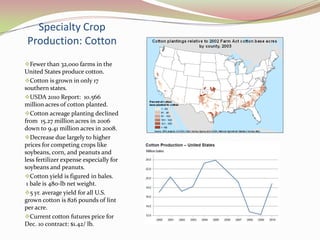
USDA 2010 Report:  10.566 million acres of cotton planted.
Cotton acreage planting declined from  15.27 million acres in 2006 down to 9.41 million acres in 2008.
Decrease due largely to higher prices for competing crops like soybeans, corn, and peanuts and less fertilizer expense especially for soybeans and peanuts.
Cotton yield is figured in bales. 1 bale is 480-lb net weight.
5 yr. average yield for all U.S. grown cotton is 826 pounds of lint per acre.
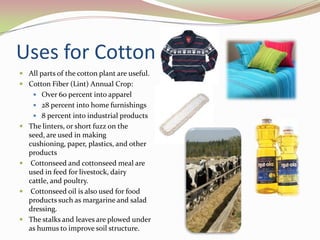
Current cotton futures price for Dec. 10 contract: $1.42/ lb.Uses for CottonAll parts of the cotton plant are useful. Cotton Fiber (Lint) Annual Crop:Over 60 percent into apparel28 percent into home furnishings8 percent into industrial productsThe linters, or short fuzz on the seed, are used in making cushioning, paper, plastics, and other products Cottonseed and cottonseed meal are used in feed for livestock, dairy cattle, and poultry. Cottonseed oil is also used for food products such as margarine and salad dressing.The stalks and leaves are plowed under as humus to improve soil structure.
Cotton Crop Overview
One of the most economically and socially important crops in the world.Size of the plant depends on: soil, climate, water conditions, plant variety.Grows best in clay loam soil with a semitropical climate.Perennial shrub with tropical origins that is produced in an annual row crop environment in the US. Growing season: 6-7 months.Typically takes about 175 days from planting to harvest.Bt cotton was introduced in 1996.Successful cotton production depends on an integrated and intense management strategy.
Fertility Requirements
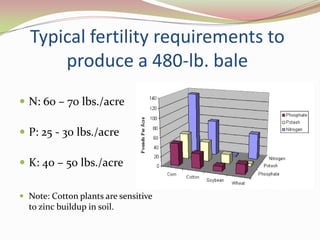
Typical fertility requirements to produce a 480-lb. baleN: 60 – 70 lbs./acreP: 25 - 30 lbs./acreK: 40 – 50 lbs./acreNote: Cotton plants are sensitive to zinc buildup in soil.
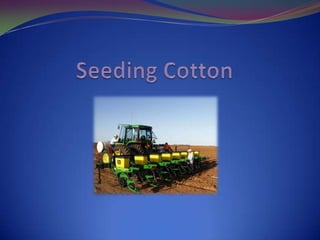
Seeding Cotton
Cotton seeding requirementsSoil temperature: min. 68°F at 2” depth.Planting dates range from April 15th through the end of May.Planting depth 0.5” to 1.5” depending on soil moisture.The optimal plant population: 30,000 to 60,000 plants per acre in 30 to 40 inch rows.Typical row width 36 to 40 inches.Seed is planted using mechanical planters.
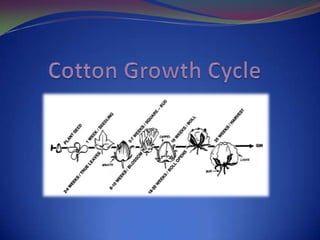
Cotton Growth Cycle
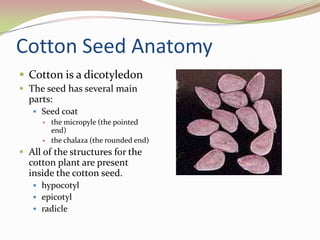
Cotton Seed AnatomyCotton is a dicotyledon
The seed has several main parts:
Seed coat
the micropyle (the pointed end)
the chalaza (the rounded end)
All of the structures for the cotton plant are present inside the cotton seed.
hypocotyl
epicotyl
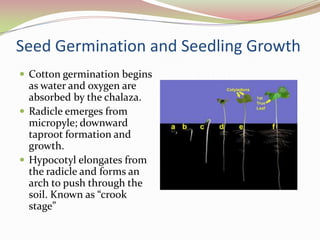
radicleSeed Germination and Seedling GrowthCotton germination begins as water and oxygen are absorbed by the chalaza.Radicle emerges from micropyle; downward taproot formation and growth. Hypocotyl elongates from the radicle and forms an arch to push through the soil. Known as “crook stage”
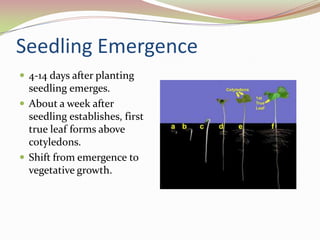
Seedling Emergence4-14 days after planting seedling emerges.About a week after seedling establishes, first true leaf forms above cotyledons.Shift from emergence to vegetative growth.
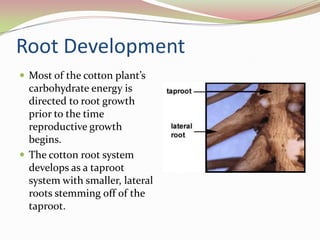
Root DevelopmentMost of the cotton plant’s carbohydrate energy is directed to root growth prior to the time reproductive growth begins.The cotton root system develops as a taproot system with smaller, lateral roots stemming off of the taproot.
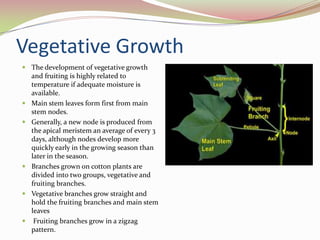
Vegetative GrowthThe development of vegetative growth and fruiting is highly related to temperature if adequate moisture is available. Main stem leaves form first from main stem nodes.Generally, a new node is produced from the apical meristem an average of every 3 days, although nodes develop more quickly early in the growing season than later in the season. Branches grown on cotton plants are divided into two groups, vegetative and fruiting branches.Vegetative branches grow straight and hold the fruiting branches and main stem leaves Fruiting branches grow in a zigzag pattern.
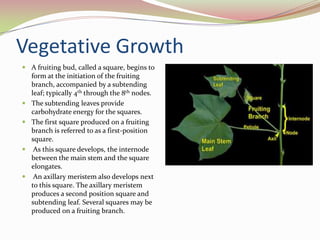
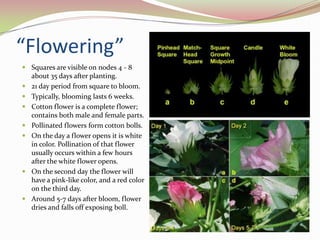
Vegetative GrowthA fruiting bud, called a square, begins to form at the initiation of the fruiting branch, accompanied by a subtending leaf; typically 4th through the 8th nodes.The subtending leaves provide carbohydrate energy for the squares.The first square produced on a fruiting branch is referred to as a first-position square. As this square develops, the internode between the main stem and the square elongates. An axillary meristem also develops next to this square. The axillary meristem produces a second position square and subtending leaf. Several squares may be produced on a fruiting branch.

Cotton Crop Presentation

  • 1.
    U.S. Specialty CropProduction: Cotton David Taylor December 7, 2010
  • 2.
    Specialty Crop Production:CottonFewer than 32,000 farms in the United States produce cotton.
  • 3.
    Cotton is grownin only 17 southern states.
  • 4.
    USDA 2010 Report: 10.566 million acres of cotton planted.
  • 5.
    Cotton acreage plantingdeclined from 15.27 million acres in 2006 down to 9.41 million acres in 2008.
  • 6.
    Decrease due largelyto higher prices for competing crops like soybeans, corn, and peanuts and less fertilizer expense especially for soybeans and peanuts.
  • 7.
    Cotton yield isfigured in bales. 1 bale is 480-lb net weight.
  • 8.
    5 yr. averageyield for all U.S. grown cotton is 826 pounds of lint per acre.
  • 9.
    Current cotton futuresprice for Dec. 10 contract: $1.42/ lb.Uses for CottonAll parts of the cotton plant are useful. Cotton Fiber (Lint) Annual Crop:Over 60 percent into apparel28 percent into home furnishings8 percent into industrial productsThe linters, or short fuzz on the seed, are used in making cushioning, paper, plastics, and other products Cottonseed and cottonseed meal are used in feed for livestock, dairy cattle, and poultry. Cottonseed oil is also used for food products such as margarine and salad dressing.The stalks and leaves are plowed under as humus to improve soil structure.
  • 10.
  • 11.
    One of themost economically and socially important crops in the world.Size of the plant depends on: soil, climate, water conditions, plant variety.Grows best in clay loam soil with a semitropical climate.Perennial shrub with tropical origins that is produced in an annual row crop environment in the US. Growing season: 6-7 months.Typically takes about 175 days from planting to harvest.Bt cotton was introduced in 1996.Successful cotton production depends on an integrated and intense management strategy.
  • 12.
  • 13.
    Typical fertility requirementsto produce a 480-lb. baleN: 60 – 70 lbs./acreP: 25 - 30 lbs./acreK: 40 – 50 lbs./acreNote: Cotton plants are sensitive to zinc buildup in soil.
  • 14.
  • 15.
    Cotton seeding requirementsSoiltemperature: min. 68°F at 2” depth.Planting dates range from April 15th through the end of May.Planting depth 0.5” to 1.5” depending on soil moisture.The optimal plant population: 30,000 to 60,000 plants per acre in 30 to 40 inch rows.Typical row width 36 to 40 inches.Seed is planted using mechanical planters.
  • 16.
  • 17.
  • 18.
    The seed hasseveral main parts:
  • 19.
  • 20.
    the micropyle (thepointed end)
  • 21.
    the chalaza (therounded end)
  • 22.
    All of thestructures for the cotton plant are present inside the cotton seed.
  • 23.
  • 24.
  • 25.
    radicleSeed Germination andSeedling GrowthCotton germination begins as water and oxygen are absorbed by the chalaza.Radicle emerges from micropyle; downward taproot formation and growth. Hypocotyl elongates from the radicle and forms an arch to push through the soil. Known as “crook stage”
  • 26.
    Seedling Emergence4-14 daysafter planting seedling emerges.About a week after seedling establishes, first true leaf forms above cotyledons.Shift from emergence to vegetative growth.
  • 27.
    Root DevelopmentMost ofthe cotton plant’s carbohydrate energy is directed to root growth prior to the time reproductive growth begins.The cotton root system develops as a taproot system with smaller, lateral roots stemming off of the taproot.
  • 28.
    Vegetative GrowthThe developmentof vegetative growth and fruiting is highly related to temperature if adequate moisture is available. Main stem leaves form first from main stem nodes.Generally, a new node is produced from the apical meristem an average of every 3 days, although nodes develop more quickly early in the growing season than later in the season. Branches grown on cotton plants are divided into two groups, vegetative and fruiting branches.Vegetative branches grow straight and hold the fruiting branches and main stem leaves Fruiting branches grow in a zigzag pattern.
  • 29.
    Vegetative GrowthA fruitingbud, called a square, begins to form at the initiation of the fruiting branch, accompanied by a subtending leaf; typically 4th through the 8th nodes.The subtending leaves provide carbohydrate energy for the squares.The first square produced on a fruiting branch is referred to as a first-position square. As this square develops, the internode between the main stem and the square elongates. An axillary meristem also develops next to this square. The axillary meristem produces a second position square and subtending leaf. Several squares may be produced on a fruiting branch.

Editor's Notes

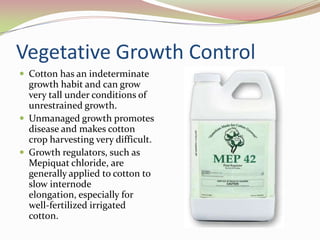
  • #18 PIX (Mepiquat chloride) is a systemic plant growth regulator, extensively used in cotton production for the last two decades. PIX treated cotton plants tended to be shorter and narrower with thick and smaller leaves. PIX has been known to reduce the synthesis of gibberellic acid, resulting in the suppressionof cell enlargement. Well managed cotton in terms of providing good irrigation and fertilizers sometimes result in extensive vegetative growth. Cottonplants that are highly vegetative are subject to more disease and harvest losses, resulting in lower yields.
  • #27 Defoliate - To cause the leaves of (a plant, tree, or forest) to fall off, especially by the use of chemicals.Desiccate – to dry out