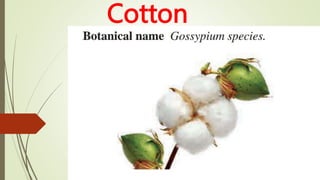
Cotton
The cotton area in a Maharashtra is
divided in to a three main tract.
1) Vidarbha
2) Marthawada
3) Deccan tract.
Vidarbha is a major cotton growing
region in a Maharashtra.
Varieties:
1) Rainfed or Deshi cotton varieties :
G-6( Gaorani ) ,G-12 ,G-22, G-46, Rohini ,
Jarilla, Jyoti, Virnar, Digvijay Eknath, Sanjay,
AKA-S , AHH-468, Y-1
2) Irrigated or Amcrican varieties :Buri- 147
, Buri- 0394 , Buri-1007 , Deviaj, Savitri,
Poornima, Laxmi, MCU-2, MCU-5, DHY-286,
STR-1, LRA 5156
3)Hybrid varieties : H-4, NHH-44 , DCH-32 ,
Godavari, Varlaxmi , PKV HY-2 , PKV HY-3
Sujata is a Egyptian variety of cotton.
Ecology:
Cimate:
Cotton is a tropical and sub tropical Crop
,
 requires a warm and dry climate,
a cool night and bright sunny days are
good for boll development.
Optimum temp. for vegetative growth is
21-27 °C and for fruiting and boll
development is a 27-31 °C and
rainfall 650-1200mm.
continuous rainfall or dry spell at
flowering and fruiting causes a
shedding of buds and yonug bolls.
it cannot be grown in a heavy
rainfall humndiy frost and cloudy
weather which spread the pest and
diseases
Soil
Soil should be a well drained,
 fertile and having a good water holding
capacity.
 it grow best in a mednum , black: cotton
soils, heavy soils, sandy , sandy loamns,
alluvial soils , red lateritic
soils having a PH- 6 5.-7.5
it can not be grown in a water logged
conditions
Land preparation:
For rainfed crop land is ploughed once in a 3-
4 year.
clods are crushed and 2-3 harrowing are given
land is cleaned by removing the weeds and
stubbles
 For irrigated crop land is ploughed with a iron
iron plough or tractor clods are crushed and
2-3 cross harrowing are given
 land is cleaned by removing the weeds and
stubbles of previous crop finally ridges and
furrows are prepared in a soil.
Sowing season:
 1) Irrigated cotton 15 March to 15 " May
2) Rainfed cotton Juue to first week of July
Seed treatment in a cotton:
1) Water soaking
2) Cow dung slurry
3) Organo mercurial fungicide (O. M.C)
4) Acid delinting ( H2SO4)
1) Water soaking:
 Cotton seeds are soaked in a water for
2-6 hours.
 light and diseased seeds float on surface
surface of water should be removed.
 healthy seds remain in the bottom
should be taken"and dried in a shade and
and than used for sowing,
this seed treatment help to increase the
germination.
2) Cow dung slurry:
 Cotton seeds are rubbed with a fresh cow dung
slurry and dried in a shade beforesowing.
 it help to remove the fuzz from seed and
convenience in a sowing.
3) Organo mercurial fangicide Treatment (
O.M.C):
Cotton seeds are treated with a fungicide like
agroson or bavistin (@ 3 gm /kg of seed.
it help to avoid the seed and soil from fungal
diseases
4) Acid delinting ( H2SO4):
Removall of fuzz from cotton seeds is
known as delinting
cotton seeds are treated with sulphuric
acid ,
then seeds are washed with a water dried
in a shade and used for sowing.
this seed treatment helps to remove the
fuzz,
 Increase the gernination and convenience
in a sowing
Methods of sowing:
 1) Drilling
2) Dibbling
3) Transplanting
 i) Drilling : This method is used for
sowing the rainfed or deshi cotton. in this
this method seedsd are sown by two or
three tyned seed dill, seds are sown at
the depth of 2-3 cm, after sowing the
seeds are covered with a soil by a harrow.
Dibbling
This method is used for sowing the
irrigated and Amecrican varieties.
 ln this methodland is prepared and
marking is done at the require spacing or
distance from both direction with the
help of a marker.
two seeds are sown at each cross point
at the depth of 5-6 cm.
this method save time seeds,
 Increase the yield and suitable for
carrying the intercultural operation from
both direction.
3) Transplanting:
In this method seeds are sown in a
plastic bag in the month of may,
 watering is done by a water cane
regulerly.
 these seedlings are than transplanted to
the main field in the month of June.
Seed rate and spacing :
Varieties
1) For deshi or rainfed cotton 12-15
ha 45 x 22 cm.
2) For American cotton - 8-10 kg/ ha
Spacing- 60 x 30 cm
3) For hybrid cotton- 3-4 kg/ ha
Rainfed- 90 x 60 cm
Irrigated 120 x 90Cm
Manures and fertilizers:
For irrigated cotton 25-30 cart load FYM / ha Dose
for irrigated cotton is 100 50 : 50 NPK kg /ha.
In case of irrgated crop half N total P&k is given at
time of sowing and
 remaining half N is given after 45 davs of sowing by
a ring method or by applying in between the lines
For rainfed cotton 15-20 cart load FYM / ha Dose
for rainfed cotton is 40, 30: 20 NPK kg/ ha In case of
rain fed all N.
P&K is given at time of sowing.
Irrigation :
Cotton crop is very sensitive to both excess
or less moisture
in a kharif season irrigation is given at the
interval of 15-20 days,
while in summer season irrigation is given at
at the interval of 7-8 days.
 imp stages of irrigation are branching,
flowering and boll formation
 Irrigation increases the Yield but reduce the
ginning percentage.
Crop rotation and mix cropping:
Cotton is rotated with a jowar, wheat,
green gram, groundnut, Cotton is sown
as a mix crop with a tur, bajra, maize
Intercultivation in a cotton:
1) Gap filling andi tinning
2) Hand weeding and hoeing
3) Topping
1)Gap filling and thinning:
 Gap filling should be done within 5-7 days of
sowing to maintain the plant populationfor gap
filling seeds are soaked in a water for 10-12 hour.
seeds are rubbed with cow dung slurry and a
small quantity of urea for quicker germination of
seeds.
 Thinning should be done within a 2-3 weeks of
sowing to maintain a optimum plant population
remove excess, weak, diseased seedling and keep
keep only healthy seedlings in the field
2) Hand weeding and hoeing:
First hand weeding is done after 3-4 weeks of
sowing.
 then 2-3 hoeing are done at interval of 15-20
days.
hand weeding and hoeing help to renove the
weeds, loose the soil and light earthing up to
plants.
3) Topping:
In this operation tips of plants are cut off to check
the vegetative growth and increasing the
branching for fruiting
Aphid jassid
Thrips Whitefly
Spotted bollwarm. Pink bollwarm
American bollwarm. Red Cotton Bug
Dusky Cotton Bug
Wilt of Cotton
Root Rot
Harvesting or picking & Yield
Cotton is harvested after 5.5 to 6 month of
sowing and
harvesting is done when balls are fully opened
fully open the balls are picked and cotton is
collected harvesting is completed in a 3-4
picking.
while picking care should be taken that leafy
portion should not be mixed with cotton ,
 middle picking a good yield while last picking
give poor quality Cotton
Yield of seed cotton :
1) Deshi cotton : 4-6 qt/ ha
2) American cotton: 10-12 q/ha
3) Hybrid rainfed cotton 12-20 qt/ha.
4) Hybrid irrigated cotton 25-30 qt/ha.
Yield of lint:
1) Rainfed 80-100 kg lint/ha.
2) Irrigated 200-300 kg/ha.
Economic uses of cotton:
1) Cotton is imp cash crop.
2) It is a main fiber crop and used for
manutacturing of cloth.
3) Cotton seeds contain a protein, CHO, vitamins
and minerals.
4) Cotton oil is a edible oil and used for
preparation of a vanaspati ghee.
5) It provide a raw material to the industries for
manufacturing the soap , paint, cosmetics, plastics,
plastics, rubber , paper , insecticide, fungicide etc.
6) seeds and oil cake is feed to cattle
7) Cotton lint is used for preparing the
surgical dressings & absorbent padding.
8) Cotton plants are used as a fuel.
9) Plants are used as a thatching material
and preparation of bins.
10) It provide a employment to people in
a ginning and pressing, fiber making ,
textileand a marketing.
Qualities of cotion:
1 ) Staple length
2) Fineness
3) Maturity
4) Fiber Strength
5) Ginning percentage
1) Staple length:
Mean fiber length of cotton is called staple
length.
Staple length is measured by a Halo
measurement method,
in this method fibers are combed on a seed it
self and the length of fiber is measured by
transparent disc.in mm
 There are three rating of cotton.
1) Long staple- 22mm and above
2) Medium staple- 17-22 mm
3) Short staple- 17 mm and above.
2) Fineness:
This term is applied to feel of cotton i.e soft or silky .
 feel is associated with a fiberdiameter and weightIt is
is a mean fiber weight per unit length fnennss is
determined by a instrument Micronaire
3) Maturity:
It indicate the degree of formation of cellulose in the
fiber or thickness of cell wall.
Maturity test consist of a fiber with 18% caustic
sodag solution and examining thems undor
microscope
There are three types of fibers :
1) Thick walled or mature fibers. 2)
thin walled or immature fibers 3)
intermediate or half mature
4) Fiber Strength:
It is a single fiber strength or fiber
bundle strength. it is judged by a
Stelometre
5) Ginning percentage:
It is the figure showing the
proportion of the lint by
weight in a 100 parts of seed
cotton
Thank you!
Agr. Vitthal Dudhate
Founder of Dudhate
Crop Academy
Join our Teligram channel
@CropsciencewithVitthalSir

BE5C .pptx

  • 1.
  • 5.
    The cotton areain a Maharashtra is divided in to a three main tract. 1) Vidarbha 2) Marthawada 3) Deccan tract. Vidarbha is a major cotton growing region in a Maharashtra.
  • 6.
    Varieties: 1) Rainfed orDeshi cotton varieties : G-6( Gaorani ) ,G-12 ,G-22, G-46, Rohini , Jarilla, Jyoti, Virnar, Digvijay Eknath, Sanjay, AKA-S , AHH-468, Y-1 2) Irrigated or Amcrican varieties :Buri- 147 , Buri- 0394 , Buri-1007 , Deviaj, Savitri, Poornima, Laxmi, MCU-2, MCU-5, DHY-286, STR-1, LRA 5156 3)Hybrid varieties : H-4, NHH-44 , DCH-32 , Godavari, Varlaxmi , PKV HY-2 , PKV HY-3 Sujata is a Egyptian variety of cotton.
  • 7.
    Ecology: Cimate: Cotton is atropical and sub tropical Crop ,  requires a warm and dry climate, a cool night and bright sunny days are good for boll development. Optimum temp. for vegetative growth is 21-27 °C and for fruiting and boll development is a 27-31 °C and
  • 8.
    rainfall 650-1200mm. continuous rainfallor dry spell at flowering and fruiting causes a shedding of buds and yonug bolls. it cannot be grown in a heavy rainfall humndiy frost and cloudy weather which spread the pest and diseases
  • 9.
    Soil Soil should bea well drained,  fertile and having a good water holding capacity.  it grow best in a mednum , black: cotton soils, heavy soils, sandy , sandy loamns, alluvial soils , red lateritic soils having a PH- 6 5.-7.5 it can not be grown in a water logged conditions
  • 10.
    Land preparation: For rainfedcrop land is ploughed once in a 3- 4 year. clods are crushed and 2-3 harrowing are given land is cleaned by removing the weeds and stubbles  For irrigated crop land is ploughed with a iron iron plough or tractor clods are crushed and 2-3 cross harrowing are given  land is cleaned by removing the weeds and stubbles of previous crop finally ridges and furrows are prepared in a soil.
  • 11.
    Sowing season:  1)Irrigated cotton 15 March to 15 " May 2) Rainfed cotton Juue to first week of July Seed treatment in a cotton: 1) Water soaking 2) Cow dung slurry 3) Organo mercurial fungicide (O. M.C) 4) Acid delinting ( H2SO4)
  • 12.
    1) Water soaking: Cotton seeds are soaked in a water for 2-6 hours.  light and diseased seeds float on surface surface of water should be removed.  healthy seds remain in the bottom should be taken"and dried in a shade and and than used for sowing, this seed treatment help to increase the germination.
  • 13.
    2) Cow dungslurry:  Cotton seeds are rubbed with a fresh cow dung slurry and dried in a shade beforesowing.  it help to remove the fuzz from seed and convenience in a sowing. 3) Organo mercurial fangicide Treatment ( O.M.C): Cotton seeds are treated with a fungicide like agroson or bavistin (@ 3 gm /kg of seed. it help to avoid the seed and soil from fungal diseases
  • 14.
    4) Acid delinting( H2SO4): Removall of fuzz from cotton seeds is known as delinting cotton seeds are treated with sulphuric acid , then seeds are washed with a water dried in a shade and used for sowing. this seed treatment helps to remove the fuzz,  Increase the gernination and convenience in a sowing
  • 15.
    Methods of sowing: 1) Drilling 2) Dibbling 3) Transplanting  i) Drilling : This method is used for sowing the rainfed or deshi cotton. in this this method seedsd are sown by two or three tyned seed dill, seds are sown at the depth of 2-3 cm, after sowing the seeds are covered with a soil by a harrow.
  • 16.
    Dibbling This method isused for sowing the irrigated and Amecrican varieties.  ln this methodland is prepared and marking is done at the require spacing or distance from both direction with the help of a marker. two seeds are sown at each cross point at the depth of 5-6 cm. this method save time seeds,  Increase the yield and suitable for carrying the intercultural operation from both direction.
  • 17.
    3) Transplanting: In thismethod seeds are sown in a plastic bag in the month of may,  watering is done by a water cane regulerly.  these seedlings are than transplanted to the main field in the month of June.
  • 18.
    Seed rate andspacing : Varieties 1) For deshi or rainfed cotton 12-15 ha 45 x 22 cm. 2) For American cotton - 8-10 kg/ ha Spacing- 60 x 30 cm 3) For hybrid cotton- 3-4 kg/ ha Rainfed- 90 x 60 cm Irrigated 120 x 90Cm
  • 19.
    Manures and fertilizers: Forirrigated cotton 25-30 cart load FYM / ha Dose for irrigated cotton is 100 50 : 50 NPK kg /ha. In case of irrgated crop half N total P&k is given at time of sowing and  remaining half N is given after 45 davs of sowing by a ring method or by applying in between the lines For rainfed cotton 15-20 cart load FYM / ha Dose for rainfed cotton is 40, 30: 20 NPK kg/ ha In case of rain fed all N. P&K is given at time of sowing.
  • 20.
    Irrigation : Cotton cropis very sensitive to both excess or less moisture in a kharif season irrigation is given at the interval of 15-20 days, while in summer season irrigation is given at at the interval of 7-8 days.  imp stages of irrigation are branching, flowering and boll formation  Irrigation increases the Yield but reduce the ginning percentage.
  • 21.
    Crop rotation andmix cropping: Cotton is rotated with a jowar, wheat, green gram, groundnut, Cotton is sown as a mix crop with a tur, bajra, maize Intercultivation in a cotton: 1) Gap filling andi tinning 2) Hand weeding and hoeing 3) Topping
  • 22.
    1)Gap filling andthinning:  Gap filling should be done within 5-7 days of sowing to maintain the plant populationfor gap filling seeds are soaked in a water for 10-12 hour. seeds are rubbed with cow dung slurry and a small quantity of urea for quicker germination of seeds.  Thinning should be done within a 2-3 weeks of sowing to maintain a optimum plant population remove excess, weak, diseased seedling and keep keep only healthy seedlings in the field
  • 23.
    2) Hand weedingand hoeing: First hand weeding is done after 3-4 weeks of sowing.  then 2-3 hoeing are done at interval of 15-20 days. hand weeding and hoeing help to renove the weeds, loose the soil and light earthing up to plants. 3) Topping: In this operation tips of plants are cut off to check the vegetative growth and increasing the branching for fruiting
  • 25.
  • 26.
  • 29.
  • 31.
  • 32.
  • 35.
  • 37.
  • 44.
    Harvesting or picking& Yield Cotton is harvested after 5.5 to 6 month of sowing and harvesting is done when balls are fully opened fully open the balls are picked and cotton is collected harvesting is completed in a 3-4 picking. while picking care should be taken that leafy portion should not be mixed with cotton ,  middle picking a good yield while last picking give poor quality Cotton
  • 45.
    Yield of seedcotton : 1) Deshi cotton : 4-6 qt/ ha 2) American cotton: 10-12 q/ha 3) Hybrid rainfed cotton 12-20 qt/ha. 4) Hybrid irrigated cotton 25-30 qt/ha. Yield of lint: 1) Rainfed 80-100 kg lint/ha. 2) Irrigated 200-300 kg/ha.
  • 46.
    Economic uses ofcotton: 1) Cotton is imp cash crop. 2) It is a main fiber crop and used for manutacturing of cloth. 3) Cotton seeds contain a protein, CHO, vitamins and minerals. 4) Cotton oil is a edible oil and used for preparation of a vanaspati ghee. 5) It provide a raw material to the industries for manufacturing the soap , paint, cosmetics, plastics, plastics, rubber , paper , insecticide, fungicide etc.
  • 47.
    6) seeds andoil cake is feed to cattle 7) Cotton lint is used for preparing the surgical dressings & absorbent padding. 8) Cotton plants are used as a fuel. 9) Plants are used as a thatching material and preparation of bins. 10) It provide a employment to people in a ginning and pressing, fiber making , textileand a marketing.
  • 48.
    Qualities of cotion: 1) Staple length 2) Fineness 3) Maturity 4) Fiber Strength 5) Ginning percentage
  • 49.
    1) Staple length: Meanfiber length of cotton is called staple length. Staple length is measured by a Halo measurement method, in this method fibers are combed on a seed it self and the length of fiber is measured by transparent disc.in mm  There are three rating of cotton. 1) Long staple- 22mm and above 2) Medium staple- 17-22 mm 3) Short staple- 17 mm and above.
  • 50.
    2) Fineness: This termis applied to feel of cotton i.e soft or silky .  feel is associated with a fiberdiameter and weightIt is is a mean fiber weight per unit length fnennss is determined by a instrument Micronaire 3) Maturity: It indicate the degree of formation of cellulose in the fiber or thickness of cell wall. Maturity test consist of a fiber with 18% caustic sodag solution and examining thems undor microscope
  • 51.
    There are threetypes of fibers : 1) Thick walled or mature fibers. 2) thin walled or immature fibers 3) intermediate or half mature 4) Fiber Strength: It is a single fiber strength or fiber bundle strength. it is judged by a Stelometre
  • 52.
    5) Ginning percentage: Itis the figure showing the proportion of the lint by weight in a 100 parts of seed cotton
  • 53.
    Thank you! Agr. VitthalDudhate Founder of Dudhate Crop Academy Join our Teligram channel @CropsciencewithVitthalSir