Prepared by 
M.Ganesh Murugan 
9715447621
• The purpose of cost estimating is to find 
the cost of the manufacturing operations 
and to assist in setting the price for the 
product
 Cost estimating may be defined as the process of 
determining the probable cost of the product 
before the start of manufacture
 Important activity in engineering design and production 
 It is forecasting the future cost 
 Cost estimating & process planning are prominent activities 
in the manufacturing system 
 It considers all the expenditures involved like engineering, 
administration, etc 
 It requires high technical knowledge
 The only accurate estimating can enable the leaders to 
make vital decisions such as manufacturing, selling policies 
Case1 
 If job is over estimated, 
› The firm will not be able to compete with its competitors 
 If the job is under estimated, 
› The firm will face huge financial loss
 To establish the selling price of a product, so as to ensure 
reasonable profit to the company 
 To determine the most economical process 
 To make/buy decisions 
 To evaluate the alternate designs 
 To prepare production budget 
 TO initiate the cost reduction in existing facilities
 To fix the selling price of the product 
 To help the contractors to submit the accurate tenders 
 To forecast the progress of production and cost 
 To set the various Standards
 Design cost 
 Drafting cost 
 R & D cost 
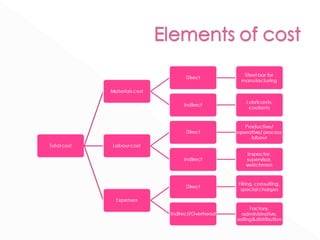
 Material cost 
 Labor cost 
 Inspection cost 
 Cost of tools, jigs, fixtures, etc. 
 Overhead cost
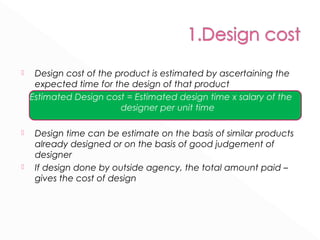
 Design cost of the product is estimated by ascertaining the 
expected time for the design of that product 
Estimated Design cost = Estimated design time x salary of the 
designer per unit time 
 Design time can be estimate on the basis of similar products 
already designed or on the basis of good judgement of 
designer 
 If design done by outside agency, the total amount paid – 
gives the cost of design
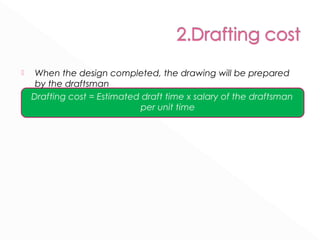
 When the design completed, the drawing will be prepared 
by the draftsman 
Drafting cost = Estimated draft time x salary of the draftsman 
per unit time
 Considerable time and money has to be spent on research 
and developmental work 
 The estimated cost and time on it are decided by the 
judgement or the past experience
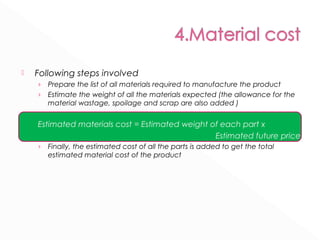
 Following steps involved 
› Prepare the list of all materials required to manufacture the product 
› Estimate the weight of all the materials expected (the allowance for the 
material wastage, spoilage and scrap are also added ) 
Estimated materials cost = Estimated weight of each part x 
Estimated future price 
› Finally, the estimated cost of all the parts is added to get the total 
estimated material cost of the product
 Following steps involved 
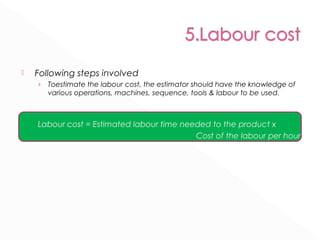
› Toestimate the labour cost, the estimator should have the knowledge of 
various operations, machines, sequence, tools & labour to be used. 
Labour cost = Estimated labour time needed to the product x 
Cost of the labour per hour
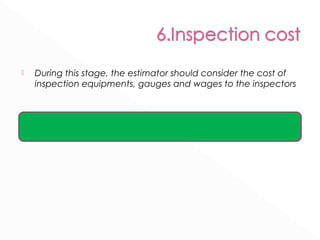
 During this stage, the estimator should consider the cost of 
inspection equipments, gauges and wages to the inspectors
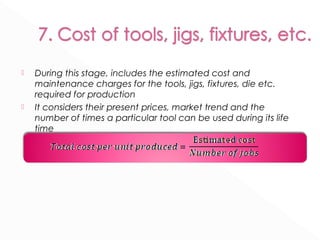
 During this stage, includes the estimated cost and 
maintenance charges for the tools, jigs, fixtures, die etc. 
required for production 
 It considers their present prices, market trend and the 
number of times a particular tool can be used during its life 
time
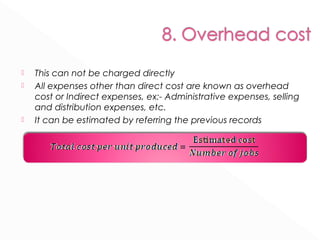
 This can not be charged directly 
 All expenses other than direct cost are known as overhead 
cost or Indirect expenses, ex:- Administrative expenses, selling 
and distribution expenses, etc. 
 It can be estimated by referring the previous records
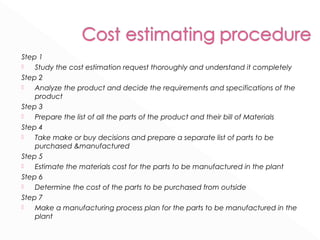
Step 1 
 Study the cost estimation request thoroughly and understand it completely 
Step 2 
 Analyze the product and decide the requirements and specifications of the 
product 
Step 3 
 Prepare the list of all the parts of the product and their bill of Materials 
Step 4 
 Take make or buy decisions and prepare a separate list of parts to be 
purchased &manufactured 
Step 5 
 Estimate the materials cost for the parts to be manufactured in the plant 
Step 6 
 Determine the cost of the parts to be purchased from outside 
Step 7 
 Make a manufacturing process plan for the parts to be manufactured in the 
plant
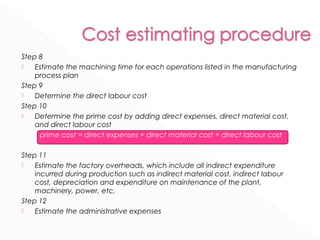
Step 8 
 Estimate the machining time for each operations listed in the manufacturing 
process plan 
Step 9 
 Determine the direct labour cost 
Step 10 
 Determine the prime cost by adding direct expenses, direct material cost, 
and direct labour cost 
prime cost = direct expenses + direct material cost + direct labour cost 
Step 11 
 Estimate the factory overheads, which include all indirect expenditure 
incurred during production such as indirect material cost, indirect labour 
cost, depreciation and expenditure on maintenance of the plant, 
machinery, power, etc. 
Step 12 
 Estimate the administrative expenses
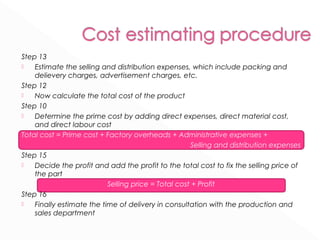
Step 13 
 Estimate the selling and distribution expenses, which include packing and 
delievery charges, advertisement charges, etc. 
Step 12 
 Now calculate the total cost of the product 
Step 10 
 Determine the prime cost by adding direct expenses, direct material cost, 
and direct labour cost 
Total cost = Prime cost + Factory overheads + Administrative expenses + 
Selling and distribution expenses 
Step 15 
 Decide the profit and add the profit to the total cost to fix the selling price of 
the part 
Selling price = Total cost + Profit 
Step 16 
 Finally estimate the time of delivery in consultation with the production and 
sales department
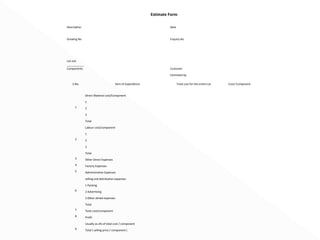
 After estimating all the elements of cost, these estimated data's entered into 
an estimate form
Estimate Form 
Description Date 
Drawing No Enquiry No 
Lot size 
___________ 
Components Customer 
Estimated by 
S.No. Item of Expenditure Total cost for the entire Lot Cost/ Component 
1 
Direct Material cost/Component 
1 
2 
3 
Total 
2 
Labour cost/component 
1 
2 
3 
Total 
3 Other Direct Expenses 
4 Factory Expenses 
5 Administrative Expenses 
6 
selling and distribution expenses 
1 Packing 
2 Advertising 
3 Other alined expenses 
Total 
7 Total cost/component 
8 Profit 
Usually as a% of total cost / component 
9 Total ( selling price / component )
• Costing is the determination of an actual 
cost of a component after adding 
different expenses incurred in various 
departments
• Costing may be defined as a systematic 
procedure for recording accurately 
every item of expenditure incurred on 
the manufacture of a product by 
different sections of any manufacturing 
concern
Cost determination:- 
 To determine the actual cost of each cost of each component and 
cost of the final product 
For fixing selling price:- 
 To provide information to ascertain the selling price of the product 
Cost control:- 
 To analyze the expenses incurred in production, so that control can 
be kept over them 
Comparison with estimate:- 
 To compare the actual cost with the estimated cost to know 
whether the estimate had been realistic or not 
Make or buy decisions:- 
 To decide which of the components to be manufactured and 
which parts to be purchased from outside
Wastage reduction:- 
 To help in detecting the undesirable wastages and expenses, so 
that corrective measures can be taken 
Suggest changes in design:- 
 To provide changes, if the cost of part is higher as compared to the 
competing product 
Profit & Loss:- 
 To locate the reasons for the increase or decrease in profit or loss of 
a company 
Fixing the discount:- 
 To help in determining the discount on catalogue or market price of 
the product 
Pricing policy:- 
 To help in formulating the policies for changing/price of the product
Budject preparation:- 
 To the enterprise to prepare its budget 
Prepare quotations/tenders:- 
 To facilitate preparation of estimate for submitting 
quotations/tenders 
Output targets:- 
 To help in regulating, from time to time, the production of a job so 
that the enterprise can earn more profits 
Legal provisions:- 
 To meet certain legal and government regulations, cost data is 
necessary 
Purchasing new one:- 
 To provide information for economic consideration for purchasing 
new plants/machines, etc.
Job/order costing:- 
 Find the cost of the each individual job/contract 
 The total cost of each order is obtained from the daily cost sheet 
Example:- ship building, machine fabricarion, building, etc. 
Batch costing:- 
 Batch costing is a form of job costing 
 Instead of costing each components, each batch of components is 
taken 
Example:- automobile switches, Plastic components, etc. 
Process costing :- 
 Employed for a product which involved a number of distinct process 
performed in a definite sequence 
 This method indicates the cost of a product at different stages as it 
passes through various operations 
 Example:- Oil refining, chemical, cement, paint, paper making
Departmental costing:- 
 This method is adopted in determining the cost of the cost of the 
output of each department separately 
 In this method, the actual expenditure of each department on various 
components is entered on a separate sheet 
Example:- steel industry, automobile industry, etc. 
Operating costing:- 
 This method is used in firms providing utility services 
Example:- water service, electricity board, transport services, etc. 
Unit costing :- 
 This method is adopted by the firms, which supply a uniform product 
rather than a variety of products 
Example:- mines, quarries, etc. 
Multiple costing :- 
 This method is adopted where manufacture of standardised products 
having no relation to one another in cost, quality and process, etc.
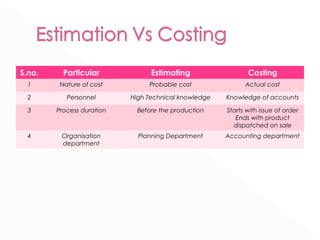
S.no. Particular Estimating Costing 
1 Nature of cost Probable cost Actual cost 
2 Personnel High Technical knowledge Knowledge of accounts 
3 Process duration Before the production Starts with issue of order 
Ends with product 
dispatched on sale 
4 Organisation 
department 
Planning Department Accounting department
Prepared by 
M.Ganesh Murugan 
9715447621

Costestimating 110323025231-phpapp02

  • 1.
    Prepared by M.GaneshMurugan 9715447621
  • 2.
    • The purposeof cost estimating is to find the cost of the manufacturing operations and to assist in setting the price for the product
  • 3.
     Cost estimatingmay be defined as the process of determining the probable cost of the product before the start of manufacture
  • 4.
     Important activityin engineering design and production  It is forecasting the future cost  Cost estimating & process planning are prominent activities in the manufacturing system  It considers all the expenditures involved like engineering, administration, etc  It requires high technical knowledge
  • 5.
     The onlyaccurate estimating can enable the leaders to make vital decisions such as manufacturing, selling policies Case1  If job is over estimated, › The firm will not be able to compete with its competitors  If the job is under estimated, › The firm will face huge financial loss
  • 6.
     To establishthe selling price of a product, so as to ensure reasonable profit to the company  To determine the most economical process  To make/buy decisions  To evaluate the alternate designs  To prepare production budget  TO initiate the cost reduction in existing facilities
  • 7.
     To fixthe selling price of the product  To help the contractors to submit the accurate tenders  To forecast the progress of production and cost  To set the various Standards
  • 8.
     Design cost  Drafting cost  R & D cost  Material cost  Labor cost  Inspection cost  Cost of tools, jigs, fixtures, etc.  Overhead cost
  • 9.
     Design costof the product is estimated by ascertaining the expected time for the design of that product Estimated Design cost = Estimated design time x salary of the designer per unit time  Design time can be estimate on the basis of similar products already designed or on the basis of good judgement of designer  If design done by outside agency, the total amount paid – gives the cost of design
  • 10.
     When thedesign completed, the drawing will be prepared by the draftsman Drafting cost = Estimated draft time x salary of the draftsman per unit time
  • 11.
     Considerable timeand money has to be spent on research and developmental work  The estimated cost and time on it are decided by the judgement or the past experience
  • 12.
     Following stepsinvolved › Prepare the list of all materials required to manufacture the product › Estimate the weight of all the materials expected (the allowance for the material wastage, spoilage and scrap are also added ) Estimated materials cost = Estimated weight of each part x Estimated future price › Finally, the estimated cost of all the parts is added to get the total estimated material cost of the product
  • 13.
     Following stepsinvolved › Toestimate the labour cost, the estimator should have the knowledge of various operations, machines, sequence, tools & labour to be used. Labour cost = Estimated labour time needed to the product x Cost of the labour per hour
  • 14.
     During thisstage, the estimator should consider the cost of inspection equipments, gauges and wages to the inspectors
  • 15.
     During thisstage, includes the estimated cost and maintenance charges for the tools, jigs, fixtures, die etc. required for production  It considers their present prices, market trend and the number of times a particular tool can be used during its life time
  • 16.
     This cannot be charged directly  All expenses other than direct cost are known as overhead cost or Indirect expenses, ex:- Administrative expenses, selling and distribution expenses, etc.  It can be estimated by referring the previous records
  • 17.
    Step 1 Study the cost estimation request thoroughly and understand it completely Step 2  Analyze the product and decide the requirements and specifications of the product Step 3  Prepare the list of all the parts of the product and their bill of Materials Step 4  Take make or buy decisions and prepare a separate list of parts to be purchased &manufactured Step 5  Estimate the materials cost for the parts to be manufactured in the plant Step 6  Determine the cost of the parts to be purchased from outside Step 7  Make a manufacturing process plan for the parts to be manufactured in the plant
  • 18.
    Step 8 Estimate the machining time for each operations listed in the manufacturing process plan Step 9  Determine the direct labour cost Step 10  Determine the prime cost by adding direct expenses, direct material cost, and direct labour cost prime cost = direct expenses + direct material cost + direct labour cost Step 11  Estimate the factory overheads, which include all indirect expenditure incurred during production such as indirect material cost, indirect labour cost, depreciation and expenditure on maintenance of the plant, machinery, power, etc. Step 12  Estimate the administrative expenses
  • 19.
    Step 13 Estimate the selling and distribution expenses, which include packing and delievery charges, advertisement charges, etc. Step 12  Now calculate the total cost of the product Step 10  Determine the prime cost by adding direct expenses, direct material cost, and direct labour cost Total cost = Prime cost + Factory overheads + Administrative expenses + Selling and distribution expenses Step 15  Decide the profit and add the profit to the total cost to fix the selling price of the part Selling price = Total cost + Profit Step 16  Finally estimate the time of delivery in consultation with the production and sales department
  • 20.
     After estimatingall the elements of cost, these estimated data's entered into an estimate form
  • 21.
    Estimate Form DescriptionDate Drawing No Enquiry No Lot size ___________ Components Customer Estimated by S.No. Item of Expenditure Total cost for the entire Lot Cost/ Component 1 Direct Material cost/Component 1 2 3 Total 2 Labour cost/component 1 2 3 Total 3 Other Direct Expenses 4 Factory Expenses 5 Administrative Expenses 6 selling and distribution expenses 1 Packing 2 Advertising 3 Other alined expenses Total 7 Total cost/component 8 Profit Usually as a% of total cost / component 9 Total ( selling price / component )
  • 22.
    • Costing isthe determination of an actual cost of a component after adding different expenses incurred in various departments
  • 23.
    • Costing maybe defined as a systematic procedure for recording accurately every item of expenditure incurred on the manufacture of a product by different sections of any manufacturing concern
  • 24.
    Cost determination:- To determine the actual cost of each cost of each component and cost of the final product For fixing selling price:-  To provide information to ascertain the selling price of the product Cost control:-  To analyze the expenses incurred in production, so that control can be kept over them Comparison with estimate:-  To compare the actual cost with the estimated cost to know whether the estimate had been realistic or not Make or buy decisions:-  To decide which of the components to be manufactured and which parts to be purchased from outside
  • 25.
    Wastage reduction:- To help in detecting the undesirable wastages and expenses, so that corrective measures can be taken Suggest changes in design:-  To provide changes, if the cost of part is higher as compared to the competing product Profit & Loss:-  To locate the reasons for the increase or decrease in profit or loss of a company Fixing the discount:-  To help in determining the discount on catalogue or market price of the product Pricing policy:-  To help in formulating the policies for changing/price of the product
  • 26.
    Budject preparation:- To the enterprise to prepare its budget Prepare quotations/tenders:-  To facilitate preparation of estimate for submitting quotations/tenders Output targets:-  To help in regulating, from time to time, the production of a job so that the enterprise can earn more profits Legal provisions:-  To meet certain legal and government regulations, cost data is necessary Purchasing new one:-  To provide information for economic consideration for purchasing new plants/machines, etc.
  • 27.
    Job/order costing:- Find the cost of the each individual job/contract  The total cost of each order is obtained from the daily cost sheet Example:- ship building, machine fabricarion, building, etc. Batch costing:-  Batch costing is a form of job costing  Instead of costing each components, each batch of components is taken Example:- automobile switches, Plastic components, etc. Process costing :-  Employed for a product which involved a number of distinct process performed in a definite sequence  This method indicates the cost of a product at different stages as it passes through various operations  Example:- Oil refining, chemical, cement, paint, paper making
  • 28.
    Departmental costing:- This method is adopted in determining the cost of the cost of the output of each department separately  In this method, the actual expenditure of each department on various components is entered on a separate sheet Example:- steel industry, automobile industry, etc. Operating costing:-  This method is used in firms providing utility services Example:- water service, electricity board, transport services, etc. Unit costing :-  This method is adopted by the firms, which supply a uniform product rather than a variety of products Example:- mines, quarries, etc. Multiple costing :-  This method is adopted where manufacture of standardised products having no relation to one another in cost, quality and process, etc.
  • 30.
    S.no. Particular EstimatingCosting 1 Nature of cost Probable cost Actual cost 2 Personnel High Technical knowledge Knowledge of accounts 3 Process duration Before the production Starts with issue of order Ends with product dispatched on sale 4 Organisation department Planning Department Accounting department
  • 31.
    Prepared by M.GaneshMurugan 9715447621