TOPIC 1:
PRELIMINARY
ESTIMATES
DEFINATION AND IMPORTANCE
OF PRELIMINARY ESTIMATES
DEFINATION
 Defined as an activity in particular work to make
possible offer to execute task base on a stipulated sum
 Technique to forecast the possible cost incurred for a
certain building or construction project via a systematic
calculation employing certain method, prepare at early
stage of the project
 Is a part of the cost planning process that is controlling
of the project cost at the design stage before any
drawings are embarked upon.
USE OF THE PRELIMINARY
ESTIMATE METHOD
 To ascertain the actual cost forecast of a
project.
 Assist the client in knowing to what extent he
need to be financially committed to a
particular project
 Estimated is also function as a design guide
whether the project to the allocation made
either
Cont’d
 If the estimate is higher that the client budget
for that particular project, the following could
be carried out :-
 The design could be altered to reduce the
cost
 Extra provisions are sought after or
requested from the client
 The project is postponed or cancelled
Cont’d
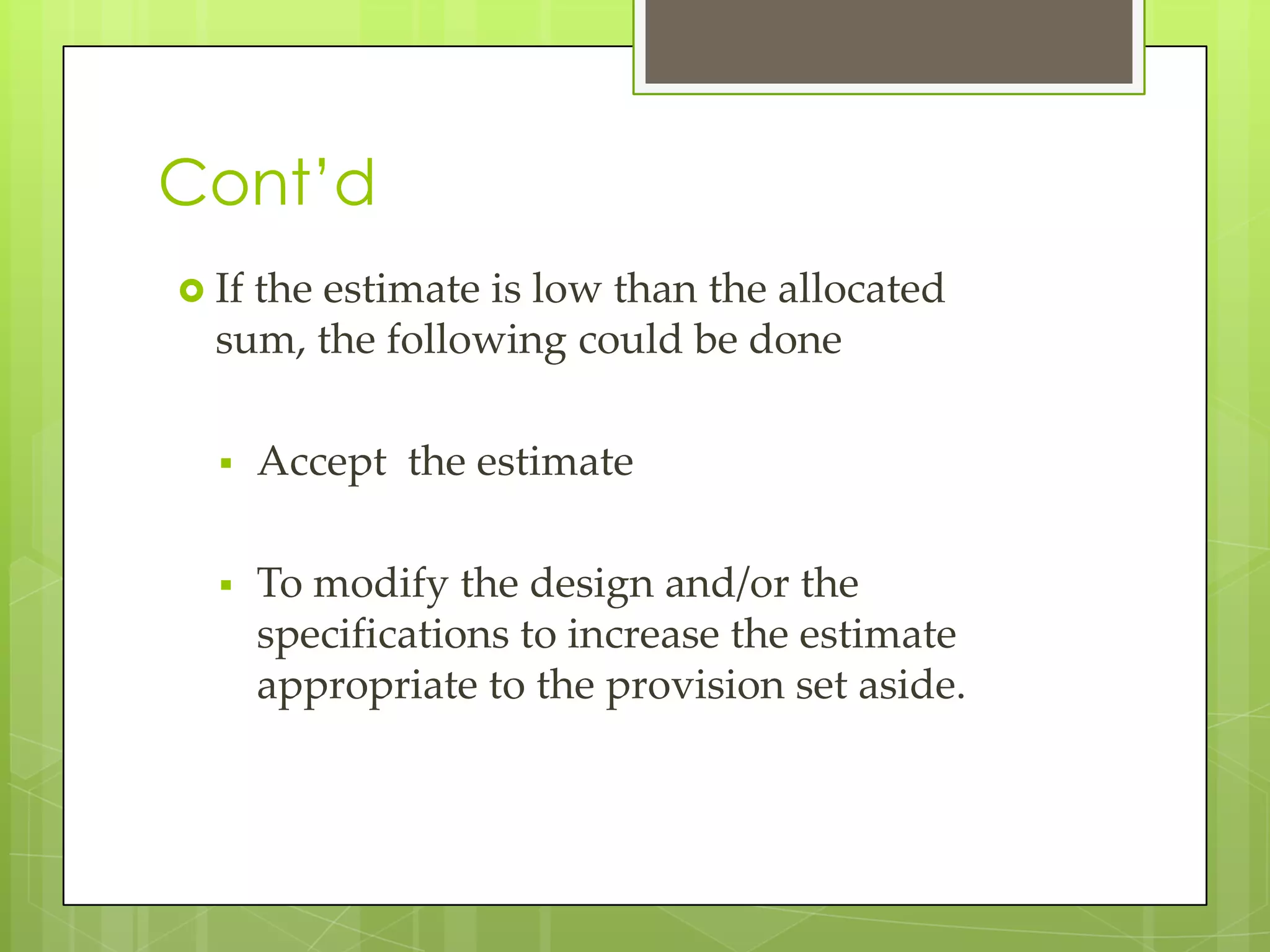
 If the estimate is low than the allocated
sum, the following could be done
 Accept the estimate
 To modify the design and/or the
specifications to increase the estimate
appropriate to the provision set aside.
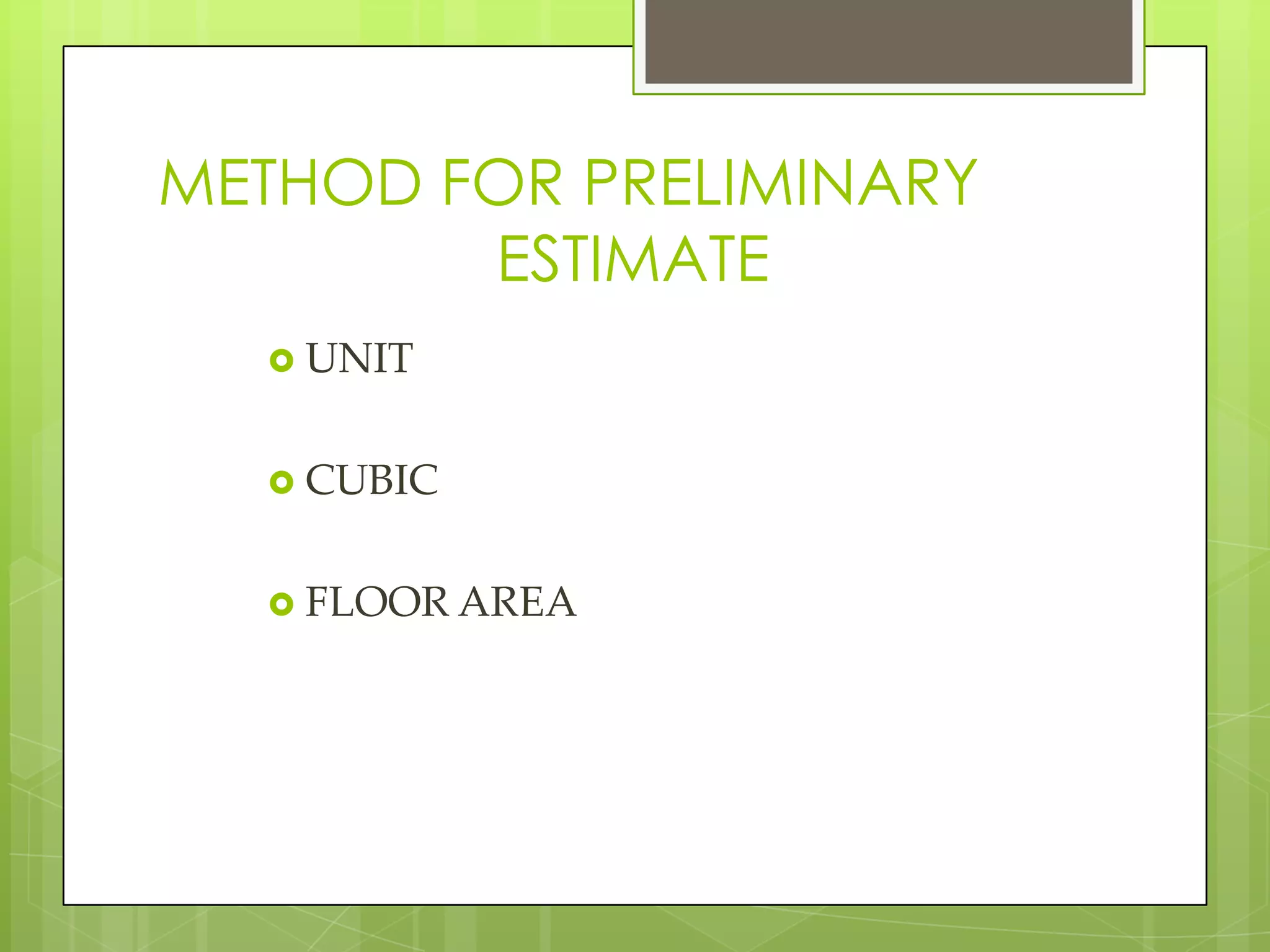
METHOD FOR PRELIMINARY
ESTIMATE
 UNIT
 CUBIC
 FLOOR AREA
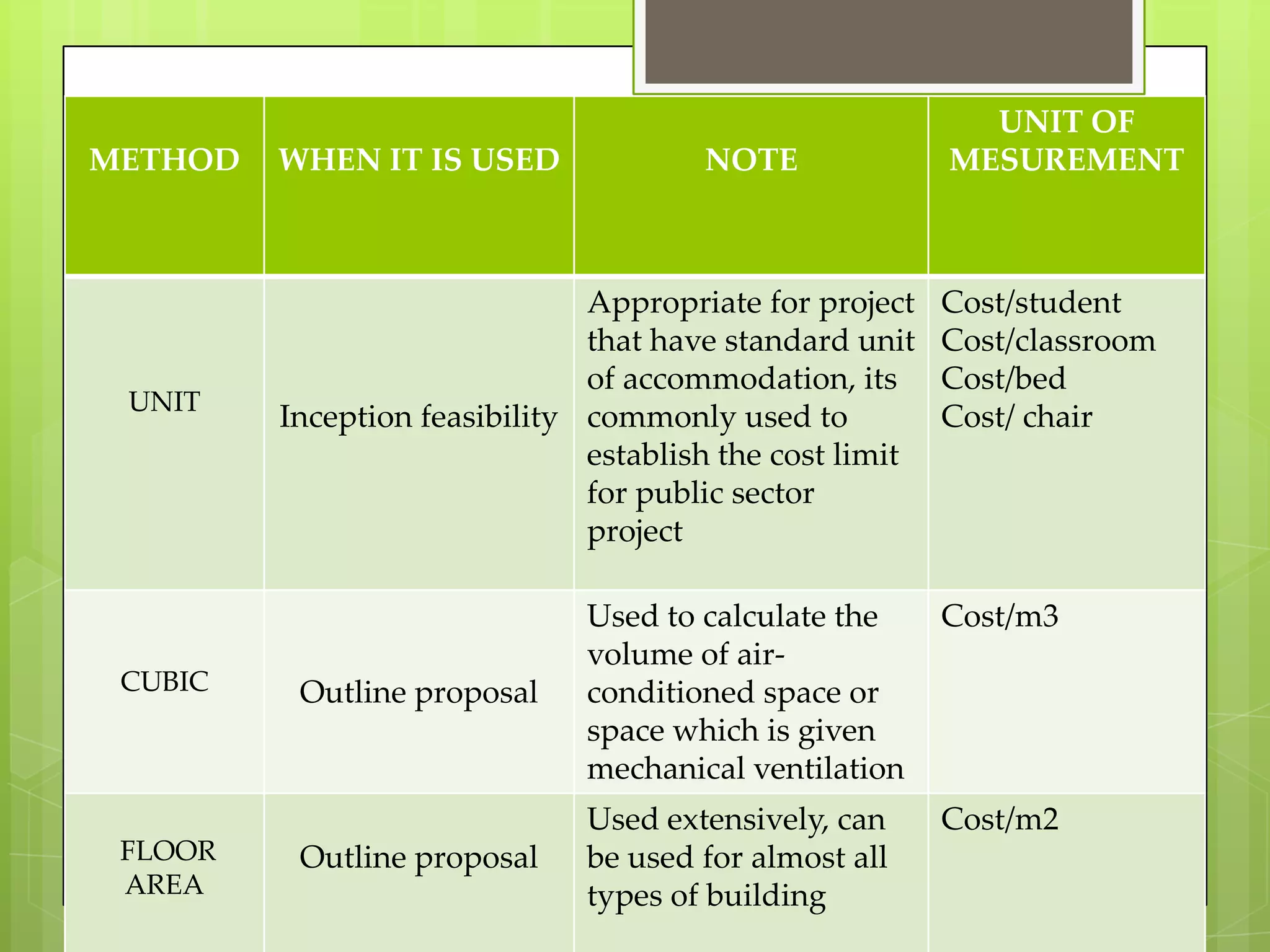
METHOD WHEN IT IS USED NOTE
UNIT OF
MESUREMENT
UNIT
Inception feasibility
Appropriate for project
that have standard unit
of accommodation, its
commonly used to
establish the cost limit
for public sector
project
Cost/student
Cost/classroom
Cost/bed
Cost/ chair
CUBIC Outline proposal
Used to calculate the
volume of air-
conditioned space or
space which is given
mechanical ventilation
Cost/m3
FLOOR
AREA
Outline proposal
Used extensively, can
be used for almost all
types of building
Cost/m2
THE SELECTION OF THE
METHOD WILL DEPEND ON
 The information and time to prepare the
estimate
 The experience of Quantity Surveyor
 The total and type of cost data available
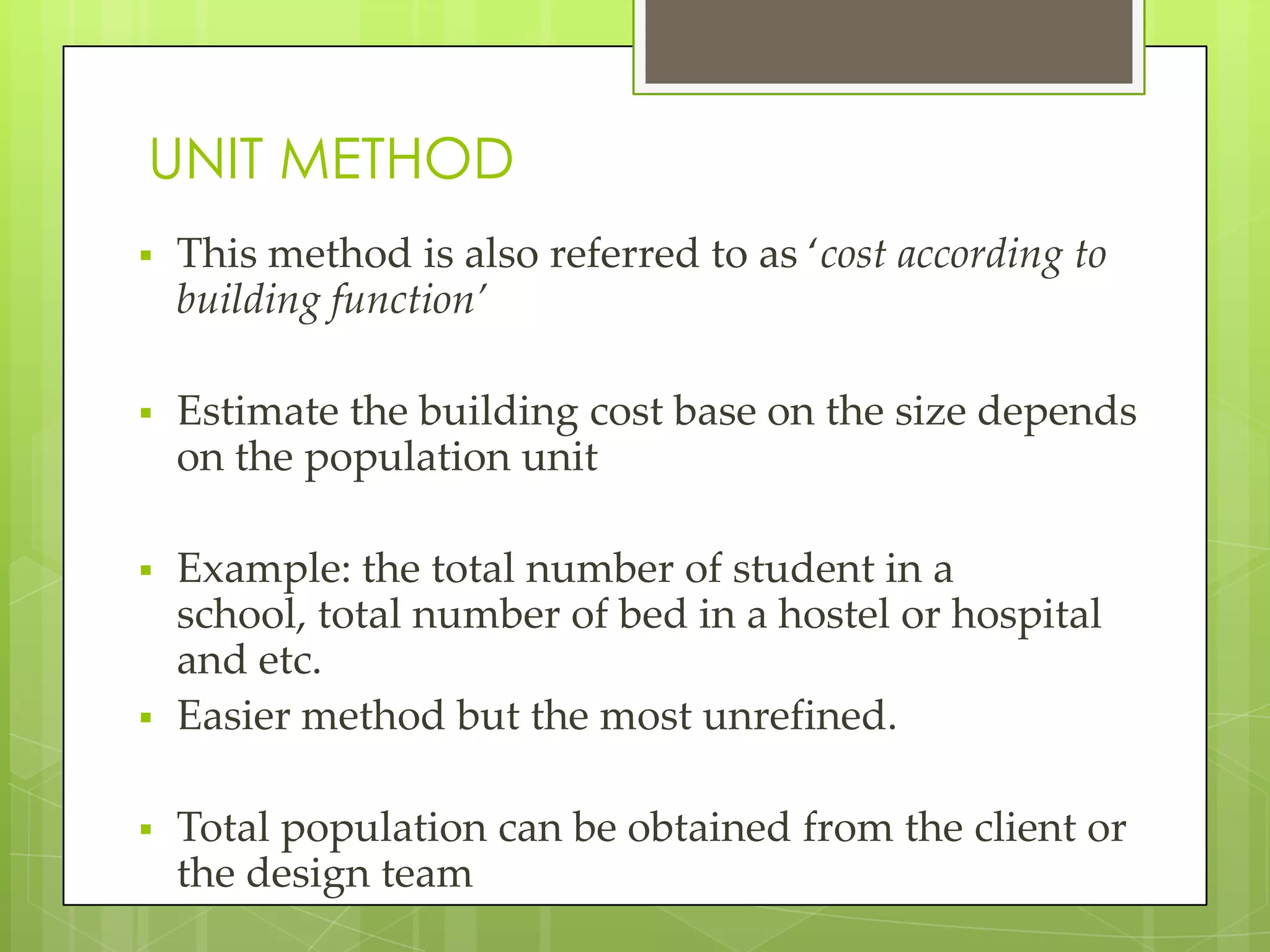
UNIT METHOD
 This method is also referred to as ‘cost according to
building function’
 Estimate the building cost base on the size depends
on the population unit
 Example: the total number of student in a
school, total number of bed in a hostel or hospital
and etc.
 Easier method but the most unrefined.
 Total population can be obtained from the client or
the design team
USAGE
 The cost estimate is obtained by multiplying the
number of accommodation for a new building with
the cost per unit of accommodation based on a
suitable building
 The current unit of accommodation can be obtained
by calculating from the sketch design or by
obtaining information from the client.
Example:
Estimate the total cost to build a mosque to house a
congregation of 500 individuals.
From a suitable cost data, get the cost/ congregation of a
similar mosque that has been updated. Lets us say that the
cost is RM 1400.00/ congregation.
Total cost = Number of accommodation x cost/congregation
500 individuals x 1,400
= RM 7000,000.00
CUBIC METHOD
 In Malaysia this method is seldom or almost
never used
 Only in certain case, it is utilized
 To calculate the space which is need to be air-
conditioned
 To calculate the space that needs mechanical
ventilation
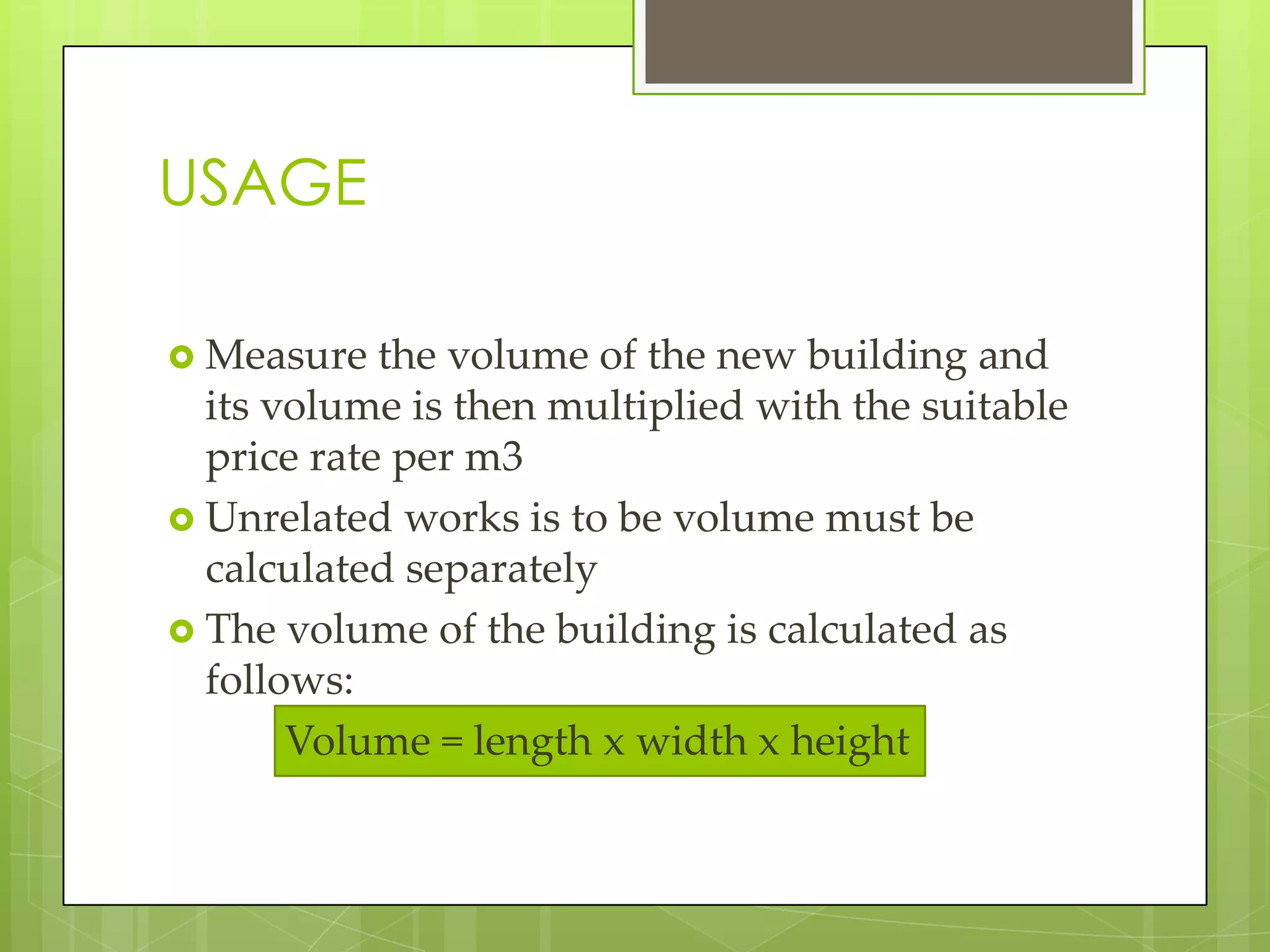
USAGE
 Measure the volume of the new building and
its volume is then multiplied with the suitable
price rate per m3
 Unrelated works is to be volume must be
calculated separately
 The volume of the building is calculated as
follows:
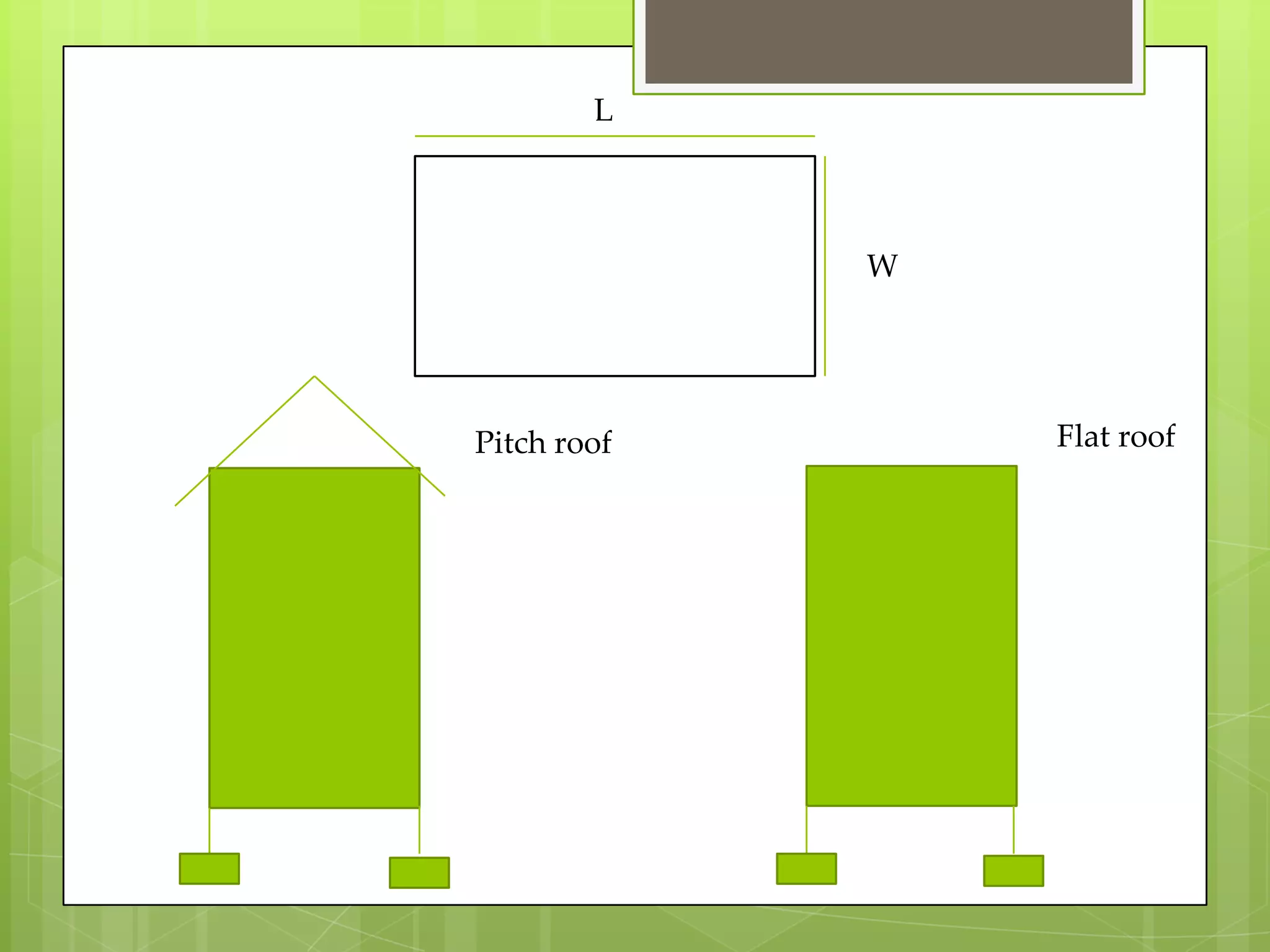
Volume = length x width x height
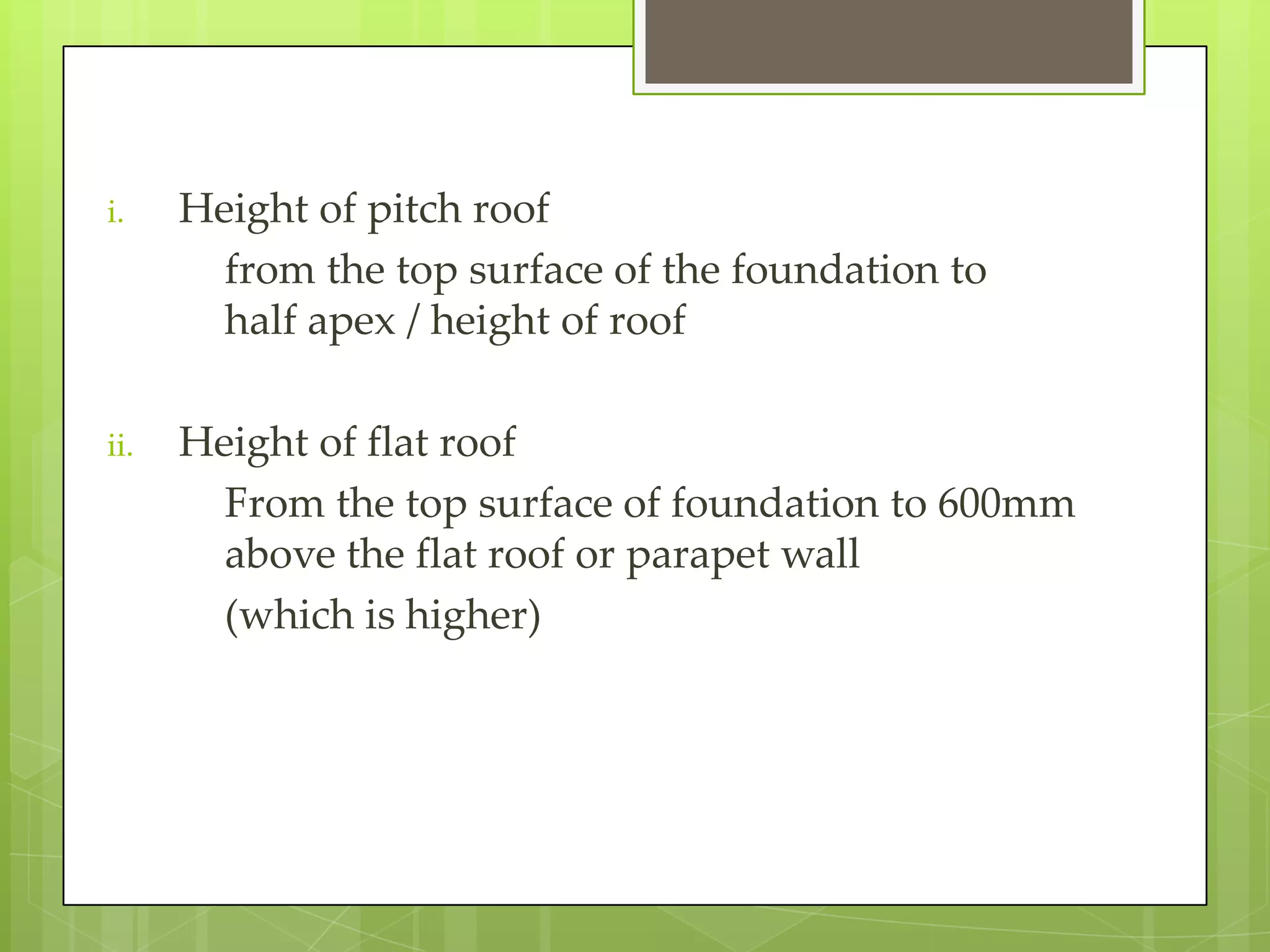
i. Height of pitch roof
from the top surface of the foundation to
half apex / height of roof
ii. Height of flat roof
From the top surface of foundation to 600mm
above the flat roof or parapet wall
(which is higher)
L
W
Flat roofPitch roof
Example
Estimate the total cost to build a 2-storey bungalow if the
construction cost/m3 of a similar construction is RM
550.00. estimate the construction cost base on
a) Pitch roof
b) Flat roof
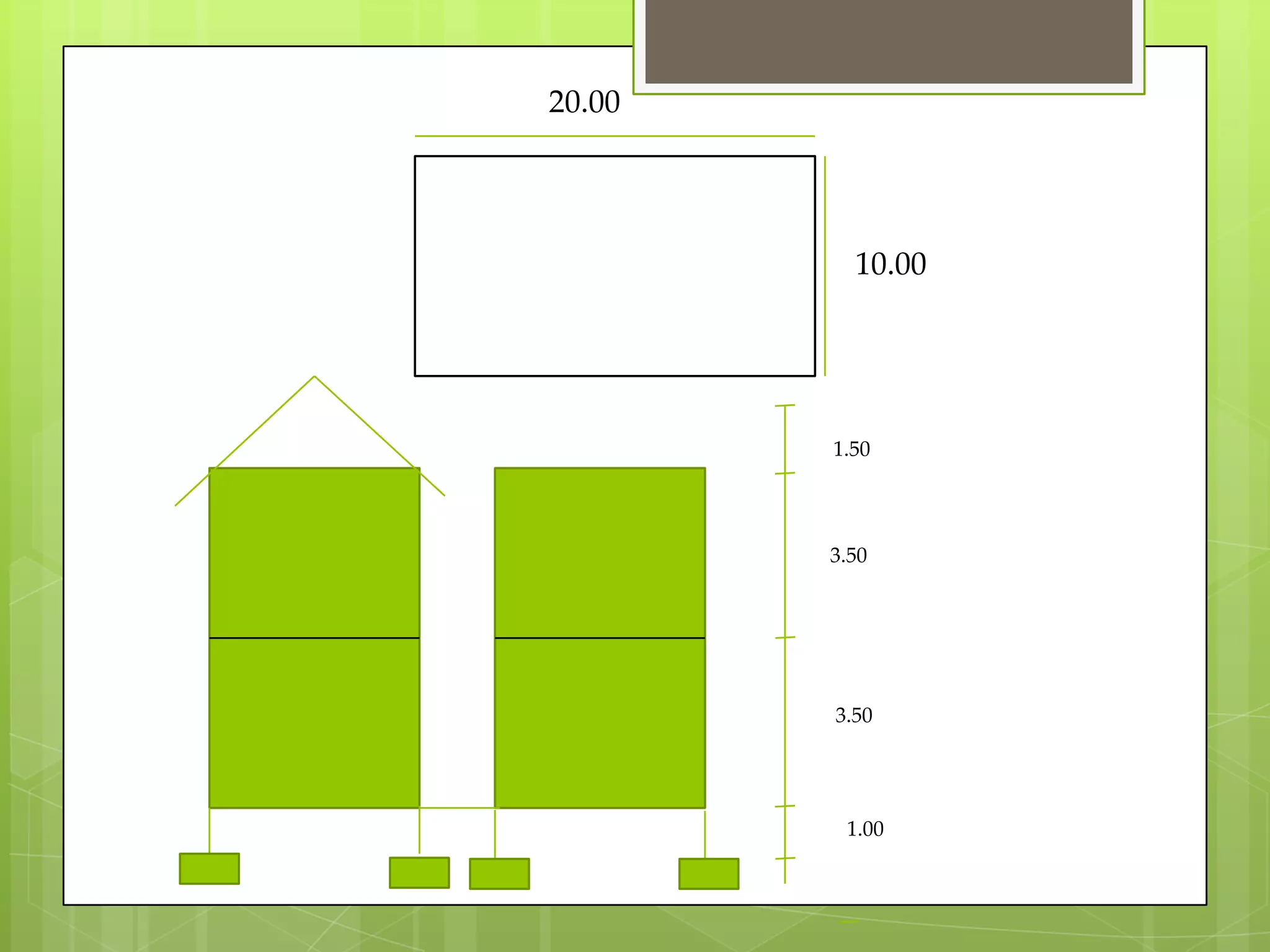
20.00
10.00
1.00
3.50
3.50
1.50
a) Pitch roof
Building volume = 20.00 x 10.00 x [1.00 +2(3.50) + ½ (1.50)]
=20.00 x 10.00 x 8.75
=1750m3
Total building cost = volume x cost/m3
=1750m3 x RM550.00
=RM962,500.00
b) Flat roof
Building volume = 20.00 x 10.00 x [1.00 +2(3.50) + 0.60]
=20.00 x 10.00 x 8.60
=1720m3
Total building cost = volume x cost/m3
=1720m3 x RM550.00
=RM946,000.00
Floor area method
 Make a preliminary estimate as most of the cost data
are kept or are available in this form
 The measurement for GFA must be similar between
the new building and the analyzed building
 Need to consider criteria in measurement of area
 In the calculation the floor area of a building there are
several criteria need to be taken
1. The actual area of the building
2. If the project offers a standard or different type of
accommodation it is better for each to be priced separately
3. Unrelated work to the area, for example, external work
must be priced separately
Cont’d
 The rate per m2 chosen must be current rate as
building cost often differ
 The site, external works, condition of contract, the
quantity and the quality of equipment and others that
related to the floor area must be calculated separately
 It is clear and difficulty of this method lies in
choosing the appropriate rate, which requires
experience, observation and familiarity toward varied
building types
USAGE
 The floor area of a building to be erected. Only the
building used this floor area method. Other works
may use other method like approximate quantity.
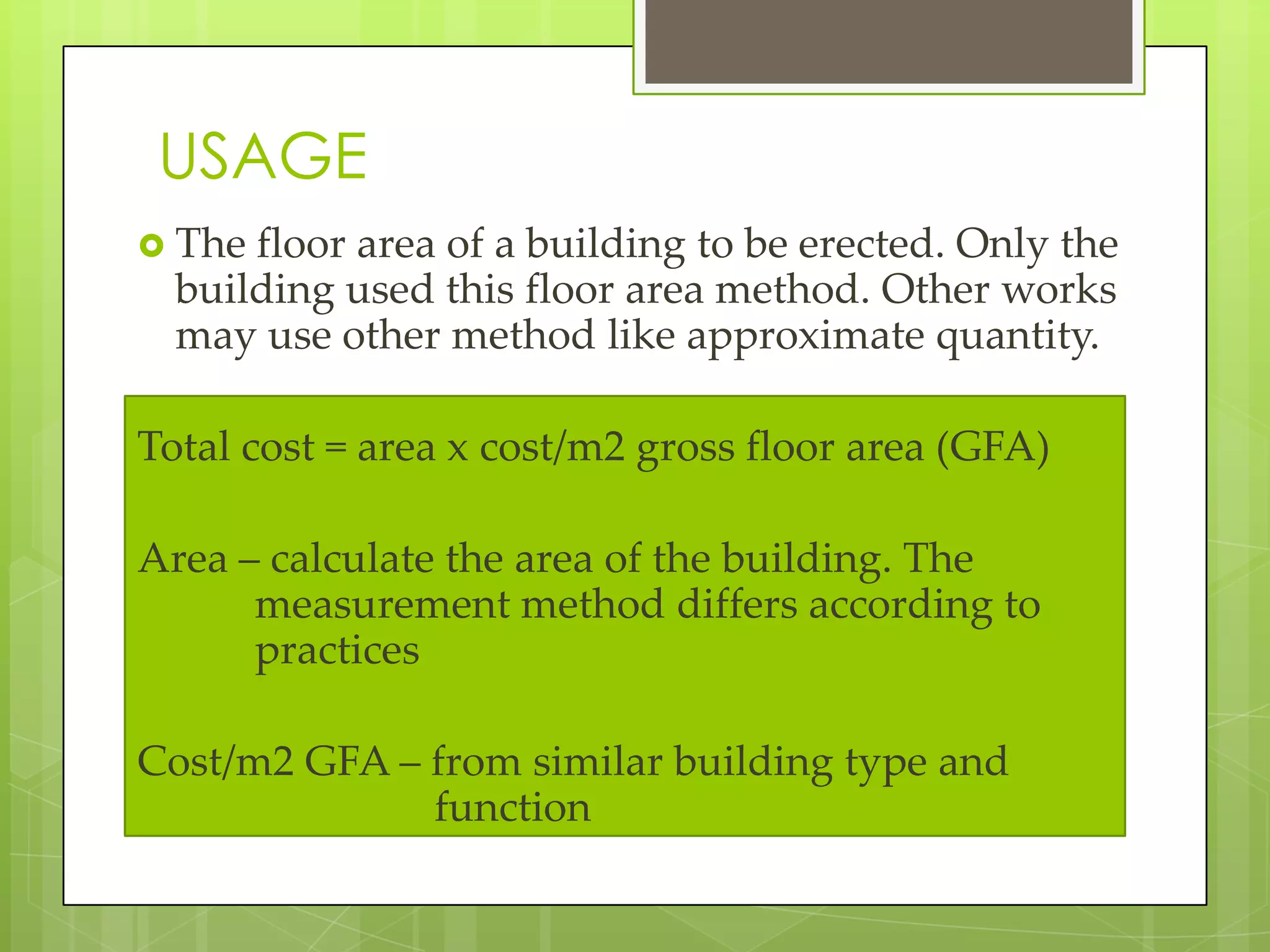
Total cost = area x cost/m2 gross floor area (GFA)
Area – calculate the area of the building. The
measurement method differs according to
practices
Cost/m2 GFA – from similar building type and
function
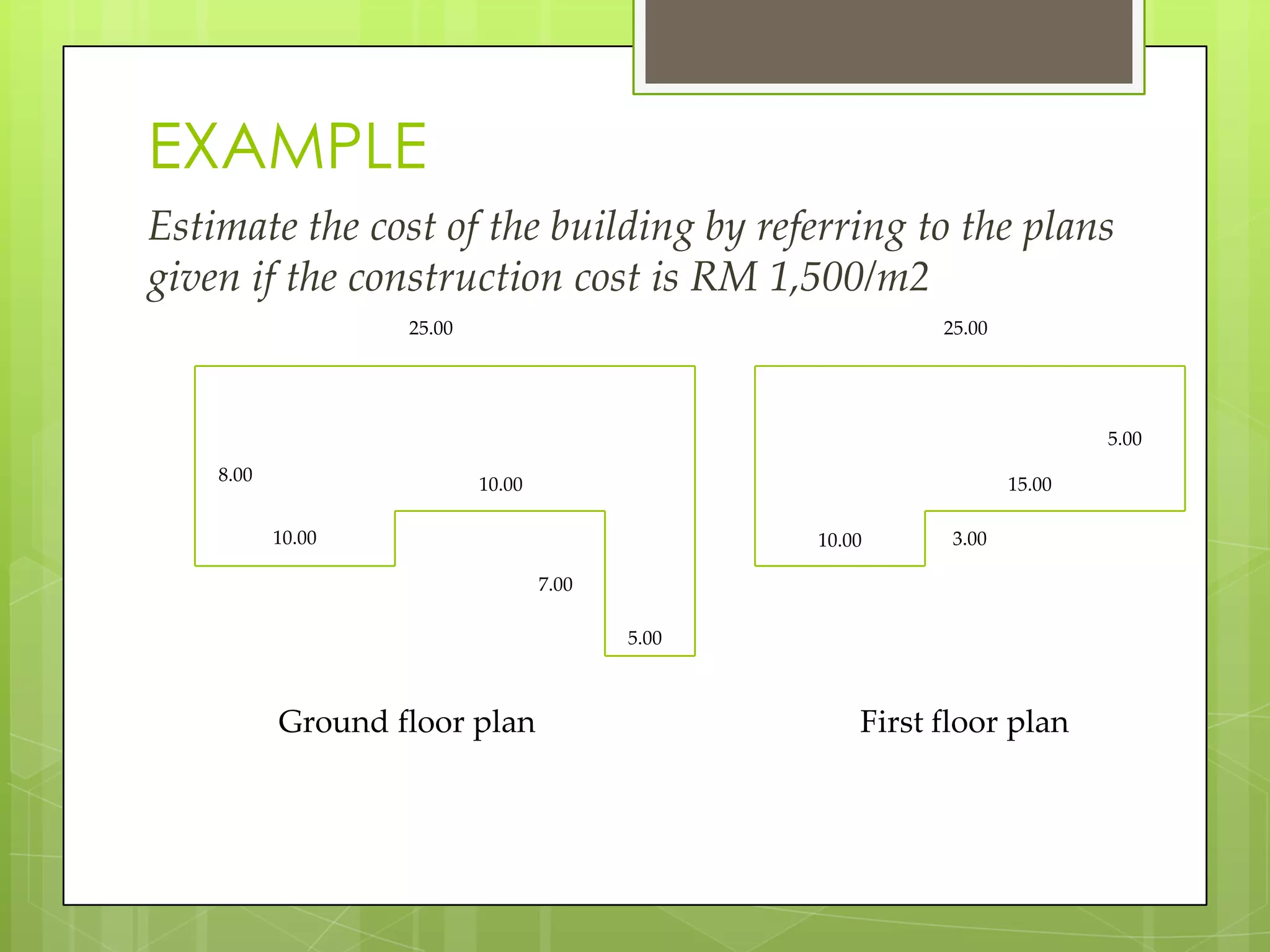
EXAMPLE
Estimate the cost of the building by referring to the plans
given if the construction cost is RM 1,500/m2
25.00
8.00
10.00 3.00
15.00
5.00
25.00
10.00
10.00
7.00
5.00
Ground floor plan First floor plan
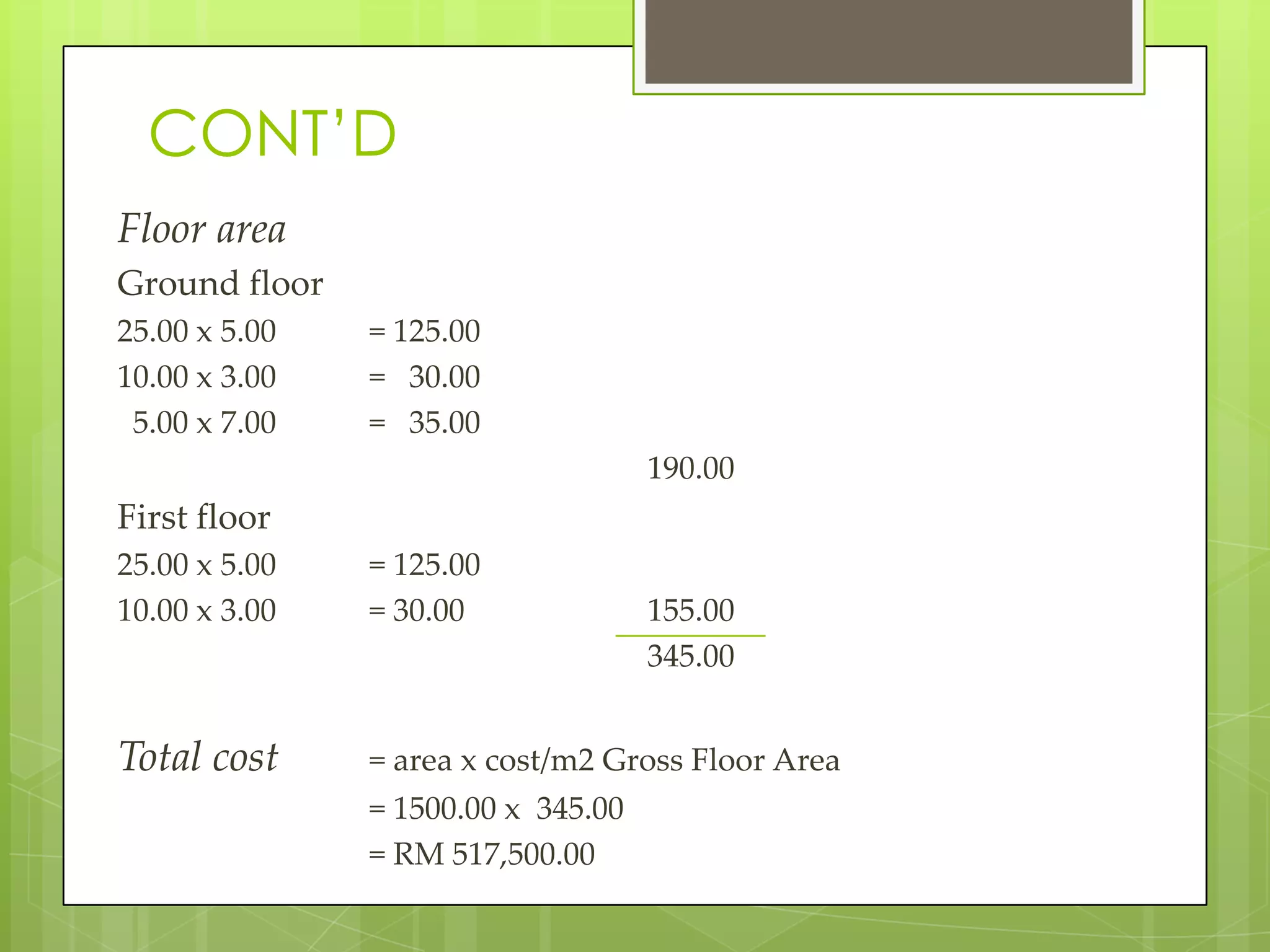
CONT’D
Floor area
Ground floor
25.00 x 5.00 = 125.00
10.00 x 3.00 = 30.00
5.00 x 7.00 = 35.00
190.00
First floor
25.00 x 5.00 = 125.00
10.00 x 3.00 = 30.00 155.00
345.00
Total cost = area x cost/m2 Gross Floor Area
= 1500.00 x 345.00
= RM 517,500.00
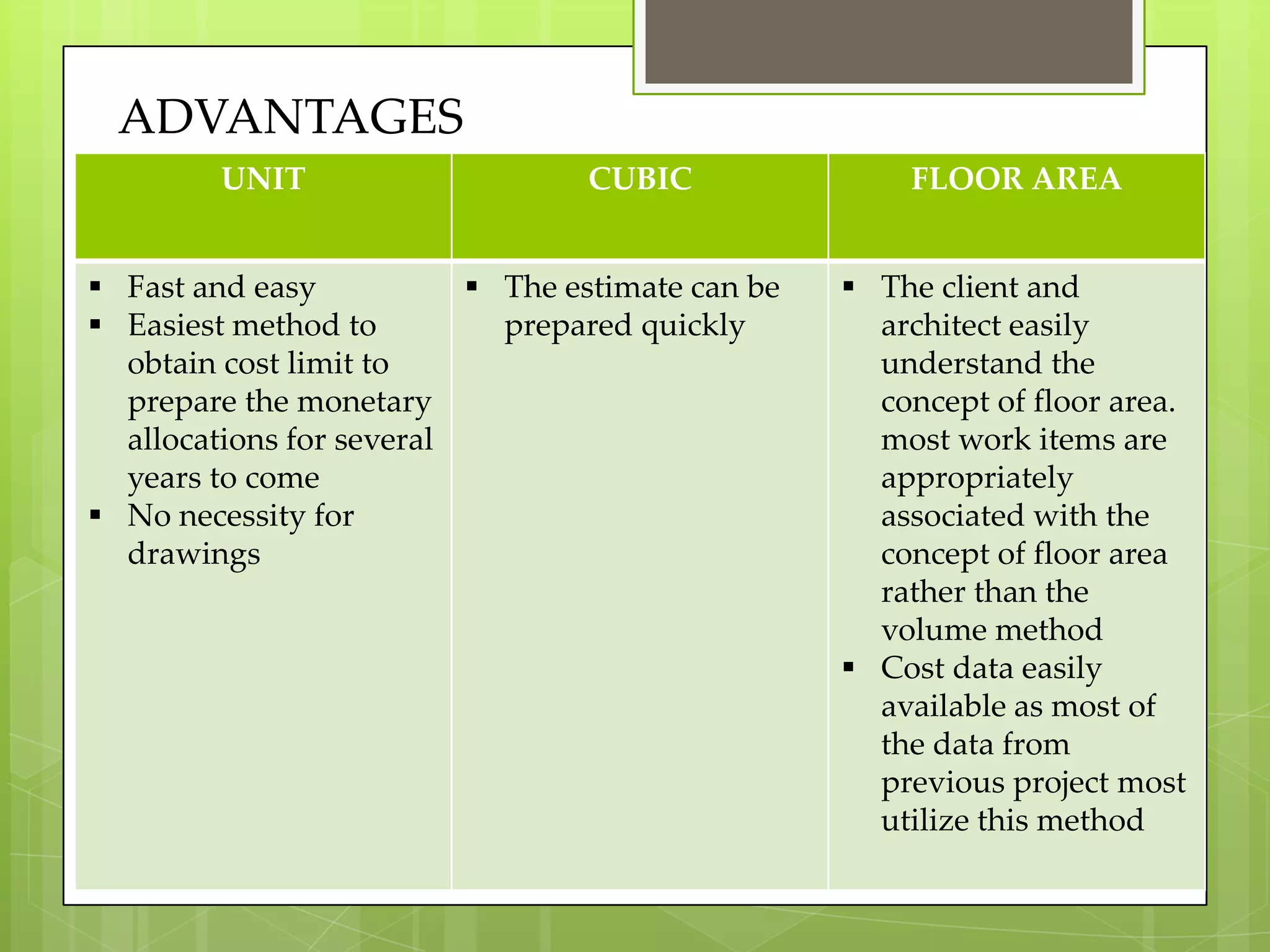
UNIT CUBIC FLOOR AREA
 Fast and easy
 Easiest method to
obtain cost limit to
prepare the monetary
allocations for several
years to come
 No necessity for
drawings
 The estimate can be
prepared quickly
 The client and
architect easily
understand the
concept of floor area.
most work items are
appropriately
associated with the
concept of floor area
rather than the
volume method
 Cost data easily
available as most of
the data from
previous project most
utilize this method
ADVANTAGES
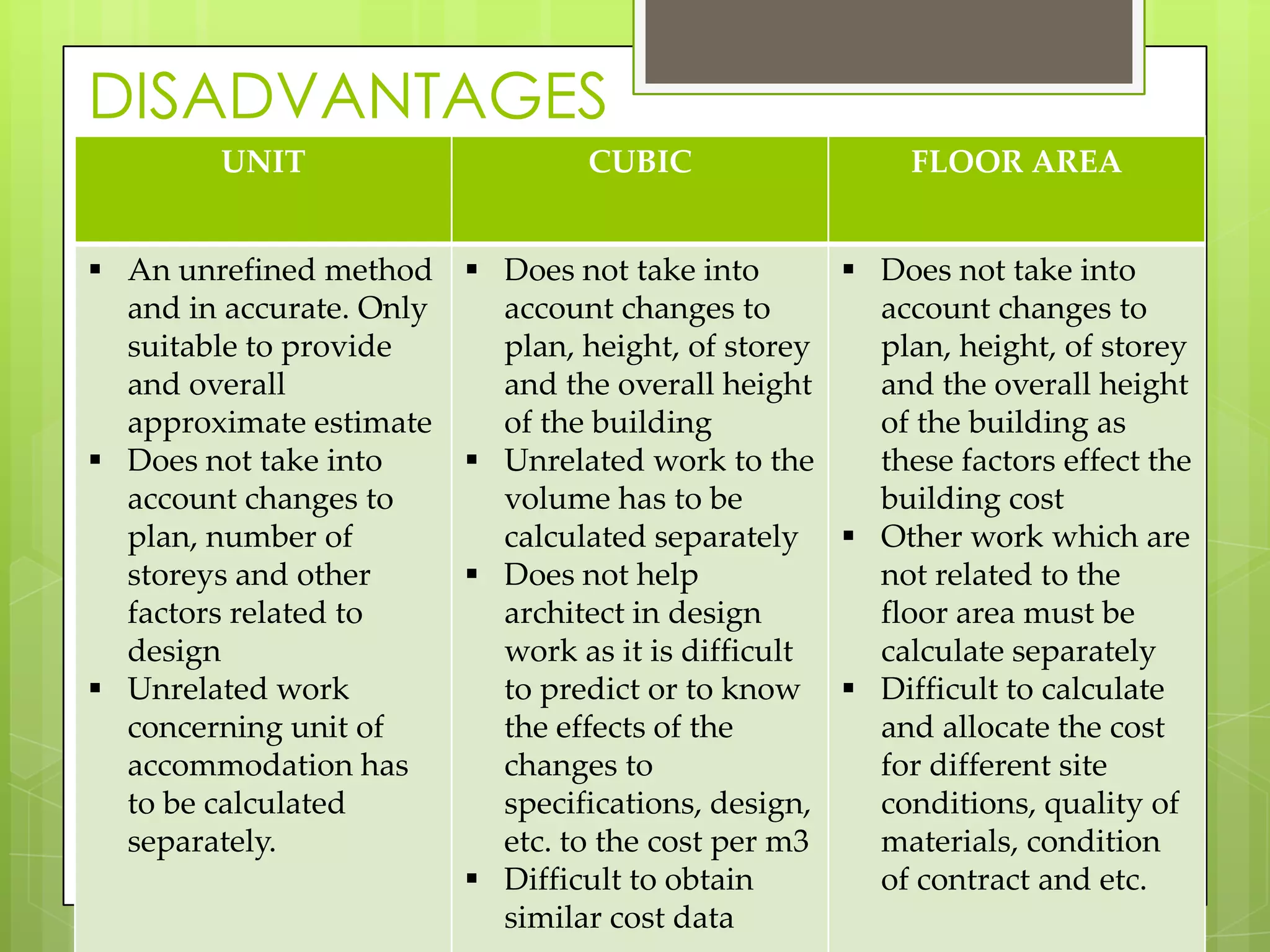
DISADVANTAGES
UNIT CUBIC FLOOR AREA
 An unrefined method
and in accurate. Only
suitable to provide
and overall
approximate estimate
 Does not take into
account changes to
plan, number of
storeys and other
factors related to
design
 Unrelated work
concerning unit of
accommodation has
to be calculated
separately.
 Does not take into
account changes to
plan, height, of storey
and the overall height
of the building
 Unrelated work to the
volume has to be
calculated separately
 Does not help
architect in design
work as it is difficult
to predict or to know
the effects of the
changes to
specifications, design,
etc. to the cost per m3
 Difficult to obtain
similar cost data
 Does not take into
account changes to
plan, height, of storey
and the overall height
of the building as
these factors effect the
building cost
 Other work which are
not related to the
floor area must be
calculate separately
 Difficult to calculate
and allocate the cost
for different site
conditions, quality of
materials, condition
of contract and etc.

Preliminary estimate

  • 1.
  • 2.
    DEFINATION AND IMPORTANCE OFPRELIMINARY ESTIMATES DEFINATION  Defined as an activity in particular work to make possible offer to execute task base on a stipulated sum  Technique to forecast the possible cost incurred for a certain building or construction project via a systematic calculation employing certain method, prepare at early stage of the project  Is a part of the cost planning process that is controlling of the project cost at the design stage before any drawings are embarked upon.
  • 3.
    USE OF THEPRELIMINARY ESTIMATE METHOD  To ascertain the actual cost forecast of a project.  Assist the client in knowing to what extent he need to be financially committed to a particular project  Estimated is also function as a design guide whether the project to the allocation made either
  • 4.
    Cont’d  If theestimate is higher that the client budget for that particular project, the following could be carried out :-  The design could be altered to reduce the cost  Extra provisions are sought after or requested from the client  The project is postponed or cancelled
  • 5.
    Cont’d  If theestimate is low than the allocated sum, the following could be done  Accept the estimate  To modify the design and/or the specifications to increase the estimate appropriate to the provision set aside.
  • 6.
    METHOD FOR PRELIMINARY ESTIMATE UNIT  CUBIC  FLOOR AREA
  • 7.
    METHOD WHEN ITIS USED NOTE UNIT OF MESUREMENT UNIT Inception feasibility Appropriate for project that have standard unit of accommodation, its commonly used to establish the cost limit for public sector project Cost/student Cost/classroom Cost/bed Cost/ chair CUBIC Outline proposal Used to calculate the volume of air- conditioned space or space which is given mechanical ventilation Cost/m3 FLOOR AREA Outline proposal Used extensively, can be used for almost all types of building Cost/m2
  • 8.
    THE SELECTION OFTHE METHOD WILL DEPEND ON  The information and time to prepare the estimate  The experience of Quantity Surveyor  The total and type of cost data available
  • 9.
    UNIT METHOD  Thismethod is also referred to as ‘cost according to building function’  Estimate the building cost base on the size depends on the population unit  Example: the total number of student in a school, total number of bed in a hostel or hospital and etc.  Easier method but the most unrefined.  Total population can be obtained from the client or the design team
  • 10.
    USAGE  The costestimate is obtained by multiplying the number of accommodation for a new building with the cost per unit of accommodation based on a suitable building  The current unit of accommodation can be obtained by calculating from the sketch design or by obtaining information from the client.
  • 11.
    Example: Estimate the totalcost to build a mosque to house a congregation of 500 individuals. From a suitable cost data, get the cost/ congregation of a similar mosque that has been updated. Lets us say that the cost is RM 1400.00/ congregation. Total cost = Number of accommodation x cost/congregation 500 individuals x 1,400 = RM 7000,000.00
  • 12.
    CUBIC METHOD  InMalaysia this method is seldom or almost never used  Only in certain case, it is utilized  To calculate the space which is need to be air- conditioned  To calculate the space that needs mechanical ventilation
  • 13.
    USAGE  Measure thevolume of the new building and its volume is then multiplied with the suitable price rate per m3  Unrelated works is to be volume must be calculated separately  The volume of the building is calculated as follows: Volume = length x width x height
  • 14.
    i. Height ofpitch roof from the top surface of the foundation to half apex / height of roof ii. Height of flat roof From the top surface of foundation to 600mm above the flat roof or parapet wall (which is higher)
  • 15.
  • 16.
    Example Estimate the totalcost to build a 2-storey bungalow if the construction cost/m3 of a similar construction is RM 550.00. estimate the construction cost base on a) Pitch roof b) Flat roof
  • 17.
  • 18.
    a) Pitch roof Buildingvolume = 20.00 x 10.00 x [1.00 +2(3.50) + ½ (1.50)] =20.00 x 10.00 x 8.75 =1750m3 Total building cost = volume x cost/m3 =1750m3 x RM550.00 =RM962,500.00
  • 19.
    b) Flat roof Buildingvolume = 20.00 x 10.00 x [1.00 +2(3.50) + 0.60] =20.00 x 10.00 x 8.60 =1720m3 Total building cost = volume x cost/m3 =1720m3 x RM550.00 =RM946,000.00
  • 20.
    Floor area method Make a preliminary estimate as most of the cost data are kept or are available in this form  The measurement for GFA must be similar between the new building and the analyzed building  Need to consider criteria in measurement of area  In the calculation the floor area of a building there are several criteria need to be taken 1. The actual area of the building 2. If the project offers a standard or different type of accommodation it is better for each to be priced separately 3. Unrelated work to the area, for example, external work must be priced separately
  • 21.
    Cont’d  The rateper m2 chosen must be current rate as building cost often differ  The site, external works, condition of contract, the quantity and the quality of equipment and others that related to the floor area must be calculated separately  It is clear and difficulty of this method lies in choosing the appropriate rate, which requires experience, observation and familiarity toward varied building types
  • 22.
    USAGE  The floorarea of a building to be erected. Only the building used this floor area method. Other works may use other method like approximate quantity. Total cost = area x cost/m2 gross floor area (GFA) Area – calculate the area of the building. The measurement method differs according to practices Cost/m2 GFA – from similar building type and function
  • 23.
    EXAMPLE Estimate the costof the building by referring to the plans given if the construction cost is RM 1,500/m2 25.00 8.00 10.00 3.00 15.00 5.00 25.00 10.00 10.00 7.00 5.00 Ground floor plan First floor plan
  • 24.
    CONT’D Floor area Ground floor 25.00x 5.00 = 125.00 10.00 x 3.00 = 30.00 5.00 x 7.00 = 35.00 190.00 First floor 25.00 x 5.00 = 125.00 10.00 x 3.00 = 30.00 155.00 345.00 Total cost = area x cost/m2 Gross Floor Area = 1500.00 x 345.00 = RM 517,500.00
  • 25.
    UNIT CUBIC FLOORAREA  Fast and easy  Easiest method to obtain cost limit to prepare the monetary allocations for several years to come  No necessity for drawings  The estimate can be prepared quickly  The client and architect easily understand the concept of floor area. most work items are appropriately associated with the concept of floor area rather than the volume method  Cost data easily available as most of the data from previous project most utilize this method ADVANTAGES
  • 26.
    DISADVANTAGES UNIT CUBIC FLOORAREA  An unrefined method and in accurate. Only suitable to provide and overall approximate estimate  Does not take into account changes to plan, number of storeys and other factors related to design  Unrelated work concerning unit of accommodation has to be calculated separately.  Does not take into account changes to plan, height, of storey and the overall height of the building  Unrelated work to the volume has to be calculated separately  Does not help architect in design work as it is difficult to predict or to know the effects of the changes to specifications, design, etc. to the cost per m3  Difficult to obtain similar cost data  Does not take into account changes to plan, height, of storey and the overall height of the building as these factors effect the building cost  Other work which are not related to the floor area must be calculate separately  Difficult to calculate and allocate the cost for different site conditions, quality of materials, condition of contract and etc.