Cosmetology
and Nails
Reviewed by

Hala Aly Ibrahim
Lecturer Of Dermatology & Venereology
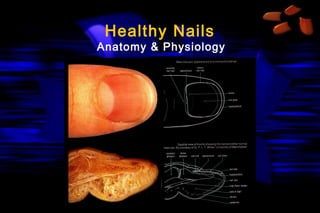
Healthy Nails

Anatomy & Physiology
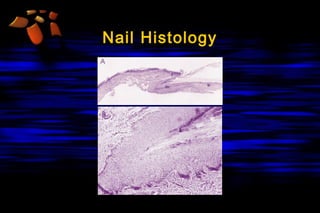
Nail Histology
Nail Plate Growth
 Complete growth for the nail plate to replace
itself from the time it is formed at the root
until it reaches beyond the finger tip needs 57 months.
Nail Regeneration
If:
 Nail plate is injured & falls off→ replaced at
normal growth rate.
 Nail matrix is destroyed→ nail plate won’t
grow.
 Nail matrix is damaged →distorted newly
growing nail plate.
I - Factors Determining Nail Beauty
a.
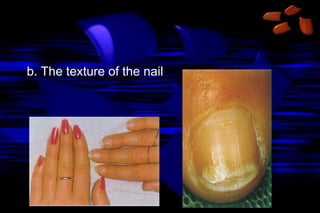
b.
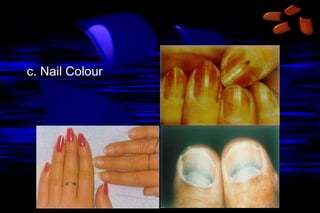
c.
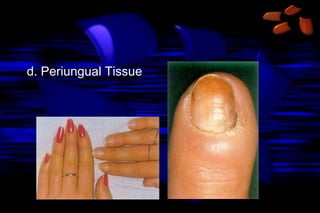
d.

The Shape of the Nail
Nail texture
Nail Colour
Periungual tissue
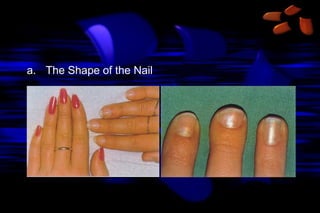
a. The Shape of the Nail
b. The texture of the nail
c. Nail Colour
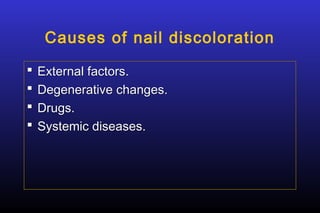
Causes of nail discoloration





External factors.
Degenerative changes.
Drugs.
Systemic diseases.
d. Periungual Tissue
a. General health care
measures
 Chemicals & repeated wetting & drying
should be avoided
 Cutting the nails [(wet) - magic ratio]
 Shaping the nails (dry)
 Splits and cracks & hang nails
 Nail health supplements
b. Nail Care Items
Instruments

i. Instruments:
 Tools
 Sanitary practice:
 Sanitation
 Disinfection
 Sterilization

Cosmetics
ii. Nail Cosmetics:
 Nail Cosmetic Products







Nail polishes
Polish removers
Basecoats & topcoats
Nail Hardeners
Conditioners & Buffering creams
Cuticle remover

 Artificial nails
Artificial Nails
 These are used as a substitute for nails in
individuals desiring long attractive nails, but whose
own nails are abnormal in appearance or break
easily.
 Types:





Sculptured
Preformed
Nail mending or wrapping kits
Gel Systems
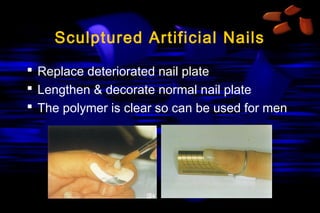
Sculptured Artificial Nails
 Replace deteriorated nail plate
 Lengthen & decorate normal nail plate
 The polymer is clear so can be used for men
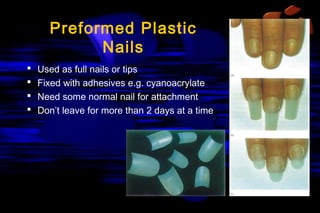
Preformed Plastic
Nails





Used as full nails or tips
Fixed with adhesives e.g. cyanoacrylate
Need some normal nail for attachment
Don’t leave for more than 2 days at a time
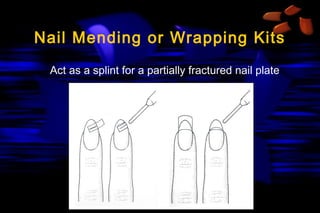
Nail Mending or Wrapping Kits
Act as a splint for a partially fractured nail plate
Gel Nails
 Acrylic-based material used as caps over
natural nails of persons having trouble
growing their own nails (chipping, cracking &
peeling) e.g. nail biters
Adverse Effects of Nail Cosmetic
Procedures
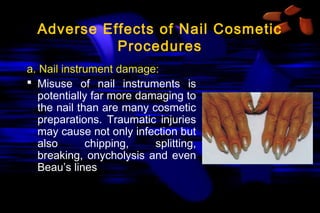
a. Nail instrument damage:
 Misuse of nail instruments is
potentially far more damaging to
the nail than are many cosmetic
preparations. Traumatic injuries
may cause not only infection but
also
chipping,
splitting,
breaking, onycholysis and even
Beau’s lines
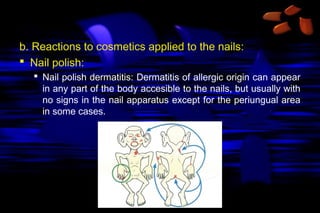
b. Reactions to cosmetics applied to the nails:
 Nail polish:
 Nail polish dermatitis: Dermatitis of allergic origin can appear
in any part of the body accesible to the nails, but usually with
no signs in the nail apparatus except for the periungual area
in some cases.
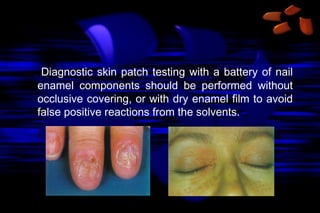
Diagnostic skin patch testing with a battery of nail
enamel components should be performed without
occlusive covering, or with dry enamel film to avoid
false positive reactions from the solvents.
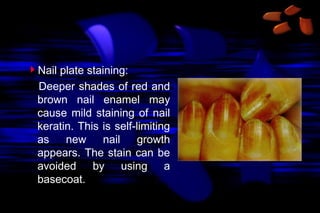
Nail plate staining:
Deeper shades of red and
brown nail enamel may
cause mild staining of nail
keratin. This is self-limiting
as
new
nail
growth
appears. The stain can be
avoided by using a
basecoat.
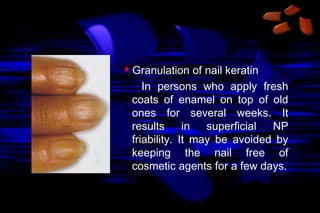
Granulation of nail keratin
In persons who apply fresh
coats of enamel on top of old
ones for several weeks. It
results
in
superficial
NP
friability. It may be avoided by
keeping the nail free of
cosmetic agents for a few days.
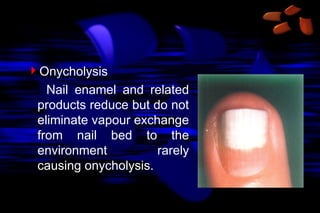
Onycholysis
Nail enamel and related
products reduce but do not
eliminate vapour exchange
from nail bed to the
environment
rarely
causing onycholysis.
 Nail polish removers:
 Acetone, ethylacetate or similar organic solvents
dehydrate the NP and decrease corneocyte
adhesion, contributing to brittleness. They also
remove lipids from the NP & cause inflammation
of the paronychial area. Rarely, irritant and
allergic contact dermatitis, blistering and
onycholysis may occur.
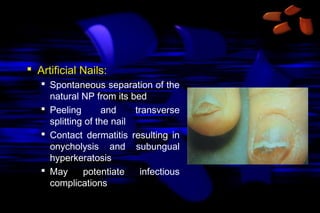
 Artificial Nails:
 Spontaneous separation of the
natural NP from its bed
 Peeling
and
transverse
splitting of the nail
 Contact dermatitis resulting in
onycholysis and subungual
hyperkeratosis
 May
potentiate
infectious
complications
Summary
 The art of nail care is a common demand
among most health oriented individuals.
 It is a mistake for the physician to view a
patient’s complaint of unattractive nails as
too trivial for medical consideration.
 The proper understanding of nail anatomy &
physiology is a baseline request.
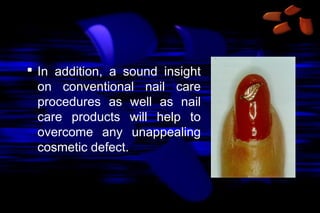
 In addition, a sound insight
on conventional nail care
procedures as well as nail
care products will help to
overcome any unappealing
cosmetic defect.
 Dystrophic, absent or diseased nails
(particularly were only few are involved, can
be improved cosmetically with nail care
regimen, added colors or artificial nails.
 Dermatologists are well advised to recognize
such means for achieving a psychologic lift in
their patients.
 Factors causing cosmetic nail derangement
 Developmental and hereditary nail disorders
 Physical or chemical trauma
 Diseases
 Systemic
 Cutaneous
 Psychological
 Tumours

 Medications
 Topical
 Systemic
Infection of nail unit
1.Nail fold (paronychia):
 Acute:
Bacterial : (staph),

Viral: herpetic whitlow honey-comb)
 Chronic:
(Candida with superadded bacteria)

 2.nail plate (onychia)
Tumours
 Benign:
•
•
•
•
•
•
•

Warts.
Myxoid cyst (synovial ).
Subungual exostosis.
Nevus Junctional N. in matrix….band).
Pyogenic granuloma.
Fibromata (tuberous sclerosis).
Glomus tumour
Malignant
 SCC
 Malignant melanoma
usually follows pigmented nail band.
 Lymphoma

Cosmetology and nails

  • 1.
    Cosmetology and Nails Reviewed by HalaAly Ibrahim Lecturer Of Dermatology & Venereology
  • 2.
  • 3.
  • 4.
    Nail Plate Growth Complete growth for the nail plate to replace itself from the time it is formed at the root until it reaches beyond the finger tip needs 57 months.
  • 5.
    Nail Regeneration If:  Nailplate is injured & falls off→ replaced at normal growth rate.  Nail matrix is destroyed→ nail plate won’t grow.  Nail matrix is damaged →distorted newly growing nail plate.
  • 6.
    I - FactorsDetermining Nail Beauty a. b. c. d. The Shape of the Nail Nail texture Nail Colour Periungual tissue
  • 7.
    a. The Shapeof the Nail
  • 8.
    b. The textureof the nail
  • 9.
  • 10.
    Causes of naildiscoloration     External factors. Degenerative changes. Drugs. Systemic diseases.
  • 11.
  • 12.
    a. General healthcare measures  Chemicals & repeated wetting & drying should be avoided  Cutting the nails [(wet) - magic ratio]  Shaping the nails (dry)  Splits and cracks & hang nails  Nail health supplements
  • 13.
    b. Nail CareItems Instruments i. Instruments:  Tools  Sanitary practice:  Sanitation  Disinfection  Sterilization Cosmetics
  • 14.
    ii. Nail Cosmetics: Nail Cosmetic Products       Nail polishes Polish removers Basecoats & topcoats Nail Hardeners Conditioners & Buffering creams Cuticle remover  Artificial nails
  • 15.
    Artificial Nails  Theseare used as a substitute for nails in individuals desiring long attractive nails, but whose own nails are abnormal in appearance or break easily.  Types:     Sculptured Preformed Nail mending or wrapping kits Gel Systems
  • 16.
    Sculptured Artificial Nails Replace deteriorated nail plate  Lengthen & decorate normal nail plate  The polymer is clear so can be used for men
  • 17.
    Preformed Plastic Nails     Used asfull nails or tips Fixed with adhesives e.g. cyanoacrylate Need some normal nail for attachment Don’t leave for more than 2 days at a time
  • 18.
    Nail Mending orWrapping Kits Act as a splint for a partially fractured nail plate
  • 19.
    Gel Nails  Acrylic-basedmaterial used as caps over natural nails of persons having trouble growing their own nails (chipping, cracking & peeling) e.g. nail biters
  • 20.
    Adverse Effects ofNail Cosmetic Procedures a. Nail instrument damage:  Misuse of nail instruments is potentially far more damaging to the nail than are many cosmetic preparations. Traumatic injuries may cause not only infection but also chipping, splitting, breaking, onycholysis and even Beau’s lines
  • 21.
    b. Reactions tocosmetics applied to the nails:  Nail polish:  Nail polish dermatitis: Dermatitis of allergic origin can appear in any part of the body accesible to the nails, but usually with no signs in the nail apparatus except for the periungual area in some cases.
  • 22.
    Diagnostic skin patchtesting with a battery of nail enamel components should be performed without occlusive covering, or with dry enamel film to avoid false positive reactions from the solvents.
  • 23.
    Nail plate staining: Deepershades of red and brown nail enamel may cause mild staining of nail keratin. This is self-limiting as new nail growth appears. The stain can be avoided by using a basecoat.
  • 24.
    Granulation of nailkeratin In persons who apply fresh coats of enamel on top of old ones for several weeks. It results in superficial NP friability. It may be avoided by keeping the nail free of cosmetic agents for a few days.
  • 25.
    Onycholysis Nail enamel andrelated products reduce but do not eliminate vapour exchange from nail bed to the environment rarely causing onycholysis.
  • 26.
     Nail polishremovers:  Acetone, ethylacetate or similar organic solvents dehydrate the NP and decrease corneocyte adhesion, contributing to brittleness. They also remove lipids from the NP & cause inflammation of the paronychial area. Rarely, irritant and allergic contact dermatitis, blistering and onycholysis may occur.
  • 27.
     Artificial Nails: Spontaneous separation of the natural NP from its bed  Peeling and transverse splitting of the nail  Contact dermatitis resulting in onycholysis and subungual hyperkeratosis  May potentiate infectious complications
  • 28.
    Summary  The artof nail care is a common demand among most health oriented individuals.  It is a mistake for the physician to view a patient’s complaint of unattractive nails as too trivial for medical consideration.  The proper understanding of nail anatomy & physiology is a baseline request.
  • 29.
     In addition,a sound insight on conventional nail care procedures as well as nail care products will help to overcome any unappealing cosmetic defect.
  • 30.
     Dystrophic, absentor diseased nails (particularly were only few are involved, can be improved cosmetically with nail care regimen, added colors or artificial nails.  Dermatologists are well advised to recognize such means for achieving a psychologic lift in their patients.
  • 31.
     Factors causingcosmetic nail derangement  Developmental and hereditary nail disorders  Physical or chemical trauma  Diseases  Systemic  Cutaneous  Psychological  Tumours  Medications  Topical  Systemic
  • 32.
    Infection of nailunit 1.Nail fold (paronychia):  Acute: Bacterial : (staph), Viral: herpetic whitlow honey-comb)  Chronic: (Candida with superadded bacteria)  2.nail plate (onychia)
  • 33.
    Tumours  Benign: • • • • • • • Warts. Myxoid cyst(synovial ). Subungual exostosis. Nevus Junctional N. in matrix….band). Pyogenic granuloma. Fibromata (tuberous sclerosis). Glomus tumour
  • 34.
    Malignant  SCC  Malignantmelanoma usually follows pigmented nail band.  Lymphoma