
Nasir Al-Hamlan BDS, MPH, MSc, FDS RCSEd, FDS RCSEd, MOrth RCSEd, FICD
Consultant and Assistant Professor, Orthodontics
King Saud bin Abdulaziz University for Health Sciences
Riyadh, Saudi Arabia
@nhalhamlan
@saudibraces
nasiralhamlan
@nasiralhamlan
Oral Hygiene ProductsOral Care Products
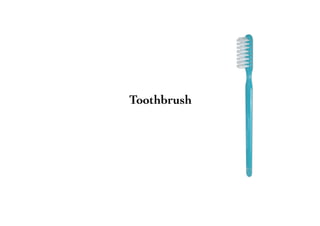
Toothbrush
Toothbrush
The function of toothbrush is to remove dental plaque from the surface of
teeth and massage the gum.
Toothbrush
History
• The toothbrush as we know it today was not invented until 1938. However, early forms of the
toothbrush have been in existence since 3000 BC. Ancient civilizations used a "chew stick,"
which was a thin twig with a frayed end. These 'chew sticks' were rubbed against the teeth.
• The bristle toothbrush, similar to the type used today, was not invented until 1498 in China.
The bristles were actually the stiff, coarse hairs taken from the back of a hog's neck and
attached to handles made of bone or bamboo.
• Boar bristles were used until 1938, when nylon bristles were introduced by Dupont de
Nemours.
• The first nylon toothbrush was called Doctor West's Miracle Toothbrush. Later, Americans
were influenced by the disciplined hygiene habits of soldiers from World War II. They became
increasingly concerned with the practice of good oral hygiene and quickly adopted the nylon
toothbrush.
• Some other interesting toothbrush facts:
• The first mass-produced toothbrush was made by William Addis of Clerkenwald, England,
around 1780.
• The first American to patent a toothbrush was H. N. Wadsworth, (patent number 18,653,) on
Nov. 7, 1857.
• Mass production of toothbrushes began in America around 1885.
• One of the first electric toothbrushes to hit the American market was in 1960. It was marketed
by the Squibb company under the name Broxodent.
• General Electric introduced a rechargeable cordless toothbrush in 1961.
• Introduced in 1987, Interplak was the first rotary action electrical toothbrush for home use,
Toothbrush
History
Manual Toothbrush
Conventional
All conventional toothbrush head designs are effective in
cleansing every tooth surface.
Shape of Toothbrush
Diamond shape
The tips of these brush heads are narrower than those of the
conventional ones. These tips are designed for an easy
access to posterior teeth.
A toothbrush with any kind of toothbrush head cleans teeth
effectively. However, the size of the toothbrush head should
be considered according to the size of the oral cavity.
Toothbrush
Manual toothbrushShape of Toothbrush
Block pattern
The bristles are of the same length and are
arranged neatly like a block.
Wavy or V-shape pattern
The bristles form a V-shape or wavy pattern.
According to the manufacturer, this is intended to
give the bristles a better contact with the areas
around the adjacent tooth surfaces.
Advantage
If these toothbrushes are used correctly, it is claimed by the manufacturer that
their bristles will naturally be pointing at the gum line at a 45 degree angle. It is
also suggested that since the bristles at the brush tip are longer, it enables the
brush to reach the difficult to clean areas.
In fact, any of the above brush head design can effectively clean the teeth. Nonetheless, the
bristles must be soft. Thus, you can choose according to your personal preference.
Toothbrush
Manual toothbrush
Handle design
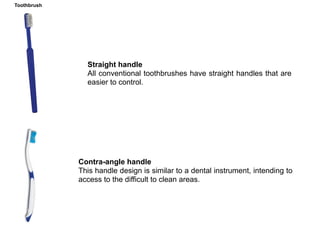
Straight handle
All conventional toothbrushes have straight handles that are
easier to control.
Contra-angle handle
This handle design is similar to a dental instrument, intending to
access to the difficult to clean areas.
Toothbrush
Manual toothbrush
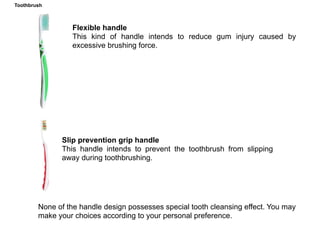
Handle designFlexible handle
This kind of handle intends to reduce gum injury caused by
excessive brushing force.
Slip prevention grip handle
This handle intends to prevent the toothbrush from slipping
away during toothbrushing.
None of the handle design possesses special tooth cleansing effect. You may
make your choices according to your personal preference.
Toothbrush
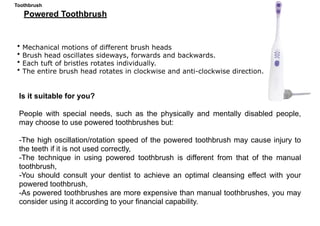
• Mechanical motions of different brush heads
• Brush head oscillates sideways, forwards and backwards.
• Each tuft of bristles rotates individually.
• The entire brush head rotates in clockwise and anti-clockwise direction.
Is it suitable for you?
People with special needs, such as the physically and mentally disabled people,
may choose to use powered toothbrushes but:
-The high oscillation/rotation speed of the powered toothbrush may cause injury to
the teeth if it is not used correctly,
-The technique in using powered toothbrush is different from that of the manual
toothbrush,
-You should consult your dentist to achieve an optimal cleansing effect with your
powered toothbrush,
-As powered toothbrushes are more expensive than manual toothbrushes, you may
consider using it according to your financial capability.
Powered Toothbrush
Toothbrush
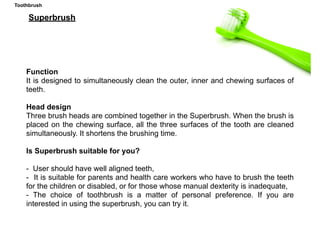
Function
It is designed to simultaneously clean the outer, inner and chewing surfaces of
teeth.
Head design
Three brush heads are combined together in the Superbrush. When the brush is
placed on the chewing surface, all the three surfaces of the tooth are cleaned
simultaneously. It shortens the brushing time.
Is Superbrush suitable for you?
- User should have well aligned teeth,
- It is suitable for parents and health care workers who have to brush the teeth
for the children or disabled, or for those whose manual dexterity is inadequate,
- The choice of toothbrush is a matter of personal preference. If you are
interested in using the superbrush, you can try it.
Superbrush
Toothbrush
Toothbrush
Single-Tuft Toothbrush
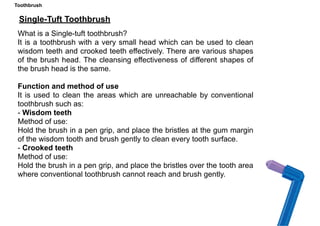
What is a Single-tuft toothbrush?
It is a toothbrush with a very small head which can be used to clean
wisdom teeth and crooked teeth effectively. There are various shapes
of the brush head. The cleansing effectiveness of different shapes of
the brush head is the same.
Function and method of use
It is used to clean the areas which are unreachable by conventional
toothbrush such as:
- Wisdom teeth
Method of use:
Hold the brush in a pen grip, and place the bristles at the gum margin
of the wisdom tooth and brush gently to clean every tooth surface.
- Crooked teeth
Method of use:
Hold the brush in a pen grip, and place the bristles over the tooth area
where conventional toothbrush cannot reach and brush gently.
Toothbrush
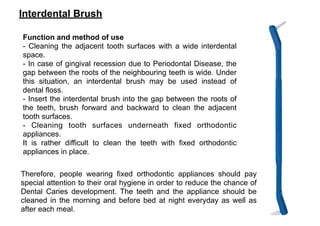
Interdental Brush
Function and method of use
- Cleaning the adjacent tooth surfaces with a wide interdental
space.
- In case of gingival recession due to Periodontal Disease, the
gap between the roots of the neighbouring teeth is wide. Under
this situation, an interdental brush may be used instead of
dental floss.
- Insert the interdental brush into the gap between the roots of
the teeth, brush forward and backward to clean the adjacent
tooth surfaces.
- Cleaning tooth surfaces underneath fixed orthodontic
appliances.
It is rather difficult to clean the teeth with fixed orthodontic
appliances in place.
Therefore, people wearing fixed orthodontic appliances should pay
special attention to their oral hygiene in order to reduce the chance of
Dental Caries development. The teeth and the appliance should be
cleaned in the morning and before bed at night everyday as well as
after each meal.
Interdental Brush
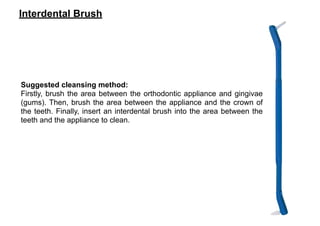
Suggested cleansing method:
Firstly, brush the area between the orthodontic appliance and gingivae
(gums). Then, brush the area between the appliance and the crown of
the teeth. Finally, insert an interdental brush into the area between the
teeth and the appliance to clean.
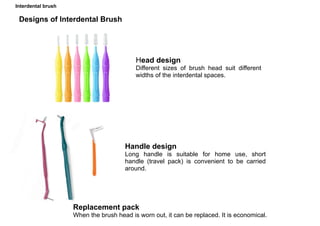
Interdental brush
Head design
Different sizes of brush head suit different
widths of the interdental spaces.
Designs of Interdental Brush
Handle design
Long handle is suitable for home use, short
handle (travel pack) is convenient to be carried
around.
Replacement pack
When the brush head is worn out, it can be replaced. It is economical.
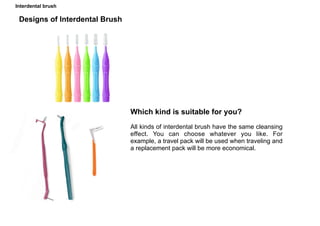
Interdental brush
Designs of Interdental Brush
Which kind is suitable for you?
All kinds of interdental brush have the same cleansing
effect. You can choose whatever you like. For
example, a travel pack will be used when traveling and
a replacement pack will be more economical.
How to choose a Toothbrush?
-It is essential that the toothbrush can move freely in your mouth to clean every
tooth surface,
-The bristles should be soft so that it does not injure the gums,
-The size of the toothbrush head should be appropriate to the size of the oral
cavity,
-In general, the size of a toothbrush head which is the same as the diameter of a
one-dollar coin will be suitable for adults,
-The bristle pattern and handle design should be determined by personal
preference and habit,
-Both manual and powered toothbrushes clean the teeth effectively as long as they
are used correctly,
-If you choose to use an interdental brush or a powered toothbrush, you should
consult your dentist first.
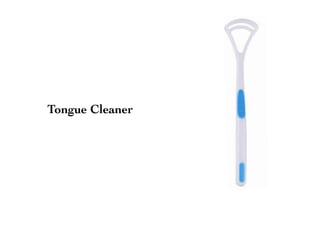
Tongue Cleaner
Tongue Cleaner
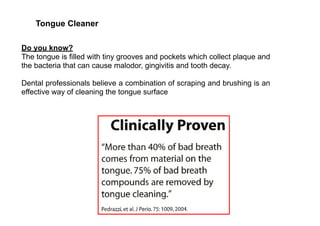
Do you know?
The tongue is filled with tiny grooves and pockets which collect plaque and
the bacteria that can cause malodor, gingivitis and tooth decay.
Dental professionals believe a combination of scraping and brushing is an
effective way of cleaning the tongue surface
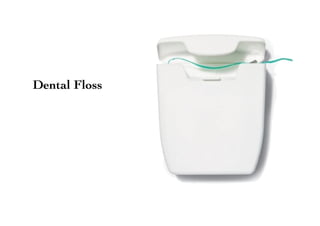
Dental Floss
Dental floss is composed of many nylon filaments which are bounded together to
form a thread.
Function and method of use
Dental floss is used to remove dental plaque from the adjacent surfaces of the
teeth. Please refer to “Oral Care Tips” for using method.
Dental Floss
Dental Floss
Dental floss is an ancient invention. Researchers have found dental floss and
toothpick grooves in the teeth of prehistoric humans. Levi Spear Parmly
(1790-1859), a New Orleans dentist is credited as being the inventor of modern
dental floss (or maybe the term re-inventor would be more accurate). Parmly
promoted teeth flossing with a piece of silk thread in 1815.
In 1882, the Codman and Shurtleft Company of Randolph, Massachusetts started
to mass-produce unwaxed silk floss for commercial home use. The Johnson and
Johnson Company of New Brunswick, New Jersey were the first to patent dental
floss in 1898. Dr. Charles C. Bass developed nylon floss as a replacement for silk
floss during WW II. Dr. Bass was also responsible for making teeth flossing an
important part of dental hygiene.
History
- Waxed floss is coated with wax which makes it easier for the floss to slide into the
tooth adjacent surface.
- Mint flavoured floss gives a feeling of freshness.
- Fluoride coated floss is intended to prevent dental caries from occurring on the
adjacent tooth surfaces, but its effectiveness has not yet been proven.
Floss Coating
Dental Floss
Shape of Floss
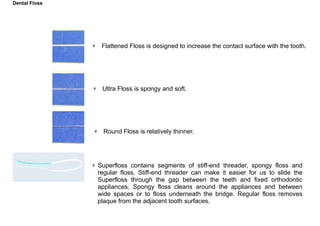
Flattened Floss is designed to increase the contact surface with the tooth.
Ultra Floss is spongy and soft.
Round Floss is relatively thinner.
Superfloss contains segments of stiff-end threader, spongy floss and
regular floss. Stiff-end threader can make it easier for us to slide the
Superfloss through the gap between the teeth and fixed orthodontic
appliances. Spongy floss cleans around the appliances and between
wide spaces or to floss underneath the bridge. Regular floss removes
plaque from the adjacent tooth surfaces.
Dental Floss
Floss Holder / Dental Floss Stick
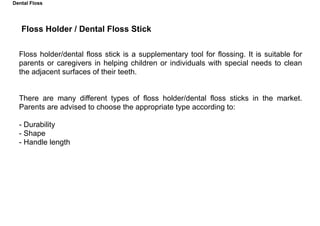
Floss holder/dental floss stick is a supplementary tool for flossing. It is suitable for
parents or caregivers in helping children or individuals with special needs to clean
the adjacent surfaces of their teeth.
There are many different types of floss holder/dental floss sticks in the market.
Parents are advised to choose the appropriate type according to:
- Durability
- Shape
- Handle length
Dental Floss
Floss Holder / Dental Floss Stick
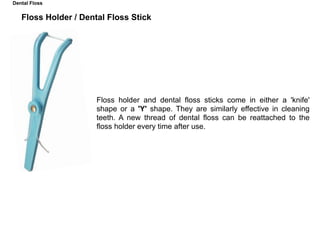
Floss holder and dental floss sticks come in either a 'knife'
shape or a 'Y' shape. They are similarly effective in cleaning
teeth. A new thread of dental floss can be reattached to the
floss holder every time after use.
Dental Floss
Floss Holder / Dental Floss Stick
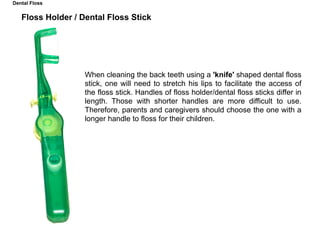
When cleaning the back teeth using a 'knife' shaped dental floss
stick, one will need to stretch his lips to facilitate the access of
the floss stick. Handles of floss holder/dental floss sticks differ in
length. Those with shorter handles are more difficult to use.
Therefore, parents and caregivers should choose the one with a
longer handle to floss for their children.
Dental Floss
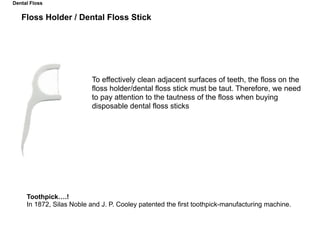
To effectively clean adjacent surfaces of teeth, the floss on the
floss holder/dental floss stick must be taut. Therefore, we need
to pay attention to the tautness of the floss when buying
disposable dental floss sticks
Toothpick….!
In 1872, Silas Noble and J. P. Cooley patented the first toothpick-manufacturing machine.
Dental Floss
Floss Holder / Dental Floss Stick
Which Dental Floss is suitable for you?
•
You can choose a kind of dental floss or dental floss stick that is suitable for you
according to your personal need or preference.
• Those who are wearing fixed orthodontic appliance or fixed bridge can use
Superfloss.
• If used correctly, any kind of dental floss will effectively remove dental plaque.
• The use of dental floss will not widen the gaps between your teeth. There is no
need to worry about it.
Dental Floss
Toothpaste
Toothpaste
Toothpaste can help remove dental plaque, their various functions depend
on the active ingredients they contain.
There are many different types of toothpaste available in the market. The
followings are the common types of toothpaste:
• Fluoride toothpaste,
• Desensitizing toothpaste,
• Anti-calculus toothpaste,
• Anti-plaque toothpaste, and whitening toothpaste.
Their various functions depend on the active ingredients they contain.
Toothpaste
History
• Toothpaste was used as long ago as 500 BC in both China and India; however, modern
toothpastes were developed in the 1800s.
• In 1824, a dentist named Peabody was the first person to add soap to toothpaste.
• John Harris first added chalk as an ingredient to toothpaste in the 1850s.
• In 1873, Colgate mass-produced the first toothpaste in a jar.
• In 1892, Dr. Washington Sheffield of Connecticut manufactured toothpaste into a collapsible
tube. Sheffield's toothpaste was called Dr. Sheffield's Creme Dentifrice.
• In 1896, Colgate Dental Cream was packaged in collapsible tubes imitating Sheffield.
• Advancements in synthetic detergents made after WW II allowed for the replacement of the
soap used in toothpaste with emulsifying agents such as Sodium Lauryl Sulphate and Sodium
Ricinoleate.
• A few years later, Colgate started to add fluoride to toothpaste.
Toothpaste
They contain Sodium Fluoride (NaF), Stannous Fluoride (SnF2), or
Monofluorophosphate (MFP2). The fluoride content is about 1,000 parts per million
(ppm). They are all effective in preventing dental caries. Children toothpaste contains
500ppm fluoride and is usually fruit flavoured, which is suitable for children.
Fluoride Toothpaste
Toothpaste
Desensitizing Toothpaste
The active ingredients help seal off the microtubules inside the exposed dentine (such as
exposed root surface due to toothbrush abrasion) to reduce tooth sensitivity. Active
ingredients such as Potassium Nitrate are used by different product manufacturers. There
are many different types of desensitizing toothpastes marketed by different brand names.
Their various functions depend on different active ingredients they contain.
Therefore, you are advised to consult the dentist and undergo a thorough check-up to
explore the cause of tooth sensitivity before using desensitizing toothpaste. You should
consult the dentist if the symptoms of tooth sensitivity persist after using desensitizing
toothpaste. Desensitizing toothpaste is not suitable for children.
Toothpaste
The manufacturer claims that the calcification of dental plaque could be retarded
by this kind of toothpaste, thus it reduces the rate of calculus formation. The
active ingredient is Pyrophosphate or Zinc Citrate. .
Anti-calculus Toothpaste
Anti-plaque Toothpaste
This kind of toothpaste inhibits plaque accumulation, reduces the toxic effects
of the bacterial toxin on the periodontal tissues, thereby reduces the chances
of getting periodontal disease. In the market, different anti- plaque toothpastes
contain different active ingredients. For example Triclosan or Zinc Citrate.
Whitening Toothpaste
This kind of toothpaste contains relatively coarse abrasives which function by
abrading the stains on the tooth surface, giving a whitening effect. However, long
term use will result in roughened tooth surfaces, which makes stains deposit more
readily.
Toothpaste
Mouthrinses
Depending on the active ingredients they contain
different types of mouth rinse can be used to prevent
dental caries, periodontal disease or reduce tooth
sensitivity.
Mouthrinses
Fluoride Mouthrinse
Most of the Fluoride Mouthrinse on the market contains 0.05% Sodium
Fluoride (NaF), which provides extra Fluoride to the people who need it.
Using it once daily will give additional protection against dental caries.
Anti-plaque Mouthrinse
It inhibits plaque accumulation, thus reducing the chance of gingivitis
(inflammation of the gums). The active ingredients include Triclosan,
Thymol, Cetylpyridinium Chloride (CPC), etc. However, none of them
have been proven to be very effective in preventing periodontal disease.
Mouthrinses
Plaque-control Mouthrinse
Chlorhexidine Gluconate has been proven to have an
antimicrobial effect, hence the prevention of periodontal disease.
However, long term use of Chlorhexidine will stain the teeth,
alter the taste sensation and may cause recurrent ulceration of
the Oral Mucosa.
Desensitizing Mouthrinse
This kind of mouthrinse contains active ingredients such as
Potassium Nitrate which seals the dentinal tubules at the sensitive
site, thus reduces tooth sensitivity. However, desensitizing
mouthrinse is not intended for long term use. You should always
consult your dentist whether you need the desensitizing
mouthrinse and follow his instruction on how to use it.
Mouthrinses
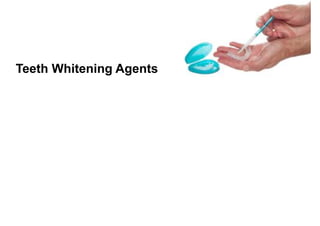
Teeth Whitening Agents
Function
It is used to lighten the tooth stain or tooth colour.
Active ingredients
Oxidizing agents such as Hydrogen Peroxide or Carbamide Peroxide.
Is it suitable for you?
The effectiveness of teeth whitening agents depends on the type and severity of the
stain or the tooth colour. Thus, you should consult your dentist before purchasing
these whitening agents.
Tooth whitening agents contain highly concentrated peroxide which, if used
carelessly, will lead to gingival inflammation, swelling and bleeding. If swallowed
accidentally, it may cause serious injury to the body. Therefore, tooth whitening
agents must be used under the dentist's supervision, and the instructions should be
followed to ensure safety.
THANK YOU

Oral Care Products

  • 1.
    Nasir Al-Hamlan BDS,MPH, MSc, FDS RCSEd, FDS RCSEd, MOrth RCSEd, FICD Consultant and Assistant Professor, Orthodontics King Saud bin Abdulaziz University for Health Sciences Riyadh, Saudi Arabia @nhalhamlan @saudibraces nasiralhamlan @nasiralhamlan Oral Hygiene ProductsOral Care Products
  • 2.
  • 3.
    Toothbrush The function oftoothbrush is to remove dental plaque from the surface of teeth and massage the gum.
  • 4.
    Toothbrush History • The toothbrushas we know it today was not invented until 1938. However, early forms of the toothbrush have been in existence since 3000 BC. Ancient civilizations used a "chew stick," which was a thin twig with a frayed end. These 'chew sticks' were rubbed against the teeth. • The bristle toothbrush, similar to the type used today, was not invented until 1498 in China. The bristles were actually the stiff, coarse hairs taken from the back of a hog's neck and attached to handles made of bone or bamboo. • Boar bristles were used until 1938, when nylon bristles were introduced by Dupont de Nemours. • The first nylon toothbrush was called Doctor West's Miracle Toothbrush. Later, Americans were influenced by the disciplined hygiene habits of soldiers from World War II. They became increasingly concerned with the practice of good oral hygiene and quickly adopted the nylon toothbrush.
  • 5.
    • Some otherinteresting toothbrush facts: • The first mass-produced toothbrush was made by William Addis of Clerkenwald, England, around 1780. • The first American to patent a toothbrush was H. N. Wadsworth, (patent number 18,653,) on Nov. 7, 1857. • Mass production of toothbrushes began in America around 1885. • One of the first electric toothbrushes to hit the American market was in 1960. It was marketed by the Squibb company under the name Broxodent. • General Electric introduced a rechargeable cordless toothbrush in 1961. • Introduced in 1987, Interplak was the first rotary action electrical toothbrush for home use, Toothbrush History
  • 6.
    Manual Toothbrush Conventional All conventionaltoothbrush head designs are effective in cleansing every tooth surface. Shape of Toothbrush Diamond shape The tips of these brush heads are narrower than those of the conventional ones. These tips are designed for an easy access to posterior teeth. A toothbrush with any kind of toothbrush head cleans teeth effectively. However, the size of the toothbrush head should be considered according to the size of the oral cavity. Toothbrush
  • 7.
    Manual toothbrushShape ofToothbrush Block pattern The bristles are of the same length and are arranged neatly like a block. Wavy or V-shape pattern The bristles form a V-shape or wavy pattern. According to the manufacturer, this is intended to give the bristles a better contact with the areas around the adjacent tooth surfaces. Advantage If these toothbrushes are used correctly, it is claimed by the manufacturer that their bristles will naturally be pointing at the gum line at a 45 degree angle. It is also suggested that since the bristles at the brush tip are longer, it enables the brush to reach the difficult to clean areas. In fact, any of the above brush head design can effectively clean the teeth. Nonetheless, the bristles must be soft. Thus, you can choose according to your personal preference. Toothbrush
  • 8.
    Manual toothbrush Handle design Straighthandle All conventional toothbrushes have straight handles that are easier to control. Contra-angle handle This handle design is similar to a dental instrument, intending to access to the difficult to clean areas. Toothbrush
  • 9.
    Manual toothbrush Handle designFlexiblehandle This kind of handle intends to reduce gum injury caused by excessive brushing force. Slip prevention grip handle This handle intends to prevent the toothbrush from slipping away during toothbrushing. None of the handle design possesses special tooth cleansing effect. You may make your choices according to your personal preference. Toothbrush
  • 10.
    • Mechanical motionsof different brush heads • Brush head oscillates sideways, forwards and backwards. • Each tuft of bristles rotates individually. • The entire brush head rotates in clockwise and anti-clockwise direction. Is it suitable for you? People with special needs, such as the physically and mentally disabled people, may choose to use powered toothbrushes but: -The high oscillation/rotation speed of the powered toothbrush may cause injury to the teeth if it is not used correctly, -The technique in using powered toothbrush is different from that of the manual toothbrush, -You should consult your dentist to achieve an optimal cleansing effect with your powered toothbrush, -As powered toothbrushes are more expensive than manual toothbrushes, you may consider using it according to your financial capability. Powered Toothbrush Toothbrush
  • 11.
    Function It is designedto simultaneously clean the outer, inner and chewing surfaces of teeth. Head design Three brush heads are combined together in the Superbrush. When the brush is placed on the chewing surface, all the three surfaces of the tooth are cleaned simultaneously. It shortens the brushing time. Is Superbrush suitable for you? - User should have well aligned teeth, - It is suitable for parents and health care workers who have to brush the teeth for the children or disabled, or for those whose manual dexterity is inadequate, - The choice of toothbrush is a matter of personal preference. If you are interested in using the superbrush, you can try it. Superbrush Toothbrush
  • 12.
    Toothbrush Single-Tuft Toothbrush What isa Single-tuft toothbrush? It is a toothbrush with a very small head which can be used to clean wisdom teeth and crooked teeth effectively. There are various shapes of the brush head. The cleansing effectiveness of different shapes of the brush head is the same. Function and method of use It is used to clean the areas which are unreachable by conventional toothbrush such as: - Wisdom teeth Method of use: Hold the brush in a pen grip, and place the bristles at the gum margin of the wisdom tooth and brush gently to clean every tooth surface. - Crooked teeth Method of use: Hold the brush in a pen grip, and place the bristles over the tooth area where conventional toothbrush cannot reach and brush gently. Toothbrush
  • 13.
    Interdental Brush Function andmethod of use - Cleaning the adjacent tooth surfaces with a wide interdental space. - In case of gingival recession due to Periodontal Disease, the gap between the roots of the neighbouring teeth is wide. Under this situation, an interdental brush may be used instead of dental floss. - Insert the interdental brush into the gap between the roots of the teeth, brush forward and backward to clean the adjacent tooth surfaces. - Cleaning tooth surfaces underneath fixed orthodontic appliances. It is rather difficult to clean the teeth with fixed orthodontic appliances in place. Therefore, people wearing fixed orthodontic appliances should pay special attention to their oral hygiene in order to reduce the chance of Dental Caries development. The teeth and the appliance should be cleaned in the morning and before bed at night everyday as well as after each meal.
  • 14.
    Interdental Brush Suggested cleansingmethod: Firstly, brush the area between the orthodontic appliance and gingivae (gums). Then, brush the area between the appliance and the crown of the teeth. Finally, insert an interdental brush into the area between the teeth and the appliance to clean.
  • 15.
    Interdental brush Head design Differentsizes of brush head suit different widths of the interdental spaces. Designs of Interdental Brush Handle design Long handle is suitable for home use, short handle (travel pack) is convenient to be carried around. Replacement pack When the brush head is worn out, it can be replaced. It is economical.
  • 16.
    Interdental brush Designs ofInterdental Brush Which kind is suitable for you? All kinds of interdental brush have the same cleansing effect. You can choose whatever you like. For example, a travel pack will be used when traveling and a replacement pack will be more economical.
  • 17.
    How to choosea Toothbrush?
  • 18.
    How to choosea Toothbrush? -It is essential that the toothbrush can move freely in your mouth to clean every tooth surface, -The bristles should be soft so that it does not injure the gums, -The size of the toothbrush head should be appropriate to the size of the oral cavity, -In general, the size of a toothbrush head which is the same as the diameter of a one-dollar coin will be suitable for adults, -The bristle pattern and handle design should be determined by personal preference and habit, -Both manual and powered toothbrushes clean the teeth effectively as long as they are used correctly, -If you choose to use an interdental brush or a powered toothbrush, you should consult your dentist first.
  • 19.
  • 20.
    Tongue Cleaner Do youknow? The tongue is filled with tiny grooves and pockets which collect plaque and the bacteria that can cause malodor, gingivitis and tooth decay. Dental professionals believe a combination of scraping and brushing is an effective way of cleaning the tongue surface
  • 21.
  • 22.
    Dental floss iscomposed of many nylon filaments which are bounded together to form a thread. Function and method of use Dental floss is used to remove dental plaque from the adjacent surfaces of the teeth. Please refer to “Oral Care Tips” for using method. Dental Floss
  • 23.
    Dental Floss Dental flossis an ancient invention. Researchers have found dental floss and toothpick grooves in the teeth of prehistoric humans. Levi Spear Parmly (1790-1859), a New Orleans dentist is credited as being the inventor of modern dental floss (or maybe the term re-inventor would be more accurate). Parmly promoted teeth flossing with a piece of silk thread in 1815. In 1882, the Codman and Shurtleft Company of Randolph, Massachusetts started to mass-produce unwaxed silk floss for commercial home use. The Johnson and Johnson Company of New Brunswick, New Jersey were the first to patent dental floss in 1898. Dr. Charles C. Bass developed nylon floss as a replacement for silk floss during WW II. Dr. Bass was also responsible for making teeth flossing an important part of dental hygiene. History
  • 24.
    - Waxed flossis coated with wax which makes it easier for the floss to slide into the tooth adjacent surface. - Mint flavoured floss gives a feeling of freshness. - Fluoride coated floss is intended to prevent dental caries from occurring on the adjacent tooth surfaces, but its effectiveness has not yet been proven. Floss Coating Dental Floss
  • 25.
    Shape of Floss FlattenedFloss is designed to increase the contact surface with the tooth. Ultra Floss is spongy and soft. Round Floss is relatively thinner. Superfloss contains segments of stiff-end threader, spongy floss and regular floss. Stiff-end threader can make it easier for us to slide the Superfloss through the gap between the teeth and fixed orthodontic appliances. Spongy floss cleans around the appliances and between wide spaces or to floss underneath the bridge. Regular floss removes plaque from the adjacent tooth surfaces. Dental Floss
  • 26.
    Floss Holder /Dental Floss Stick Floss holder/dental floss stick is a supplementary tool for flossing. It is suitable for parents or caregivers in helping children or individuals with special needs to clean the adjacent surfaces of their teeth. There are many different types of floss holder/dental floss sticks in the market. Parents are advised to choose the appropriate type according to: - Durability - Shape - Handle length Dental Floss
  • 27.
    Floss Holder /Dental Floss Stick Floss holder and dental floss sticks come in either a 'knife' shape or a 'Y' shape. They are similarly effective in cleaning teeth. A new thread of dental floss can be reattached to the floss holder every time after use. Dental Floss
  • 28.
    Floss Holder /Dental Floss Stick When cleaning the back teeth using a 'knife' shaped dental floss stick, one will need to stretch his lips to facilitate the access of the floss stick. Handles of floss holder/dental floss sticks differ in length. Those with shorter handles are more difficult to use. Therefore, parents and caregivers should choose the one with a longer handle to floss for their children. Dental Floss
  • 29.
    To effectively cleanadjacent surfaces of teeth, the floss on the floss holder/dental floss stick must be taut. Therefore, we need to pay attention to the tautness of the floss when buying disposable dental floss sticks Toothpick….! In 1872, Silas Noble and J. P. Cooley patented the first toothpick-manufacturing machine. Dental Floss Floss Holder / Dental Floss Stick
  • 30.
    Which Dental Flossis suitable for you? • You can choose a kind of dental floss or dental floss stick that is suitable for you according to your personal need or preference. • Those who are wearing fixed orthodontic appliance or fixed bridge can use Superfloss. • If used correctly, any kind of dental floss will effectively remove dental plaque. • The use of dental floss will not widen the gaps between your teeth. There is no need to worry about it. Dental Floss
  • 31.
  • 32.
    Toothpaste Toothpaste can helpremove dental plaque, their various functions depend on the active ingredients they contain. There are many different types of toothpaste available in the market. The followings are the common types of toothpaste: • Fluoride toothpaste, • Desensitizing toothpaste, • Anti-calculus toothpaste, • Anti-plaque toothpaste, and whitening toothpaste. Their various functions depend on the active ingredients they contain.
  • 33.
    Toothpaste History • Toothpaste wasused as long ago as 500 BC in both China and India; however, modern toothpastes were developed in the 1800s. • In 1824, a dentist named Peabody was the first person to add soap to toothpaste. • John Harris first added chalk as an ingredient to toothpaste in the 1850s. • In 1873, Colgate mass-produced the first toothpaste in a jar. • In 1892, Dr. Washington Sheffield of Connecticut manufactured toothpaste into a collapsible tube. Sheffield's toothpaste was called Dr. Sheffield's Creme Dentifrice. • In 1896, Colgate Dental Cream was packaged in collapsible tubes imitating Sheffield. • Advancements in synthetic detergents made after WW II allowed for the replacement of the soap used in toothpaste with emulsifying agents such as Sodium Lauryl Sulphate and Sodium Ricinoleate. • A few years later, Colgate started to add fluoride to toothpaste. Toothpaste
  • 34.
    They contain SodiumFluoride (NaF), Stannous Fluoride (SnF2), or Monofluorophosphate (MFP2). The fluoride content is about 1,000 parts per million (ppm). They are all effective in preventing dental caries. Children toothpaste contains 500ppm fluoride and is usually fruit flavoured, which is suitable for children. Fluoride Toothpaste Toothpaste
  • 35.
    Desensitizing Toothpaste The activeingredients help seal off the microtubules inside the exposed dentine (such as exposed root surface due to toothbrush abrasion) to reduce tooth sensitivity. Active ingredients such as Potassium Nitrate are used by different product manufacturers. There are many different types of desensitizing toothpastes marketed by different brand names. Their various functions depend on different active ingredients they contain. Therefore, you are advised to consult the dentist and undergo a thorough check-up to explore the cause of tooth sensitivity before using desensitizing toothpaste. You should consult the dentist if the symptoms of tooth sensitivity persist after using desensitizing toothpaste. Desensitizing toothpaste is not suitable for children. Toothpaste
  • 36.
    The manufacturer claimsthat the calcification of dental plaque could be retarded by this kind of toothpaste, thus it reduces the rate of calculus formation. The active ingredient is Pyrophosphate or Zinc Citrate. . Anti-calculus Toothpaste Anti-plaque Toothpaste This kind of toothpaste inhibits plaque accumulation, reduces the toxic effects of the bacterial toxin on the periodontal tissues, thereby reduces the chances of getting periodontal disease. In the market, different anti- plaque toothpastes contain different active ingredients. For example Triclosan or Zinc Citrate. Whitening Toothpaste This kind of toothpaste contains relatively coarse abrasives which function by abrading the stains on the tooth surface, giving a whitening effect. However, long term use will result in roughened tooth surfaces, which makes stains deposit more readily. Toothpaste
  • 37.
  • 38.
    Depending on theactive ingredients they contain different types of mouth rinse can be used to prevent dental caries, periodontal disease or reduce tooth sensitivity. Mouthrinses
  • 39.
    Fluoride Mouthrinse Most ofthe Fluoride Mouthrinse on the market contains 0.05% Sodium Fluoride (NaF), which provides extra Fluoride to the people who need it. Using it once daily will give additional protection against dental caries. Anti-plaque Mouthrinse It inhibits plaque accumulation, thus reducing the chance of gingivitis (inflammation of the gums). The active ingredients include Triclosan, Thymol, Cetylpyridinium Chloride (CPC), etc. However, none of them have been proven to be very effective in preventing periodontal disease. Mouthrinses
  • 40.
    Plaque-control Mouthrinse Chlorhexidine Gluconatehas been proven to have an antimicrobial effect, hence the prevention of periodontal disease. However, long term use of Chlorhexidine will stain the teeth, alter the taste sensation and may cause recurrent ulceration of the Oral Mucosa. Desensitizing Mouthrinse This kind of mouthrinse contains active ingredients such as Potassium Nitrate which seals the dentinal tubules at the sensitive site, thus reduces tooth sensitivity. However, desensitizing mouthrinse is not intended for long term use. You should always consult your dentist whether you need the desensitizing mouthrinse and follow his instruction on how to use it. Mouthrinses
  • 41.
  • 42.
    Teeth Whitening Agents Function Itis used to lighten the tooth stain or tooth colour. Active ingredients Oxidizing agents such as Hydrogen Peroxide or Carbamide Peroxide. Is it suitable for you? The effectiveness of teeth whitening agents depends on the type and severity of the stain or the tooth colour. Thus, you should consult your dentist before purchasing these whitening agents. Tooth whitening agents contain highly concentrated peroxide which, if used carelessly, will lead to gingival inflammation, swelling and bleeding. If swallowed accidentally, it may cause serious injury to the body. Therefore, tooth whitening agents must be used under the dentist's supervision, and the instructions should be followed to ensure safety.
  • 43.