Seminar on
Cleansing and Care for Nail,
Hand and Feet
Guided By
Mrs. Rashmi Mathews
Associate professor
Dept. of Pharmaceutics
Karnataka College of
Pharmacy
Presented By
Mr. Sujit Shrestha
M.Pharm (II semester)
Pharmaceutics
Human Nail
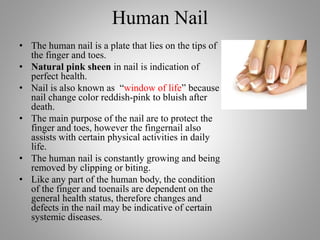
• The human nail is a plate that lies on the tips of
the finger and toes.
• Natural pink sheen in nail is indication of
perfect health.
• Nail is also known as “window of life” because
nail change color reddish-pink to bluish after
death.
• The main purpose of the nail are to protect the
finger and toes, however the fingernail also
assists with certain physical activities in daily
life.
• The human nail is constantly growing and being
removed by clipping or biting.
• Like any part of the human body, the condition
of the finger and toenails are dependent on the
general health status, therefore changes and
defects in the nail may be indicative of certain
systemic diseases.
Parts of nail
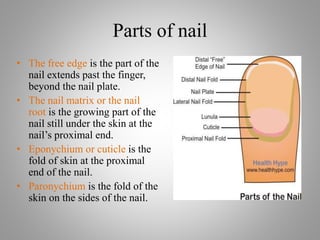
• The free edge is the part of the
nail extends past the finger,
beyond the nail plate.
• The nail matrix or the nail
root is the growing part of the
nail still under the skin at the
nail’s proximal end.
• Eponychium or cuticle is the
fold of skin at the proximal
end of the nail.
• Paronychium is the fold of the
skin on the sides of the nail.
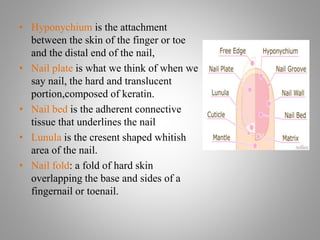
• Hyponychium is the attachment
between the skin of the finger or toe
and the distal end of the nail,
• Nail plate is what we think of when we
say nail, the hard and translucent
portion,composed of keratin.
• Nail bed is the adherent connective
tissue that underlines the nail
• Lunula is the cresent shaped whitish
area of the nail.
• Nail fold: a fold of hard skin
overlapping the base and sides of a
fingernail or toenail.
Growth of Nails
• Nail grows at an average rate of 0.1mm/day (10mm every 100
days).
• Fingernails require 4 to 6 months to regrow completely.
• Toes nails require 12to 18 months.
• Actual growth rate is dependent upon age, season, exercise
level, and hereditary factors.
• Physiological imbalances (major illness) will cause a deep
horizontal groove to form in the nails.
Fingernail and Toenail Care
• Cleaned and trimmed fingernails and toenails are important for
overall health.
• Germs often collect underneath the nails. Frequent and
thorough hand washing and foot care is a good way to
prevent germ or fungus buildup.
• Nails that become too long and/or are rough and torn can
scratch and cut an individual’s skin and may result in a local
infection.
• Some individuals (those with diabetes) should have their nail
care completed by a health care professional.
• Athlete’s foot, a fungus that causes an inflammation, cracking,
and peeling of the skin between the toes and can also infect the
toenails is of particular concern, and must be treated as soon as
it is noted.
Cleaning and trimming nails
• Special care should be practiced when assisting with nail care.
Individuals with diabetes require professional assistance with
nail care.
• Toenails and fingernails should be kept clean, neatly trimmed,
and smooth to prevent injury to skin.
• Trimming the nail too short may cause ingrown nails that can
be painful and cause infection. Encourage individuals to do as
much as they can for themselves.
Requirements
 Personal nail clippers or nail scissors
 Personal cuticle or orange stick
 bowl of warm water
 Clean water
 Soap
 Nail brush
 Personal emery board or nail file
 Moisturizer
Methods of cleansing
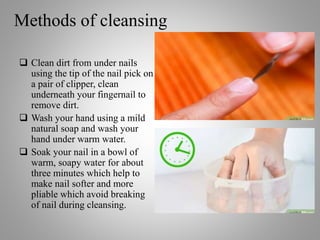
 Clean dirt from under nails
using the tip of the nail pick on
a pair of clipper, clean
underneath your fingernail to
remove dirt.
 Wash your hand using a mild
natural soap and wash your
hand under warm water.
 Soak your nail in a bowl of
warm, soapy water for about
three minutes which help to
make nail softer and more
pliable which avoid breaking
of nail during cleansing.
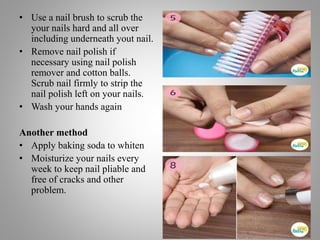
• Use a nail brush to scrub the
your nails hard and all over
including underneath yout nail.
• Remove nail polish if
necessary using nail polish
remover and cotton balls.
Scrub nail firmly to strip the
nail polish left on your nails.
• Wash your hands again
Another method
• Apply baking soda to whiten
• Moisturize your nails every
week to keep nail pliable and
free of cracks and other
problem.
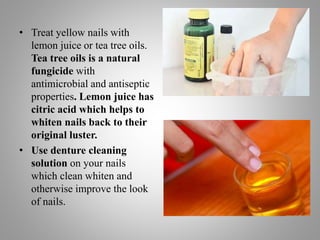
• Treat yellow nails with
lemon juice or tea tree oils.
Tea tree oils is a natural
fungicide with
antimicrobial and antiseptic
properties. Lemon juice has
citric acid which helps to
whiten nails back to their
original luster.
• Use denture cleaning
solution on your nails
which clean whiten and
otherwise improve the look
of nails.
• Try apple cider vinegar
which have cleansing and
anti fungal properties which
can help to whiten nails and
keep them away from
infection and discoloration.
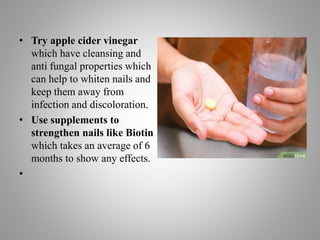
• Use supplements to
strengthen nails like Biotin
which takes an average of 6
months to show any effects.
•
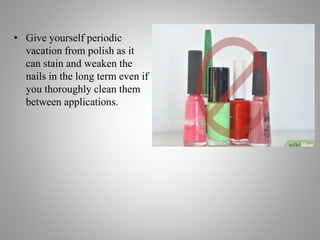
• Give yourself periodic
vacation from polish as it
can stain and weaken the
nails in the long term even if
you thoroughly clean them
between applications.
The Nail Manicure
 Manicure and pedicure are the health and cosmetics
procedures to groom, trim, and paint the nails and manage
callous.
 They requires various tools such as cuticle scissors, nail
scissors, nail clippers, and nail files.
Nail lacquers (Nail Polish)
 Nail lacquers/paint/enamel/varnish are viscous preparation
intended to decorate nail of fingers and toes.
 They can be transparent or colored, plain or with a glitter, but
they all should provide a smooth, impervious film on the nail,
without leaving any stains on its surface.
Nail lacquers Formulation
 Lacquer Base
i. Filmformer (nitrocelluose)
ii. Resin(hardness & gloss to film)
(eg:benzoin, shellac, sandarac)
iii. Plasticizer(reduce hardness)
(eg: dibutyl phthalate, tributyl
phthalate,benzyl benzoate )
iv. Solvent(brushability& regulate
drying)
(eg: n butyl acetate, amyl acetate)
v. Diluent(lower and stablize
viscosity of lacquers)
(eg: toulene, xylene, hexane)
Coloring Agent
i. Dyes/lakes (red iron oxide, iron blue,
chromium oxide)
ii. Pigments
iii. Glitters
iv. Pearlescent Agents (guanine from fish scale,
silver and aluminium powder)
Other formulating agents
i. Opacifying agents (titanium dioxide,zinc
oxide)
ii. Suspending agents
(montomorillonites,bentonite)
iii. Perfumes
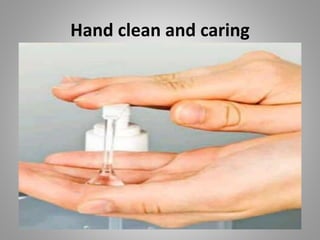
Hand clean and caring
Hand care
Why??
• Thousand of people die everyday around the
world from infections acquired while receiving
health care.
• Hand are the main pathway of germ
transmission during health care.
• Hand hygiene is therefore the most
important measure to avoid the
transmission of harmful germs and prevent
health care associated infections.
How??
• Clean your hands by rubbing them with an
alcohol-based formulation, as the preferred
mean for routine hygienic hand antiseptics if
hand are visibly soiled.
• Wash your hands with soap and water when
hands are visibly dirty or visibly soiled with
blood or other body fluids or after using the
toilet.
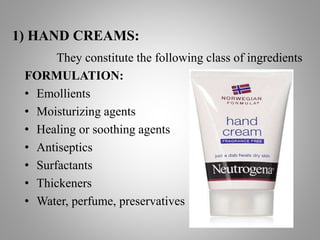
1) HAND CREAMS:
They constitute the following class of ingredients
FORMULATION:
• Emollients
• Moisturizing agents
• Healing or soothing agents
• Antiseptics
• Surfactants
• Thickeners
• Water, perfume, preservatives
Emollient:
• Emollients are the complex mixture of chemical agents
specially designed to make the external layer softer and more
pliable. e.g
• Water
• Oily materials
 Mineral oil 4%
 Lanolin 0.5-2%
 Stearic acid 7%
Moisturizing agent:-
• moisturizing agents are added to cosmetics to prevent any loss
of moisture and hydrate the skin.
• They help in retaining the inherent moisture and give a smooth
appearance to the skin.e.g
 Glycerine 8% , sorbitol 10%
Healing or soothing agent:
• Healing agents are the topical agents promoting healing
and healthy granulation.(new connective tissue). e.g
 Allantoin and its salts
Antiseptics:
• It is the substances which inhibits the growth and
development of micro-organisms.
• For practical purposes, antiseptics are routinely thought
of as topical agents, for application to skin, mucus
membranes and inanimate objects, although a formal
definition includes agents which are used internally,
such as the urinary tract antiseptics. E.g. Cetrimonium
chloride 1%.
Surfactant:
• Surfactants are the compound that lowers the surface
tension between two liquids, between a gas and a liquid
or between a liquid and a solid.
• Surfactants may act as detergents, wetting agent,
emulsifiers, foaming agents and dispersants. E.g
 Sodium lauryl sulfate 0.3%
 Glyceryl stearate
Thickeners:
• Thickeners or thickening agents are the substances
which can increases the viscosity of a liquid without
substantially changing its other properties.
• E.g cetyl alcohol, stearic acid, stearyl alcohol
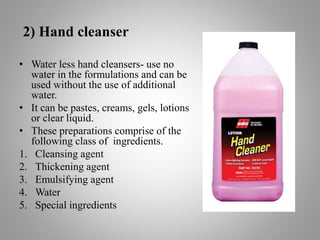
2) Hand cleanser
• Water less hand cleansers- use no
water in the formulations and can be
used without the use of additional
water.
• It can be pastes, creams, gels, lotions
or clear liquid.
• These preparations comprise of the
following class of ingredients.
1. Cleansing agent
2. Thickening agent
3. Emulsifying agent
4. Water
5. Special ingredients
CLEANSING AGENT
• Heavy duty should cleanse even water-insoluble
materials, effective cheap innocuous of readily
available.
• E.g odourless kerosene 20-35% ,mineral spirits,
mineral oils 20%
THICKENING AGENT
• e.g magnesium aluminium silicate 2.5%
• Methyl cellulose 0.50%
• Soaps or non-ionic emulgents also increase viscosity by
forming gels.
EMULSIFYING AGENTS:
• E.g soaps- sodium triethanolamine,
monoethanolamide salts of stearic or oleic acid or
both, polysorbate 60, triethanolamine stearate,
PEG -2 cocoate etc.
EMOLLIENT:
• It improves the application properties and prevent
defatting of the skin. E.g lanolin 10%, ethylated
lanolin 0.50%, myristyl myrisate 15% and
propylene glycol 5%.
SPECIALADDITIVES:
ANTISEPTIC AGENTS- e.g Triclosan
MILD ABRASIVES- e.g finely ground pumice
• Mild abrasives are primarily used to remove
tenacious grime(surface dirt).
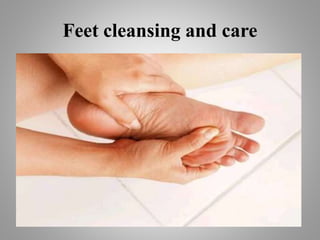
Feet cleansing and care
Cleansing and caring tips
• Take care of your diabetes and keep your
blood sugar within a good range.
• Check your feet everyday. Use mirror to
check your bottoms of your feet.
• Wash your feet everyday with warm water
(not hot water).
• Keep your skin soft and smooth. Rub a thin
coat of skin lotion over the tops and bottom of
your feet, but not between your toes.
• Trim your toe nails each week or when needed.
• Wear shoes and socks. Never walk barefoot.
• Feel inside your shoes before putting them on each
time to make sure the lining is smooth and there are
no objects inside.
• Protect your feet from hot and cold. Wear shoes at
the beach or hot pavement. Wear socks at night if
your feet get cold.
• Keep your blood flowing to your feet. Put your feet
up when sitting.wiggle your toes and move your
ankles up and down for 5 minutes, 2 to 3 times a day.
Don’t cross your leg for long period of time.
• Check with your doctor. Have a check up to find out
whether you are likely to have a serious foot
problems. Call doctor if cut, sore, blister or bruise on
foot does not begin to heel after one day. Follow
doctor’s advice about foot care.
Feet problem:
1)Diabetic foot
2) Crack foot
1) DIABETIC FOOT
• It is one of the most significant and devastating
complications of diabetes.
• Also defined as a foot affected by ulceration that
is associated with neurotherapy and or peripheral
arterial disease of the lower limb in the patient
with diabetes.
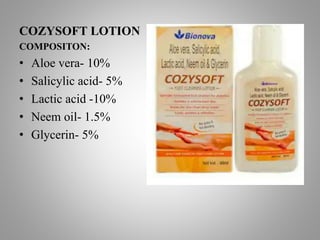
• Cozysoft lotion is mostly used for diabetic foot.
COZYSOFT LOTION
COMPOSITON:
• Aloe vera- 10%
• Salicylic acid- 5%
• Lactic acid -10%
• Neem oil- 1.5%
• Glycerin- 5%
ALOE VERA:-
• Increases capillary blood circulation in dermis, hence
skin nutrition of epidermis is improved.
• Also has anti-inflammatory action and anti-pruritic
action which plays a role in relieving the itchy skin
conditions associated with dryness.
SALICYLIC ACID:-
• It helps to cause the wart to gradually peel off.
• It is also used to help remove corns and calluses.
• Salicylic acid is a keratolytic and works by increasing
the amount of moisture in the skin and dissolving the
substances that causes the skin cells to stick together,
LACTIC ACID:-
• It is an organic compound.
• It is used in topical preparations and cosmetics
to adjust acidity and for its disinfectant and
keratolytic properties.
NEEM:
• It contains chemical that help to reduce blood
sugar levels, heal ulcers in the digestive tract,
prevent conception, kill bacteria and prevent
plaque formation in the mouth.
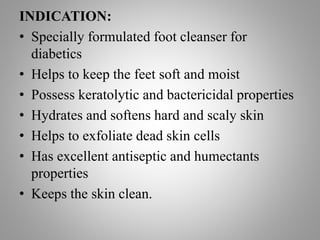
INDICATION:
• Specially formulated foot cleanser for
diabetics
• Helps to keep the feet soft and moist
• Possess keratolytic and bactericidal properties
• Hydrates and softens hard and scaly skin
• Helps to exfoliate dead skin cells
• Has excellent antiseptic and humectants
properties
• Keeps the skin clean.
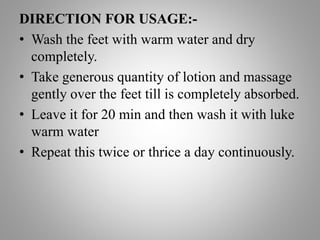
DIRECTION FOR USAGE:-
• Wash the feet with warm water and dry
completely.
• Take generous quantity of lotion and massage
gently over the feet till is completely absorbed.
• Leave it for 20 min and then wash it with luke
warm water
• Repeat this twice or thrice a day continuously.
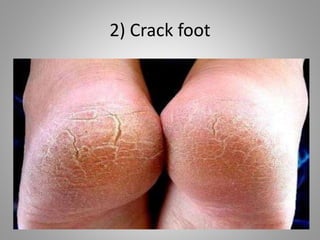
2) Crack foot
2) CRACK FOOT
• Crack foot are the most common problem.
• This can occur in both adults and children and seems to
affect women more often than man.
• It may cause discomfort when going barefoot.
• Cracks in foot can become very deep and cause pain.
PREVENTION AND TREATMENT
HEEL BALMS OR THICK MOISTURIZERS:
• It is the first line treatment.
• These balm contain ingredients to moisturize, soften
and exfoliate dead skin.
• Following are the ingredients used in heel balm:
• Urea
• Salicylic acid
• Alpha- hydroxy acids
• Saccharide isomerate
SOAK AND EXFOLIATE THE FEET:
• Keep the feet in lukewarm, soapy water for upto 20
minutes.
• Use a loofah, foot scrubber or pumice stone to remove any
hard, thick skin.
• Gently pat the feet dry.
• Apply a heel balm or thick moisturizer to the affected area.
• Apply petroleum jelly over the feet to lock in moisture. Put
on socks to avoid spreading any grease around.
Sujit

Sujit

  • 1.
    Seminar on Cleansing andCare for Nail, Hand and Feet Guided By Mrs. Rashmi Mathews Associate professor Dept. of Pharmaceutics Karnataka College of Pharmacy Presented By Mr. Sujit Shrestha M.Pharm (II semester) Pharmaceutics
  • 2.
    Human Nail • Thehuman nail is a plate that lies on the tips of the finger and toes. • Natural pink sheen in nail is indication of perfect health. • Nail is also known as “window of life” because nail change color reddish-pink to bluish after death. • The main purpose of the nail are to protect the finger and toes, however the fingernail also assists with certain physical activities in daily life. • The human nail is constantly growing and being removed by clipping or biting. • Like any part of the human body, the condition of the finger and toenails are dependent on the general health status, therefore changes and defects in the nail may be indicative of certain systemic diseases.
  • 3.
    Parts of nail •The free edge is the part of the nail extends past the finger, beyond the nail plate. • The nail matrix or the nail root is the growing part of the nail still under the skin at the nail’s proximal end. • Eponychium or cuticle is the fold of skin at the proximal end of the nail. • Paronychium is the fold of the skin on the sides of the nail.
  • 4.
    • Hyponychium isthe attachment between the skin of the finger or toe and the distal end of the nail, • Nail plate is what we think of when we say nail, the hard and translucent portion,composed of keratin. • Nail bed is the adherent connective tissue that underlines the nail • Lunula is the cresent shaped whitish area of the nail. • Nail fold: a fold of hard skin overlapping the base and sides of a fingernail or toenail.
  • 5.
    Growth of Nails •Nail grows at an average rate of 0.1mm/day (10mm every 100 days). • Fingernails require 4 to 6 months to regrow completely. • Toes nails require 12to 18 months. • Actual growth rate is dependent upon age, season, exercise level, and hereditary factors. • Physiological imbalances (major illness) will cause a deep horizontal groove to form in the nails.
  • 6.
    Fingernail and ToenailCare • Cleaned and trimmed fingernails and toenails are important for overall health. • Germs often collect underneath the nails. Frequent and thorough hand washing and foot care is a good way to prevent germ or fungus buildup. • Nails that become too long and/or are rough and torn can scratch and cut an individual’s skin and may result in a local infection. • Some individuals (those with diabetes) should have their nail care completed by a health care professional.
  • 7.
    • Athlete’s foot,a fungus that causes an inflammation, cracking, and peeling of the skin between the toes and can also infect the toenails is of particular concern, and must be treated as soon as it is noted.
  • 8.
    Cleaning and trimmingnails • Special care should be practiced when assisting with nail care. Individuals with diabetes require professional assistance with nail care. • Toenails and fingernails should be kept clean, neatly trimmed, and smooth to prevent injury to skin. • Trimming the nail too short may cause ingrown nails that can be painful and cause infection. Encourage individuals to do as much as they can for themselves.
  • 9.
    Requirements  Personal nailclippers or nail scissors  Personal cuticle or orange stick  bowl of warm water  Clean water  Soap  Nail brush  Personal emery board or nail file  Moisturizer
  • 10.
    Methods of cleansing Clean dirt from under nails using the tip of the nail pick on a pair of clipper, clean underneath your fingernail to remove dirt.  Wash your hand using a mild natural soap and wash your hand under warm water.  Soak your nail in a bowl of warm, soapy water for about three minutes which help to make nail softer and more pliable which avoid breaking of nail during cleansing.
  • 11.
    • Use anail brush to scrub the your nails hard and all over including underneath yout nail. • Remove nail polish if necessary using nail polish remover and cotton balls. Scrub nail firmly to strip the nail polish left on your nails. • Wash your hands again Another method • Apply baking soda to whiten • Moisturize your nails every week to keep nail pliable and free of cracks and other problem.
  • 12.
    • Treat yellownails with lemon juice or tea tree oils. Tea tree oils is a natural fungicide with antimicrobial and antiseptic properties. Lemon juice has citric acid which helps to whiten nails back to their original luster. • Use denture cleaning solution on your nails which clean whiten and otherwise improve the look of nails.
  • 13.
    • Try applecider vinegar which have cleansing and anti fungal properties which can help to whiten nails and keep them away from infection and discoloration. • Use supplements to strengthen nails like Biotin which takes an average of 6 months to show any effects. •
  • 14.
    • Give yourselfperiodic vacation from polish as it can stain and weaken the nails in the long term even if you thoroughly clean them between applications.
  • 15.
    The Nail Manicure Manicure and pedicure are the health and cosmetics procedures to groom, trim, and paint the nails and manage callous.  They requires various tools such as cuticle scissors, nail scissors, nail clippers, and nail files. Nail lacquers (Nail Polish)  Nail lacquers/paint/enamel/varnish are viscous preparation intended to decorate nail of fingers and toes.  They can be transparent or colored, plain or with a glitter, but they all should provide a smooth, impervious film on the nail, without leaving any stains on its surface.
  • 16.
    Nail lacquers Formulation Lacquer Base i. Filmformer (nitrocelluose) ii. Resin(hardness & gloss to film) (eg:benzoin, shellac, sandarac) iii. Plasticizer(reduce hardness) (eg: dibutyl phthalate, tributyl phthalate,benzyl benzoate ) iv. Solvent(brushability& regulate drying) (eg: n butyl acetate, amyl acetate) v. Diluent(lower and stablize viscosity of lacquers) (eg: toulene, xylene, hexane)
  • 17.
    Coloring Agent i. Dyes/lakes(red iron oxide, iron blue, chromium oxide) ii. Pigments iii. Glitters iv. Pearlescent Agents (guanine from fish scale, silver and aluminium powder)
  • 18.
    Other formulating agents i.Opacifying agents (titanium dioxide,zinc oxide) ii. Suspending agents (montomorillonites,bentonite) iii. Perfumes
  • 19.
  • 20.
    Hand care Why?? • Thousandof people die everyday around the world from infections acquired while receiving health care. • Hand are the main pathway of germ transmission during health care. • Hand hygiene is therefore the most important measure to avoid the transmission of harmful germs and prevent health care associated infections.
  • 21.
    How?? • Clean yourhands by rubbing them with an alcohol-based formulation, as the preferred mean for routine hygienic hand antiseptics if hand are visibly soiled. • Wash your hands with soap and water when hands are visibly dirty or visibly soiled with blood or other body fluids or after using the toilet.
  • 22.
    1) HAND CREAMS: Theyconstitute the following class of ingredients FORMULATION: • Emollients • Moisturizing agents • Healing or soothing agents • Antiseptics • Surfactants • Thickeners • Water, perfume, preservatives
  • 23.
    Emollient: • Emollients arethe complex mixture of chemical agents specially designed to make the external layer softer and more pliable. e.g • Water • Oily materials  Mineral oil 4%  Lanolin 0.5-2%  Stearic acid 7% Moisturizing agent:- • moisturizing agents are added to cosmetics to prevent any loss of moisture and hydrate the skin. • They help in retaining the inherent moisture and give a smooth appearance to the skin.e.g  Glycerine 8% , sorbitol 10%
  • 24.
    Healing or soothingagent: • Healing agents are the topical agents promoting healing and healthy granulation.(new connective tissue). e.g  Allantoin and its salts Antiseptics: • It is the substances which inhibits the growth and development of micro-organisms. • For practical purposes, antiseptics are routinely thought of as topical agents, for application to skin, mucus membranes and inanimate objects, although a formal definition includes agents which are used internally, such as the urinary tract antiseptics. E.g. Cetrimonium chloride 1%.
  • 25.
    Surfactant: • Surfactants arethe compound that lowers the surface tension between two liquids, between a gas and a liquid or between a liquid and a solid. • Surfactants may act as detergents, wetting agent, emulsifiers, foaming agents and dispersants. E.g  Sodium lauryl sulfate 0.3%  Glyceryl stearate Thickeners: • Thickeners or thickening agents are the substances which can increases the viscosity of a liquid without substantially changing its other properties. • E.g cetyl alcohol, stearic acid, stearyl alcohol
  • 26.
    2) Hand cleanser •Water less hand cleansers- use no water in the formulations and can be used without the use of additional water. • It can be pastes, creams, gels, lotions or clear liquid. • These preparations comprise of the following class of ingredients. 1. Cleansing agent 2. Thickening agent 3. Emulsifying agent 4. Water 5. Special ingredients
  • 27.
    CLEANSING AGENT • Heavyduty should cleanse even water-insoluble materials, effective cheap innocuous of readily available. • E.g odourless kerosene 20-35% ,mineral spirits, mineral oils 20% THICKENING AGENT • e.g magnesium aluminium silicate 2.5% • Methyl cellulose 0.50% • Soaps or non-ionic emulgents also increase viscosity by forming gels.
  • 28.
    EMULSIFYING AGENTS: • E.gsoaps- sodium triethanolamine, monoethanolamide salts of stearic or oleic acid or both, polysorbate 60, triethanolamine stearate, PEG -2 cocoate etc. EMOLLIENT: • It improves the application properties and prevent defatting of the skin. E.g lanolin 10%, ethylated lanolin 0.50%, myristyl myrisate 15% and propylene glycol 5%.
  • 29.
    SPECIALADDITIVES: ANTISEPTIC AGENTS- e.gTriclosan MILD ABRASIVES- e.g finely ground pumice • Mild abrasives are primarily used to remove tenacious grime(surface dirt).
  • 30.
  • 31.
    Cleansing and caringtips • Take care of your diabetes and keep your blood sugar within a good range. • Check your feet everyday. Use mirror to check your bottoms of your feet. • Wash your feet everyday with warm water (not hot water). • Keep your skin soft and smooth. Rub a thin coat of skin lotion over the tops and bottom of your feet, but not between your toes.
  • 32.
    • Trim yourtoe nails each week or when needed. • Wear shoes and socks. Never walk barefoot. • Feel inside your shoes before putting them on each time to make sure the lining is smooth and there are no objects inside. • Protect your feet from hot and cold. Wear shoes at the beach or hot pavement. Wear socks at night if your feet get cold. • Keep your blood flowing to your feet. Put your feet up when sitting.wiggle your toes and move your ankles up and down for 5 minutes, 2 to 3 times a day. Don’t cross your leg for long period of time.
  • 33.
    • Check withyour doctor. Have a check up to find out whether you are likely to have a serious foot problems. Call doctor if cut, sore, blister or bruise on foot does not begin to heel after one day. Follow doctor’s advice about foot care.
  • 34.
    Feet problem: 1)Diabetic foot 2)Crack foot 1) DIABETIC FOOT • It is one of the most significant and devastating complications of diabetes. • Also defined as a foot affected by ulceration that is associated with neurotherapy and or peripheral arterial disease of the lower limb in the patient with diabetes. • Cozysoft lotion is mostly used for diabetic foot.
  • 35.
    COZYSOFT LOTION COMPOSITON: • Aloevera- 10% • Salicylic acid- 5% • Lactic acid -10% • Neem oil- 1.5% • Glycerin- 5%
  • 36.
    ALOE VERA:- • Increasescapillary blood circulation in dermis, hence skin nutrition of epidermis is improved. • Also has anti-inflammatory action and anti-pruritic action which plays a role in relieving the itchy skin conditions associated with dryness. SALICYLIC ACID:- • It helps to cause the wart to gradually peel off. • It is also used to help remove corns and calluses. • Salicylic acid is a keratolytic and works by increasing the amount of moisture in the skin and dissolving the substances that causes the skin cells to stick together,
  • 37.
    LACTIC ACID:- • Itis an organic compound. • It is used in topical preparations and cosmetics to adjust acidity and for its disinfectant and keratolytic properties. NEEM: • It contains chemical that help to reduce blood sugar levels, heal ulcers in the digestive tract, prevent conception, kill bacteria and prevent plaque formation in the mouth.
  • 38.
    INDICATION: • Specially formulatedfoot cleanser for diabetics • Helps to keep the feet soft and moist • Possess keratolytic and bactericidal properties • Hydrates and softens hard and scaly skin • Helps to exfoliate dead skin cells • Has excellent antiseptic and humectants properties • Keeps the skin clean.
  • 39.
    DIRECTION FOR USAGE:- •Wash the feet with warm water and dry completely. • Take generous quantity of lotion and massage gently over the feet till is completely absorbed. • Leave it for 20 min and then wash it with luke warm water • Repeat this twice or thrice a day continuously.
  • 40.
  • 41.
    2) CRACK FOOT •Crack foot are the most common problem. • This can occur in both adults and children and seems to affect women more often than man. • It may cause discomfort when going barefoot. • Cracks in foot can become very deep and cause pain. PREVENTION AND TREATMENT HEEL BALMS OR THICK MOISTURIZERS: • It is the first line treatment. • These balm contain ingredients to moisturize, soften and exfoliate dead skin. • Following are the ingredients used in heel balm:
  • 42.
    • Urea • Salicylicacid • Alpha- hydroxy acids • Saccharide isomerate SOAK AND EXFOLIATE THE FEET: • Keep the feet in lukewarm, soapy water for upto 20 minutes. • Use a loofah, foot scrubber or pumice stone to remove any hard, thick skin. • Gently pat the feet dry. • Apply a heel balm or thick moisturizer to the affected area. • Apply petroleum jelly over the feet to lock in moisture. Put on socks to avoid spreading any grease around.