GUIDED BY: PREPARED BY:
Ms. FAYEJA S. RAJEBHAI RINKAL S. SHAH
Aassistant Professor Enrollmentno:182520290033
182520290033
1
A REVIEW ON ORAL CARE
PRODUCTS
Shri B.M.Shah College Of Pharmaceutical Education And Research,Modasa.
List of Content
182520290033
2
1. ANATOMY OF THE ORAL CAVITY
2. ADVANTAGES AND DISADVANTAGES
3. APPLICATIONS
4. ORAL HYGIENE
5. TOOTH CLEANING AND DECAY
6. ORAL DISEASES
7. SOURCES OF PROBLEMS
8. PREVENTIVE CARE
9. CONCLUSION
10. REFERENCES
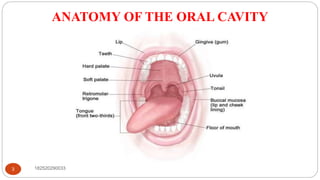
ANATOMY OF THE ORAL CAVITY
182520290033
3
ADVANTAGES DISADVANTAGES
182520290033
4
• Fights off cavities.
• Prevent against plaque and gum
disease.
• Promotes oral health and good
hygiene.
• Smooth mouth ulcer.
• Teeth whitening & give nice
breath.
• Helps in enhancing your
immunity.
• Has been linked to oral cancer.
• Increase sensitivity of your teeth.
• Irritates cancer sores.
• Masks bad breath.
• Fluorine is known to cause health
issues.
• Patient noncompliance.
• Cause gum bleeding.
APPLICATIONS
182520290033
5
• Preventative Oral Care. Millions of bacteria and other germs can
be found in your oral cavity.
• Prevents Tartar Build-Up. It doesn't take long for plaque to
accumulate on your teeth.
• Prevents Bad Breath and Gum Disease.
• Cosmetic mouthrinses temporarily control or reduce bad breath
and leave the mouth with a pleasant taste.
• Rinsing with water or mouthwash after brushing with a fluoride
toothpaste can reduce the availability of salivary fluoride.
ORAL HYGIENE
182520290033
6
• Oral hygiene is the practice of keeping one's mouth clean and
free of disease and other problems (e.g. bad breath) by regular
brushing of the teeth (dental hygiene) and cleaning between the
teeth.
• It is important that oral hygiene be carried out on a regular basis to
enable prevention of dental disease and bad breath.
• The most common types of dental disease are tooth decay
(cavities, dental caries) and gum diseases, including gingivitis,
and periodontitis.
• Cleaning between the teeth is called interdental cleaning and is as
important as tooth brushing.
TOOTH CLEANING AND DECAY
182520290033
7
• Tooth decay is the most common global disease. Over 80% of
cavities occur inside fissures in teeth where brushing cannot reach
food left trapped after eating and saliva and fluoride have no access
to neutralize acid and remineralize demineralized teeth, unlike
easy-to-clean parts of the tooth, where less cavities occur.
• It is the removal of dental plaque and tartar from teeth to
prevent cavities, gingivitis, gum disease, and tooth decay.
Severe gum disease causes at least one-third of adult tooth loss.
• Professional cleaning includes tooth scaling, tooth polishing and if
tartar has accumulated, debridement; this is usually followed by a
fluoride treatment.
ORAL DISEASES
182520290033
8
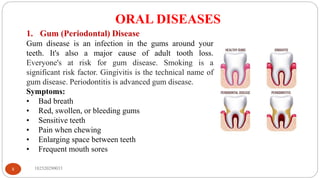
1. Gum (Periodontal) Disease
Gum disease is an infection in the gums around your
teeth. It's also a major cause of adult tooth loss.
Everyone's at risk for gum disease. Smoking is a
significant risk factor. Gingivitis is the technical name of
gum disease. Periodontitis is advanced gum disease.
Symptoms:
• Bad breath
• Red, swollen, or bleeding gums
• Sensitive teeth
• Pain when chewing
• Enlarging space between teeth
• Frequent mouth sores
182520290033
9
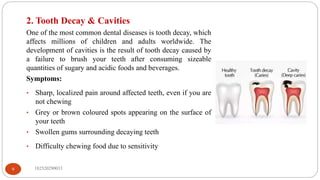
2. Tooth Decay & Cavities
One of the most common dental diseases is tooth decay, which
affects millions of children and adults worldwide. The
development of cavities is the result of tooth decay caused by
a failure to brush your teeth after consuming sizeable
quantities of sugary and acidic foods and beverages.
Symptoms:
• Sharp, localized pain around affected teeth, even if you are
not chewing
• Grey or brown coloured spots appearing on the surface of
your teeth
• Swollen gums surrounding decaying teeth
• Difficulty chewing food due to sensitivity
182520290033
10
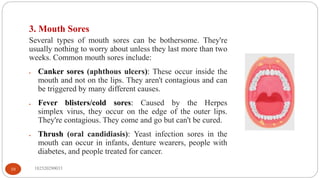
3. Mouth Sores
Several types of mouth sores can be bothersome. They're
usually nothing to worry about unless they last more than two
weeks. Common mouth sores include:
 Canker sores (aphthous ulcers): These occur inside the
mouth and not on the lips. They aren't contagious and can
be triggered by many different causes.
 Fever blisters/cold sores: Caused by the Herpes
simplex virus, they occur on the edge of the outer lips.
They're contagious. They come and go but can't be cured.
 Thrush (oral candidiasis): Yeast infection sores in the
mouth can occur in infants, denture wearers, people with
diabetes, and people treated for cancer.
182520290033
11
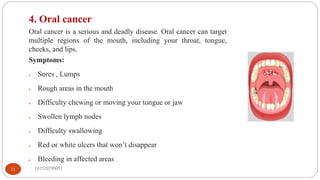
4. Oral cancer
Oral cancer is a serious and deadly disease. Oral cancer can target
multiple regions of the mouth, including your throat, tongue,
cheeks, and lips.
Symptoms:
 Sores , Lumps
 Rough areas in the mouth
 Difficulty chewing or moving your tongue or jaw
 Swollen lymph nodes
 Difficulty swallowing
 Red or white ulcers that won’t disappear
 Bleeding in affected areas
182520290033
12
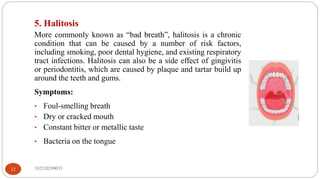
5. Halitosis
More commonly known as “bad breath”, halitosis is a chronic
condition that can be caused by a number of risk factors,
including smoking, poor dental hygiene, and existing respiratory
tract infections. Halitosis can also be a side effect of gingivitis
or periodontitis, which are caused by plaque and tartar build up
around the teeth and gums.
Symptoms:
• Foul-smelling breath
• Dry or cracked mouth
• Constant bitter or metallic taste
• Bacteria on the tongue
SOURCES OF PROBLEMS
182520290033
13
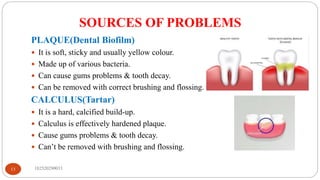
PLAQUE(Dental Biofilm)
 It is soft, sticky and usually yellow colour.
 Made up of various bacteria.
 Can cause gums problems & tooth decay.
 Can be removed with correct brushing and flossing.
CALCULUS(Tartar)
 It is a hard, calcified build-up.
 Calculus is effectively hardened plaque.
 Cause gums problems & tooth decay.
 Can’t be removed with brushing and flossing.
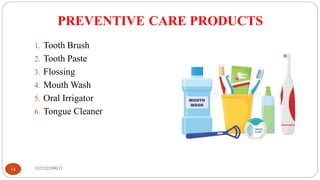
PREVENTIVE CARE PRODUCTS
182520290033
14
1. Tooth Brush
2. Tooth Paste
3. Flossing
4. Mouth Wash
5. Oral Irrigator
6. Tongue Cleaner
1. Tooth Brush
• A toothbrush is an oral hygiene tool used to clean the teeth, gums and tongue.
It consists of a head of tightly clustered bristles, atop of which toothpaste
can be applied, mounted on a handle which facilitates the cleaning of
hard-to-reach areas of the mouth.
• They should be used in conjunction with something to clean between the teeth
where the bristles of the toothbrush cannot reach - for example floss, tape or
interdental brushes.
• Routine tooth brushing is the principal method of preventing many oral
diseases, and perhaps the most important activity an individual can
practice to reduce plaque build up.
• Toothbrushing can only clean to a depth of about 1.5 mm inside the gingival
pockets, but a sustained regime of plaque removal above the gum line can
affect the ecology of the microbes below the gums and may reduce the number
of pathogens in pockets up to 5 mm in depth.
182520290033
15
Types of tooth brush
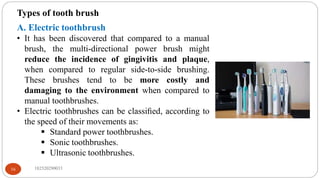
A. Electric toothbrush
• It has been discovered that compared to a manual
brush, the multi-directional power brush might
reduce the incidence of gingivitis and plaque,
when compared to regular side-to-side brushing.
These brushes tend to be more costly and
damaging to the environment when compared to
manual toothbrushes.
• Electric toothbrushes can be classified, according to
the speed of their movements as:
 Standard power toothbrushes.
 Sonic toothbrushes.
 Ultrasonic toothbrushes.
182520290033
16
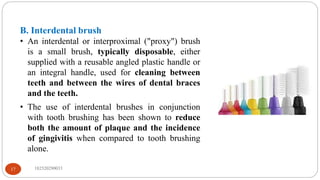
B. Interdental brush
• An interdental or interproximal ("proxy") brush
is a small brush, typically disposable, either
supplied with a reusable angled plastic handle or
an integral handle, used for cleaning between
teeth and between the wires of dental braces
and the teeth.
• The use of interdental brushes in conjunction
with tooth brushing has been shown to reduce
both the amount of plaque and the incidence
of gingivitis when compared to tooth brushing
alone.
182520290033
17
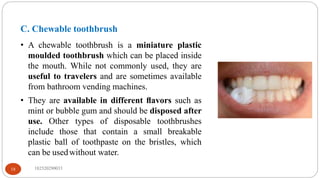
C. Chewable toothbrush
• A chewable toothbrush is a miniature plastic
moulded toothbrush which can be placed inside
the mouth. While not commonly used, they are
useful to travelers and are sometimes available
from bathroom vending machines.
• They are available in different flavors such as
mint or bubble gum and should be disposed after
use. Other types of disposable toothbrushes
include those that contain a small breakable
plastic ball of toothpaste on the bristles, which
can be usedwithout water.
182520290033
18
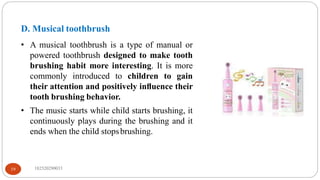
D. Musical toothbrush
• A musical toothbrush is a type of manual or
powered toothbrush designed to make tooth
brushing habit more interesting. It is more
commonly introduced to children to gain
their attention and positively influence their
tooth brushing behavior.
• The music starts while child starts brushing, it
continuously plays during the brushing and it
ends when the child stopsbrushing.
182520290033
19
182520290033
20
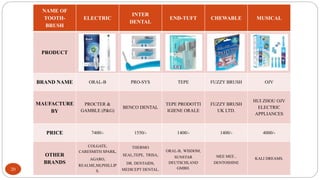
NAME OF
TOOTH-
BRUSH
ELECTRIC
INTER
DENTAL
END-TUFT CHEWABLE MUSICAL
PRODUCT
BRAND NAME ORAL-B PRO-SYS TEPE FUZZY BRUSH OJV
MAUFACTURE
BY
PROCTER &
GAMBLE (P&G)
BENCO DENTAL
TEPE PRODOTTI
IGIENE ORALE
FUZZY BRUSH
UK LTD.
HUI ZHOU OJV
ELECTRIC
APPLIANCES
PRICE 7400/- 1550/- 1400/- 1400/- 4000/-
OTHER
BRANDS
COLGATE,
CARESMITH SPARK,
AGARO,
REALME,MI,PHILLIP
S.
THERMO
SEAL,TEPE, TRISA,
DR. DENTAIDS,
MEDICEPT DENTAL.
ORAL-B, WISDOM,
SUNSTAR
DEUTSCHLAND
GMBH.
MEE MEE ,
DENTOSHINE
KALI DREAMS.
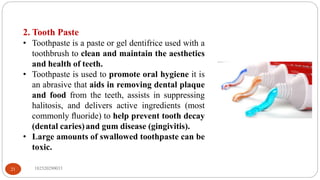
2. Tooth Paste
• Toothpaste is a paste or gel dentifrice used with a
toothbrush to clean and maintain the aesthetics
and health of teeth.
• Toothpaste is used to promote oral hygiene it is
an abrasive that aids in removing dental plaque
and food from the teeth, assists in suppressing
halitosis, and delivers active ingredients (most
commonly fluoride) to help prevent tooth decay
(dental caries)and gum disease (gingivitis).
• Large amounts of swallowed toothpaste can be
toxic.
182520290033
21
Use of toothpaste
• Toothpastes are generally useful to maintain dental health.
• Toothpastes containing fluoride are effective at preventing tooth decay.
• Toothpastes may also help to control and remove plaque build-up, promoting
healthy gums.
• However, the active ingredients in toothpastes are able to prevent dental diseases
with regular use.
182520290033
22
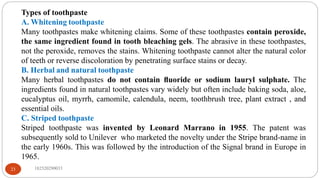
Types of toothpaste
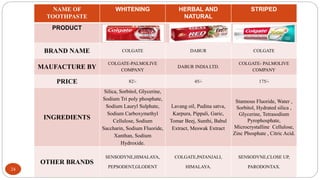
A. Whitening toothpaste
Many toothpastes make whitening claims. Some of these toothpastes contain peroxide,
the same ingredient found in tooth bleaching gels. The abrasive in these toothpastes,
not the peroxide, removes the stains. Whitening toothpaste cannot alter the natural color
of teeth or reverse discoloration by penetrating surface stains or decay.
B. Herbal and natural toothpaste
Many herbal toothpastes do not contain fluoride or sodium lauryl sulphate. The
ingredients found in natural toothpastes vary widely but often include baking soda, aloe,
eucalyptus oil, myrrh, camomile, calendula, neem, toothbrush tree, plant extract , and
essential oils.
C. Striped toothpaste
Striped toothpaste was invented by Leonard Marrano in 1955. The patent was
subsequently sold to Unilever who marketed the novelty under the Stripe brand-name in
the early 1960s. This was followed by the introduction of the Signal brand in Europe in
1965.
182520290033
23
182520290033
24
NAME OF
TOOTHPASTE
WHITENING HERBAL AND
NATURAL
STRIPED
PRODUCT
BRAND NAME COLGATE DABUR COLGATE
MAUFACTURE BY
COLGATE-PALMOLIVE
COMPANY
DABUR INDIA LTD.
COLGATE- PALMOLIVE
COMPANY
PRICE 82/- 45/- 175/-
INGREDIENTS
Silica, Sorbitol, Glycerine,
Sodium Tri poly phosphate,
Sodium Lauryl Sulphate,
Sodium Carboxymethyl
Cellulose, Sodium
Saccharin, Sodium Fluoride,
Xanthan, Sodium
Hydroxide.
Lavang oil, Pudina satva,
Karpura, Pippali, Garic,
Tomar Beej, Sunthi, Babul
Extract, Meswak Extract
Stannous Fluoride, Water ,
Sorbitol, Hydrated silica ,
Glycerine, Tetrasodium
Pyrophosphate,
Microcrystalline Cellulose,
Zinc Phosphate , Citric Acid.
OTHER BRANDS
SENSODYNE,HIMALAYA,
PEPSODENT,GLODENT
COLGATE,PATANJALI,
HIMALAYA.
SENSODYNE,CLOSE UP,
PARODONTAX.
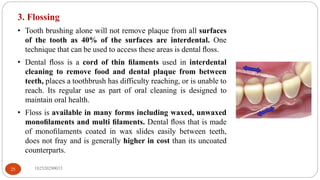
3. Flossing
• Tooth brushing alone will not remove plaque from all surfaces
of the tooth as 40% of the surfaces are interdental. One
technique that can be used to access these areas is dental floss.
• Dental floss is a cord of thin filaments used in interdental
cleaning to remove food and dental plaque from between
teeth, places a toothbrush has difficulty reaching, or is unable to
reach. Its regular use as part of oral cleaning is designed to
maintain oral health.
• Floss is available in many forms including waxed, unwaxed
monofilaments and multi filaments. Dental floss that is made
of monofilaments coated in wax slides easily between teeth,
does not fray and is generally higher in cost than its uncoated
counterparts.
182520290033
25
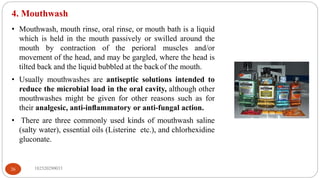
4. Mouthwash
• Mouthwash, mouth rinse, oral rinse, or mouth bath is a liquid
which is held in the mouth passively or swilled around the
mouth by contraction of the perioral muscles and/or
movement of the head, and may be gargled, where the head is
tilted back and the liquid bubbled at the backof the mouth.
• Usually mouthwashes are antiseptic solutions intended to
reduce the microbial load in the oral cavity, although other
mouthwashes might be given for other reasons such as for
their analgesic, anti-inflammatory or anti-fungal action.
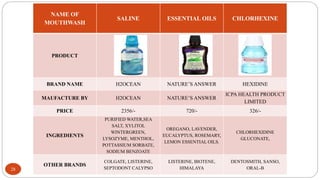
• There are three commonly used kinds of mouthwash saline
(salty water), essential oils (Listerine etc.), and chlorhexidine
gluconate.
182520290033
26
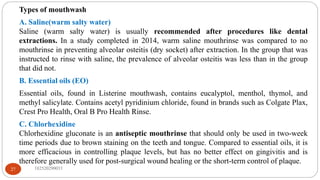
Types of mouthwash
A. Saline(warm salty water)
Saline (warm salty water) is usually recommended after procedures like dental
extractions. In a study completed in 2014, warm saline mouthrinse was compared to no
mouthrinse in preventing alveolar osteitis (dry socket) after extraction. In the group that was
instructed to rinse with saline, the prevalence of alveolar osteitis was less than in the group
that did not.
B. Essential oils (EO)
Essential oils, found in Listerine mouthwash, contains eucalyptol, menthol, thymol, and
methyl salicylate. Contains acetyl pyridinium chloride, found in brands such as Colgate Plax,
Crest Pro Health, Oral B Pro Health Rinse.
C. Chlorhexidine
Chlorhexidine gluconate is an antiseptic mouthrinse that should only be used in two-week
time periods due to brown staining on the teeth and tongue. Compared to essential oils, it is
more efficacious in controlling plaque levels, but has no better effect on gingivitis and is
therefore generally used for post-surgical wound healing or the short-term control of plaque.
182520290033
27
182520290033
28
NAME OF
MOUTHWASH
SALINE ESSENTIAL OILS CHLORHEXINE
PRODUCT
BRAND NAME H2OCEAN NATURE’S ANSWER HEXIDINE
MAUFACTURE BY H2OCEAN NATURE’S ANSWER
ICPA HEALTH PRODUCT
LIMITED
PRICE 2356/- 720/- 326/-
INGREDIENTS
PURIFIED WATER,SEA
SALT, XYLITOL
WINTERGREEN,
LYSOZYME, MENTHOL,
POTTASSIUM SORBATE,
SODIUM BENZOATE
OREGANO, LAVENDER,
EUCALYPTUS, ROSEMARY,
LEMON ESSENTIAL OILS.
CHLORHEXIDINE
GLUCONATE,
OTHER BRANDS
COLGATE, LISTERINE,
SEPTODONT CALYPSO
LISTERINE, BIOTENE,
HIMALAYA
DENTOSMITH, SANSO,
ORAL-B
182520290033
29
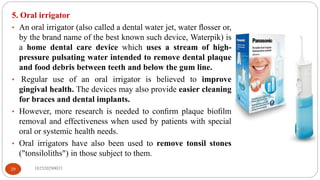
5. Oral irrigator
• An oral irrigator (also called a dental water jet, water flosser or,
by the brand name of the best known such device, Waterpik) is
a home dental care device which uses a stream of high-
pressure pulsating water intended to remove dental plaque
and food debris between teeth and below the gum line.
• Regular use of an oral irrigator is believed to improve
gingival health. The devices may also provide easier cleaning
for braces and dental implants.
• However, more research is needed to confirm plaque biofilm
removal and effectiveness when used by patients with special
oral or systemic health needs.
• Oral irrigators have also been used to remove tonsil stones
("tonsiloliths") in those subject to them.
182520290033
30
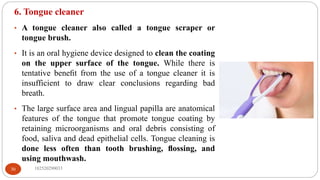
6. Tongue cleaner
• A tongue cleaner also called a tongue scraper or
tongue brush.
• It is an oral hygiene device designed to clean the coating
on the upper surface of the tongue. While there is
tentative benefit from the use of a tongue cleaner it is
insufficient to draw clear conclusions regarding bad
breath.
• The large surface area and lingual papilla are anatomical
features of the tongue that promote tongue coating by
retaining microorganisms and oral debris consisting of
food, saliva and dead epithelial cells. Tongue cleaning is
done less often than tooth brushing, flossing, and
using mouthwash.
CONCLUSION
182520290033
31
 All these products aim at preventing caries and most of the periodontal
diseases. They promote healthy oral tissues which in turn is the evident marker of
the oral health. These products eventually ensure that oral health is maintained
without any hinderance no matter what the age or the present condition of the
user is. We have evolved from chewsticks to electronic toothbrushes and there has
been a marked evolution with regard to all the other oral hygiene products. The
purpose of oral care should be to keep the lips and mucosa soft, clean, intact and
moist. However, without proper oral hygiene, bacteria can reach levels that might
lead to oral infections, such as tooth decay and gum disease.
REFERENCES
182520290033
32
1. Claydon, N.C. (2008) ‘Current concepts in toothbrushing and interdental cleaning’, Periodontology 2000., Vol.48, pp.10–22.
2. Chen, J. Jacox L.A. Saldanha, F. Sive H. (2017) ‘Mouth development’, Wiley Interdiscip Rev Dev Biol., Vol.6, No.5, pp.15-
18.
3. Lee, D.W. Moon, I.S. (2011) ‘The plaque-removing efficacy of a single-tufted brush on the lingual and buccal surfaces of the
molars’, Journal of Periodontal & Implant Science., Vol.41, No.3, pp.131–134.
4. Kilian, M. Chapple, I.L. Hannig, M. Marsh, P.D. Meuric, V. Pedersen, A.M. (2016) ‘The oral microbiome - an update for oral
healthcare professionals’, British Dental Journal., Vol.221, No.10, pp.657–666.
5. Mahasneh, S.A. Mahasneh, A.M. (2017) ‘Probiotics: A Promising Role in Dental Health’, Dentistry Journal., Vol.5, No.4,
pp.26.
6. Bartold, P.M. VanDyke, T.E. (2013) ‘Periodontitis: a host-mediated disruption of microbial homeostasis Unlearning learned
concepts’. Periodontology 2000., Vol.62, No.1, pp.203–217.
7. Marsh, P.D. Devine, D.A. (2011) ‘How is the development of dental biofilms influenced by the host?’. Journal of Clinical
Periodontology., Vol.11, No.38, pp.28–35.
THANK YOU
182520290033
33

oral care products.pptx

  • 1.
    GUIDED BY: PREPAREDBY: Ms. FAYEJA S. RAJEBHAI RINKAL S. SHAH Aassistant Professor Enrollmentno:182520290033 182520290033 1 A REVIEW ON ORAL CARE PRODUCTS Shri B.M.Shah College Of Pharmaceutical Education And Research,Modasa.
  • 2.
    List of Content 182520290033 2 1.ANATOMY OF THE ORAL CAVITY 2. ADVANTAGES AND DISADVANTAGES 3. APPLICATIONS 4. ORAL HYGIENE 5. TOOTH CLEANING AND DECAY 6. ORAL DISEASES 7. SOURCES OF PROBLEMS 8. PREVENTIVE CARE 9. CONCLUSION 10. REFERENCES
  • 3.
    ANATOMY OF THEORAL CAVITY 182520290033 3
  • 4.
    ADVANTAGES DISADVANTAGES 182520290033 4 • Fightsoff cavities. • Prevent against plaque and gum disease. • Promotes oral health and good hygiene. • Smooth mouth ulcer. • Teeth whitening & give nice breath. • Helps in enhancing your immunity. • Has been linked to oral cancer. • Increase sensitivity of your teeth. • Irritates cancer sores. • Masks bad breath. • Fluorine is known to cause health issues. • Patient noncompliance. • Cause gum bleeding.
  • 5.
    APPLICATIONS 182520290033 5 • Preventative OralCare. Millions of bacteria and other germs can be found in your oral cavity. • Prevents Tartar Build-Up. It doesn't take long for plaque to accumulate on your teeth. • Prevents Bad Breath and Gum Disease. • Cosmetic mouthrinses temporarily control or reduce bad breath and leave the mouth with a pleasant taste. • Rinsing with water or mouthwash after brushing with a fluoride toothpaste can reduce the availability of salivary fluoride.
  • 6.
    ORAL HYGIENE 182520290033 6 • Oralhygiene is the practice of keeping one's mouth clean and free of disease and other problems (e.g. bad breath) by regular brushing of the teeth (dental hygiene) and cleaning between the teeth. • It is important that oral hygiene be carried out on a regular basis to enable prevention of dental disease and bad breath. • The most common types of dental disease are tooth decay (cavities, dental caries) and gum diseases, including gingivitis, and periodontitis. • Cleaning between the teeth is called interdental cleaning and is as important as tooth brushing.
  • 7.
    TOOTH CLEANING ANDDECAY 182520290033 7 • Tooth decay is the most common global disease. Over 80% of cavities occur inside fissures in teeth where brushing cannot reach food left trapped after eating and saliva and fluoride have no access to neutralize acid and remineralize demineralized teeth, unlike easy-to-clean parts of the tooth, where less cavities occur. • It is the removal of dental plaque and tartar from teeth to prevent cavities, gingivitis, gum disease, and tooth decay. Severe gum disease causes at least one-third of adult tooth loss. • Professional cleaning includes tooth scaling, tooth polishing and if tartar has accumulated, debridement; this is usually followed by a fluoride treatment.
  • 8.
    ORAL DISEASES 182520290033 8 1. Gum(Periodontal) Disease Gum disease is an infection in the gums around your teeth. It's also a major cause of adult tooth loss. Everyone's at risk for gum disease. Smoking is a significant risk factor. Gingivitis is the technical name of gum disease. Periodontitis is advanced gum disease. Symptoms: • Bad breath • Red, swollen, or bleeding gums • Sensitive teeth • Pain when chewing • Enlarging space between teeth • Frequent mouth sores
  • 9.
    182520290033 9 2. Tooth Decay& Cavities One of the most common dental diseases is tooth decay, which affects millions of children and adults worldwide. The development of cavities is the result of tooth decay caused by a failure to brush your teeth after consuming sizeable quantities of sugary and acidic foods and beverages. Symptoms: • Sharp, localized pain around affected teeth, even if you are not chewing • Grey or brown coloured spots appearing on the surface of your teeth • Swollen gums surrounding decaying teeth • Difficulty chewing food due to sensitivity
  • 10.
    182520290033 10 3. Mouth Sores Severaltypes of mouth sores can be bothersome. They're usually nothing to worry about unless they last more than two weeks. Common mouth sores include:  Canker sores (aphthous ulcers): These occur inside the mouth and not on the lips. They aren't contagious and can be triggered by many different causes.  Fever blisters/cold sores: Caused by the Herpes simplex virus, they occur on the edge of the outer lips. They're contagious. They come and go but can't be cured.  Thrush (oral candidiasis): Yeast infection sores in the mouth can occur in infants, denture wearers, people with diabetes, and people treated for cancer.
  • 11.
    182520290033 11 4. Oral cancer Oralcancer is a serious and deadly disease. Oral cancer can target multiple regions of the mouth, including your throat, tongue, cheeks, and lips. Symptoms:  Sores , Lumps  Rough areas in the mouth  Difficulty chewing or moving your tongue or jaw  Swollen lymph nodes  Difficulty swallowing  Red or white ulcers that won’t disappear  Bleeding in affected areas
  • 12.
    182520290033 12 5. Halitosis More commonlyknown as “bad breath”, halitosis is a chronic condition that can be caused by a number of risk factors, including smoking, poor dental hygiene, and existing respiratory tract infections. Halitosis can also be a side effect of gingivitis or periodontitis, which are caused by plaque and tartar build up around the teeth and gums. Symptoms: • Foul-smelling breath • Dry or cracked mouth • Constant bitter or metallic taste • Bacteria on the tongue
  • 13.
    SOURCES OF PROBLEMS 182520290033 13 PLAQUE(DentalBiofilm)  It is soft, sticky and usually yellow colour.  Made up of various bacteria.  Can cause gums problems & tooth decay.  Can be removed with correct brushing and flossing. CALCULUS(Tartar)  It is a hard, calcified build-up.  Calculus is effectively hardened plaque.  Cause gums problems & tooth decay.  Can’t be removed with brushing and flossing.
  • 14.
    PREVENTIVE CARE PRODUCTS 182520290033 14 1.Tooth Brush 2. Tooth Paste 3. Flossing 4. Mouth Wash 5. Oral Irrigator 6. Tongue Cleaner
  • 15.
    1. Tooth Brush •A toothbrush is an oral hygiene tool used to clean the teeth, gums and tongue. It consists of a head of tightly clustered bristles, atop of which toothpaste can be applied, mounted on a handle which facilitates the cleaning of hard-to-reach areas of the mouth. • They should be used in conjunction with something to clean between the teeth where the bristles of the toothbrush cannot reach - for example floss, tape or interdental brushes. • Routine tooth brushing is the principal method of preventing many oral diseases, and perhaps the most important activity an individual can practice to reduce plaque build up. • Toothbrushing can only clean to a depth of about 1.5 mm inside the gingival pockets, but a sustained regime of plaque removal above the gum line can affect the ecology of the microbes below the gums and may reduce the number of pathogens in pockets up to 5 mm in depth. 182520290033 15
  • 16.
    Types of toothbrush A. Electric toothbrush • It has been discovered that compared to a manual brush, the multi-directional power brush might reduce the incidence of gingivitis and plaque, when compared to regular side-to-side brushing. These brushes tend to be more costly and damaging to the environment when compared to manual toothbrushes. • Electric toothbrushes can be classified, according to the speed of their movements as:  Standard power toothbrushes.  Sonic toothbrushes.  Ultrasonic toothbrushes. 182520290033 16
  • 17.
    B. Interdental brush •An interdental or interproximal ("proxy") brush is a small brush, typically disposable, either supplied with a reusable angled plastic handle or an integral handle, used for cleaning between teeth and between the wires of dental braces and the teeth. • The use of interdental brushes in conjunction with tooth brushing has been shown to reduce both the amount of plaque and the incidence of gingivitis when compared to tooth brushing alone. 182520290033 17
  • 18.
    C. Chewable toothbrush •A chewable toothbrush is a miniature plastic moulded toothbrush which can be placed inside the mouth. While not commonly used, they are useful to travelers and are sometimes available from bathroom vending machines. • They are available in different flavors such as mint or bubble gum and should be disposed after use. Other types of disposable toothbrushes include those that contain a small breakable plastic ball of toothpaste on the bristles, which can be usedwithout water. 182520290033 18
  • 19.
    D. Musical toothbrush •A musical toothbrush is a type of manual or powered toothbrush designed to make tooth brushing habit more interesting. It is more commonly introduced to children to gain their attention and positively influence their tooth brushing behavior. • The music starts while child starts brushing, it continuously plays during the brushing and it ends when the child stopsbrushing. 182520290033 19
  • 20.
    182520290033 20 NAME OF TOOTH- BRUSH ELECTRIC INTER DENTAL END-TUFT CHEWABLEMUSICAL PRODUCT BRAND NAME ORAL-B PRO-SYS TEPE FUZZY BRUSH OJV MAUFACTURE BY PROCTER & GAMBLE (P&G) BENCO DENTAL TEPE PRODOTTI IGIENE ORALE FUZZY BRUSH UK LTD. HUI ZHOU OJV ELECTRIC APPLIANCES PRICE 7400/- 1550/- 1400/- 1400/- 4000/- OTHER BRANDS COLGATE, CARESMITH SPARK, AGARO, REALME,MI,PHILLIP S. THERMO SEAL,TEPE, TRISA, DR. DENTAIDS, MEDICEPT DENTAL. ORAL-B, WISDOM, SUNSTAR DEUTSCHLAND GMBH. MEE MEE , DENTOSHINE KALI DREAMS.
  • 21.
    2. Tooth Paste •Toothpaste is a paste or gel dentifrice used with a toothbrush to clean and maintain the aesthetics and health of teeth. • Toothpaste is used to promote oral hygiene it is an abrasive that aids in removing dental plaque and food from the teeth, assists in suppressing halitosis, and delivers active ingredients (most commonly fluoride) to help prevent tooth decay (dental caries)and gum disease (gingivitis). • Large amounts of swallowed toothpaste can be toxic. 182520290033 21
  • 22.
    Use of toothpaste •Toothpastes are generally useful to maintain dental health. • Toothpastes containing fluoride are effective at preventing tooth decay. • Toothpastes may also help to control and remove plaque build-up, promoting healthy gums. • However, the active ingredients in toothpastes are able to prevent dental diseases with regular use. 182520290033 22
  • 23.
    Types of toothpaste A.Whitening toothpaste Many toothpastes make whitening claims. Some of these toothpastes contain peroxide, the same ingredient found in tooth bleaching gels. The abrasive in these toothpastes, not the peroxide, removes the stains. Whitening toothpaste cannot alter the natural color of teeth or reverse discoloration by penetrating surface stains or decay. B. Herbal and natural toothpaste Many herbal toothpastes do not contain fluoride or sodium lauryl sulphate. The ingredients found in natural toothpastes vary widely but often include baking soda, aloe, eucalyptus oil, myrrh, camomile, calendula, neem, toothbrush tree, plant extract , and essential oils. C. Striped toothpaste Striped toothpaste was invented by Leonard Marrano in 1955. The patent was subsequently sold to Unilever who marketed the novelty under the Stripe brand-name in the early 1960s. This was followed by the introduction of the Signal brand in Europe in 1965. 182520290033 23
  • 24.
    182520290033 24 NAME OF TOOTHPASTE WHITENING HERBALAND NATURAL STRIPED PRODUCT BRAND NAME COLGATE DABUR COLGATE MAUFACTURE BY COLGATE-PALMOLIVE COMPANY DABUR INDIA LTD. COLGATE- PALMOLIVE COMPANY PRICE 82/- 45/- 175/- INGREDIENTS Silica, Sorbitol, Glycerine, Sodium Tri poly phosphate, Sodium Lauryl Sulphate, Sodium Carboxymethyl Cellulose, Sodium Saccharin, Sodium Fluoride, Xanthan, Sodium Hydroxide. Lavang oil, Pudina satva, Karpura, Pippali, Garic, Tomar Beej, Sunthi, Babul Extract, Meswak Extract Stannous Fluoride, Water , Sorbitol, Hydrated silica , Glycerine, Tetrasodium Pyrophosphate, Microcrystalline Cellulose, Zinc Phosphate , Citric Acid. OTHER BRANDS SENSODYNE,HIMALAYA, PEPSODENT,GLODENT COLGATE,PATANJALI, HIMALAYA. SENSODYNE,CLOSE UP, PARODONTAX.
  • 25.
    3. Flossing • Toothbrushing alone will not remove plaque from all surfaces of the tooth as 40% of the surfaces are interdental. One technique that can be used to access these areas is dental floss. • Dental floss is a cord of thin filaments used in interdental cleaning to remove food and dental plaque from between teeth, places a toothbrush has difficulty reaching, or is unable to reach. Its regular use as part of oral cleaning is designed to maintain oral health. • Floss is available in many forms including waxed, unwaxed monofilaments and multi filaments. Dental floss that is made of monofilaments coated in wax slides easily between teeth, does not fray and is generally higher in cost than its uncoated counterparts. 182520290033 25
  • 26.
    4. Mouthwash • Mouthwash,mouth rinse, oral rinse, or mouth bath is a liquid which is held in the mouth passively or swilled around the mouth by contraction of the perioral muscles and/or movement of the head, and may be gargled, where the head is tilted back and the liquid bubbled at the backof the mouth. • Usually mouthwashes are antiseptic solutions intended to reduce the microbial load in the oral cavity, although other mouthwashes might be given for other reasons such as for their analgesic, anti-inflammatory or anti-fungal action. • There are three commonly used kinds of mouthwash saline (salty water), essential oils (Listerine etc.), and chlorhexidine gluconate. 182520290033 26
  • 27.
    Types of mouthwash A.Saline(warm salty water) Saline (warm salty water) is usually recommended after procedures like dental extractions. In a study completed in 2014, warm saline mouthrinse was compared to no mouthrinse in preventing alveolar osteitis (dry socket) after extraction. In the group that was instructed to rinse with saline, the prevalence of alveolar osteitis was less than in the group that did not. B. Essential oils (EO) Essential oils, found in Listerine mouthwash, contains eucalyptol, menthol, thymol, and methyl salicylate. Contains acetyl pyridinium chloride, found in brands such as Colgate Plax, Crest Pro Health, Oral B Pro Health Rinse. C. Chlorhexidine Chlorhexidine gluconate is an antiseptic mouthrinse that should only be used in two-week time periods due to brown staining on the teeth and tongue. Compared to essential oils, it is more efficacious in controlling plaque levels, but has no better effect on gingivitis and is therefore generally used for post-surgical wound healing or the short-term control of plaque. 182520290033 27
  • 28.
    182520290033 28 NAME OF MOUTHWASH SALINE ESSENTIALOILS CHLORHEXINE PRODUCT BRAND NAME H2OCEAN NATURE’S ANSWER HEXIDINE MAUFACTURE BY H2OCEAN NATURE’S ANSWER ICPA HEALTH PRODUCT LIMITED PRICE 2356/- 720/- 326/- INGREDIENTS PURIFIED WATER,SEA SALT, XYLITOL WINTERGREEN, LYSOZYME, MENTHOL, POTTASSIUM SORBATE, SODIUM BENZOATE OREGANO, LAVENDER, EUCALYPTUS, ROSEMARY, LEMON ESSENTIAL OILS. CHLORHEXIDINE GLUCONATE, OTHER BRANDS COLGATE, LISTERINE, SEPTODONT CALYPSO LISTERINE, BIOTENE, HIMALAYA DENTOSMITH, SANSO, ORAL-B
  • 29.
    182520290033 29 5. Oral irrigator •An oral irrigator (also called a dental water jet, water flosser or, by the brand name of the best known such device, Waterpik) is a home dental care device which uses a stream of high- pressure pulsating water intended to remove dental plaque and food debris between teeth and below the gum line. • Regular use of an oral irrigator is believed to improve gingival health. The devices may also provide easier cleaning for braces and dental implants. • However, more research is needed to confirm plaque biofilm removal and effectiveness when used by patients with special oral or systemic health needs. • Oral irrigators have also been used to remove tonsil stones ("tonsiloliths") in those subject to them.
  • 30.
    182520290033 30 6. Tongue cleaner •A tongue cleaner also called a tongue scraper or tongue brush. • It is an oral hygiene device designed to clean the coating on the upper surface of the tongue. While there is tentative benefit from the use of a tongue cleaner it is insufficient to draw clear conclusions regarding bad breath. • The large surface area and lingual papilla are anatomical features of the tongue that promote tongue coating by retaining microorganisms and oral debris consisting of food, saliva and dead epithelial cells. Tongue cleaning is done less often than tooth brushing, flossing, and using mouthwash.
  • 31.
    CONCLUSION 182520290033 31  All theseproducts aim at preventing caries and most of the periodontal diseases. They promote healthy oral tissues which in turn is the evident marker of the oral health. These products eventually ensure that oral health is maintained without any hinderance no matter what the age or the present condition of the user is. We have evolved from chewsticks to electronic toothbrushes and there has been a marked evolution with regard to all the other oral hygiene products. The purpose of oral care should be to keep the lips and mucosa soft, clean, intact and moist. However, without proper oral hygiene, bacteria can reach levels that might lead to oral infections, such as tooth decay and gum disease.
  • 32.
    REFERENCES 182520290033 32 1. Claydon, N.C.(2008) ‘Current concepts in toothbrushing and interdental cleaning’, Periodontology 2000., Vol.48, pp.10–22. 2. Chen, J. Jacox L.A. Saldanha, F. Sive H. (2017) ‘Mouth development’, Wiley Interdiscip Rev Dev Biol., Vol.6, No.5, pp.15- 18. 3. Lee, D.W. Moon, I.S. (2011) ‘The plaque-removing efficacy of a single-tufted brush on the lingual and buccal surfaces of the molars’, Journal of Periodontal & Implant Science., Vol.41, No.3, pp.131–134. 4. Kilian, M. Chapple, I.L. Hannig, M. Marsh, P.D. Meuric, V. Pedersen, A.M. (2016) ‘The oral microbiome - an update for oral healthcare professionals’, British Dental Journal., Vol.221, No.10, pp.657–666. 5. Mahasneh, S.A. Mahasneh, A.M. (2017) ‘Probiotics: A Promising Role in Dental Health’, Dentistry Journal., Vol.5, No.4, pp.26. 6. Bartold, P.M. VanDyke, T.E. (2013) ‘Periodontitis: a host-mediated disruption of microbial homeostasis Unlearning learned concepts’. Periodontology 2000., Vol.62, No.1, pp.203–217. 7. Marsh, P.D. Devine, D.A. (2011) ‘How is the development of dental biofilms influenced by the host?’. Journal of Clinical Periodontology., Vol.11, No.38, pp.28–35.
  • 33.