C.O.S.H.H
Promoting the Safe
Use of Chemicals in Cleaning
C.O.S.H.H Awareness Training
By
Power Hygiene
Control of Substances Hazardous to Health
Aim of COSHH?
To protect people against risks to their health, whether immediate or delayed, from
substances hazardous to health arising from a work activity.
COSHH is a legal objective and requirement.
It is there to enforce and raise safety standards in the workplace.
It is there to reduce the frequency and severity of accidents involving chemicals and
other hazardous substances.
COSHH is based on identifying the hazard of a substance and then determining the
risk…
What is C.O.S.H.H?
Summary
A 46-year-old school cook developed breathing problems after working with flour in
the school kitchen. The room was small with poor ventilation.
Her breathing problems became so severe that she could hardly walk. She had to
sleep sitting up.
Her daily job included dough making in a large mixer. There were no controls for the
flour dust.
HSE investigation
The cook contacted her union, which supported her with a compensation claim on
the basis that decent working conditions were not provided.
The council admitted that it had not taken sufficient action over the problem
despite repeated complaints. HSE was not involved.
Effects
The cook became severely asthmatic. She had to retire early on health grounds, and
the courts eventually awarded her £200,000 in damages.
But the money will not bring back her health. While she was able to move out of
town, she rarely leaves the house. She faces a very restricted lifestyle.
Details From Health & Safety Executive
Case Studies
School cook can hardly Walk
What’s Wrong Here
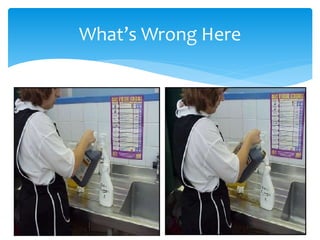
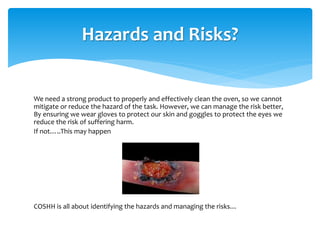
We need a strong product to properly and effectively clean the oven, so we cannot
mitigate or reduce the hazard of the task. However, we can manage the risk better,
By ensuring we wear gloves to protect our skin and goggles to protect the eyes we
reduce the risk of suffering harm.
If not…..This may happen
COSHH is all about identifying the hazards and managing the risks…
Hazards and Risks?
Everyone!
COSHH is everyone’s responsibility. We are all responsible for complying with
COSHH. Which falls under the scope of the Health and Safety at Work act.
Ignorance of the law is no defence and should your actions (or inaction) cause an
accident you could be charged with anything from negligence to manslaughter.
Therefore, it is important that you fully understand your responsibility – not only
to ensure your safety and your colleagues safety, but also to avoid falling foul of
the law.
This may all sound rather alarming. Thankfully, it is really very, very simple to stay
legal and stay safe…
C.O.S.H.H – Who is Responsible?
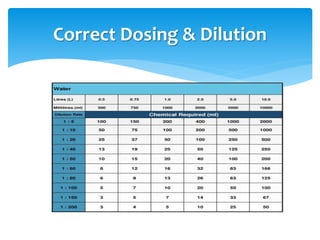
Correct Dosing & Dilution
The CLP regulation implements the United Nations’ Globally Harmonised System of
Classification and Labelling of Chemicals (GHS) in the EU. GHS is being adopted
worldwide to improve and harmonise worker and consumer safety and facilitate
global trade.
Some of the differences you may see are:
‣ classification criteria and classification methods are different for some types of
hazard, so some chemical products may be classified more or less severely;
‣ new hazard pictograms will replace danger symbols on labels;
‣ new wording in hazard (H) and precautionary (P) statements will replace risk (R)
and safety (S) phrases;
‣ classifications for both the CLP and the previous legislation on SDS, and label
information moved from Section 15 to Section 2 of the SDS.
CLP Regulation
New Hazard Symbols
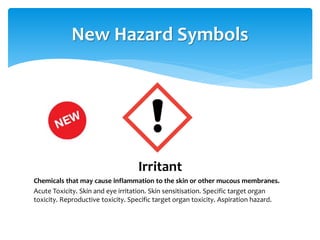
Irritant
Chemicals that may cause inflammation to the skin or other mucous membranes.
Acute Toxicity. Skin and eye irritation. Skin sensitisation. Specific target organ
toxicity. Reproductive toxicity. Specific target organ toxicity. Aspiration hazard.
New Hazard Symbols
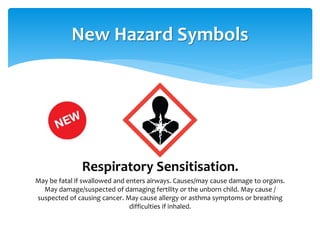
Respiratory Sensitisation.
May be fatal if swallowed and enters airways. Causes/may cause damage to organs.
May damage/suspected of damaging fertility or the unborn child. May cause /
suspected of causing cancer. May cause allergy or asthma symptoms or breathing
difficulties if inhaled.
New Hazard Symbols
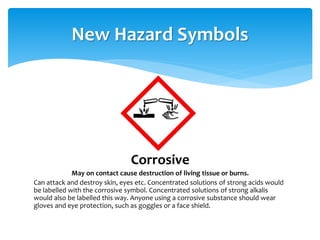
Corrosive
May on contact cause destruction of living tissue or burns.
Can attack and destroy skin, eyes etc. Concentrated solutions of strong acids would
be labelled with the corrosive symbol. Concentrated solutions of strong alkalis
would also be labelled this way. Anyone using a corrosive substance should wear
gloves and eye protection, such as goggles or a face shield.
New Hazard Symbols
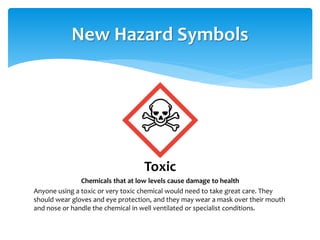
Toxic
Chemicals that at low levels cause damage to health
Anyone using a toxic or very toxic chemical would need to take great care. They
should wear gloves and eye protection, and they may wear a mask over their mouth
and nose or handle the chemical in well ventilated or specialist conditions.
New Hazard Symbols
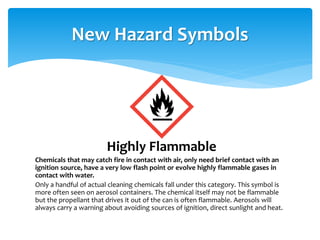
Highly Flammable
Chemicals that may catch fire in contact with air, only need brief contact with an
ignition source, have a very low flash point or evolve highly flammable gases in
contact with water.
Only a handful of actual cleaning chemicals fall under this category. This symbol is
more often seen on aerosol containers. The chemical itself may not be flammable
but the propellant that drives it out of the can is often flammable. Aerosols will
always carry a warning about avoiding sources of ignition, direct sunlight and heat.
New Hazard Symbols
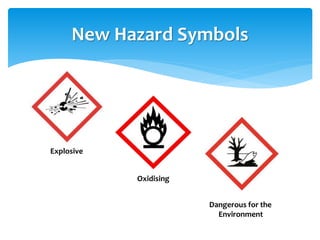
Explosive
Oxidising
Dangerous for the
Environment
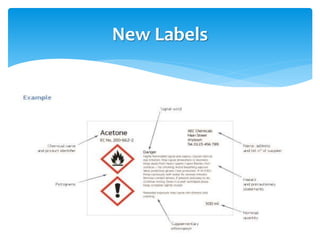
New Labels
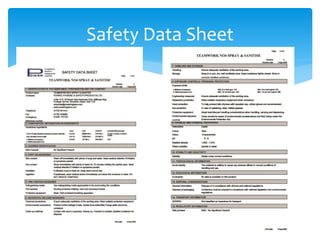
Safety Data Sheet
Eyes
Rinse immediately with plenty of water, holding the eyelids open and seek medical
advice immediately if corrosive, irritant or caustic products, for all other
classifications seek medical advice if effects persist.
Inhalation
Remove from source of vapour or spray mist and seek medical advice.
Skin
Wash thoroughly, (for corrosive, irritant or caustic products seek medical advice)
Ingestion
Remove product from mouth, Never induce vomiting, if conscious give plenty of water or
milk to drink and seek medical advice..
First Aid
“accidents can happen –take the correct actions immediately.”
What Time Is IT
The abbreviation COSHH stands for?
• Control of slurry in hot hard water
• Cast of shoes and hard hats
• Control of substances hazardous to health
Question Time
The abbreviation COSHH stands for?
• Control of substances hazardous to health
Question Time
It is important to use cleaning chemicals safely because?
• This will produce better cleaning results
• If incorrectly used all chemicals have the potential to
harm you
• The chemicals will last longer
Question Time
It is important to use cleaning chemicals safely because?
• If incorrectly used all chemicals have the potential to
harm you
* Remember that all cleaning chemicals can potentially
harm you
Question Time
Under COSHH employees have a responsibility to
• Decide for themselves the best way to handle
chemicals.
• Follow their employers procedures for the safe
handling of chemicals.
• Ignore COSHH, because it is a law only to be followed
by employers.
Question Time
Under COSHH employees have a responsibility to
• Follow their employers procedures for the safe
handling of chemicals.
* COSHH is a law for both employers and employees to
follow.
Question Time
A hazards symbol is a symbol show on cleaning
chemicals
• Denoting the strength of a chemicals
• Showing the capacity of a bottle
• Alerting you to the potential hazards of a chemical
Question Time
A hazards symbol is a symbol show on cleaning
chemicals
• Alerting you to the potential hazards of a chemical
* Make sure that you know the meaning of all hazards
symbols
Question Time
Which of the following statements are false
• Manufacturers can pick and choose which hazards
symbols to display
• Cleaning chemicals often show more than one
hazards symbol on a container
• The smaller the hazards symbol, the lesser the
potential hazard
Question Time
Which of the following statements are false
• Manufacturers can pick and choose which hazards
symbols to display
• The smaller the hazards symbol, the lesser the
potential hazard
Question Time
You should refer to the instructions label on a chemical
in order to
• Discover this week’s special offer.
• To find out where the chemical was made.
• To tell you how to use the chemical correctly and
safely.
Question Time
You should refer to the instructions label on a chemical
in order to
• To tell you how to use the chemical correctly and
safely.
* Always follow the manufacturers safety instructions
Question Time
By accident one of your colleagues has swallowed some
cleaning chemical. You immediately seek medical help.
Which of the following should you take with you.
• A photograph of the container or bottle
• The bottle containing the chemical
• The COSHH sheet of the chemical
Question Time
By accident one of your colleagues has swallowed some
cleaning chemical. You immediately seek medical help.
Which of the following should you take with you.
• The COSHH sheet of the chemical
Question Time
If you find an unlabelled chemical bottle, you Should
• Ignore that it is unlabelled and use the chemical
anyway
• Immediately tip the chemical down the sink
• Bring the matter immediately to the attention of your
supervisor/manager
Question Time
If you find an unlabelled chemical bottle, you Should
• Bring the matter immediately to the attention of your
supervisor/manager
Question Time
You must make full use of any Personal Protective Equipment which is provided for your
use. If you are in any doubt over the correct PPE required for a given task then ASK!
Never overlook your overalls as a means of protection. They may seem pretty flimsy but
they can protect you from all sorts of potential hazards. Be sure to use them as intended,
not with the sleeves rolled up to clean an oven, for example. And don’t forget to change
them immediately if any chemical is spilled on them.
Gloves and gauntlets will give excellent protection of hands and forearms, even if you
do find them uncomfortable to wear.
Goggles are essential when handling any chemical which could spill or splash. You only
get one pair of eyes, so look after them.
In some situations it may be necessary to wear some protection on your feet. This may
be the case if you are washing down a waste disposal area, and run the risk of walking
through a solution of water and chemicals.
PPE
Personal Protection Equipment
ALWAYS treat all chemicals with respect - familiarity can breed complacency.
AVOID personal contact with chemicals. Protect the skin and eyes. Avoid swallowing
/ inhaling.
ALWAYS wear protective equipment. Use eye protection, gloves, protective
workwear, etc.
ALWAYS obey instructions supplied with the chemicals - Refer to labels & safety
literature.
ALWAYS replace closures on containers.
ALWAYS store chemicals correctly.
ALWAYS ensure that safe systems of work are implemented whenever chemicals
are handled.
ALWAYS know the emergency first aid procedures.
Pay attention to the particular hazards of individual chemicals. eg corrosives.
The Golden Rules of Chemical
Safety
 mix chemicals unless specialised knowledge is available.
 Leave chemicals in unmarked containers
 Put chemicals into other incorrect containers
 Leave chemicals unattended
 Deviate from manufacturer’s instructions
 Use chemicals you are not trained to use
 Use any chemicals other than those approved
 Store chemicals other than those approved
 Issue chemicals to unauthorised persons
 Indulge in horseplay.
 Smoke, eat or drink near chemicals: use only designated areas.
C.O.S.H.H
DO NOTs
C.O.S.H.H
Promoting the Safe
Use of Chemicals in Cleaning
C.O.S.H.H Awareness Training
By
Power Hygiene

COSHH & CLP Training 2015

  • 1.
    C.O.S.H.H Promoting the Safe Useof Chemicals in Cleaning C.O.S.H.H Awareness Training By Power Hygiene
  • 2.
    Control of SubstancesHazardous to Health Aim of COSHH? To protect people against risks to their health, whether immediate or delayed, from substances hazardous to health arising from a work activity. COSHH is a legal objective and requirement. It is there to enforce and raise safety standards in the workplace. It is there to reduce the frequency and severity of accidents involving chemicals and other hazardous substances. COSHH is based on identifying the hazard of a substance and then determining the risk… What is C.O.S.H.H?
  • 3.
    Summary A 46-year-old schoolcook developed breathing problems after working with flour in the school kitchen. The room was small with poor ventilation. Her breathing problems became so severe that she could hardly walk. She had to sleep sitting up. Her daily job included dough making in a large mixer. There were no controls for the flour dust. HSE investigation The cook contacted her union, which supported her with a compensation claim on the basis that decent working conditions were not provided. The council admitted that it had not taken sufficient action over the problem despite repeated complaints. HSE was not involved. Effects The cook became severely asthmatic. She had to retire early on health grounds, and the courts eventually awarded her £200,000 in damages. But the money will not bring back her health. While she was able to move out of town, she rarely leaves the house. She faces a very restricted lifestyle. Details From Health & Safety Executive Case Studies School cook can hardly Walk
  • 4.
  • 5.
    We need astrong product to properly and effectively clean the oven, so we cannot mitigate or reduce the hazard of the task. However, we can manage the risk better, By ensuring we wear gloves to protect our skin and goggles to protect the eyes we reduce the risk of suffering harm. If not…..This may happen COSHH is all about identifying the hazards and managing the risks… Hazards and Risks?
  • 6.
    Everyone! COSHH is everyone’sresponsibility. We are all responsible for complying with COSHH. Which falls under the scope of the Health and Safety at Work act. Ignorance of the law is no defence and should your actions (or inaction) cause an accident you could be charged with anything from negligence to manslaughter. Therefore, it is important that you fully understand your responsibility – not only to ensure your safety and your colleagues safety, but also to avoid falling foul of the law. This may all sound rather alarming. Thankfully, it is really very, very simple to stay legal and stay safe… C.O.S.H.H – Who is Responsible?
  • 7.
  • 8.
    The CLP regulationimplements the United Nations’ Globally Harmonised System of Classification and Labelling of Chemicals (GHS) in the EU. GHS is being adopted worldwide to improve and harmonise worker and consumer safety and facilitate global trade. Some of the differences you may see are: ‣ classification criteria and classification methods are different for some types of hazard, so some chemical products may be classified more or less severely; ‣ new hazard pictograms will replace danger symbols on labels; ‣ new wording in hazard (H) and precautionary (P) statements will replace risk (R) and safety (S) phrases; ‣ classifications for both the CLP and the previous legislation on SDS, and label information moved from Section 15 to Section 2 of the SDS. CLP Regulation
  • 9.
    New Hazard Symbols Irritant Chemicalsthat may cause inflammation to the skin or other mucous membranes. Acute Toxicity. Skin and eye irritation. Skin sensitisation. Specific target organ toxicity. Reproductive toxicity. Specific target organ toxicity. Aspiration hazard.
  • 10.
    New Hazard Symbols RespiratorySensitisation. May be fatal if swallowed and enters airways. Causes/may cause damage to organs. May damage/suspected of damaging fertility or the unborn child. May cause / suspected of causing cancer. May cause allergy or asthma symptoms or breathing difficulties if inhaled.
  • 11.
    New Hazard Symbols Corrosive Mayon contact cause destruction of living tissue or burns. Can attack and destroy skin, eyes etc. Concentrated solutions of strong acids would be labelled with the corrosive symbol. Concentrated solutions of strong alkalis would also be labelled this way. Anyone using a corrosive substance should wear gloves and eye protection, such as goggles or a face shield.
  • 12.
    New Hazard Symbols Toxic Chemicalsthat at low levels cause damage to health Anyone using a toxic or very toxic chemical would need to take great care. They should wear gloves and eye protection, and they may wear a mask over their mouth and nose or handle the chemical in well ventilated or specialist conditions.
  • 13.
    New Hazard Symbols HighlyFlammable Chemicals that may catch fire in contact with air, only need brief contact with an ignition source, have a very low flash point or evolve highly flammable gases in contact with water. Only a handful of actual cleaning chemicals fall under this category. This symbol is more often seen on aerosol containers. The chemical itself may not be flammable but the propellant that drives it out of the can is often flammable. Aerosols will always carry a warning about avoiding sources of ignition, direct sunlight and heat.
  • 14.
  • 15.
  • 16.
  • 17.
    Eyes Rinse immediately withplenty of water, holding the eyelids open and seek medical advice immediately if corrosive, irritant or caustic products, for all other classifications seek medical advice if effects persist. Inhalation Remove from source of vapour or spray mist and seek medical advice. Skin Wash thoroughly, (for corrosive, irritant or caustic products seek medical advice) Ingestion Remove product from mouth, Never induce vomiting, if conscious give plenty of water or milk to drink and seek medical advice.. First Aid “accidents can happen –take the correct actions immediately.”
  • 18.
  • 19.
    The abbreviation COSHHstands for? • Control of slurry in hot hard water • Cast of shoes and hard hats • Control of substances hazardous to health Question Time
  • 20.
    The abbreviation COSHHstands for? • Control of substances hazardous to health Question Time
  • 21.
    It is importantto use cleaning chemicals safely because? • This will produce better cleaning results • If incorrectly used all chemicals have the potential to harm you • The chemicals will last longer Question Time
  • 22.
    It is importantto use cleaning chemicals safely because? • If incorrectly used all chemicals have the potential to harm you * Remember that all cleaning chemicals can potentially harm you Question Time
  • 23.
    Under COSHH employeeshave a responsibility to • Decide for themselves the best way to handle chemicals. • Follow their employers procedures for the safe handling of chemicals. • Ignore COSHH, because it is a law only to be followed by employers. Question Time
  • 24.
    Under COSHH employeeshave a responsibility to • Follow their employers procedures for the safe handling of chemicals. * COSHH is a law for both employers and employees to follow. Question Time
  • 25.
    A hazards symbolis a symbol show on cleaning chemicals • Denoting the strength of a chemicals • Showing the capacity of a bottle • Alerting you to the potential hazards of a chemical Question Time
  • 26.
    A hazards symbolis a symbol show on cleaning chemicals • Alerting you to the potential hazards of a chemical * Make sure that you know the meaning of all hazards symbols Question Time
  • 27.
    Which of thefollowing statements are false • Manufacturers can pick and choose which hazards symbols to display • Cleaning chemicals often show more than one hazards symbol on a container • The smaller the hazards symbol, the lesser the potential hazard Question Time
  • 28.
    Which of thefollowing statements are false • Manufacturers can pick and choose which hazards symbols to display • The smaller the hazards symbol, the lesser the potential hazard Question Time
  • 29.
    You should referto the instructions label on a chemical in order to • Discover this week’s special offer. • To find out where the chemical was made. • To tell you how to use the chemical correctly and safely. Question Time
  • 30.
    You should referto the instructions label on a chemical in order to • To tell you how to use the chemical correctly and safely. * Always follow the manufacturers safety instructions Question Time
  • 31.
    By accident oneof your colleagues has swallowed some cleaning chemical. You immediately seek medical help. Which of the following should you take with you. • A photograph of the container or bottle • The bottle containing the chemical • The COSHH sheet of the chemical Question Time
  • 32.
    By accident oneof your colleagues has swallowed some cleaning chemical. You immediately seek medical help. Which of the following should you take with you. • The COSHH sheet of the chemical Question Time
  • 33.
    If you findan unlabelled chemical bottle, you Should • Ignore that it is unlabelled and use the chemical anyway • Immediately tip the chemical down the sink • Bring the matter immediately to the attention of your supervisor/manager Question Time
  • 34.
    If you findan unlabelled chemical bottle, you Should • Bring the matter immediately to the attention of your supervisor/manager Question Time
  • 35.
    You must makefull use of any Personal Protective Equipment which is provided for your use. If you are in any doubt over the correct PPE required for a given task then ASK! Never overlook your overalls as a means of protection. They may seem pretty flimsy but they can protect you from all sorts of potential hazards. Be sure to use them as intended, not with the sleeves rolled up to clean an oven, for example. And don’t forget to change them immediately if any chemical is spilled on them. Gloves and gauntlets will give excellent protection of hands and forearms, even if you do find them uncomfortable to wear. Goggles are essential when handling any chemical which could spill or splash. You only get one pair of eyes, so look after them. In some situations it may be necessary to wear some protection on your feet. This may be the case if you are washing down a waste disposal area, and run the risk of walking through a solution of water and chemicals. PPE Personal Protection Equipment
  • 36.
    ALWAYS treat allchemicals with respect - familiarity can breed complacency. AVOID personal contact with chemicals. Protect the skin and eyes. Avoid swallowing / inhaling. ALWAYS wear protective equipment. Use eye protection, gloves, protective workwear, etc. ALWAYS obey instructions supplied with the chemicals - Refer to labels & safety literature. ALWAYS replace closures on containers. ALWAYS store chemicals correctly. ALWAYS ensure that safe systems of work are implemented whenever chemicals are handled. ALWAYS know the emergency first aid procedures. Pay attention to the particular hazards of individual chemicals. eg corrosives. The Golden Rules of Chemical Safety
  • 37.
     mix chemicalsunless specialised knowledge is available.  Leave chemicals in unmarked containers  Put chemicals into other incorrect containers  Leave chemicals unattended  Deviate from manufacturer’s instructions  Use chemicals you are not trained to use  Use any chemicals other than those approved  Store chemicals other than those approved  Issue chemicals to unauthorised persons  Indulge in horseplay.  Smoke, eat or drink near chemicals: use only designated areas. C.O.S.H.H DO NOTs
  • 38.
    C.O.S.H.H Promoting the Safe Useof Chemicals in Cleaning C.O.S.H.H Awareness Training By Power Hygiene