1
Chemical Safety Training
Chemical safety training
Course Objectives
▶ Provide participants with training to
▶ Identify hazards that exist in their workplaces
▶ Identify potential health effects of workplace hazards
▶ Understand ways that chemicals can enter the body
▶ Understand principles of hazard prevention and control
▶ Apply principles of hazard control in the work place
▶ Understand employer responsibilities regarding exposure to
hazardous chemicals
▶ Discuss and analyze strategies to create safer workplaces
2
Introduction
▶ About 32 million workers are potentially exposed to one or
more chemical hazards1
▶ There are approximately 650,000 existing chemical products,
and hundreds of new ones being introduced annually1
▶ Chemical exposure may cause or contribute to many serious
health effects such as heart ailments, central nervous system
damage, kidney and lung damage, sterility, cancer, burns, and
rashes
▶ Some chemicals may also be safety hazards and have the
potential to cause fires and explosions and other serious
accidents
3
Hazard Identification
▶ What are some hazards that can be
found in your workplace?
▶ Routes of exposure
▶Inhalation
▶Absorption
▶Ingestion
▶Injection
4
Hazard Identification (cont. )
▶ Severity of health effects depend on
▶ Duration of exposure
▶ Frequency of exposure
▶ Route of exposure
▶ Personal health
▶ Type of chemical
5
Types of Health Effects
▶ May be acute or long-term
▶ Neurologic
▶ Affect the brain, spinal cord, or nerves
▶ Respiratory
▶ Affects lung function
▶ Cardiovascular
▶ Affects movement of nutrients & wastes; body temperature
6
Types of Health Effects (cont.)
▶ Immunologic
▶ Affects body’s ability to fight infection
▶ Mutagenic
▶ Cause changes in the genetic code
▶ Teratogenic
▶ Affect developing fetus or embryo
▶ Carcinogenic
▶ Affect rate of cell division
7
Types of Hazards
▶ Biological
▶ Chemical
▶ Ergonomic
▶ Physical
▶ Psychosocial
▶ Safety
8
Types of Chemicals
▶ Flammable
▶ Uses: solvents, adhesives, fuel
▶ Examples: Methanol, acetonitrile, diesel fuel, mineral spirits
▶ Corrosive
▶ Uses: cleaning agents, degreasers, chemical reactants
▶ Examples: Acetic acid, sodium hydroxide, ammonia; phenol
▶ Reactive
▶ Oxidizers
▶ Uses: disinfectants, cleaning agents; chlorine
▶ Examples: nitric acid, hydrogen peroxide
9
Types of Chemicals (cont.)
▶ Organic peroxides
▶ Uses: Bleaching agents, disinfectants, chemical synthesis reactions
▶ Examples: benzoyl peroxide, methyl ethyl ketone peroxide; hydrogen
peroxide
▶ Water reactive
▶ Uses: Additives, neutralizers, chemical synthesis reactions
▶ Examples: sodium metal, sodium borohydride, sodium hydroxide
▶ Air reactive
▶ Uses: Adhesives, coating agents, chemical synthesis reactions
▶ Examples: silane, t-butyl lithium
10
Types of Chemicals ( cont.)
▶ Toxic
▶ Carcinogen
▶ Uses: Solvent, cleaning fluid, degreaser, disinfectant
▶ Examples: benzene, carbon tetrachloride, formaldehyde*
▶ Mutagen:
▶ Uses: Disinfectant, solvent
▶ Examples: bromine, benzene; phenol
▶ Poison:
▶ Uses: Chemical preservative, pigment
▶ Examples: sodium azide, powdered pigments/inks
11
Types of Chemicals (cont.)
▶ Sensitizer:
▶ Uses: Disinfectants, biocides
▶ Examples: formaldeyde, phenol
▶ Teratogen:
▶ Uses: Electrical equipment, insulation; conductors
▶ Examples: PCBs, mercury
▶ Irritant
▶ Powdered substances
▶ Uses: Filler, casting
▶ Examples: silica
12
Protective Measures
▶ Substitute a safe(r) chemical, if possible
▶ Use appropriate engineering controls, including ventilation
▶ Wear appropriate personal protective equipment (PPE)
when handling hazardous materials
▶ Remove PPE when entering common areas and hallways
▶ Label areas that require PPE
▶ Do not eat, drink, smoke, store food, or apply make up in
work areas
13
Hierarchy of Controls
14
https://www.cdc.gov/niosh/topics/hierarchy/
How can workplace hazards be minimized?
▶ The first step in minimizing workplace hazards is to perform
a thorough hazard assessment
▶ Employers can rely on the evaluations performed by the
manufacturers or importers to establish the hazards of the
chemicals they use
▶ This information is obtained from SDSs and labels
15
Employer Responsibilities
▶ Provide a workplace free of recognized hazards
▶ Identify and list hazardous chemicals in their workplaces
▶ Implement a written HazCom program
▶ Communicate hazard information to employees
▶ Provide training
16
Training
▶ Training is required for employees who are exposed to
hazardous chemicals in their work area:
▶ At the time of initial assignment
▶ Whenever a new hazard is introduced into their work area
▶ Training must be provided in the language that the employee
can understand
17
https://www.arlo.co/features/training-company-software
What training is needed to protect workers?
▶ Explanation of the HazCom program, including information
on labels, SDSs, and how to obtain and use available hazard
information
▶ How to detect the presence or release of a hazardous
chemical (using monitoring devices, observation, or smell)
▶ Hazards and potential health effects of chemicals
▶ Protective measures such as engineering controls, work
practices, and the use of PPE
18
What information must be provided
to workers?
▶ Employees must be informed of:
▶ The HazCom standard and its requirements
▶ Operations in their work areas where hazardous
chemicals are present
▶ Location and availability of the written hazard evaluation
procedures, communications program, lists of hazardous
chemicals, and the required SDSs
19
Purpose of OSHA’s Hazard
Communication Standard
20
Hazard
Communication
Program
Container
Labeling
Safety
Data Sheet
SDS
Program
Label
To ensure that employers and employees know about work
hazards and how to protect themselves so that the incidence of
illnesses and injuries due to hazardous chemicals is reduced.
Container Labeling in the Workplace
▶ Effective 2012, all chemicals must be labeled using the
Globally Harmonized System (GHS)
▶ There are 6 elements of a GHS label:
21
Signal Word
Manufacturer Information
GHS Symbol
Precautionary Statement
Hazard Statement
Product Name
https://www.bradyid.com/en-us/applications/ghs-labeling-requirements
Safety Data Sheets
▶ Prepared by the chemical manufacturer or importer
▶ Must describe:
▶ Physical hazards, such as fire and explosion
▶ Health hazards, such as signs of exposure
▶ Routes of exposure
▶ Precautions for safe handling and use
▶ Emergency and first-aid procedures
▶ Control measures
22
Safety Data Sheets (cont’d)
▶ Must be in English and include information regarding the
specific chemical identity and common names
▶ Must provide information about the:
▶ Physical and chemical characteristics
▶ Health effects
▶ Exposure limits
▶ Carcinogenicity (cancer-causing)
▶ Identification (name, address, and telephone number) of the
organization responsible for preparing the sheet
▶ Must be readily accessible to employees in their work area
23
Safety Data Sheets (cont’d.)
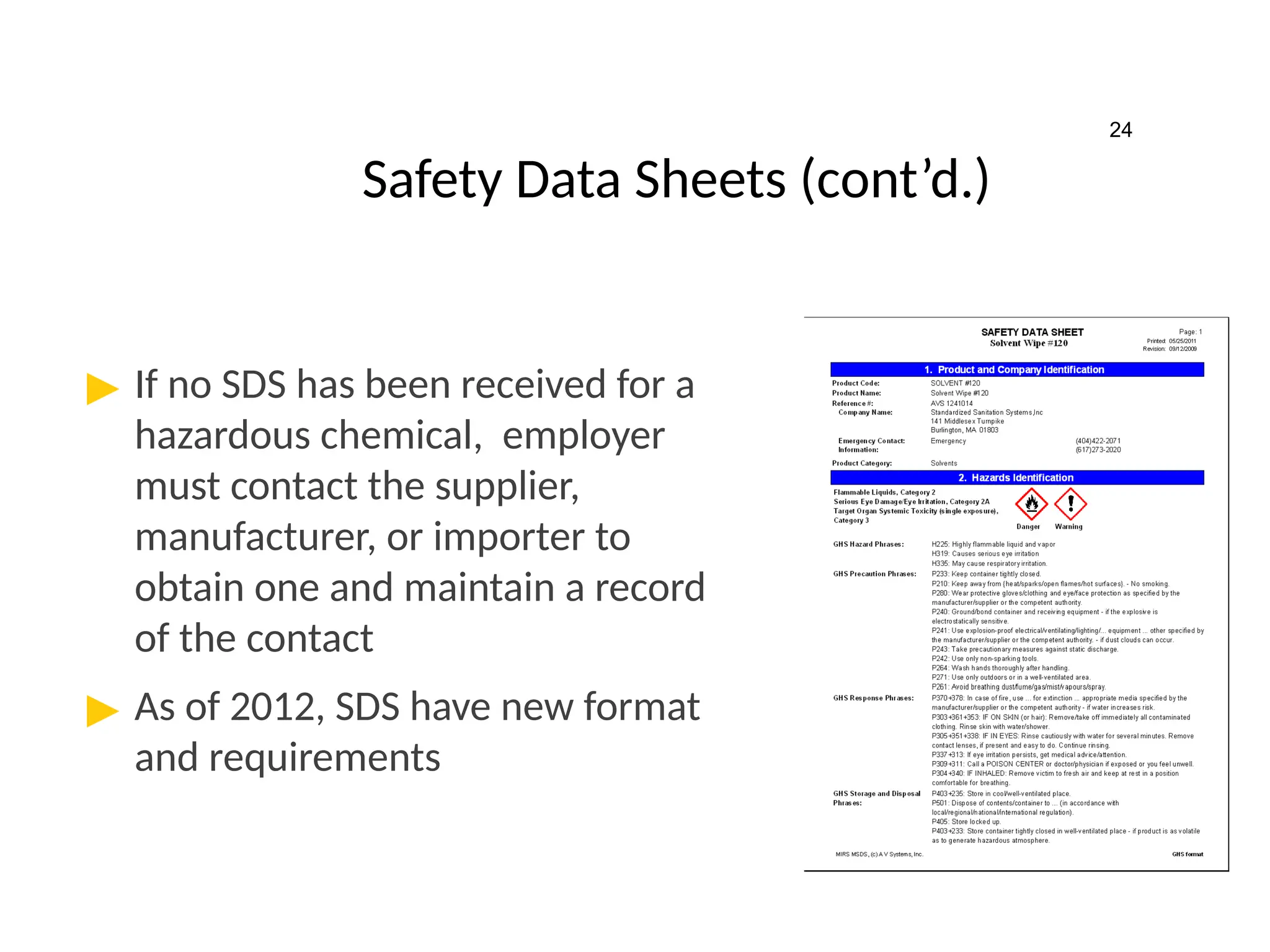
▶ If no SDS has been received for a
hazardous chemical, employer
must contact the supplier,
manufacturer, or importer to
obtain one and maintain a record
of the contact
▶ As of 2012, SDS have new format
and requirements
24
Safety Data Sheets ( cont’d)
1. Identification (product, manufacturer, contact)
2. Hazard Identification
3. Ingredients
4. First Aid Measures
5. Fire Fighting Measures
6. Accidental Release Measures
7. Handling and Storage
8. Exposure Controls/Personal Protection
9. Physical and Chemical Properties
10. Stability and Reactivity
11. Toxicological Information
12. Ecological Information (non-mandatory)
13. Disposal Considerations (non-mandatory)
14. Transport Information (non-mandatory)
15. Regulatory Information (non-mandatory)
16. Other Information
25
Summary
▶ OSHA’s Hazard Communication Standard is based on a
simple concept - that employees have both a need and a
right to know the hazards and identities of the chemicals
they are exposed to when working
▶ Employees also need to know what protective measures
are available to prevent adverse effects from occurring.
▶ Reporting injury or incident is protected by law
▶ Disciplinary action against employee for reporting an
injury or incident is in violation of OSH Act
26

Chemical Safety awareness Training program.pptx

  • 1.
  • 2.
    Course Objectives ▶ Provideparticipants with training to ▶ Identify hazards that exist in their workplaces ▶ Identify potential health effects of workplace hazards ▶ Understand ways that chemicals can enter the body ▶ Understand principles of hazard prevention and control ▶ Apply principles of hazard control in the work place ▶ Understand employer responsibilities regarding exposure to hazardous chemicals ▶ Discuss and analyze strategies to create safer workplaces 2
  • 3.
    Introduction ▶ About 32million workers are potentially exposed to one or more chemical hazards1 ▶ There are approximately 650,000 existing chemical products, and hundreds of new ones being introduced annually1 ▶ Chemical exposure may cause or contribute to many serious health effects such as heart ailments, central nervous system damage, kidney and lung damage, sterility, cancer, burns, and rashes ▶ Some chemicals may also be safety hazards and have the potential to cause fires and explosions and other serious accidents 3
  • 4.
    Hazard Identification ▶ Whatare some hazards that can be found in your workplace? ▶ Routes of exposure ▶Inhalation ▶Absorption ▶Ingestion ▶Injection 4
  • 5.
    Hazard Identification (cont.) ▶ Severity of health effects depend on ▶ Duration of exposure ▶ Frequency of exposure ▶ Route of exposure ▶ Personal health ▶ Type of chemical 5
  • 6.
    Types of HealthEffects ▶ May be acute or long-term ▶ Neurologic ▶ Affect the brain, spinal cord, or nerves ▶ Respiratory ▶ Affects lung function ▶ Cardiovascular ▶ Affects movement of nutrients & wastes; body temperature 6
  • 7.
    Types of HealthEffects (cont.) ▶ Immunologic ▶ Affects body’s ability to fight infection ▶ Mutagenic ▶ Cause changes in the genetic code ▶ Teratogenic ▶ Affect developing fetus or embryo ▶ Carcinogenic ▶ Affect rate of cell division 7
  • 8.
    Types of Hazards ▶Biological ▶ Chemical ▶ Ergonomic ▶ Physical ▶ Psychosocial ▶ Safety 8
  • 9.
    Types of Chemicals ▶Flammable ▶ Uses: solvents, adhesives, fuel ▶ Examples: Methanol, acetonitrile, diesel fuel, mineral spirits ▶ Corrosive ▶ Uses: cleaning agents, degreasers, chemical reactants ▶ Examples: Acetic acid, sodium hydroxide, ammonia; phenol ▶ Reactive ▶ Oxidizers ▶ Uses: disinfectants, cleaning agents; chlorine ▶ Examples: nitric acid, hydrogen peroxide 9
  • 10.
    Types of Chemicals(cont.) ▶ Organic peroxides ▶ Uses: Bleaching agents, disinfectants, chemical synthesis reactions ▶ Examples: benzoyl peroxide, methyl ethyl ketone peroxide; hydrogen peroxide ▶ Water reactive ▶ Uses: Additives, neutralizers, chemical synthesis reactions ▶ Examples: sodium metal, sodium borohydride, sodium hydroxide ▶ Air reactive ▶ Uses: Adhesives, coating agents, chemical synthesis reactions ▶ Examples: silane, t-butyl lithium 10
  • 11.
    Types of Chemicals( cont.) ▶ Toxic ▶ Carcinogen ▶ Uses: Solvent, cleaning fluid, degreaser, disinfectant ▶ Examples: benzene, carbon tetrachloride, formaldehyde* ▶ Mutagen: ▶ Uses: Disinfectant, solvent ▶ Examples: bromine, benzene; phenol ▶ Poison: ▶ Uses: Chemical preservative, pigment ▶ Examples: sodium azide, powdered pigments/inks 11
  • 12.
    Types of Chemicals(cont.) ▶ Sensitizer: ▶ Uses: Disinfectants, biocides ▶ Examples: formaldeyde, phenol ▶ Teratogen: ▶ Uses: Electrical equipment, insulation; conductors ▶ Examples: PCBs, mercury ▶ Irritant ▶ Powdered substances ▶ Uses: Filler, casting ▶ Examples: silica 12
  • 13.
    Protective Measures ▶ Substitutea safe(r) chemical, if possible ▶ Use appropriate engineering controls, including ventilation ▶ Wear appropriate personal protective equipment (PPE) when handling hazardous materials ▶ Remove PPE when entering common areas and hallways ▶ Label areas that require PPE ▶ Do not eat, drink, smoke, store food, or apply make up in work areas 13
  • 14.
  • 15.
    How can workplacehazards be minimized? ▶ The first step in minimizing workplace hazards is to perform a thorough hazard assessment ▶ Employers can rely on the evaluations performed by the manufacturers or importers to establish the hazards of the chemicals they use ▶ This information is obtained from SDSs and labels 15
  • 16.
    Employer Responsibilities ▶ Providea workplace free of recognized hazards ▶ Identify and list hazardous chemicals in their workplaces ▶ Implement a written HazCom program ▶ Communicate hazard information to employees ▶ Provide training 16
  • 17.
    Training ▶ Training isrequired for employees who are exposed to hazardous chemicals in their work area: ▶ At the time of initial assignment ▶ Whenever a new hazard is introduced into their work area ▶ Training must be provided in the language that the employee can understand 17 https://www.arlo.co/features/training-company-software
  • 18.
    What training isneeded to protect workers? ▶ Explanation of the HazCom program, including information on labels, SDSs, and how to obtain and use available hazard information ▶ How to detect the presence or release of a hazardous chemical (using monitoring devices, observation, or smell) ▶ Hazards and potential health effects of chemicals ▶ Protective measures such as engineering controls, work practices, and the use of PPE 18
  • 19.
    What information mustbe provided to workers? ▶ Employees must be informed of: ▶ The HazCom standard and its requirements ▶ Operations in their work areas where hazardous chemicals are present ▶ Location and availability of the written hazard evaluation procedures, communications program, lists of hazardous chemicals, and the required SDSs 19
  • 20.
    Purpose of OSHA’sHazard Communication Standard 20 Hazard Communication Program Container Labeling Safety Data Sheet SDS Program Label To ensure that employers and employees know about work hazards and how to protect themselves so that the incidence of illnesses and injuries due to hazardous chemicals is reduced.
  • 21.
    Container Labeling inthe Workplace ▶ Effective 2012, all chemicals must be labeled using the Globally Harmonized System (GHS) ▶ There are 6 elements of a GHS label: 21 Signal Word Manufacturer Information GHS Symbol Precautionary Statement Hazard Statement Product Name https://www.bradyid.com/en-us/applications/ghs-labeling-requirements
  • 22.
    Safety Data Sheets ▶Prepared by the chemical manufacturer or importer ▶ Must describe: ▶ Physical hazards, such as fire and explosion ▶ Health hazards, such as signs of exposure ▶ Routes of exposure ▶ Precautions for safe handling and use ▶ Emergency and first-aid procedures ▶ Control measures 22
  • 23.
    Safety Data Sheets(cont’d) ▶ Must be in English and include information regarding the specific chemical identity and common names ▶ Must provide information about the: ▶ Physical and chemical characteristics ▶ Health effects ▶ Exposure limits ▶ Carcinogenicity (cancer-causing) ▶ Identification (name, address, and telephone number) of the organization responsible for preparing the sheet ▶ Must be readily accessible to employees in their work area 23
  • 24.
    Safety Data Sheets(cont’d.) ▶ If no SDS has been received for a hazardous chemical, employer must contact the supplier, manufacturer, or importer to obtain one and maintain a record of the contact ▶ As of 2012, SDS have new format and requirements 24
  • 25.
    Safety Data Sheets( cont’d) 1. Identification (product, manufacturer, contact) 2. Hazard Identification 3. Ingredients 4. First Aid Measures 5. Fire Fighting Measures 6. Accidental Release Measures 7. Handling and Storage 8. Exposure Controls/Personal Protection 9. Physical and Chemical Properties 10. Stability and Reactivity 11. Toxicological Information 12. Ecological Information (non-mandatory) 13. Disposal Considerations (non-mandatory) 14. Transport Information (non-mandatory) 15. Regulatory Information (non-mandatory) 16. Other Information 25
  • 26.
    Summary ▶ OSHA’s HazardCommunication Standard is based on a simple concept - that employees have both a need and a right to know the hazards and identities of the chemicals they are exposed to when working ▶ Employees also need to know what protective measures are available to prevent adverse effects from occurring. ▶ Reporting injury or incident is protected by law ▶ Disciplinary action against employee for reporting an injury or incident is in violation of OSH Act 26

Editor's Notes

  • #1 The photo in this slide depicts unsafe chemical storage. Visible issues include: -Different types of chemicals stored together -Containers that are unlabeled or have labels worn off -Damaged or rusted containers -Visible mist suggests presence of a leak ----------------------------------------------------------------------------------------- This PowerPoint is designed to focus on chemical safety and hazards identification. It briefly covers the hierarchy of hazard controls and OSHA’s Right to Know law. The main goal of this training initiative is to create safer work practices and a safer work environment in order to prevent workplace illnesses and injuries.
  • #3 1 OSHA 3084; Chemical Hazard Communication. https://www.osha.gov/Publications/osha3084.html Revised in 1998. We expect both the number of workers and the number of chemicals has increased since then. This is one of the most frequently cited OSHA standards. This program is intended for workplaces that do not manufacture, import, or distribute hazardous chemicals. Notes have been provided that highlight some of the requirements for these employers. For complete requirements, consult 29 CFR 1910.1200.
  • #6 Neurologic symptoms can include: muscle weakness, partial or complete loss of sensation, partial or complete paralysis, seizures, loss of cognitive abilities, unexplained pain decreased alertness Respiratory symptoms can include: sore throat coughing/wheezing shortness of breath decreased lung capacity/decreased lung function suffocation/asphyxiation lung cancer Respiratory symptoms can include: heart failure inability of blood to carry oxygen throughout the body
  • #7 Immunologic symptoms can include: allergy immune system slow down or failure autoimmune disorders (body attacks itself) Mutagens can cause a permanent change to the DNA, which may harm cells and cause certain diseases (such as cancer). Mutations can be passed down to offspring Teratogens can affect the development of an embryo or fetus, which may cause birth defects Carcinogens can affect the DNA directly (similar to mutagens), but can also cause cells to divide at a faster rate, which could increase the likelihood of cell division error, which could result in changes to the DNA code (mutation)
  • #8 biological - bacteria, viruses, insects, plants, birds, animals, and humans, etc., chemical - depends on the physical, chemical and toxic properties of the chemical, ergonomic - repetitive movements, improper set up of workstation, etc., physical - radiation, magnetic fields, pressure extremes (high pressure or vacuum), noise, etc., psychosocial - stress, violence, etc., safety - slipping/tripping hazards, inappropriate machine guarding, equipment malfunctions or breakdowns.
  • #9 Flammable: Material that will burn or ignite, causing fire or combustion. An ignitable chemical has a flashpoint less than 100° F. A combustible material will burn, but require a flame or elevated temperature plus a spark to start them; and has a flashpoint greater than 100° F but less than 200° F. Corrosive: Chemical that causes visible destruction of, or irreversible alterations in, living tissue by chemical action at the site of contact.pH < 2 and pH > 12.5 Reactive: Material that reacts violently or explodes under either ambient conditions or when in contact with air, water, or other chemicals. Oxidizers: materials that react strongly with organic materials, sometimes strongly enough to start fires
  • #10 Organic Peroxides: form friction and shock-sensitive explosives Water Reactive: react violently with water Air Reactive (pyrophoric): react violently with air
  • #11 Toxic: Material that may cause harm to an individual if it enters the body. Carcinogen: a substance or agent that may cause cancer *IARC classifies formaldehyde as a human carcinogen; EPA classifies it as a probable human carcinogen Mutagen: An agent that can induce or increase the frequency of mutation in an organism Poison: any substance that can impair function, cause structural damage, or otherwise injure the body
  • #12 Sensitizer: a substance that causes hypersensitivity or reactivity to an antigen, such as pollen, especially by a second or repeated exposure. Teratogen: An agent that causes malformation of an embryo or fetus. Irritant: Material that can cause harm to an individual in the following ways: Irritant: a substance that can irritate the skin or eyes Skin Sensitizer: a substance which can cause an allergic response following skin contact Acute Toxicity (harmful): a substance that may be fatal or cause organ damage from a single short-term exposure
  • #14 Eliminating the hazard is the most effective method of controlling hazards. Next best is substituting the hazard for a non- or less hazardous chemical or process. However, for existing operations, elimination and substitution may be the most difficult to implement, as major changes may be needed to remove the hazardous substance or process. Engineering controls are designed to remove the hazard at the source, before it comes in contact with the worker. This is preferable to administrative controls or personal protective equipment (PPE) because it is not dependent on human action or behavior. The initial cost of engineering controls can be higher than the cost of administrative controls or PPE, but may lower operating costs in the long term. Administrative Controls are aimed at changing the human element of the work process or schedule. For example, limiting an employee’s time in an area of exposure, rotating shifts, etc. PPE is safety equipment worn by the employees to protect them from the hazard(s) they come into contact with. Administrative controls and PPE rely heavily on the employees for implementation. Administrative controls and PPE have been demonstrated to be less effective than other measures. They may be relatively inexpensive to establish (particularly when compared to the up-front cost of an engineering control) but, over the long term, can be very costly to sustain (eg, continuously purchasing PPE).
  • #15 Chemical manufacturers and importers must review scientific evidence on the hazards of chemicals they produce or import and report findings to their employees and to employers who distribute or use their products.
  • #16 It is the employer’s responsibility to obtain Safety Data Sheets (SDSs) and labels for each hazardous chemical if they are not provided by the manufacturer, importer, or distributor Written HazCom program includes labels, SDSs, and employee training Communicate hazard information to employees through labels, SDSs, and formal training programs. Employees should know where to find information on hazards, and it should be accessible to them.
  • #17 1910.1200(h) Training is not satisfied solely by giving the employee the data sheets to read. An employer's training program is to be a forum for explaining to employees not only the hazards of the chemicals in their work area, but also how to use the information generated in the hazard communication program. This can be accomplished in many ways (audiovisuals, classroom instruction, interactive video), and should include an opportunity for employees to ask questions to ensure that they understand the information presented to them. Training must be carried out in a language that is comprehensible to the employees. Training need not be conducted on each specific chemical found in the workplace, but may be conducted by categories of hazard (e.g., carcinogens, sensitizers, acutely toxic agents, irritants, flammables) that are or may be encountered by an employee during the course of his duties. Employees who have been previously trained by another employer, union, or other entity, do not have to be retrained if the previous training is sufficient to meet the standard’s training requirements for the current work being performed. However, employees must have information about where to find SDSs in the workplace, who in the company is responsible for the HazCom program, and where to get copies.
  • #20 29 CFR 1910.1200 The Hazard Communication (HazCom) standard establishes uniform requirements to make sure that the hazards of all chemicals imported into, produced, or used in U.S. workplaces are evaluated, and that this hazard information is transmitted to affected employers and exposed employees. The HazCom standard is different from other OSHA health rules because it covers all hazardous chemicals. The rule also incorporates a “downstream flow of information,” which means that producers of chemicals have the primary responsibility for generating and disseminating information, whereas users of chemicals must obtain the information and transmit it to their employees.
  • #21 1910.1200(f) Chemical manufacturers and importers must convey the hazard information to downstream employers by means of labels on containers and Safety Data Sheets (SDSs) Chemical manufacturers, importers, and distributors must be sure that containers of hazardous chemicals leaving the workplace are labeled, tagged, or marked with the appropriate information. Consumer products having labels meeting requirements of the Consumer Product Safety Act do not have to have additional labeling under the HazCom Standard. Various other chemical products (for example, pesticides, foods, drugs, cosmetics, beverage alcohols) that are subject to labeling laws administered by other Federal agencies are also exempt from the labeling requirements of the HazCom Standard. 1- Signal Word – The signal word indicates hazard level. "Danger" is used for the most severe instances, while "Warning" is less severe. 2- GHS Symbol (Pictogram)- These pictograms are used to identify hazardous products and are commonly grouped by chemical/physical risk, health risk and environmental risk 3- Manufacturer Information- This identifies the manufacturer's company name, address and telephone number. 4- Precautionary Statements/First Aid- These are phrases that are tied to each hazard statement. They describe general preventative, response, storage, or disposal precautions. These statements are found on the chemical's Safety Data Sheet. Similar to Hazard Statements, Precautionary Statements can be identified by a P-Code (like P100). 5- Hazard Statements- These are phrases that describe the nature of hazardous products and the degree of hazard. Hazard statements are on the chemical's Safety Data Sheet (SDS) and identified by an H-Code (like H100). 6- Product Name or Identifiers- This identifies the product or chemical name. Additional identifiers can be noted to the right of the Manufacturer's information (#1).
  • #22 1910.1200(g) Chemical manufacturers and importers must develop an SDS for each hazardous chemical they produce or import, and must provide the SDS at the time of the initial shipment to a downstream distributor or user. Distributors also must ensure that downstream employers are similarly provided an SDS. Employers who become newly aware of “any significant information” regarding the hazards of a chemical must revise the labels for the chemical within six months of becoming aware of the new information and labels on containers of hazardous chemicals after that time must contain the new information. OSHA does not require that SDSs be provided to purchasers of household consumer products (such as "windex" and "white‑out“) when the products are used in the workplace in the same manner that a consumer would use them, i.e.; where the duration and frequency of use (and therefore exposure) is not greater than what the typical consumer would experience. Employees who are required to work with hazardous chemicals in a greater duration and frequency of exposure than a normal consumer have a right to know about the properties of those hazardous chemicals.
  • #23 In the absence of other employee exposure records, SDSs that indicate a health hazard are considered employee exposure records under the Access to Employee Medical Records standard, 29 CFR 1910.1020 and must be preserved and maintained for at least thirty years, with some exceptions. [See 29 CFR 1910.1020(d)] Electronic access is acceptable provided: - A back-up procedure is available if the electronic system fails - It can be accessed in the employee’s work area The telephone number provided must be that of a person who can provide additional information about the hazardous chemical and appropriate emergency procedures.
  • #25 Section 1, Identification includes product identifier; manufacturer or distributor name, address, phone number; emergency phone number; recommended use; restrictions on use. Section 2, Hazard(s) identification includes all hazards regarding the chemical; required label elements. Section 3, Composition/information on ingredients includes information on chemical ingredients; trade secret claims. Section 4, First-aid measures includes important symptoms/effects, acute, delayed; required treatment. Section 5, Fire-fighting measures lists suitable extinguishing techniques, equipment; chemical hazards from fire. Section 6, Accidental release measures lists emergency procedures; protective equipment; proper methods of containment and cleanup. Section 7, Handling and storage lists precautions for safe handling and storage, including incompatibilities. Section 8, Exposure controls/personal protection lists OSHA’s Permissible Exposure Limits (PELs); ACGIH Threshold Limit Values (TLVs); and any other exposure limit used or recommended by the chemical manufacturer, importer, or employer preparing the SDS where available as well as appropriate engineering controls; personal protective equipment (PPE). Section 9, Physical and chemical properties lists the chemical's characteristics. Section 10, Stability and reactivity lists chemical stability and possibility of hazardous reactions. Section 11, Toxicological information includes routes of exposure; related symptoms, acute and chronic effects; numerical measures of toxicity. Section 12, Ecological information* Section 13, Disposal considerations* Section 14, Transport information* Section 15, Regulatory information* Section 16, Other information, includes the date of preparation or last revision. *Note: Since other Agencies regulate this information, OSHA will not be enforcing Sections 12 through 15 (29 CFR 1910.1200(g)(2)). Employers must ensure that SDSs are readily accessible to employees.
  • #26 See www.osha.gov for more information on hazard communication, including the following publications: Hazard Communication Guidelines for Compliance – OSHA 3111 (This is the same information that is contained in Appendix E to 1910.1200 and is also available in Spanish.) Chemical Hazard Communication – OSHA 3084 (This is also available in Spanish.)