Control of Substances
Hazardous to Health
HSE in the Oil and Gas
Learning Objectives
What is COSHH?
Why COSHH Matters!
The Eight Steps towards COSHH Compliance
• Step 1 – Assessment of the risk
• Step 2 - What precautions are needed?
• Step 3 - Adequately control the exposure
• Step 4 - Ensure the control measures are used
• Step 5 – Monitor exposure
• Step 6 - Conduct health surveillance checks
• Step 7 – Plan for incidents and accidents
• Step 8 – Provide information, instructions and
training.
What is COSHH?
Control of Substances Hazardous to Health
Good working practice expects oil and gas companies to
• Identify the hazards
• Assess the risks, and
• Prevent (or adequately control) staff exposure to
substances hazardous to their health associated with
their work activities.
Why COSHH Matters
Uncontrolled exposure to hazardous substances in the workplace
can cause long-term ill health and even death
Cancer
Asthma
Dermatitis
Birth Defects
Chronic Obstructive Pulmonary Disease (COPD).
Why COSHH Matters
Why COSHH matters to employers
• Protection of staff from Hazardous Substances
• Provision of healthy and safe working environments
• Maintenance of high staff attendance rates
• Avoidance of prohibition or prosecution (Laws of the Land)
• Avoidance of civil claims as a result of work-related ill-health
Why COSHH matters to you and me
• Knowledge of the Hazardous Substances we may be exposed to
at work
• Training in the appropriate control measures to implement
• Maintaining these controls to keep us safe.
Understanding the term “Substances”?
A Chemical, or mixture of Chemicals making a Substance Or, a mixture of
substances
Everyday products – Solvents – Cleaning Products - Oils
Solids: e.g. Beryllium Copper – Stone (silica)
Biological Agents: e.g. bacteria (legionella)
Any Dust: e.g. Flour - Hard Wood - asbestos
Fumes, Mists and Vapours: e.g. Welding - Soldering – Process by-products.
Identifying Hazardous Substances?
Labelling of hazardous substances
Name of Product
Hazard Symbol - Indication of Danger
Supplier provided details - MSDS
Risk and Safety Phrases
Don’t assume the label is correct
• The label may have fallen off
• The substance may have been transferred
• The substance may be safe until processed.
Substance Labelling and Definition
Toxic /
Very Toxic
Can cause death, acute or chronic
damage to health when inhaled,
swallowed or absorbed via the skin
Harmful
Irritant
Can cause acute or chronic damage to
health when inhaled, swallowed or
absorbed via the skin.
May cause inflammation of the skin or
mucous membrane
Corrosive Substances and Preparations which, may
on contact with living tissues destroy them
Extremely /
Highly
Flammable
Substances which may become hot and
catch fire in contact with air
Liquids or substances having a Low Flash
Point
Substance Labelling and Definition
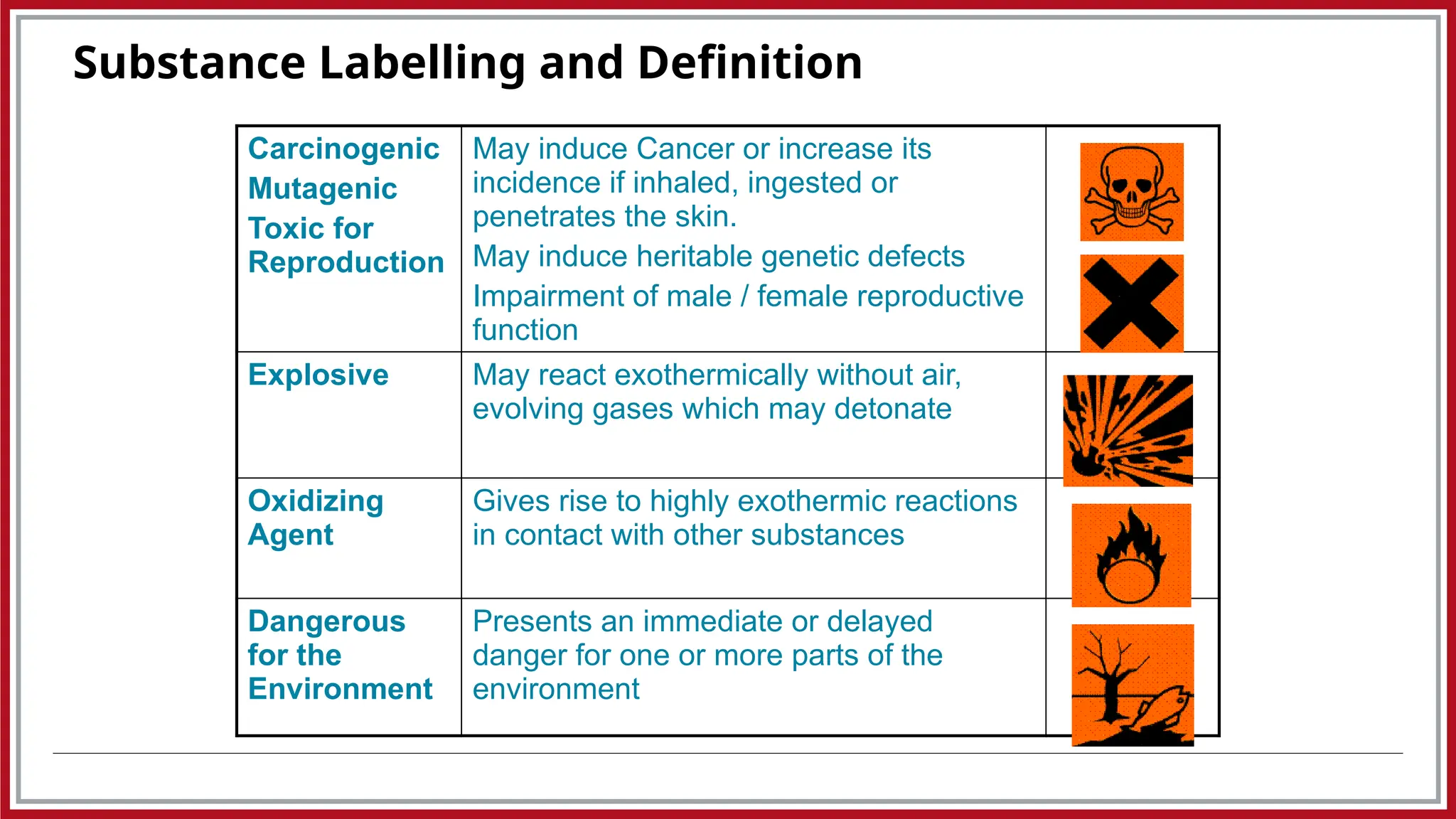
Carcinogenic
Mutagenic
Toxic for
Reproduction
May induce Cancer or increase its
incidence if inhaled, ingested or
penetrates the skin.
May induce heritable genetic defects
Impairment of male / female reproductive
function
Explosive May react exothermically without air,
evolving gases which may detonate
Oxidizing
Agent
Gives rise to highly exothermic reactions
in contact with other substances
Dangerous
for the
Environment
Presents an immediate or delayed
danger for one or more parts of the
environment
New International Symbols
Routes of Entry to the Body
Inhalation - via dust, fume, vapour or gases
Ingestion – via eating with contaminated hands
Absorption - through skin / eyes
Injection - via high pressure gas & liquid, puncture wound for solids to gain entry.
Health Effects
- Short term
- Skin/ eye/ breathing irritation
- Headaches
- Dizziness
- Nausea
- Unconsciousness
- Potential for Death
- Long term
- Cancer
- Lung disease
- Vital organ dysfunction
- Skin disease
- Sensitisation
- Death
8 Steps to COSHH Compliance
Step 1 – Assessment of the risk
Step 2 - What precautions are needed?
Step 3 - Adequately control the exposure
Step 4 - Ensure the control measures are used
Step 5 - Monitor exposure
Step 6 - Conduct health surveillance checks
Step 7 – Plan for incidents and accidents
Step 8 - Provide information, instructions and training.
STEP 1 – Assessment of the Risk
Is there a problem with substances in my workplace?
Identify all of the Substances used
What are the risks these Substances present to staff?
• How much of the substance is used?
• How is the substance used?
• Who could be exposed and how often?
• How could these substances enter the body?
Who should perform the assessment?
• Those that understand the COSHH Risk Assessment process
• Those that can find the necessary information
• Those having knowledge of when and how much substance is used or produced.
STEP 1 – Assessment of the Risk
Is there a need for a NEW substances in my workplace?
Identify any new Substance required
Request a MSDS from the Supplier
Perform a Risk Assessment
Discuss Hazards and Control Measures
If too hazardous – Is there an alternative?
Agree Control Measures
Purchase through normal channels
Inform staff – train in Use and Control Measures.
Significant risk is identified
Decide on action to take to eliminate or reduce risk as low as reasonably
practicable (ALARP) by
First of all using the COSHH Risk Assessment form
Use the Material Safety Data Sheet for detailed information on the substance
Identify how the substance can enter the body
STEP 2 – What Precautions are Needed
COSHH Compliance –
Step 2 - Material Safety Data Sheet - MSDS
Contains the following information
• 1: Identification of the substance/preparation
• 2: Composition/information on ingredients
• 3: Hazard identification
• 4: First aid measures
• 5: Fire-fighting measures
• 6: Accidental release measures
• 7: Handling and storage
• 8: Exposure controls/personal protection
• 9: Physical and chemical properties
• 10: Stability and reactivity
• 11: Toxicological information
• 12: Ecological information
• 13: Disposal considerations
• 14: Transport information
• 15: Regulatory information
• 16: Other information
Examples of some “Risk and Safety Phrases”
Risk Phrases
Total of 123 – some examples are:
R1 – Explosive when dry
R14 – Reacts violently with water
R23 – Toxic by inhalation
R25 – Toxic if swallowed
R35 – Causes severe burns
R38 – Irritating to skin
R 45 – May cause cancer
R54 – Toxic to flora
R60 – May impair fertility
R68 – Possible risk of irreversible effects
Safety Phrases
Total of 74 – some examples are:
S1 – Keep locked up
S3 – Keep Cool
S8 – Keep container dry
S13 – Keep away from food and drink
S15 – Keep away from heat
S21 – When using do not smoke
S22 – Do not breathe dust
S24 – Avoid contact with skin
S25 – Avoid contact with eyes
S29 – Do not empty into drains
S37 – Wear suitable gloves
Workplace Exposure Limits - WELs
WELs are set in order to help protect the health of staff
WELs are concentrations of hazardous substances in the air
They are measured
• Long Term – 8 Hours
• Short Term – 15 minutes
Control of Workplace Exposure Limits (WELs)?
• Adequately Control Exposure
• Workplace Air Monitoring
• Staff must co-operate with monitoring sampling strategies.
COSHH Compliance
Step 3 - Adequately Control Exposure
Elimination
Substitution
Total or partial enclosure
Local exhaust ventilation
Dilution ventilation
Reduction in employees exposed
Reduced time exposure
Housekeeping
Personal protective equipment –
Is suitable and sufficient.
Easy to implement
But
Least Effective in
Control
High Degree of
Difficulty
But
Most Effective Control
COSHH Compliance
Step 3 Adequately Control Exposure
Personal Protective Equipment
The last choice for controlling risks
Expro will provide the appropriate PPE to the identified risks
Must be suitable for the hazard
Must be suitable for the user
It must be stored in a well defined place
Expro must ensure that staff are trained in the use of PPE
Staff must use the PPE provided in accordance with instructions
Staff must report any loss or defective PPE.
COSHH Compliance –
Step 4 – Ensure the Control Measures are Used
Using the Exposure Control Measures
• Staff must receive appropriate Information and training for the selected Control
Measures
• Appropriate supervision for the task
• Staff must make proper use of control measures
• Reporting of defects with Control Measures (torn PPE etc.)
Maintaining the Exposure Control Measures
• Management must ensure that exposure controls are maintained
• Local Exhaust Ventilation inspected and tested on a regular basis
• Respiratory Protective Equipment inspected / tested and maintained at appropriate
intervals.
COSHH Compliance –
Step 5 - Monitor Exposure
Air Monitoring measures the concentration of Hazardous Substances
which may be inhaled by staff and is used to determine the
adequacy of the Control Measures in maintaining levels below the
WEL
Air Monitoring can be performed by trained staff, or
Specialist Air Monitoring Companies – Official Reports.
COSHH Compliance –
Step 6 - Conduct Health Surveillance Checks
Health Surveillance can be provided by Occupational Health Services
Medical Surveillance must be carried out where employees are
exposed to a substance linked to a particular disease and a valid
method of detection is available
Health Checks (eg Checking Operators hands for Industrial
dermatitis) could be performed by trained supervisors
Simple records of health surveillance must be kept for 40 years.
COSHH Compliance –
Step 7 - Plan for Incidents and Accidents
If you work with Hazardous Substances, the business must have an Incident – Accident -
Emergency Plan and Prepare emergency response procedures
Set up warning and communication systems
Links with Emergency Services as appropriate
Perform “ER Drills” regularly to practice the procedure.
COSHH Compliance –
Step 8 – Provide Information, Instructions and
Training
All staff must be supplied with suitable and sufficient
• Information
• Instruction
• Training
Which includes
• Names of all substances used and their risks
• Access to Material Safety Data Sheets (MSDS)
• Knowledge of the main findings from the Risk Assessment
• Control measures to take to protect themselves
• How to use PPE and RPE
• Results of any Exposure Monitoring
• Understanding of Emergency Procedures as appropriate.
Location, Date

Oil and gas safety and COSHH Training.pptx

  • 1.
    Control of Substances Hazardousto Health HSE in the Oil and Gas
  • 2.
    Learning Objectives What isCOSHH? Why COSHH Matters! The Eight Steps towards COSHH Compliance • Step 1 – Assessment of the risk • Step 2 - What precautions are needed? • Step 3 - Adequately control the exposure • Step 4 - Ensure the control measures are used • Step 5 – Monitor exposure • Step 6 - Conduct health surveillance checks • Step 7 – Plan for incidents and accidents • Step 8 – Provide information, instructions and training.
  • 3.
    What is COSHH? Controlof Substances Hazardous to Health Good working practice expects oil and gas companies to • Identify the hazards • Assess the risks, and • Prevent (or adequately control) staff exposure to substances hazardous to their health associated with their work activities.
  • 4.
    Why COSHH Matters Uncontrolledexposure to hazardous substances in the workplace can cause long-term ill health and even death Cancer Asthma Dermatitis Birth Defects Chronic Obstructive Pulmonary Disease (COPD).
  • 5.
    Why COSHH Matters WhyCOSHH matters to employers • Protection of staff from Hazardous Substances • Provision of healthy and safe working environments • Maintenance of high staff attendance rates • Avoidance of prohibition or prosecution (Laws of the Land) • Avoidance of civil claims as a result of work-related ill-health Why COSHH matters to you and me • Knowledge of the Hazardous Substances we may be exposed to at work • Training in the appropriate control measures to implement • Maintaining these controls to keep us safe.
  • 6.
    Understanding the term“Substances”? A Chemical, or mixture of Chemicals making a Substance Or, a mixture of substances Everyday products – Solvents – Cleaning Products - Oils Solids: e.g. Beryllium Copper – Stone (silica) Biological Agents: e.g. bacteria (legionella) Any Dust: e.g. Flour - Hard Wood - asbestos Fumes, Mists and Vapours: e.g. Welding - Soldering – Process by-products.
  • 7.
    Identifying Hazardous Substances? Labellingof hazardous substances Name of Product Hazard Symbol - Indication of Danger Supplier provided details - MSDS Risk and Safety Phrases Don’t assume the label is correct • The label may have fallen off • The substance may have been transferred • The substance may be safe until processed.
  • 8.
    Substance Labelling andDefinition Toxic / Very Toxic Can cause death, acute or chronic damage to health when inhaled, swallowed or absorbed via the skin Harmful Irritant Can cause acute or chronic damage to health when inhaled, swallowed or absorbed via the skin. May cause inflammation of the skin or mucous membrane Corrosive Substances and Preparations which, may on contact with living tissues destroy them Extremely / Highly Flammable Substances which may become hot and catch fire in contact with air Liquids or substances having a Low Flash Point
  • 9.
    Substance Labelling andDefinition Carcinogenic Mutagenic Toxic for Reproduction May induce Cancer or increase its incidence if inhaled, ingested or penetrates the skin. May induce heritable genetic defects Impairment of male / female reproductive function Explosive May react exothermically without air, evolving gases which may detonate Oxidizing Agent Gives rise to highly exothermic reactions in contact with other substances Dangerous for the Environment Presents an immediate or delayed danger for one or more parts of the environment
  • 10.
  • 11.
    Routes of Entryto the Body Inhalation - via dust, fume, vapour or gases Ingestion – via eating with contaminated hands Absorption - through skin / eyes Injection - via high pressure gas & liquid, puncture wound for solids to gain entry.
  • 12.
    Health Effects - Shortterm - Skin/ eye/ breathing irritation - Headaches - Dizziness - Nausea - Unconsciousness - Potential for Death - Long term - Cancer - Lung disease - Vital organ dysfunction - Skin disease - Sensitisation - Death
  • 13.
    8 Steps toCOSHH Compliance Step 1 – Assessment of the risk Step 2 - What precautions are needed? Step 3 - Adequately control the exposure Step 4 - Ensure the control measures are used Step 5 - Monitor exposure Step 6 - Conduct health surveillance checks Step 7 – Plan for incidents and accidents Step 8 - Provide information, instructions and training.
  • 14.
    STEP 1 –Assessment of the Risk Is there a problem with substances in my workplace? Identify all of the Substances used What are the risks these Substances present to staff? • How much of the substance is used? • How is the substance used? • Who could be exposed and how often? • How could these substances enter the body? Who should perform the assessment? • Those that understand the COSHH Risk Assessment process • Those that can find the necessary information • Those having knowledge of when and how much substance is used or produced.
  • 15.
    STEP 1 –Assessment of the Risk Is there a need for a NEW substances in my workplace? Identify any new Substance required Request a MSDS from the Supplier Perform a Risk Assessment Discuss Hazards and Control Measures If too hazardous – Is there an alternative? Agree Control Measures Purchase through normal channels Inform staff – train in Use and Control Measures.
  • 16.
    Significant risk isidentified Decide on action to take to eliminate or reduce risk as low as reasonably practicable (ALARP) by First of all using the COSHH Risk Assessment form Use the Material Safety Data Sheet for detailed information on the substance Identify how the substance can enter the body STEP 2 – What Precautions are Needed
  • 17.
    COSHH Compliance – Step2 - Material Safety Data Sheet - MSDS Contains the following information • 1: Identification of the substance/preparation • 2: Composition/information on ingredients • 3: Hazard identification • 4: First aid measures • 5: Fire-fighting measures • 6: Accidental release measures • 7: Handling and storage • 8: Exposure controls/personal protection • 9: Physical and chemical properties • 10: Stability and reactivity • 11: Toxicological information • 12: Ecological information • 13: Disposal considerations • 14: Transport information • 15: Regulatory information • 16: Other information
  • 18.
    Examples of some“Risk and Safety Phrases” Risk Phrases Total of 123 – some examples are: R1 – Explosive when dry R14 – Reacts violently with water R23 – Toxic by inhalation R25 – Toxic if swallowed R35 – Causes severe burns R38 – Irritating to skin R 45 – May cause cancer R54 – Toxic to flora R60 – May impair fertility R68 – Possible risk of irreversible effects Safety Phrases Total of 74 – some examples are: S1 – Keep locked up S3 – Keep Cool S8 – Keep container dry S13 – Keep away from food and drink S15 – Keep away from heat S21 – When using do not smoke S22 – Do not breathe dust S24 – Avoid contact with skin S25 – Avoid contact with eyes S29 – Do not empty into drains S37 – Wear suitable gloves
  • 19.
    Workplace Exposure Limits- WELs WELs are set in order to help protect the health of staff WELs are concentrations of hazardous substances in the air They are measured • Long Term – 8 Hours • Short Term – 15 minutes Control of Workplace Exposure Limits (WELs)? • Adequately Control Exposure • Workplace Air Monitoring • Staff must co-operate with monitoring sampling strategies.
  • 20.
    COSHH Compliance Step 3- Adequately Control Exposure Elimination Substitution Total or partial enclosure Local exhaust ventilation Dilution ventilation Reduction in employees exposed Reduced time exposure Housekeeping Personal protective equipment – Is suitable and sufficient. Easy to implement But Least Effective in Control High Degree of Difficulty But Most Effective Control
  • 21.
    COSHH Compliance Step 3Adequately Control Exposure
  • 22.
    Personal Protective Equipment Thelast choice for controlling risks Expro will provide the appropriate PPE to the identified risks Must be suitable for the hazard Must be suitable for the user It must be stored in a well defined place Expro must ensure that staff are trained in the use of PPE Staff must use the PPE provided in accordance with instructions Staff must report any loss or defective PPE.
  • 23.
    COSHH Compliance – Step4 – Ensure the Control Measures are Used Using the Exposure Control Measures • Staff must receive appropriate Information and training for the selected Control Measures • Appropriate supervision for the task • Staff must make proper use of control measures • Reporting of defects with Control Measures (torn PPE etc.) Maintaining the Exposure Control Measures • Management must ensure that exposure controls are maintained • Local Exhaust Ventilation inspected and tested on a regular basis • Respiratory Protective Equipment inspected / tested and maintained at appropriate intervals.
  • 24.
    COSHH Compliance – Step5 - Monitor Exposure Air Monitoring measures the concentration of Hazardous Substances which may be inhaled by staff and is used to determine the adequacy of the Control Measures in maintaining levels below the WEL Air Monitoring can be performed by trained staff, or Specialist Air Monitoring Companies – Official Reports.
  • 25.
    COSHH Compliance – Step6 - Conduct Health Surveillance Checks Health Surveillance can be provided by Occupational Health Services Medical Surveillance must be carried out where employees are exposed to a substance linked to a particular disease and a valid method of detection is available Health Checks (eg Checking Operators hands for Industrial dermatitis) could be performed by trained supervisors Simple records of health surveillance must be kept for 40 years.
  • 26.
    COSHH Compliance – Step7 - Plan for Incidents and Accidents If you work with Hazardous Substances, the business must have an Incident – Accident - Emergency Plan and Prepare emergency response procedures Set up warning and communication systems Links with Emergency Services as appropriate Perform “ER Drills” regularly to practice the procedure.
  • 27.
    COSHH Compliance – Step8 – Provide Information, Instructions and Training All staff must be supplied with suitable and sufficient • Information • Instruction • Training Which includes • Names of all substances used and their risks • Access to Material Safety Data Sheets (MSDS) • Knowledge of the main findings from the Risk Assessment • Control measures to take to protect themselves • How to use PPE and RPE • Results of any Exposure Monitoring • Understanding of Emergency Procedures as appropriate.
  • 28.

Editor's Notes

  • #3 To make the COSHH Process work we must have commitment and ownership from all involved. Do not forget about any specific the “Law of the Land” and include a statement referencing local legal requirement as you see appropriate. COSHH is the application of “Good Working Practice” for the control of risks to staff, let us follow “Good Working Practice”. Substances hazardous to health covers chemicals, products containing chemicals, fumes, dusts, vapours, mists, gases and biological agents. These can be the generated from use of a substance or from a process generated activity
  • #4  Some Hazardous substances can cause major heath problems. There are substances that are classified as Carcinogens, Mutagens, Respiratory Sensitizers. COPD affects the lungs and airways making it very difficult to breathe most commonly caused by smoking, but uncontrolled exposure to certain dusts and fumes can result in COPD
  • #5 Simple slide – discuss the points indicated under each section with the trainees
  • #6 When trying to identify “Hazardous Substances” it is important to open your mind as to what makes a substance. It is not just a Tin of Paint or an aerosol of solvent cleaner. - Does that Heated water carry Legionella? - Does that metal I am going to machine contain Chromium 6? - Why do we need controls for Beryllium Alloys? - What's wrong with Solder Fumes?
  • #7 We will be looking into:- “Symbols” “Material Safety Data Sheets (MSDS)” together with “Risk and Safety Phrases” in some depth during the next few slides.
  • #8 We are looking at 3 columns:- “Classification” (Toxic - Harmful – Irritant etc.) “Meaning” (A brief definition or description of the Classification) “Symbol” (Pictogram to aid those who might have learning difficulties) A picture says a 1000 words!
  • #10 The majority of the new international symbols still contain familiar pictograms however there are also some new ones. Starting from top row left to right: - Toxic; Health Hazard – This is a new symbol that refers to less serious health hazards such as skin irritancy / sensitisation and replaces the old harmful / irritant symbol; Corrosive; Flammable; Explosive; Bottom row left to right: - Oxidising; Dangerous to the environment; Contains gas under pressure – this is a new symbol that is applied to containers that hold gas under pressure. Respiratory Hazard – this is a new symbol that represents serious long term health hazards such as cancer and respiratory sensitisation.
  • #11 We have looked at “Substances” Now we look at the “Routes of Entry into the Body” Inhalation – This the most common route of exposure to hazardous substances in the form of dust, fume, vapour or gas with the substance entering the lungs causing damage to the lungs or entering the blood stream then damaging target organs or the central nervous system. Injection – This can happen through eating, drinking or smoking with hands contaminated with the hazardous substance. It can also occur through accidental injection such as chemicals stored in inappropriate containers such as water bottles. - Ensure that you stress the importance of washing hands before eating, drinking or smoking. Eating snacks at the workplace is inviting substances to be ingested. Absorption – Skin or eye contact with certain substances can result in harm as the substance can be absorbed through the skin or eye. If the skin is broken or damaged this will allow the body to absorb substances that may not normally penetrate the skin. Repeated contact with certain substances can have long term health affects such as dermatitis or cancer. Injection – Substances can be injected into the body if they come in contact with fluid or gas under pressure such as holding a hose with a pin hole leak. Accidental needle stick injuries can also introduce hazardous substances into the body via injection.
  • #12 It is very important to identify the “Short Term” (Acute) Health Effects. To continue experiencing Short Term effects, you are “accepting” a poor working environment. Continuing Short Term Effects may eventually lead to a “LONG TERM CONDITION”. With some Hazardous Substances you may be exposed to “LONG TERM (Chronic) HEALTH EFFECTS” without experiencing any short term effects.
  • #13 Re-enforce the steps and explain that each one will be covered in more depth as we work through the course.
  • #14 The previous slides should have given the trainees a good basic grounding to “Substances” and their “Route of Entry” We now move onto the 8 Steps for COSHH Compliance – Or how we should develop “Best Practice” to avoid the consequences of Hazardous Substances. It is critically important that staff ask the question Is there a problem with substances in my workplace? To answer this question, staff must:- List ALL Substances + How it is used + How much is used + Who is Exposed to the substance Then request the support of your HSE Department The HSE Department is there to provide help and support, use them. Find out what Substances can potentially do to you.
  • #15 This additional slide deals with the process for “Bringing a NEW Substance into the workplace”. MSDS will be explained later. This is just a step by step GENERIC guide, the process might change slightly from Region to Region, Business Unit to Business Unit.
  • #16 We now move onto STEP 2 - What precautions are needed? It is important to inform Trainees that Steps 2 to 8 are all performed by Staff who are competent to perform the COSHH Process, but with assistance from those using the substances. Please repeat that the essence of this training is to take staff through the “COSHH Management Process” so that everyone is made aware of the system and how it works. This slide takes the trainee through the “Information Gathering Stage” in readiness to perform the Risk Assessment
  • #17 Lets look at “Material Safety Data Sheets” (MSDS) These documents are written by the Manufacturer / Distributor of the Substance and supplied with the substance generally when delivered. Most Companies now have all of their MSDS available via their website There are 16 Sections to a MSDS, as described above, giving sufficient information for Staff to perform a Risk Assessment. Note: - You may wish to have a copy of a typical MSDS to hand out to the class.
  • #19 Workplace Exposure Limits (WEL’s) These will quite likely vary from country to country What are Exposure Limits ? - They are concentrations of Hazardous Substances in the air - That exposure to staff should always be below the WEL value WEL Values are measured by Air Monitoring
  • #20  STEP 3 the “Hierarchy of Control Measures” The ARROW says it all:– - If we can Eliminate the Substance our problem goes away - PPE is the last option, and only taken when all other options have been exhausted.
  • #21 Another slide on the requirement to Adequately Control Exposure No 3 Containment = Total or Partial Enclosure No 2 Engineering Control = Local Exhaust Ventilation No 1 General Ventilation = Dilution Ventilation
  • #23 We now move to STEP 4 Ensure the Control Measures are Used The COSHH Risk Assessment has identified the type of Control Measure We must ensure that the “Control Measure” is used by staff exposed to the substance/s. Staff must be given:- - Information - Training - Supervision Also staff using the Control Measure MUST report defects in the operation of the equipment. - Torn PPE - Reduced of air flow within the Local Exhaust Ventilation system. Maintaining the Exposure Control Measures This is a management responsibility, but as stated above staff must proactively report any defects in operation of the Control Measure.
  • #24 We have followed the COSHH Process path from:- Identification of Hazardous Substances Assessing the risk and Workplace Exposure Levels Implementing the Control Measures Now we need to understand how we might monitor the levels of exposure, staff are experiencing of a particular substance. Air Monitoring instruments can be purchased, the setting up of the instrument is relatively simple, they are worn by staff who are using the particular substance for an 8 hour period. The “filters” are sent away for analysis.
  • #27 RPE = Respiratory Protective Equipment