COSHH Awareness
Training
Course
Objectives
By the end of the course, you will be able to:
To understand:
• The requirements of the
COSHH Regulations.
• The importance of labelling
and Safety Data Sheet
information.
• How to comply with the
WHAT
IS
COSHH
?
• COSHH stands for the Control of
Substances Hazardous to Health
Regulations 2002.
• Using hazardous substances could
potentially put people's health at risk.
• COSHH requires employers to
control exposures to hazardous
substances
COSHH
2002
• What is an Hazardous substance under
the Regulations?
• Substances and mixtures classified as
dangerous under the Chemicals (Hazard
Information and Packaging for Supply)
Regulations 2008.
• Substances with workplace exposure
limits as listed in the HSE publication
EH40 Workplace Exposure Limits.
• Biological agents.
• Some dusts, especially in high
COSHH
2002
• COSHH stands for the Control of
Substances Hazardous to Health
Regulations 2002.
• Using hazardous substances could
potentially put people's health at risk.
• COSHH requires employers to
control exposures to hazardous
substances
COSHH
2002
• Finding out what the health hazards
are when using a substance
• Deciding how to prevent harm
• Providing control measures to reduce
harm to health
• Controls are implemented and in
working order
• Providing information instruction and
training
• Providing Health surveillance in
COSHH
2002
• Routes of Entry into the body, the
toxicity and the amount
• The Risk can be acute or chronic
• Substitute for less toxic substance
• Ventilation
• PPE to be used as a last resort
• Requires COSHH Risk Assessment to
be undertaken
• Remember a Material Safety Data
• The hazard will depend on:
COSHH
2002
The aim of COSHH assessment is to
prevent exposure and where this is not
possible reduce the exposure by
identifying suitable controls.
There should be a COSHH assessment
for any chemicals you need to use at
work.
Your Line Manager should explain to
you the issues found during risk
assessment and what you need to do
COSHH
2002 •Many substances can hurt you when they
get inside your body.
•A hazardous substance is any material or
substance with the potential to cause illness
or injury to the people who come into
contact with it.
•These are used in many workplaces and
may lead to a range of conditions including
dermatitis, asthma and infectious diseases.
•The hazard depends on the way the
substance gets into the body (for example
breathing in a gas) and the toxicity.
•The level of risk needs to be evaluated, if
the risk is very high then all efforts should
COSHH
2002 •Many substances can hurt you when they
get inside your body.
•A hazardous substance is any material or
substance with the potential to cause illness
or injury to the people who come into
contact with it.
•These are used in many workplaces and
may lead to a range of conditions including
dermatitis, asthma and infectious diseases.
•The hazard depends on the way the
substance gets into the body (for example
breathing in a gas) and the toxicity.
•The level of risk needs to be evaluated, if
the risk is very high then all efforts should
COSHH
2002 •Effects of hazardous substances:
•Skin irritation or dermatitis as a result of
skin contact.
•Asthma as a result of developing an allergy
to substances used at work.
•Losing consciousness as a result of being
overcome by toxic fumes.
•Cancer, which may appear long after the
exposure to the chemical that caused it.
•Infection from bacteria and other micro-
organisms (biological agents).
•Substances may cause health problems
from a single exposure even for a short time
this is an acute effect. It may cause
COSHH
2002
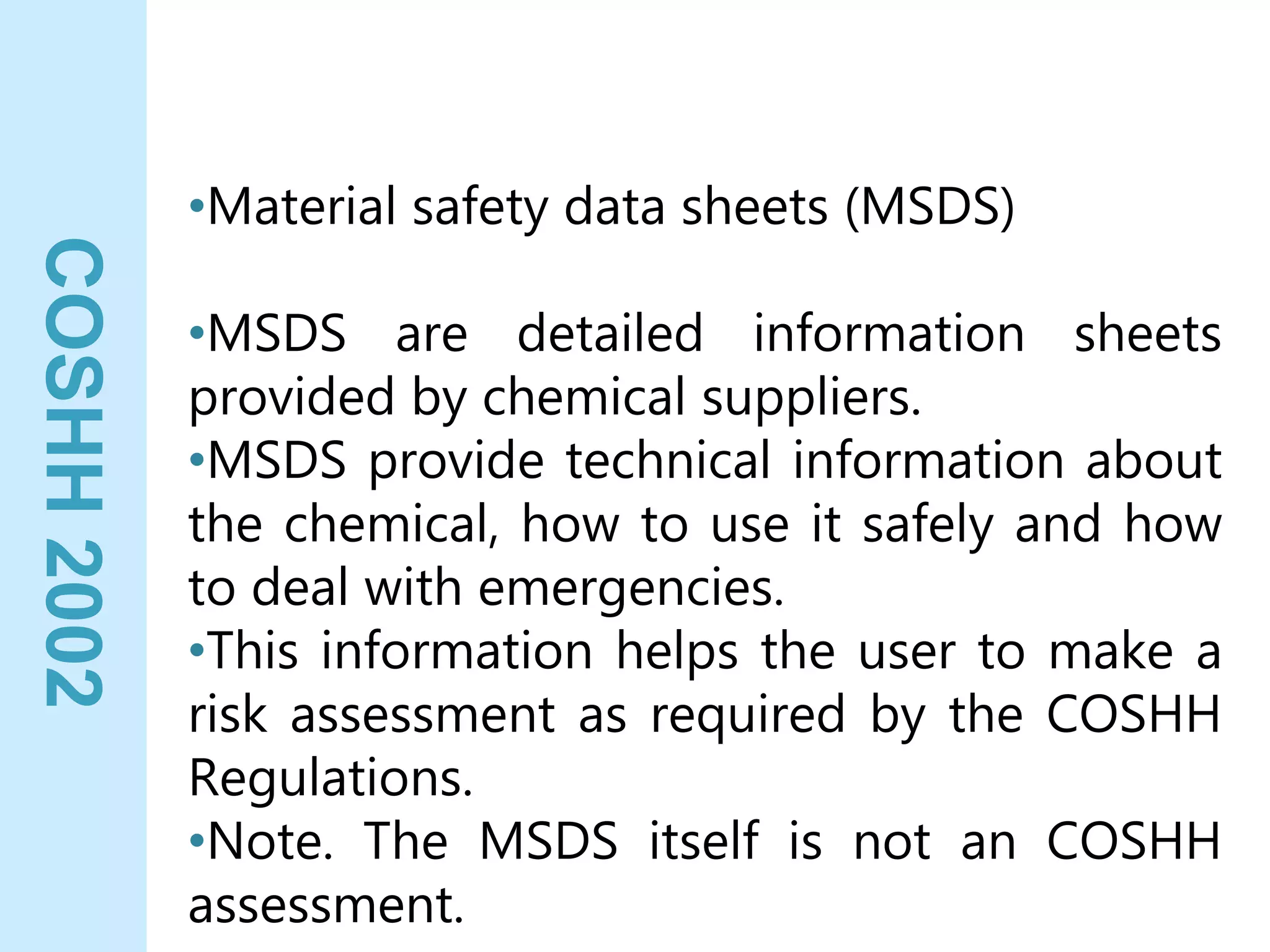
•Material safety data sheets (MSDS)
•MSDS are detailed information sheets
provided by chemical suppliers.
•MSDS provide technical information about
the chemical, how to use it safely and how
to deal with emergencies.
•This information helps the user to make a
risk assessment as required by the COSHH
Regulations.
•Note. The MSDS itself is not an COSHH
assessment.
COSHH
2002
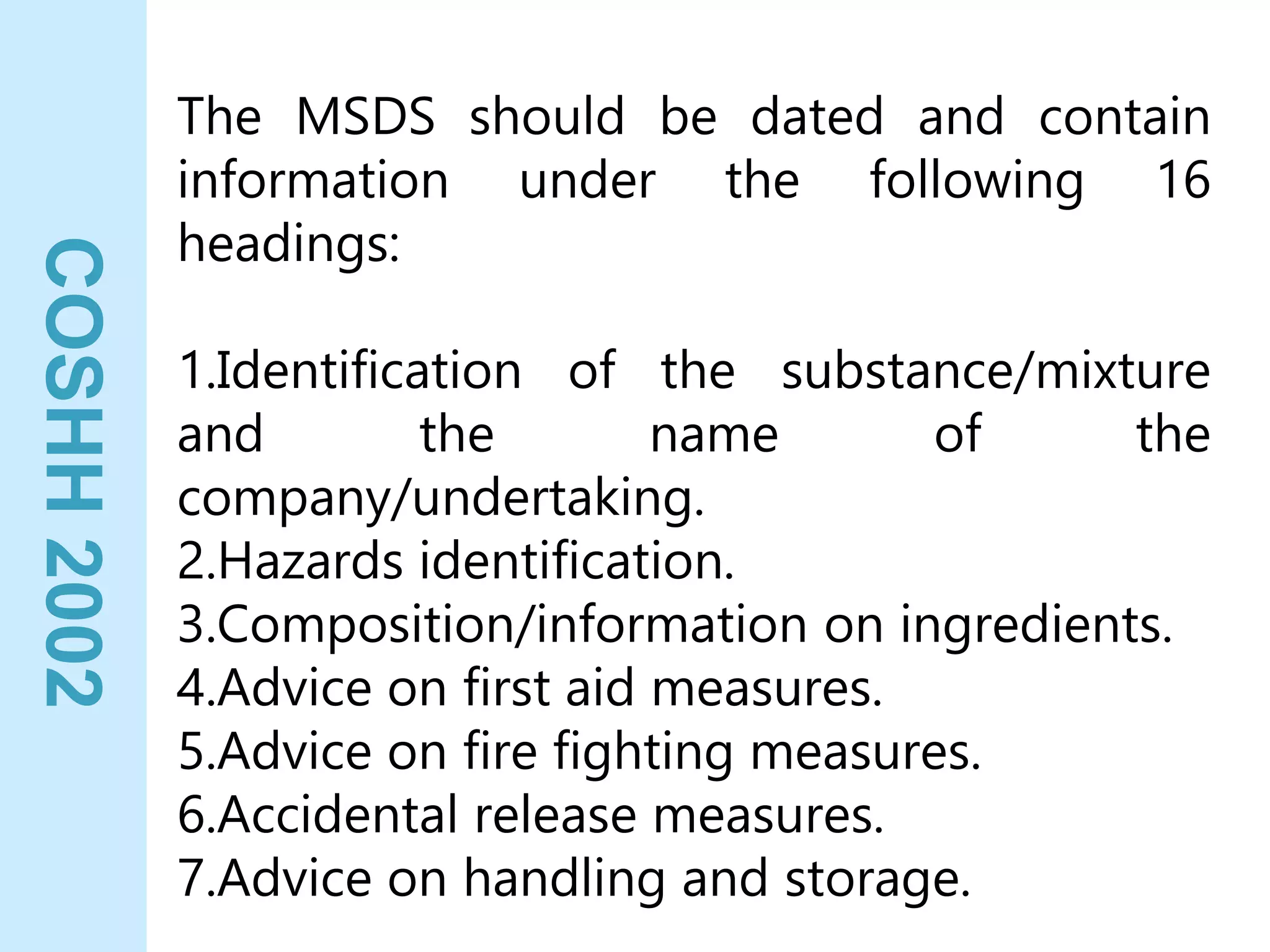
The MSDS should be dated and contain
information under the following 16
headings:
1.Identification of the substance/mixture
and the name of the
company/undertaking.
2.Hazards identification.
3.Composition/information on ingredients.
4.Advice on first aid measures.
5.Advice on fire fighting measures.
6.Accidental release measures.
7.Advice on handling and storage.
COSHH
2002
8. Exposure controls/personal protection.
9. Physical and chemical properties.
10. Stability and reactivity.
11. Toxicological information.
12. Ecological information.
13. Disposal considerations.
14. Transport information.
15. Regulatory information.
16. Other information.
COSHH
2002
•Risk and Safety phrases
•MSDS will also show one or more of 70 risk
phrases and one or more of over 60 safety
phrases to provide additional information
about a substance.
•For example:
R20 – Harmful by inhalation
S24 – Avoid contact with the skin
•The full list can be obtained from the HSE
Website:
COSHH
2002
Skin, Eye irritants; unclassified. [A
Rated] Least Hazardous
Harmful on single exposure. [B
Rated]
Toxic, Corrosive. [C Rated]
Very toxic to reproduction [D Rated]
Asthma, Cancer, Genetic damage [E
Rated] Most Hazardous
L
TO
M
COSHH
2002
•Safety information can be found on the
product label
COSHH
2002
•The Chemicals (Hazard Information and
Packaging for Supply) Regulations 2002
(CHIP), require suppliers to identify the
hazards (or dangers) of chemicals or
chemical mixtures they supply for use in the
workplace and to classify them into
appropriate hazard groups. The supplier
might be the manufacturer, importer or
distributor.
•If a chemical is classified as dangerous
under CHIP the supplier must also provide
accurate information about the hazards that
the chemical presents.
COSHH
2002
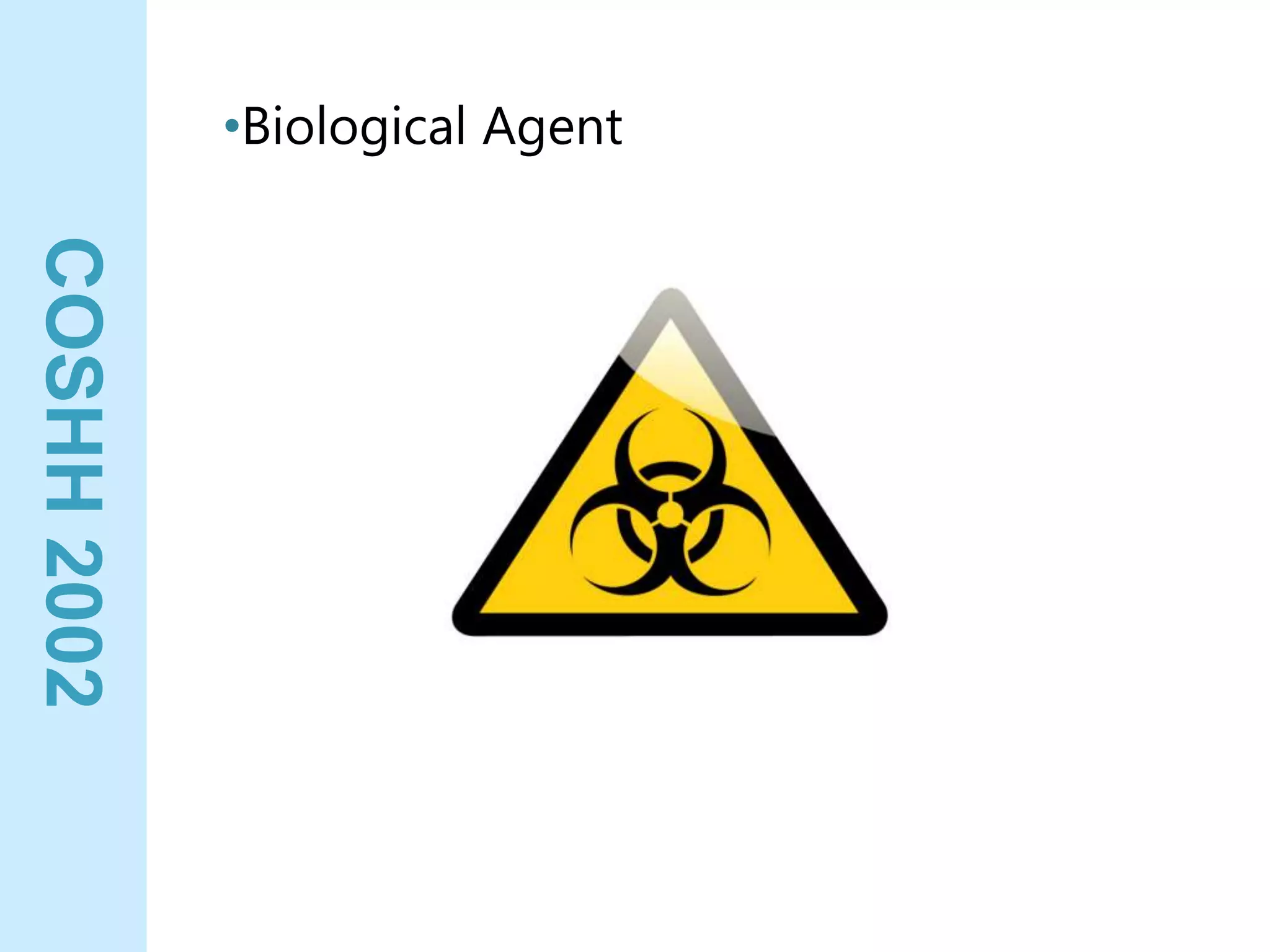
•Biological Agent
COSHH
2002
New international hazard
symbols (to replace the symbols
under CHIP by 2015):
Danger Flammable
Oxidiser
COSHH
2002
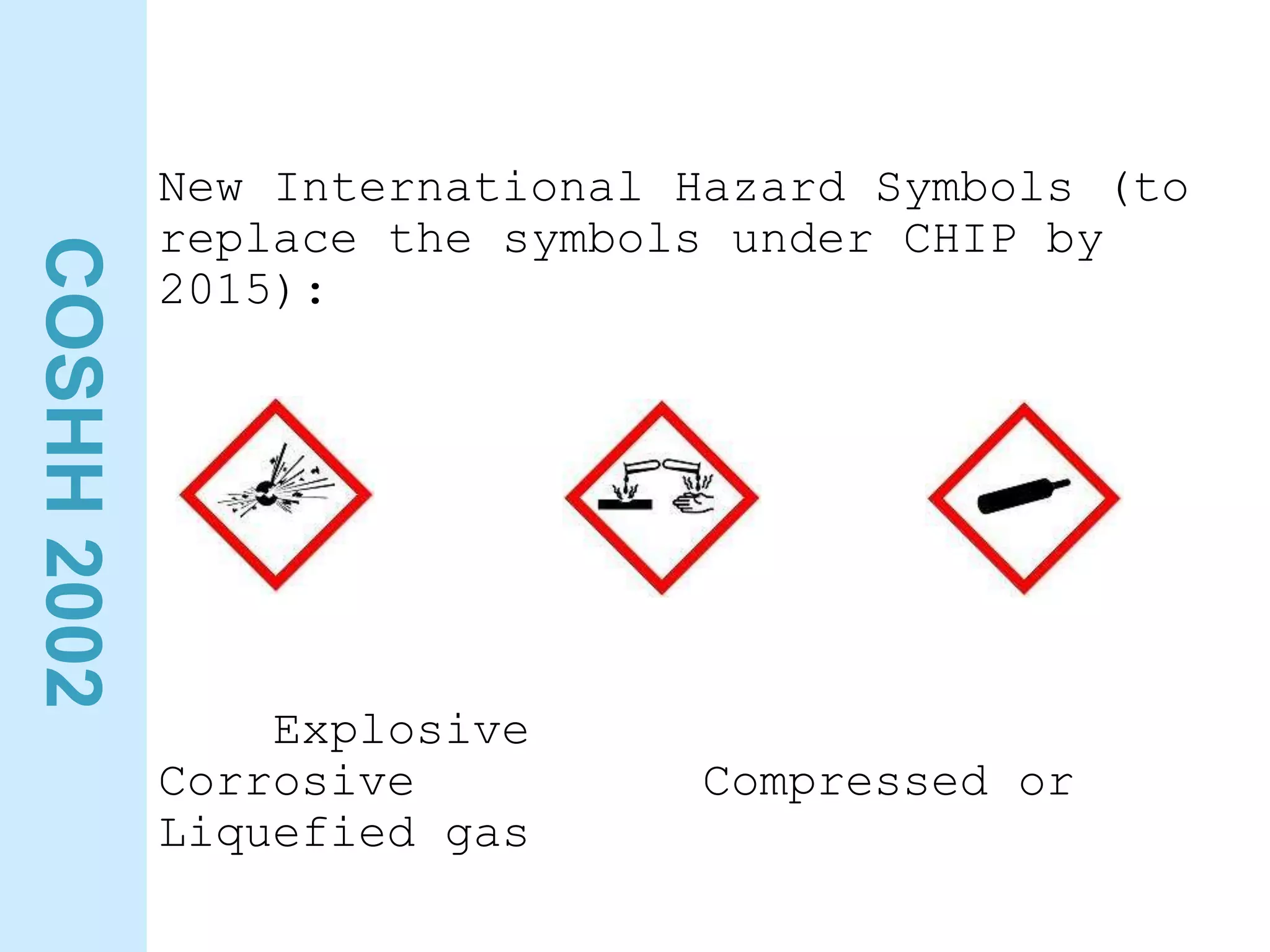
New International Hazard Symbols (to
replace the symbols under CHIP by
2015):
Explosive
Corrosive Compressed or
Liquefied gas
COSHH
2002
New International Hazard Symbols (to
replace the symbols under CHIP by
2015):
Aquatic Toxicity Warning
Sensitiser, Cacinogen. Mutugen,
Teratogen
COSHH
2002
Explanations:
Aquatic Toxicity
The substance is toxic to the
aquatic environment
Sensitisers
The substance may cause
respiratory irritation is
inhaled
Carcinogens
May cause cancer
Mutagenic
May cause genetic defects
Teratogen
COSHH
2002
Complying with COSHH - You need to
follow these eight steps:
1.Assess the risks.
2.Decide what precautions are
needed.
3.Prevent or adequately control
exposure.
4.Ensure that control measures are
used and maintained.
5.Monitor exposure.
6.Carry out appropriate health
surveillance.
COSHH
2002
To satisfy the first three of
these items you will need to
carry out a COSHH assessment
as follows:
Step 1 - Assess the risks.
You must identify all
hazardous substances present
in your workplace and compile
an inventory of them.
Remember to think about
substances that have been
COSHH
2002
You must also consider the
risks these substances present
to people’s health. Assessing
the risk involves making a
judgement on how likely it is
that a hazardous substance
will affect someone’s health.
You need to consider how much
of the substance is in use or
produced by the work activity
COSHH
2002
WELs are the British occupational
exposure limits and are set to help
protect the health of workers. They
are concentrations of hazardous
substances in the air, averaged over
a specified period of time, referred
to as a time-weighted average. Two
time periods are used:
1. Long-term (eight hours).
2. Short-term (15 minutes).
Short-term exposure limits may also
be set to help prevent effects such
as eye irritation which may occur
following exposure for a few
COSHH
2002
Step 2 - Decide what precautions
are needed.
If you identify significant
risks, decide on the action you
need to take to remove or reduce
them to acceptable levels.
To help you decide whether risks
are significant check the results
of any exposure with the
recommended WELs from EH40.
If you decide that there are
COSHH
2002
• If you have five or more
employees you must make and
keep a record of the main
findings of the assessment.
• The record should be made as
soon as practicable after the
assessment and contain enough
information to explain the
decisions you have taken about
whether risks are significant
and the need for any control
measures.
COSHH
2002
Step 3 - Prevent or adequately
control exposure.
The COSHH Regulations require you to
prevent exposure to substances
hazardous to health, if it is
reasonably practicable to do so.
You might consider:
Changing the process or activity so
that the hazardous substance is not
needed or generated.
Replacing it with a safer
alternative.
Using it in a safer form, e.g.
pellets instead of powder.
COSHH
2002
If prevention is not
reasonably practicable, you
must adequately control
exposure. You should consider
and put in place measures
appropriate to the activity
and consistent with the risk
assessment as follows:
Use appropriate work
processes, systems,
COSHH
2002
• Control exposure at source,
e.g. local exhaust
ventilation, and reduce the
number of employees exposed;
limit the level and duration
of their exposure; and the
quantity of hazardous
substances used or produced
in the workplace.
• Provide personal protective
COSHH
2002
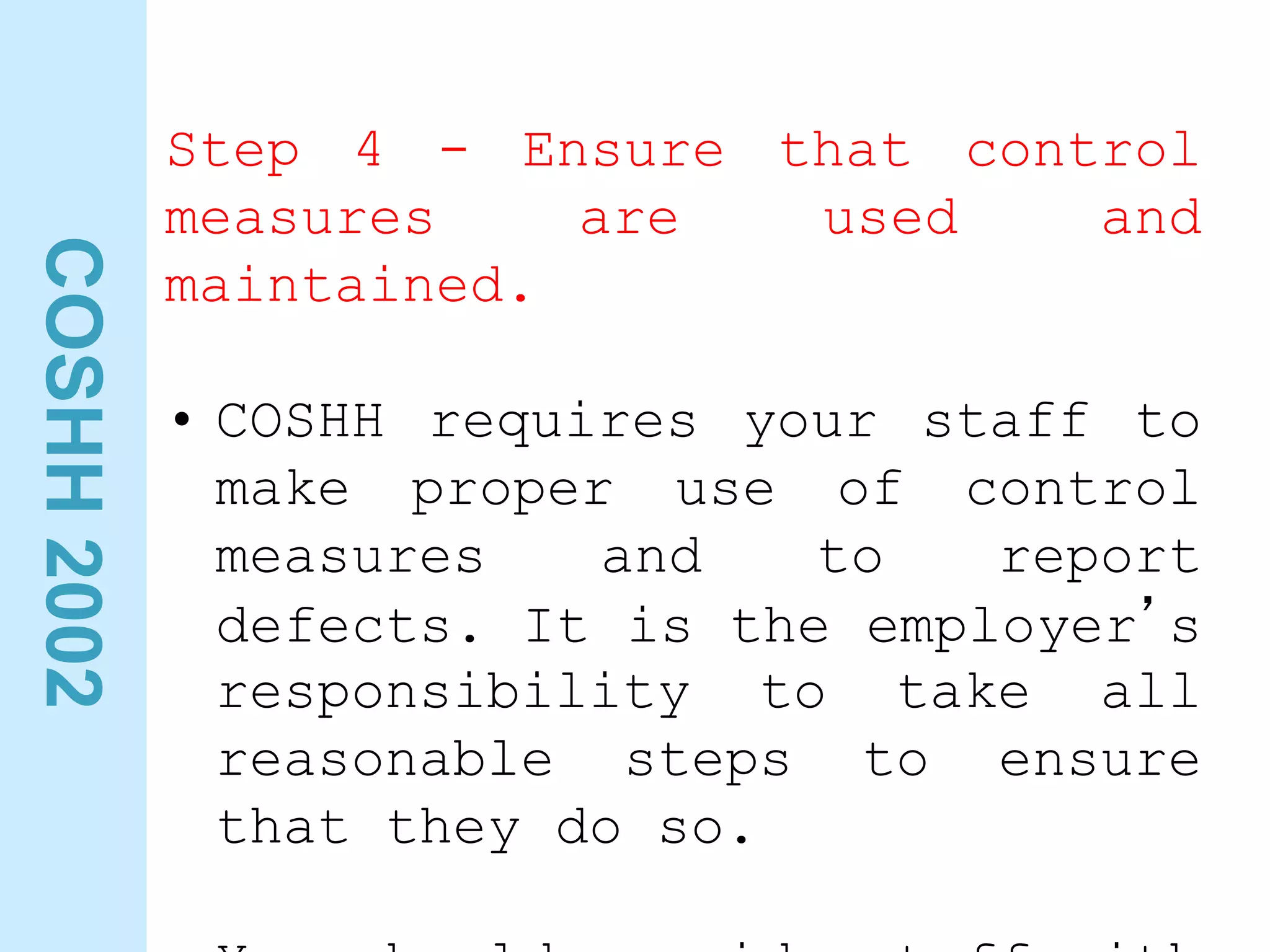
Step 4 - Ensure that control
measures are used and
maintained.
• COSHH requires your staff to
make proper use of control
measures and to report
defects. It is the employer’s
responsibility to take all
reasonable steps to ensure
that they do so.
COSHH
2002
Step 5 - Monitor exposure.
Under COSHH, you need to
measure the concentration of
hazardous substances in the
air breathed in by workers
where your assessment
concludes that:
There could be serious risks
to health if control measures
failed or deteriorated.
Workplace exposure limits
COSHH
2002
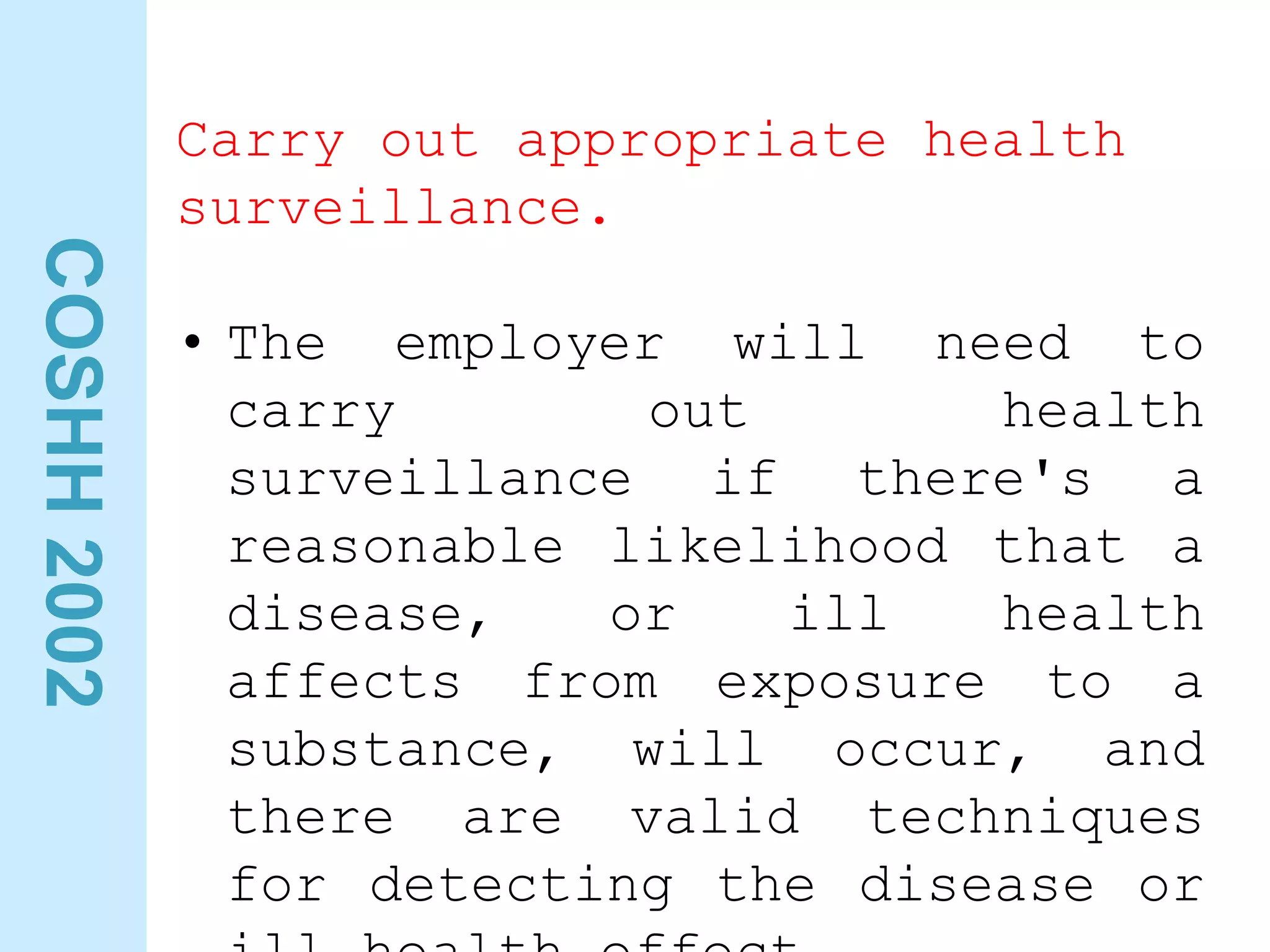
Carry out appropriate health
surveillance.
• The employer will need to
carry out health
surveillance if there's a
reasonable likelihood that a
disease, or ill health
affects from exposure to a
substance, will occur, and
there are valid techniques
for detecting the disease or
COSHH
2002
If any accident, incident or
emergency occurs you must
ensure that immediate steps
are taken to minimise the
harmful effects, restore the
situation to normal and inform
staff who may be affected.
You should therefore have a
plan of action and ensure that
staff are trained in any
response methods you have set
COSHH
2002
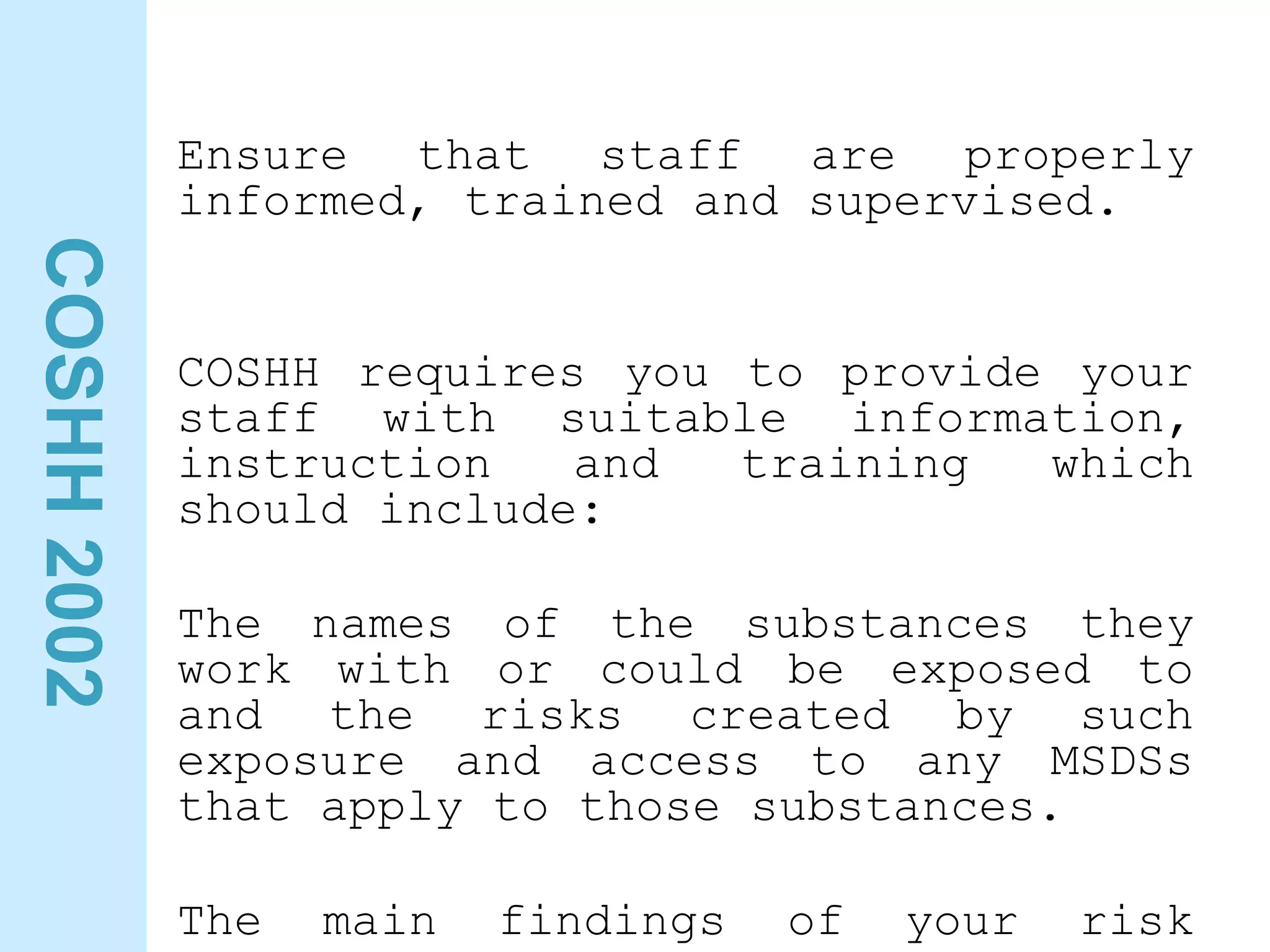
Ensure that staff are properly
informed, trained and supervised.
COSHH requires you to provide your
staff with suitable information,
instruction and training which
should include:
The names of the substances they
work with or could be exposed to
and the risks created by such
exposure and access to any MSDSs
that apply to those substances.
The main findings of your risk
COSHH
2002
COSHH assessments must be
reviewed at regular intervals
and immediately if:
• There is any reason to
suppose that the original
assessment is no longer
valid, e.g. evidence from
the results of examining and
testing engineering controls,
reports from supervisors
about defects in control
systems, etc.
COSHH
2002
Hierarchy of Controls:
• Elimination
• Substitution
• Engineering Controls:
• Enclosure
• Local Exhaust Ventilation
• Administrative Controls
• Worker Rotation
• Personal Hygiene
• Good practice
• Labelling
• Personal Protective
COSHH
2002
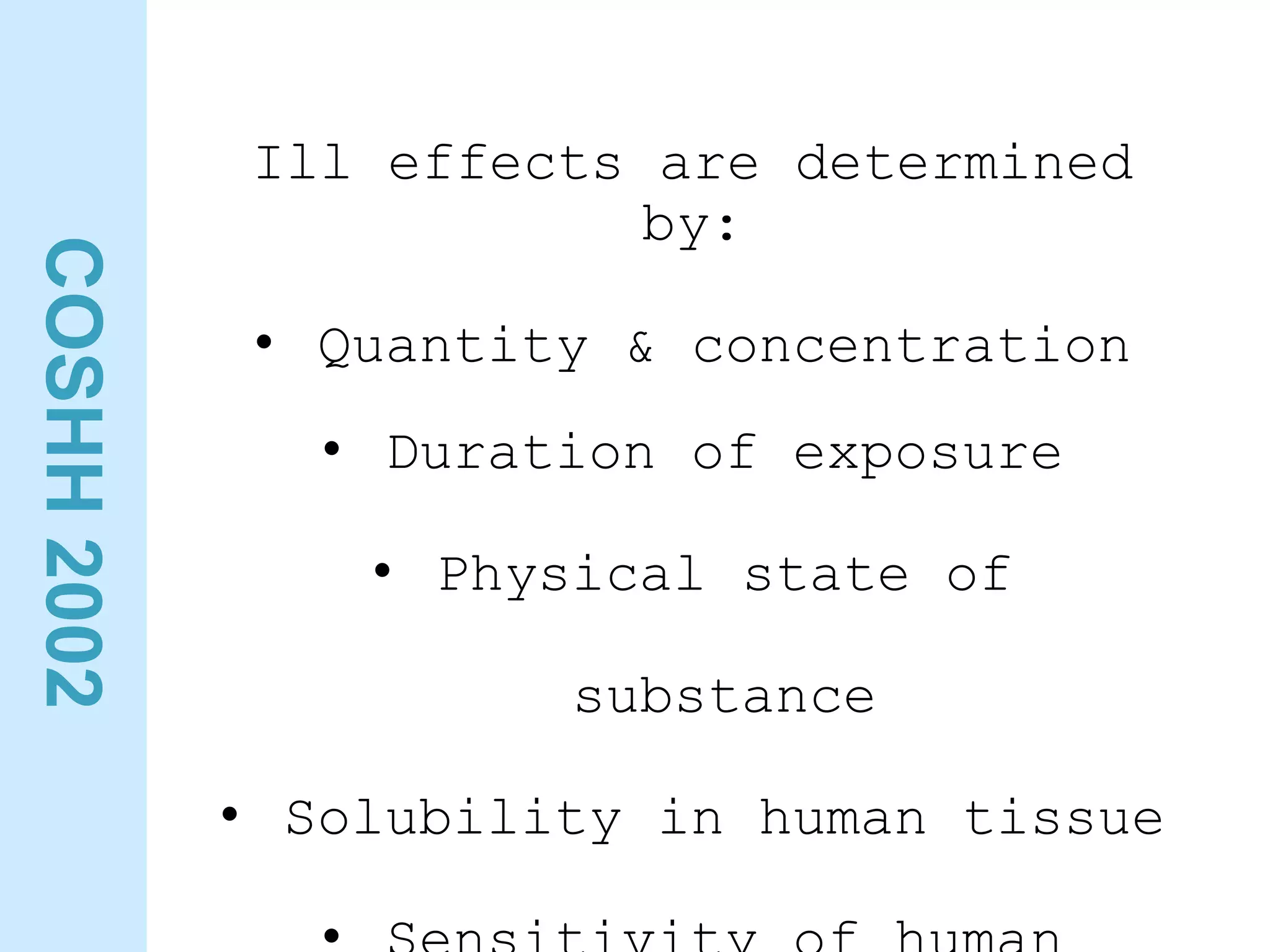
Ill effects are determined
by:
• Quantity & concentration
• Duration of exposure
• Physical state of
substance
• Solubility in human tissue
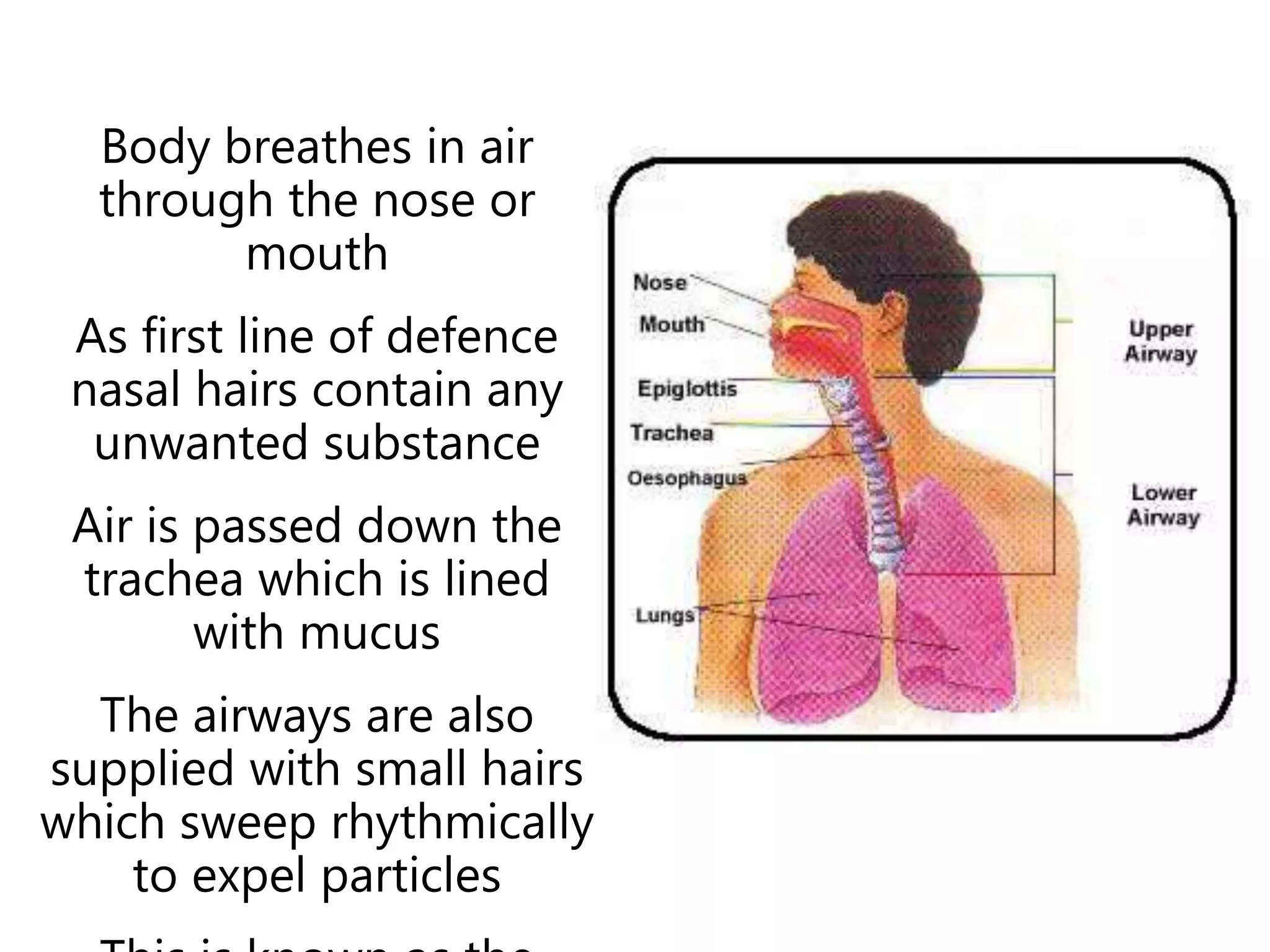
Body breathes in air
through the nose or
mouth
As first line of defence
nasal hairs contain any
unwanted substance
Air is passed down the
trachea which is lined
with mucus
The airways are also
supplied with small hairs
which sweep rhythmically
to expel particles
Respiratory system
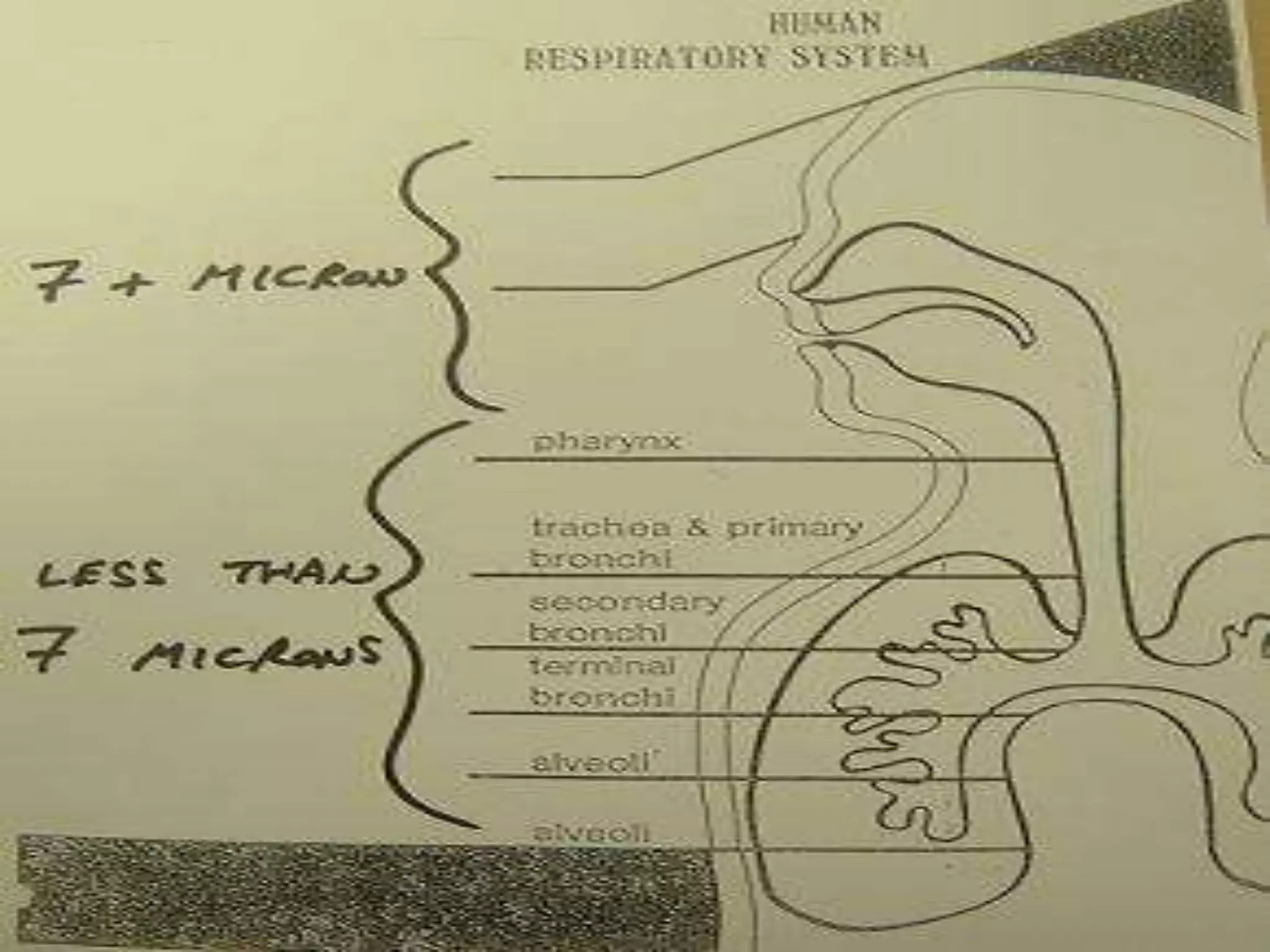
The airways divide into
two tubes called the
bronchi
Which in turn divide
further into the
bronchioles which end
at the structure known
as the alveoli
The alveoli are thin
delicate air sacs
Respiratory system
Filter Selection
Colour code Application
O
rg
a
nicg
a
s
e
sa
ndva
po
urs
.
Ino
rg
a
nicg
a
s
e
sa
ndva
po
urs
S
ulphur dio
xide
Am
m
o
nia
Dus
ts
Glove Donning and Doffing
Image: World Health Organization

COSHH-AWARENESS-TRAINING-wecompress.com_.ppt

  • 1.
  • 2.
    Course Objectives By the endof the course, you will be able to: To understand: • The requirements of the COSHH Regulations. • The importance of labelling and Safety Data Sheet information. • How to comply with the
  • 3.
    WHAT IS COSHH ? • COSHH standsfor the Control of Substances Hazardous to Health Regulations 2002. • Using hazardous substances could potentially put people's health at risk. • COSHH requires employers to control exposures to hazardous substances
  • 4.
    COSHH 2002 • What isan Hazardous substance under the Regulations? • Substances and mixtures classified as dangerous under the Chemicals (Hazard Information and Packaging for Supply) Regulations 2008. • Substances with workplace exposure limits as listed in the HSE publication EH40 Workplace Exposure Limits. • Biological agents. • Some dusts, especially in high
  • 5.
    COSHH 2002 • COSHH standsfor the Control of Substances Hazardous to Health Regulations 2002. • Using hazardous substances could potentially put people's health at risk. • COSHH requires employers to control exposures to hazardous substances
  • 6.
    COSHH 2002 • Finding outwhat the health hazards are when using a substance • Deciding how to prevent harm • Providing control measures to reduce harm to health • Controls are implemented and in working order • Providing information instruction and training • Providing Health surveillance in
  • 7.
    COSHH 2002 • Routes ofEntry into the body, the toxicity and the amount • The Risk can be acute or chronic • Substitute for less toxic substance • Ventilation • PPE to be used as a last resort • Requires COSHH Risk Assessment to be undertaken • Remember a Material Safety Data • The hazard will depend on:
  • 8.
    COSHH 2002 The aim ofCOSHH assessment is to prevent exposure and where this is not possible reduce the exposure by identifying suitable controls. There should be a COSHH assessment for any chemicals you need to use at work. Your Line Manager should explain to you the issues found during risk assessment and what you need to do
  • 9.
    COSHH 2002 •Many substancescan hurt you when they get inside your body. •A hazardous substance is any material or substance with the potential to cause illness or injury to the people who come into contact with it. •These are used in many workplaces and may lead to a range of conditions including dermatitis, asthma and infectious diseases. •The hazard depends on the way the substance gets into the body (for example breathing in a gas) and the toxicity. •The level of risk needs to be evaluated, if the risk is very high then all efforts should
  • 10.
    COSHH 2002 •Many substancescan hurt you when they get inside your body. •A hazardous substance is any material or substance with the potential to cause illness or injury to the people who come into contact with it. •These are used in many workplaces and may lead to a range of conditions including dermatitis, asthma and infectious diseases. •The hazard depends on the way the substance gets into the body (for example breathing in a gas) and the toxicity. •The level of risk needs to be evaluated, if the risk is very high then all efforts should
  • 11.
    COSHH 2002 •Effects ofhazardous substances: •Skin irritation or dermatitis as a result of skin contact. •Asthma as a result of developing an allergy to substances used at work. •Losing consciousness as a result of being overcome by toxic fumes. •Cancer, which may appear long after the exposure to the chemical that caused it. •Infection from bacteria and other micro- organisms (biological agents). •Substances may cause health problems from a single exposure even for a short time this is an acute effect. It may cause
  • 12.
    COSHH 2002 •Material safety datasheets (MSDS) •MSDS are detailed information sheets provided by chemical suppliers. •MSDS provide technical information about the chemical, how to use it safely and how to deal with emergencies. •This information helps the user to make a risk assessment as required by the COSHH Regulations. •Note. The MSDS itself is not an COSHH assessment.
  • 13.
    COSHH 2002 The MSDS shouldbe dated and contain information under the following 16 headings: 1.Identification of the substance/mixture and the name of the company/undertaking. 2.Hazards identification. 3.Composition/information on ingredients. 4.Advice on first aid measures. 5.Advice on fire fighting measures. 6.Accidental release measures. 7.Advice on handling and storage.
  • 14.
    COSHH 2002 8. Exposure controls/personalprotection. 9. Physical and chemical properties. 10. Stability and reactivity. 11. Toxicological information. 12. Ecological information. 13. Disposal considerations. 14. Transport information. 15. Regulatory information. 16. Other information.
  • 15.
    COSHH 2002 •Risk and Safetyphrases •MSDS will also show one or more of 70 risk phrases and one or more of over 60 safety phrases to provide additional information about a substance. •For example: R20 – Harmful by inhalation S24 – Avoid contact with the skin •The full list can be obtained from the HSE Website:
  • 16.
    COSHH 2002 Skin, Eye irritants;unclassified. [A Rated] Least Hazardous Harmful on single exposure. [B Rated] Toxic, Corrosive. [C Rated] Very toxic to reproduction [D Rated] Asthma, Cancer, Genetic damage [E Rated] Most Hazardous L TO M
  • 17.
    COSHH 2002 •Safety information canbe found on the product label
  • 18.
    COSHH 2002 •The Chemicals (HazardInformation and Packaging for Supply) Regulations 2002 (CHIP), require suppliers to identify the hazards (or dangers) of chemicals or chemical mixtures they supply for use in the workplace and to classify them into appropriate hazard groups. The supplier might be the manufacturer, importer or distributor. •If a chemical is classified as dangerous under CHIP the supplier must also provide accurate information about the hazards that the chemical presents.
  • 19.
  • 20.
    COSHH 2002 New international hazard symbols(to replace the symbols under CHIP by 2015): Danger Flammable Oxidiser
  • 21.
    COSHH 2002 New International HazardSymbols (to replace the symbols under CHIP by 2015): Explosive Corrosive Compressed or Liquefied gas
  • 22.
    COSHH 2002 New International HazardSymbols (to replace the symbols under CHIP by 2015): Aquatic Toxicity Warning Sensitiser, Cacinogen. Mutugen, Teratogen
  • 23.
    COSHH 2002 Explanations: Aquatic Toxicity The substanceis toxic to the aquatic environment Sensitisers The substance may cause respiratory irritation is inhaled Carcinogens May cause cancer Mutagenic May cause genetic defects Teratogen
  • 24.
    COSHH 2002 Complying with COSHH- You need to follow these eight steps: 1.Assess the risks. 2.Decide what precautions are needed. 3.Prevent or adequately control exposure. 4.Ensure that control measures are used and maintained. 5.Monitor exposure. 6.Carry out appropriate health surveillance.
  • 25.
    COSHH 2002 To satisfy thefirst three of these items you will need to carry out a COSHH assessment as follows: Step 1 - Assess the risks. You must identify all hazardous substances present in your workplace and compile an inventory of them. Remember to think about substances that have been
  • 26.
    COSHH 2002 You must alsoconsider the risks these substances present to people’s health. Assessing the risk involves making a judgement on how likely it is that a hazardous substance will affect someone’s health. You need to consider how much of the substance is in use or produced by the work activity
  • 27.
    COSHH 2002 WELs are theBritish occupational exposure limits and are set to help protect the health of workers. They are concentrations of hazardous substances in the air, averaged over a specified period of time, referred to as a time-weighted average. Two time periods are used: 1. Long-term (eight hours). 2. Short-term (15 minutes). Short-term exposure limits may also be set to help prevent effects such as eye irritation which may occur following exposure for a few
  • 28.
    COSHH 2002 Step 2 -Decide what precautions are needed. If you identify significant risks, decide on the action you need to take to remove or reduce them to acceptable levels. To help you decide whether risks are significant check the results of any exposure with the recommended WELs from EH40. If you decide that there are
  • 29.
    COSHH 2002 • If youhave five or more employees you must make and keep a record of the main findings of the assessment. • The record should be made as soon as practicable after the assessment and contain enough information to explain the decisions you have taken about whether risks are significant and the need for any control measures.
  • 30.
    COSHH 2002 Step 3 -Prevent or adequately control exposure. The COSHH Regulations require you to prevent exposure to substances hazardous to health, if it is reasonably practicable to do so. You might consider: Changing the process or activity so that the hazardous substance is not needed or generated. Replacing it with a safer alternative. Using it in a safer form, e.g. pellets instead of powder.
  • 31.
    COSHH 2002 If prevention isnot reasonably practicable, you must adequately control exposure. You should consider and put in place measures appropriate to the activity and consistent with the risk assessment as follows: Use appropriate work processes, systems,
  • 32.
    COSHH 2002 • Control exposureat source, e.g. local exhaust ventilation, and reduce the number of employees exposed; limit the level and duration of their exposure; and the quantity of hazardous substances used or produced in the workplace. • Provide personal protective
  • 33.
    COSHH 2002 Step 4 -Ensure that control measures are used and maintained. • COSHH requires your staff to make proper use of control measures and to report defects. It is the employer’s responsibility to take all reasonable steps to ensure that they do so.
  • 34.
    COSHH 2002 Step 5 -Monitor exposure. Under COSHH, you need to measure the concentration of hazardous substances in the air breathed in by workers where your assessment concludes that: There could be serious risks to health if control measures failed or deteriorated. Workplace exposure limits
  • 35.
    COSHH 2002 Carry out appropriatehealth surveillance. • The employer will need to carry out health surveillance if there's a reasonable likelihood that a disease, or ill health affects from exposure to a substance, will occur, and there are valid techniques for detecting the disease or
  • 36.
    COSHH 2002 If any accident,incident or emergency occurs you must ensure that immediate steps are taken to minimise the harmful effects, restore the situation to normal and inform staff who may be affected. You should therefore have a plan of action and ensure that staff are trained in any response methods you have set
  • 37.
    COSHH 2002 Ensure that staffare properly informed, trained and supervised. COSHH requires you to provide your staff with suitable information, instruction and training which should include: The names of the substances they work with or could be exposed to and the risks created by such exposure and access to any MSDSs that apply to those substances. The main findings of your risk
  • 38.
    COSHH 2002 COSHH assessments mustbe reviewed at regular intervals and immediately if: • There is any reason to suppose that the original assessment is no longer valid, e.g. evidence from the results of examining and testing engineering controls, reports from supervisors about defects in control systems, etc.
  • 39.
    COSHH 2002 Hierarchy of Controls: •Elimination • Substitution • Engineering Controls: • Enclosure • Local Exhaust Ventilation • Administrative Controls • Worker Rotation • Personal Hygiene • Good practice • Labelling • Personal Protective
  • 40.
    COSHH 2002 Ill effects aredetermined by: • Quantity & concentration • Duration of exposure • Physical state of substance • Solubility in human tissue
  • 41.
    Body breathes inair through the nose or mouth As first line of defence nasal hairs contain any unwanted substance Air is passed down the trachea which is lined with mucus The airways are also supplied with small hairs which sweep rhythmically to expel particles Respiratory system
  • 42.
    The airways divideinto two tubes called the bronchi Which in turn divide further into the bronchioles which end at the structure known as the alveoli The alveoli are thin delicate air sacs Respiratory system
  • 44.
    Filter Selection Colour codeApplication O rg a nicg a s e sa ndva po urs . Ino rg a nicg a s e sa ndva po urs S ulphur dio xide Am m o nia Dus ts
  • 45.
    Glove Donning andDoffing Image: World Health Organization

Editor's Notes

  • #8  The aim is to identify any sub-standard practices or conditions in the workplace and recommend remedial actions to rectify These substandard practices or conditions are known as???
  • #9  The aim is to identify any sub-standard practices or conditions in the workplace and recommend remedial actions to rectify These substandard practices or conditions are known as???
  • #10  The aim is to identify any sub-standard practices or conditions in the workplace and recommend remedial actions to rectify These substandard practices or conditions are known as???
  • #11  The aim is to identify any sub-standard practices or conditions in the workplace and recommend remedial actions to rectify These substandard practices or conditions are known as???
  • #12  The aim is to identify any sub-standard practices or conditions in the workplace and recommend remedial actions to rectify These substandard practices or conditions are known as???
  • #13  The aim is to identify any sub-standard practices or conditions in the workplace and recommend remedial actions to rectify These substandard practices or conditions are known as???
  • #14  These substandard practices or conditions are known as???
  • #15  The aim is to identify any sub-standard practices or conditions in the workplace and recommend remedial actions to rectify These substandard practices or conditions are known as???
  • #16  The aim is to identify any sub-standard practices or conditions in the workplace and recommend remedial actions to rectify These substandard practices or conditions are known as???
  • #17  The aim is to identify any sub-standard practices or conditions in the workplace and recommend remedial actions to rectify These substandard practices or conditions are known as???
  • #18  The aim is to identify any sub-standard practices or conditions in the workplace and recommend remedial actions to rectify These substandard practices or conditions are known as???
  • #19  The aim is to identify any sub-standard practices or conditions in the workplace and recommend remedial actions to rectify These substandard practices or conditions are known as???
  • #20  The aim is to identify any sub-standard practices or conditions in the workplace and recommend remedial actions to rectify These substandard practices or conditions are known as???
  • #21  The aim is to identify any sub-standard practices or conditions in the workplace and recommend remedial actions to rectify These substandard practices or conditions are known as???
  • #22  The aim is to identify any sub-standard practices or conditions in the workplace and recommend remedial actions to rectify These substandard practices or conditions are known as???
  • #23  The aim is to identify any sub-standard practices or conditions in the workplace and recommend remedial actions to rectify These substandard practices or conditions are known as???
  • #24  The aim is to identify any sub-standard practices or conditions in the workplace and recommend remedial actions to rectify These substandard practices or conditions are known as???
  • #27  The aim is to identify any sub-standard practices or conditions in the workplace and recommend remedial actions to rectify These substandard practices or conditions are known as???
  • #28  These substandard practices or conditions are known as???
  • #29  The aim is to identify any sub-standard practices or conditions in the workplace and recommend remedial actions to rectify These substandard practices or conditions are known as???
  • #30  The aim is to identify any sub-standard practices or conditions in the workplace and recommend remedial actions to rectify These substandard practices or conditions are known as???
  • #31  The aim is to identify any sub-standard practices or conditions in the workplace and recommend remedial actions to rectify These substandard practices or conditions are known as???
  • #32  The aim is to identify any sub-standard practices or conditions in the workplace and recommend remedial actions to rectify These substandard practices or conditions are known as???
  • #33  The aim is to identify any sub-standard practices or conditions in the workplace and recommend remedial actions to rectify These substandard practices or conditions are known as???
  • #34  The aim is to identify any sub-standard practices or conditions in the workplace and recommend remedial actions to rectify These substandard practices or conditions are known as???
  • #35  The aim is to identify any sub-standard practices or conditions in the workplace and recommend remedial actions to rectify These substandard practices or conditions are known as???
  • #36  The aim is to identify any sub-standard practices or conditions in the workplace and recommend remedial actions to rectify These substandard practices or conditions are known as???
  • #37  The aim is to identify any sub-standard practices or conditions in the workplace and recommend remedial actions to rectify These substandard practices or conditions are known as???
  • #38  The aim is to identify any sub-standard practices or conditions in the workplace and recommend remedial actions to rectify These substandard practices or conditions are known as???
  • #39  The aim is to identify any sub-standard practices or conditions in the workplace and recommend remedial actions to rectify These substandard practices or conditions are known as???
  • #40  The aim is to identify any sub-standard practices or conditions in the workplace and recommend remedial actions to rectify These substandard practices or conditions are known as???
  • #41  These substandard practices or conditions are known as???