1
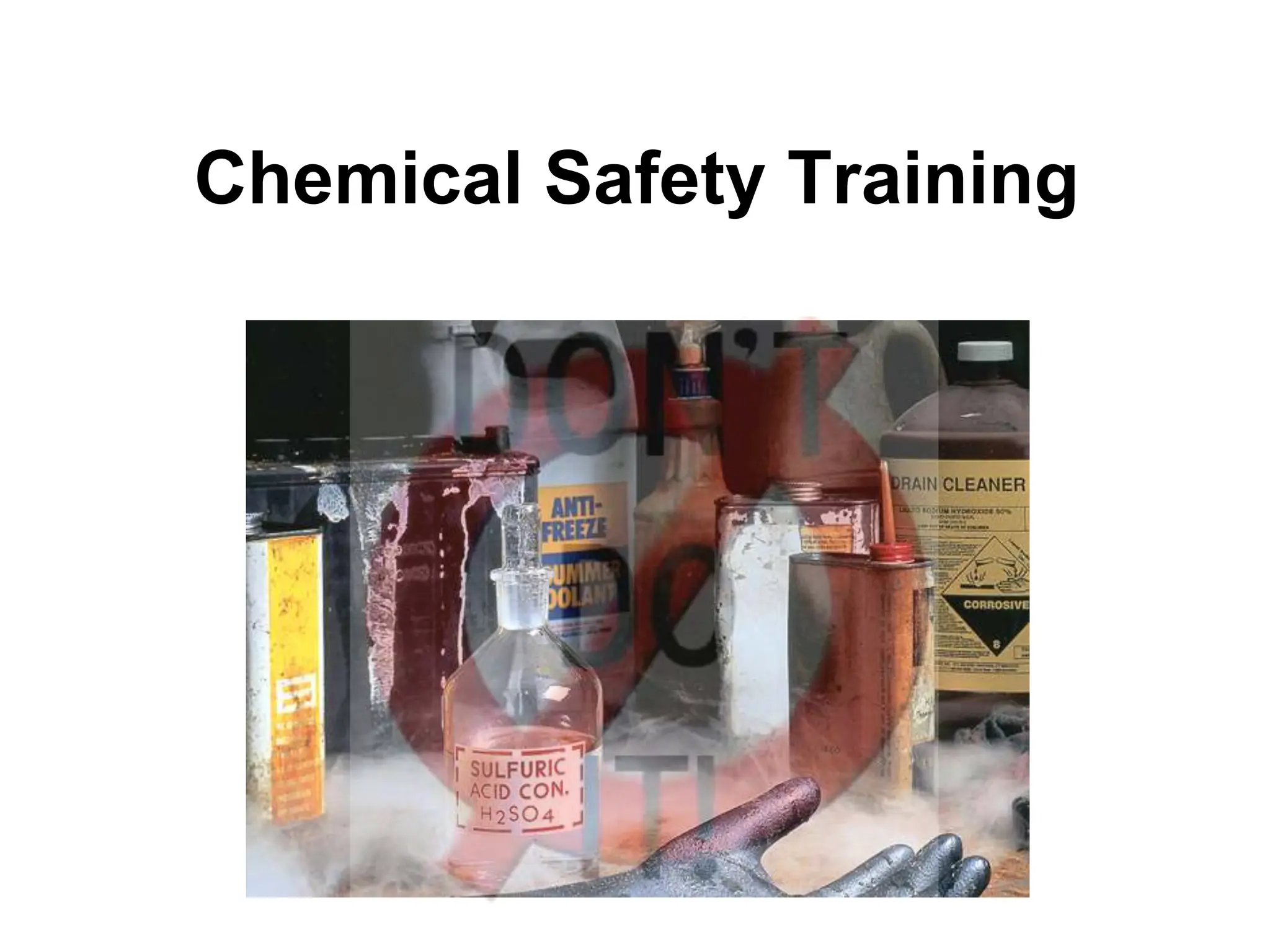
Chemical Safety Training
Chemical safety training
Course Objectives
▶ Provide participants with training to
▶ Identify hazards that exist in their workplaces
▶ Identify potential health effects of workplace hazards
▶ Understand ways that chemicals can enter the body
▶ Understand principles of hazard prevention and control
▶ Apply principles of hazard control in the work place
▶ Understand employer responsibilities regarding exposure to
hazardous chemicals
▶ Discuss and analyze strategies to create safer workplaces
2
Introduction
▶ About 32 million workers are potentially exposed to one or
more chemical hazards1
▶ There are approximately 650,000 existing chemical products,
and hundreds of new ones being introduced annually1
▶ Chemical exposure may cause or contribute to many serious
health effects such as heart ailments, central nervous system
damage, kidney and lung damage, sterility, cancer, burns,
and rashes
▶ Some chemicals may also be safety hazards and have the
potential to cause fires and explosions and other serious
accidents
3
Hazard Identification
▶ What are some hazards that can be
found in your workplace?
4
Hazard Identification (cont.)
▶ Routes of exposure
▶ Inhalation
▶ Absorption
▶ Ingestion
▶ Injection
5
Hazard Identification (cont. )
▶ Severity of health effects depend on
▶ Duration of exposure
▶ Frequency of exposure
▶ Route of exposure
▶ Personal health
▶ Type of chemical
6
Types of Health Effects
▶ May be acute or long-term
▶ Neurologic
▶ Affect the brain, spinal cord, or nerves
▶ Respiratory
▶ Affects lung function
▶ Cardiovascular
▶ Affects movement of nutrients & wastes; body temperature
7
Types of Health Effects (cont.)
▶ Immunologic
▶ Affects body’s ability to fight infection
▶ Mutagenic
▶ Cause changes in the genetic code
▶ Teratogenic
▶ Affect developing fetus or embryo
▶ Carcinogenic
▶ Affect rate of cell division
8
Types of Hazards
▶ Biological
▶ Chemical
▶ Ergonomic
▶ Physical
▶ Psychosocial
▶ Safety
9
Types of Chemicals
▶ Flammable
▶ Uses: solvents, adhesives, fuel
▶ Examples: Methanol, acetonitrile, diesel fuel, mineral spirits
▶ Corrosive
▶ Uses: cleaning agents, degreasers, chemical reactants
▶ Examples: Acetic acid, sodium hydroxide, ammonia; phenol
▶ Reactive
▶ Oxidizers
▶ Uses: disinfectants, cleaning agents; chlorine
▶ Examples: nitric acid, hydrogen peroxide
10
Types of Chemicals (cont.)
▶ Organic peroxides
▶ Uses: Bleaching agents, disinfectants, chemical synthesis reactions
▶ Examples: benzoyl peroxide, methyl ethyl ketone peroxide; hydrogen
peroxide
▶ Water reactive
▶ Uses: Additives, neutralizers, chemical synthesis reactions
▶ Examples: sodium metal, sodium borohydride, sodium hydroxide
▶ Air reactive
▶ Uses: Adhesives, coating agents, chemical synthesis reactions
▶ Examples: silane, t-butyl lithium
11
Types of Chemicals ( cont.)
▶ Toxic
▶ Carcinogen
▶ Uses: Solvent, cleaning fluid, degreaser, disinfectant
▶ Examples: benzene, carbon tetrachloride, formaldehyde*
▶ Mutagen:
▶ Uses: Disinfectant, solvent
▶ Examples: bromine, benzene; phenol
▶ Poison:
▶ Uses: Chemical preservative, pigment
▶ Examples: sodium azide, powdered pigments/inks
12
Types of Chemicals (cont.)
▶ Sensitizer:
▶ Uses: Disinfectants, biocides
▶ Examples: formaldeyde, phenol
▶ Teratogen:
▶ Uses: Electrical equipment, insulation; conductors
▶ Examples: PCBs, mercury
▶ Irritant
▶ Powdered substances
▶ Uses: Filler, casting
▶ Examples: silica
13
Protective Measures
▶ Substitute a safe(r) chemical, if possible
▶ Use appropriate engineering controls, including ventilation
▶ Wear appropriate personal protective equipment (PPE)
when handling hazardous materials
▶ Remove PPE when entering common areas and hallways
▶ Label areas that require PPE
▶ Do not eat, drink, smoke, store food, or apply make up in
work areas
14
Hierarchy of Controls
15
https://www.cdc.gov/niosh/topics/hierarchy/
How can workplace hazards be minimized?
▶ The first step in minimizing workplace hazards is to perform
a thorough hazard assessment
▶ Employers can rely on the evaluations performed by the
manufacturers or importers to establish the hazards of the
chemicals they use
▶ This information is obtained from SDSs and labels
16
General Duty Clause
▶ Provide a workplace free of recognized hazards
▶ Employer has a legal obligation to provide workplace
without conditions or activities that are recognized as
hazardous and that cause, or are likely to cause, death
or serious physical harm to employees
17
Employer Responsibilities
▶ Provide a workplace free of recognized hazards
▶ Identify and list hazardous chemicals in their workplaces
▶ Implement a written HazCom program
▶ Communicate hazard information to employees
▶ Provide training
18
Training
▶ Training is required for employees who are exposed to
hazardous chemicals in their work area:
▶ At the time of initial assignment
▶ Whenever a new hazard is introduced into their work
area
▶ Training must be provided in the language that the
employee can understand
19
https://www.arlo.co/features/training-company-software
What training is needed to protect workers?
▶ Explanation of the HazCom program, including information
on labels, SDSs, and how to obtain and use available hazard
information
▶ How to detect the presence or release of a hazardous
chemical (using monitoring devices, observation, or smell)
▶ Hazards and potential health effects of chemicals
▶ Protective measures such as engineering controls, work
practices, and the use of PPE
20
What information must be provided
to workers?
▶ Employees must be informed of:
▶ The HazCom standard and its requirements
▶ Operations in their work areas where hazardous
chemicals are present
▶ Location and availability of the written hazard evaluation
procedures, communications program, lists of hazardous
chemicals, and the required SDSs
21
Purpose of OSHA’s Hazard
Communication Standard
22
Hazard
Communication
Program
Container
Labeling
Safety
Data Sheet
SDS
Program
Label
To ensure that employers and employees know about work
hazards and how to protect themselves so that the incidence of
illnesses and injuries due to hazardous chemicals is reduced.
Container Labeling in the Workplace
▶ Effective 2012, all chemicals must be labeled using the
Globally Harmonized System (GHS)
▶ There are 6 elements of a GHS label:
23
Signal
Word
Manufacturer Information
GHS Symbol
Precautionary Statement
Hazard Statement
Product Name
https://www.bradyid.com/en-us/applications/ghs-labeling-requirements
Primary vs Secondary Container Labeling
▶ Primary containers must be labeled following GHS guidelines
▶ Bags, barrels, bottles, boxes, cans, cylinders, drums
▶ Received from manufacturer
▶ Secondary containers hold chemicals transferred from
primary containers
▶ Spray bottles, jugs, jars
▶ Must comply with GHS except when:
▶ Container stays within the work area and in possession of the
worker who filled it
▶ Material is used within the work shift of the individual who filled it
Globally Harmonized System (GHS)
25
▶ The purpose of the GHS is to
standardize hazard
communication worldwide
▶ OSHA’s HazCom standard
incorporates GHS classifications
and labeling
▶ New SDS must incorporate GHS
system
Safety Data Sheets
▶ Prepared by the chemical manufacturer or importer
▶ Must describe:
▶ Physical hazards, such as fire and explosion
▶ Health hazards, such as signs of exposure
▶ Routes of exposure
▶ Precautions for safe handling and use
▶ Emergency and first-aid procedures
▶ Control measures
26
Safety Data Sheets (cont’d)
▶ Must be in English and include information regarding the
specific chemical identity and common names
▶ Must provide information about the:
▶ Physical and chemical characteristics
▶ Health effects
▶ Exposure limits
▶ Carcinogenicity (cancer-causing)
▶ Identification (name, address, and telephone number) of the
organization responsible for preparing the sheet
▶ Must be readily accessible to employees in their work area
27
Safety Data Sheets (cont’d.)
▶ If no SDS has been received for a
hazardous chemical, employer
must contact the supplier,
manufacturer, or importer to
obtain one and maintain a record
of the contact
▶ As of 2012, SDS have new format
and requirements
28
Safety Data Sheets ( cont’d)
1. Identification (product, manufacturer, contact)
2. Hazard Identification
3. Ingredients
4. First Aid Measures
5. Fire Fighting Measures
6. Accidental Release Measures
7. Handling and Storage
8. Exposure Controls/Personal Protection
9. Physical and Chemical Properties
10. Stability and Reactivity
11. Toxicological Information
12. Ecological Information (non-mandatory)
13. Disposal Considerations (non-mandatory)
14. Transport Information (non-mandatory)
15. Regulatory Information (non-mandatory)
16. Other Information
29
Summary
▶ OSHA’s Hazard Communication Standard is based on a
simple concept - that employees have both a need and a
right to know the hazards and identities of the chemicals
they are exposed to when working
▶ Employees also need to know what protective measures
are available to prevent adverse effects from occurring.
▶ Reporting injury or incident is protected by law
▶ Disciplinary action against employee for reporting an
injury or incident is in violation of OSH Act
30

Chemical Safety is achieved by undertaking all activities involving chemicals in such a way as to ensure the safety of human health and the environment..pptx

  • 1.
  • 2.
    Course Objectives ▶ Provideparticipants with training to ▶ Identify hazards that exist in their workplaces ▶ Identify potential health effects of workplace hazards ▶ Understand ways that chemicals can enter the body ▶ Understand principles of hazard prevention and control ▶ Apply principles of hazard control in the work place ▶ Understand employer responsibilities regarding exposure to hazardous chemicals ▶ Discuss and analyze strategies to create safer workplaces 2
  • 3.
    Introduction ▶ About 32million workers are potentially exposed to one or more chemical hazards1 ▶ There are approximately 650,000 existing chemical products, and hundreds of new ones being introduced annually1 ▶ Chemical exposure may cause or contribute to many serious health effects such as heart ailments, central nervous system damage, kidney and lung damage, sterility, cancer, burns, and rashes ▶ Some chemicals may also be safety hazards and have the potential to cause fires and explosions and other serious accidents 3
  • 4.
    Hazard Identification ▶ Whatare some hazards that can be found in your workplace? 4
  • 5.
    Hazard Identification (cont.) ▶Routes of exposure ▶ Inhalation ▶ Absorption ▶ Ingestion ▶ Injection 5
  • 6.
    Hazard Identification (cont.) ▶ Severity of health effects depend on ▶ Duration of exposure ▶ Frequency of exposure ▶ Route of exposure ▶ Personal health ▶ Type of chemical 6
  • 7.
    Types of HealthEffects ▶ May be acute or long-term ▶ Neurologic ▶ Affect the brain, spinal cord, or nerves ▶ Respiratory ▶ Affects lung function ▶ Cardiovascular ▶ Affects movement of nutrients & wastes; body temperature 7
  • 8.
    Types of HealthEffects (cont.) ▶ Immunologic ▶ Affects body’s ability to fight infection ▶ Mutagenic ▶ Cause changes in the genetic code ▶ Teratogenic ▶ Affect developing fetus or embryo ▶ Carcinogenic ▶ Affect rate of cell division 8
  • 9.
    Types of Hazards ▶Biological ▶ Chemical ▶ Ergonomic ▶ Physical ▶ Psychosocial ▶ Safety 9
  • 10.
    Types of Chemicals ▶Flammable ▶ Uses: solvents, adhesives, fuel ▶ Examples: Methanol, acetonitrile, diesel fuel, mineral spirits ▶ Corrosive ▶ Uses: cleaning agents, degreasers, chemical reactants ▶ Examples: Acetic acid, sodium hydroxide, ammonia; phenol ▶ Reactive ▶ Oxidizers ▶ Uses: disinfectants, cleaning agents; chlorine ▶ Examples: nitric acid, hydrogen peroxide 10
  • 11.
    Types of Chemicals(cont.) ▶ Organic peroxides ▶ Uses: Bleaching agents, disinfectants, chemical synthesis reactions ▶ Examples: benzoyl peroxide, methyl ethyl ketone peroxide; hydrogen peroxide ▶ Water reactive ▶ Uses: Additives, neutralizers, chemical synthesis reactions ▶ Examples: sodium metal, sodium borohydride, sodium hydroxide ▶ Air reactive ▶ Uses: Adhesives, coating agents, chemical synthesis reactions ▶ Examples: silane, t-butyl lithium 11
  • 12.
    Types of Chemicals( cont.) ▶ Toxic ▶ Carcinogen ▶ Uses: Solvent, cleaning fluid, degreaser, disinfectant ▶ Examples: benzene, carbon tetrachloride, formaldehyde* ▶ Mutagen: ▶ Uses: Disinfectant, solvent ▶ Examples: bromine, benzene; phenol ▶ Poison: ▶ Uses: Chemical preservative, pigment ▶ Examples: sodium azide, powdered pigments/inks 12
  • 13.
    Types of Chemicals(cont.) ▶ Sensitizer: ▶ Uses: Disinfectants, biocides ▶ Examples: formaldeyde, phenol ▶ Teratogen: ▶ Uses: Electrical equipment, insulation; conductors ▶ Examples: PCBs, mercury ▶ Irritant ▶ Powdered substances ▶ Uses: Filler, casting ▶ Examples: silica 13
  • 14.
    Protective Measures ▶ Substitutea safe(r) chemical, if possible ▶ Use appropriate engineering controls, including ventilation ▶ Wear appropriate personal protective equipment (PPE) when handling hazardous materials ▶ Remove PPE when entering common areas and hallways ▶ Label areas that require PPE ▶ Do not eat, drink, smoke, store food, or apply make up in work areas 14
  • 15.
  • 16.
    How can workplacehazards be minimized? ▶ The first step in minimizing workplace hazards is to perform a thorough hazard assessment ▶ Employers can rely on the evaluations performed by the manufacturers or importers to establish the hazards of the chemicals they use ▶ This information is obtained from SDSs and labels 16
  • 17.
    General Duty Clause ▶Provide a workplace free of recognized hazards ▶ Employer has a legal obligation to provide workplace without conditions or activities that are recognized as hazardous and that cause, or are likely to cause, death or serious physical harm to employees 17
  • 18.
    Employer Responsibilities ▶ Providea workplace free of recognized hazards ▶ Identify and list hazardous chemicals in their workplaces ▶ Implement a written HazCom program ▶ Communicate hazard information to employees ▶ Provide training 18
  • 19.
    Training ▶ Training isrequired for employees who are exposed to hazardous chemicals in their work area: ▶ At the time of initial assignment ▶ Whenever a new hazard is introduced into their work area ▶ Training must be provided in the language that the employee can understand 19 https://www.arlo.co/features/training-company-software
  • 20.
    What training isneeded to protect workers? ▶ Explanation of the HazCom program, including information on labels, SDSs, and how to obtain and use available hazard information ▶ How to detect the presence or release of a hazardous chemical (using monitoring devices, observation, or smell) ▶ Hazards and potential health effects of chemicals ▶ Protective measures such as engineering controls, work practices, and the use of PPE 20
  • 21.
    What information mustbe provided to workers? ▶ Employees must be informed of: ▶ The HazCom standard and its requirements ▶ Operations in their work areas where hazardous chemicals are present ▶ Location and availability of the written hazard evaluation procedures, communications program, lists of hazardous chemicals, and the required SDSs 21
  • 22.
    Purpose of OSHA’sHazard Communication Standard 22 Hazard Communication Program Container Labeling Safety Data Sheet SDS Program Label To ensure that employers and employees know about work hazards and how to protect themselves so that the incidence of illnesses and injuries due to hazardous chemicals is reduced.
  • 23.
    Container Labeling inthe Workplace ▶ Effective 2012, all chemicals must be labeled using the Globally Harmonized System (GHS) ▶ There are 6 elements of a GHS label: 23 Signal Word Manufacturer Information GHS Symbol Precautionary Statement Hazard Statement Product Name https://www.bradyid.com/en-us/applications/ghs-labeling-requirements
  • 24.
    Primary vs SecondaryContainer Labeling ▶ Primary containers must be labeled following GHS guidelines ▶ Bags, barrels, bottles, boxes, cans, cylinders, drums ▶ Received from manufacturer ▶ Secondary containers hold chemicals transferred from primary containers ▶ Spray bottles, jugs, jars ▶ Must comply with GHS except when: ▶ Container stays within the work area and in possession of the worker who filled it ▶ Material is used within the work shift of the individual who filled it
  • 25.
    Globally Harmonized System(GHS) 25 ▶ The purpose of the GHS is to standardize hazard communication worldwide ▶ OSHA’s HazCom standard incorporates GHS classifications and labeling ▶ New SDS must incorporate GHS system
  • 26.
    Safety Data Sheets ▶Prepared by the chemical manufacturer or importer ▶ Must describe: ▶ Physical hazards, such as fire and explosion ▶ Health hazards, such as signs of exposure ▶ Routes of exposure ▶ Precautions for safe handling and use ▶ Emergency and first-aid procedures ▶ Control measures 26
  • 27.
    Safety Data Sheets(cont’d) ▶ Must be in English and include information regarding the specific chemical identity and common names ▶ Must provide information about the: ▶ Physical and chemical characteristics ▶ Health effects ▶ Exposure limits ▶ Carcinogenicity (cancer-causing) ▶ Identification (name, address, and telephone number) of the organization responsible for preparing the sheet ▶ Must be readily accessible to employees in their work area 27
  • 28.
    Safety Data Sheets(cont’d.) ▶ If no SDS has been received for a hazardous chemical, employer must contact the supplier, manufacturer, or importer to obtain one and maintain a record of the contact ▶ As of 2012, SDS have new format and requirements 28
  • 29.
    Safety Data Sheets( cont’d) 1. Identification (product, manufacturer, contact) 2. Hazard Identification 3. Ingredients 4. First Aid Measures 5. Fire Fighting Measures 6. Accidental Release Measures 7. Handling and Storage 8. Exposure Controls/Personal Protection 9. Physical and Chemical Properties 10. Stability and Reactivity 11. Toxicological Information 12. Ecological Information (non-mandatory) 13. Disposal Considerations (non-mandatory) 14. Transport Information (non-mandatory) 15. Regulatory Information (non-mandatory) 16. Other Information 29
  • 30.
    Summary ▶ OSHA’s HazardCommunication Standard is based on a simple concept - that employees have both a need and a right to know the hazards and identities of the chemicals they are exposed to when working ▶ Employees also need to know what protective measures are available to prevent adverse effects from occurring. ▶ Reporting injury or incident is protected by law ▶ Disciplinary action against employee for reporting an injury or incident is in violation of OSH Act 30