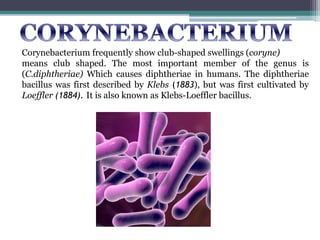
Corynebacterium frequently show club-shaped swellings (coryne)
means club shaped. The most important member of the genus is
(C.diphtheriae) Which causes diphtheriae in humans. The diphtheriae
bacillus was first described by Klebs (1883), but was first cultivated by
Loeffler (1884). It is also known as Klebs-Loeffler bacillus.
• Morphology
1- They are thin, slender, Gram positive bacilli.
2- Approximately 3-6µm × 0.6-0.8µm.
3- Non-acid fast, non-motile, non-sporing.
4- They are pleomorphic. They are club shaped due
to the presence of metachromatic granules at both
ends.
• Laboratory Diagnosis:
Specific treatment should be started immediately
after clinical diagnosis without waiting for lab
reports.
• Collection of specimen:
Tw0 swabs from the lesions (throat, nose, larynx
ear, conjunctiva, vagina or skin are collected. One
swab is for smear examination & other is for culture.
Direct microscopy
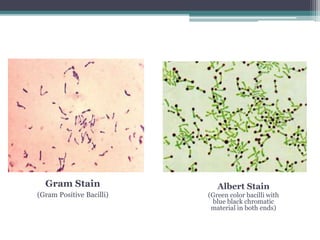
Smears are stained with both Gram and
Albert stain. Diphtheria bacilli show beaded
slender green rods in typical Chinese letter
pattern on Albert's staining.
• Gram staining is done to identify Vincent's
spirochaetes and fusiform bacilli (other
causes of sore throat).
Gram Stain
(Gram Positive Bacilli)
Albert Stain
(Green color bacilli with
blue black chromatic
material in both ends)
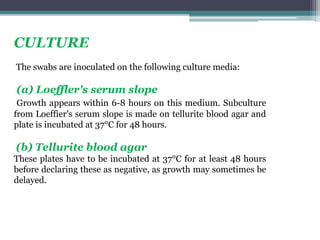
CULTURE
The swabs are inoculated on the following culture media:
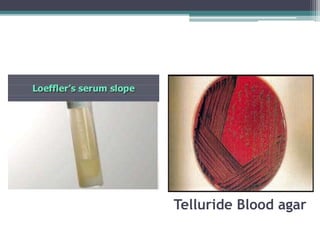
(a) Loeffler's serum slope
Growth appears within 6-8 hours on this medium. Subculture
from Loeffier's serum slope is made on tellurite blood agar and
plate is incubated at 37°C for 48 hours.
(b) Tellurite blood agar
These plates have to be incubated at 37°C for at least 48 hours
before declaring these as negative, as growth may sometimes be
delayed.
Telluride Blood agar
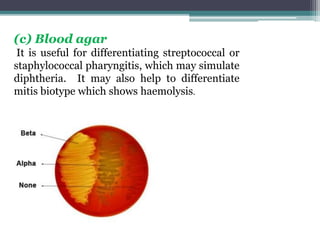
(c) Blood agar
It is useful for differentiating streptococcal or
staphylococcal pharyngitis, which may simulate
diphtheria. It may also help to differentiate
mitis biotype which shows haemolysis.
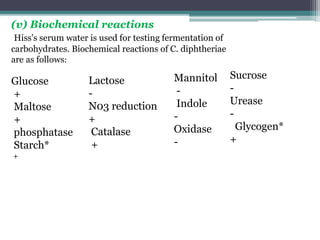
(v) Biochemical reactions
Hiss's serum water is used for testing fermentation of
carbohydrates. Biochemical reactions of C. diphtheriae
are as follows:
Glucose
+
Maltose
+
phosphatase
Starch*
+
Lactose
-
N03 reduction
+
Catalase
+
Mannitol
-
Indole
-
Oxidase
-
Sucrose
-
Urease
-
Glycogen*
+
PYRAZINAMIDASE (PYZ)TEST
Pyrazinamide is converted into pyrazinoic acid by the
organisms which produce pyrazinamidase (PYZ). This test is
helpful to distinguish 'C. diphtheriae' (PYZ-negative) from
other corynebacterium species (mostly PYZpositive ).
VIRULENCE TESTS
These tests demonstrate the production of exotoxin by
bacteria isolated on culture. Virulence testing may be done
by in vivo or in vitro methods.
In vivo tests
Guinea pigs and rabbits are susceptible to toxin produced
by C. diphtheriae. Two types of test are used viz.
subcutaneous and intracutaneous.
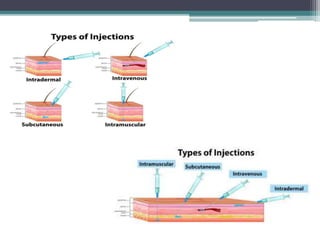
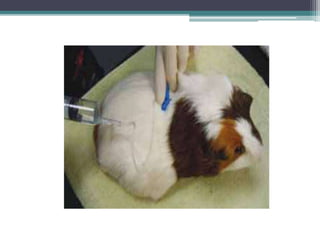
(a) Subcutaneous test
The growth from an overnight culture on Loeffler's
serum slope is emulsified in 2- 5 ml broth and 0.8 ml of
this emulsion is injected subcutaneously into two
guinea pigs, one of which has received an
intramuscular injection of 500 units of diphtheria
antitoxin 18- 24 hours previously (this protected animal
acts as a control). If the strain is virulent, the
unprotected animal will die within 2 to 3 days with
evidence of haemorrhage in the adrenal glands which is
the pathognomonic feature.
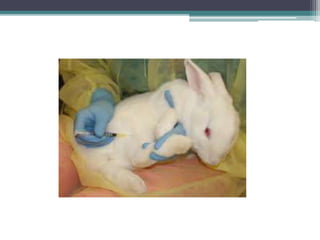
(b) Intracutaneous test
Two guinea pigs (or rabbits) are injected intracutaneously with 0.1 ml
emulsion from growth on Loeffier's serum slope, one of these animals is
protected with 500 units antitoxin the previous day (control) and the other
is given 50 units of antitoxin intraperitoneally four hours after the skin
test, in order to prevent death. If the strain is toxigenic (virulent), the
inflammatory reaction at the site of injection, progresses to necrosis in 48
to 72 hours in the test animal but there is no change in the control animal.
An advantage in the intracutaneous test is that 8 to 10 strains can be tested
at a time on a pair of animals and the animals do not die.
IN VITRO TESTS
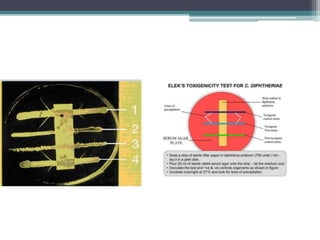
(a) Elek's gel precipitation test -
This is an immunodiffusion test described by Elek (1949). A
rectangular strip of filter paper soaked in diphtheria antitoxin (1000
units per ml) is placed on the surface of a 20% horse serum agar
plate while the medium is still fluid. When the agar solidifies, the
test strain is streaked at right angle to the filter paper strip. The
positive and negative controls are also put up. The plate is incubated
at 37°C for 24 to 48 hours. The toxin produced by the bacterial
growth diffuses in the agar and produces a line of precipitation
where it meets the antitoxin at optimum concentration. Non-
toxigenic strains will not produce any precipitation line.
(b) Tissue culture test
This is done by incorporating the test strains
into the agar overlay of cell culture
monolayers. The toxin produced diffuses
into the underlying cells and kills them.
(c) Other tests
Enzyme linked immunosorbent assays
(ELISA) and immunochromatographic strip
assays are also available for the detection of
toxin. These are rapid tests.
(d) Polymerase chain reaction (PCR)
C. diphtheriae tox gene can be detected by
PCR. This test can also be applied directly to
clinical specimen.
CORYNEBACTERIUM (Diphtheria).pptx

CORYNEBACTERIUM (Diphtheria).pptx

  • 2.
    Corynebacterium frequently showclub-shaped swellings (coryne) means club shaped. The most important member of the genus is (C.diphtheriae) Which causes diphtheriae in humans. The diphtheriae bacillus was first described by Klebs (1883), but was first cultivated by Loeffler (1884). It is also known as Klebs-Loeffler bacillus.
  • 3.
    • Morphology 1- Theyare thin, slender, Gram positive bacilli. 2- Approximately 3-6µm × 0.6-0.8µm. 3- Non-acid fast, non-motile, non-sporing. 4- They are pleomorphic. They are club shaped due to the presence of metachromatic granules at both ends. • Laboratory Diagnosis: Specific treatment should be started immediately after clinical diagnosis without waiting for lab reports. • Collection of specimen: Tw0 swabs from the lesions (throat, nose, larynx ear, conjunctiva, vagina or skin are collected. One swab is for smear examination & other is for culture.
  • 4.
    Direct microscopy Smears arestained with both Gram and Albert stain. Diphtheria bacilli show beaded slender green rods in typical Chinese letter pattern on Albert's staining. • Gram staining is done to identify Vincent's spirochaetes and fusiform bacilli (other causes of sore throat).
  • 5.
    Gram Stain (Gram PositiveBacilli) Albert Stain (Green color bacilli with blue black chromatic material in both ends)
  • 6.
    CULTURE The swabs areinoculated on the following culture media: (a) Loeffler's serum slope Growth appears within 6-8 hours on this medium. Subculture from Loeffier's serum slope is made on tellurite blood agar and plate is incubated at 37°C for 48 hours. (b) Tellurite blood agar These plates have to be incubated at 37°C for at least 48 hours before declaring these as negative, as growth may sometimes be delayed.
  • 7.
  • 8.
    (c) Blood agar Itis useful for differentiating streptococcal or staphylococcal pharyngitis, which may simulate diphtheria. It may also help to differentiate mitis biotype which shows haemolysis.
  • 9.
    (v) Biochemical reactions Hiss'sserum water is used for testing fermentation of carbohydrates. Biochemical reactions of C. diphtheriae are as follows: Glucose + Maltose + phosphatase Starch* + Lactose - N03 reduction + Catalase + Mannitol - Indole - Oxidase - Sucrose - Urease - Glycogen* +
  • 10.
    PYRAZINAMIDASE (PYZ)TEST Pyrazinamide isconverted into pyrazinoic acid by the organisms which produce pyrazinamidase (PYZ). This test is helpful to distinguish 'C. diphtheriae' (PYZ-negative) from other corynebacterium species (mostly PYZpositive ).
  • 11.
    VIRULENCE TESTS These testsdemonstrate the production of exotoxin by bacteria isolated on culture. Virulence testing may be done by in vivo or in vitro methods. In vivo tests Guinea pigs and rabbits are susceptible to toxin produced by C. diphtheriae. Two types of test are used viz. subcutaneous and intracutaneous.
  • 13.
    (a) Subcutaneous test Thegrowth from an overnight culture on Loeffler's serum slope is emulsified in 2- 5 ml broth and 0.8 ml of this emulsion is injected subcutaneously into two guinea pigs, one of which has received an intramuscular injection of 500 units of diphtheria antitoxin 18- 24 hours previously (this protected animal acts as a control). If the strain is virulent, the unprotected animal will die within 2 to 3 days with evidence of haemorrhage in the adrenal glands which is the pathognomonic feature.
  • 15.
    (b) Intracutaneous test Twoguinea pigs (or rabbits) are injected intracutaneously with 0.1 ml emulsion from growth on Loeffier's serum slope, one of these animals is protected with 500 units antitoxin the previous day (control) and the other is given 50 units of antitoxin intraperitoneally four hours after the skin test, in order to prevent death. If the strain is toxigenic (virulent), the inflammatory reaction at the site of injection, progresses to necrosis in 48 to 72 hours in the test animal but there is no change in the control animal. An advantage in the intracutaneous test is that 8 to 10 strains can be tested at a time on a pair of animals and the animals do not die.
  • 17.
    IN VITRO TESTS (a)Elek's gel precipitation test - This is an immunodiffusion test described by Elek (1949). A rectangular strip of filter paper soaked in diphtheria antitoxin (1000 units per ml) is placed on the surface of a 20% horse serum agar plate while the medium is still fluid. When the agar solidifies, the test strain is streaked at right angle to the filter paper strip. The positive and negative controls are also put up. The plate is incubated at 37°C for 24 to 48 hours. The toxin produced by the bacterial growth diffuses in the agar and produces a line of precipitation where it meets the antitoxin at optimum concentration. Non- toxigenic strains will not produce any precipitation line.
  • 19.
    (b) Tissue culturetest This is done by incorporating the test strains into the agar overlay of cell culture monolayers. The toxin produced diffuses into the underlying cells and kills them. (c) Other tests Enzyme linked immunosorbent assays (ELISA) and immunochromatographic strip assays are also available for the detection of toxin. These are rapid tests. (d) Polymerase chain reaction (PCR) C. diphtheriae tox gene can be detected by PCR. This test can also be applied directly to clinical specimen.