Observing the Night Sky
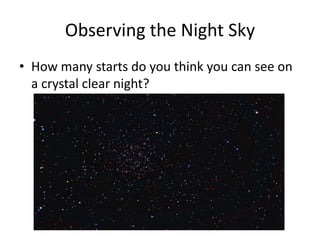
• How many starts do you think you can see on
  a crystal clear night?
Visible stars on a clear night
• Unaided human eye – 6,000 stars
• At any one time – 3,000 stars
   – ½ above horizon, ½ below horizon
• Reality – light pollution and other factors limit
  visible stars to a few hundred
   – Suburban: 500+
   – Inner-city: 300+
Constellations


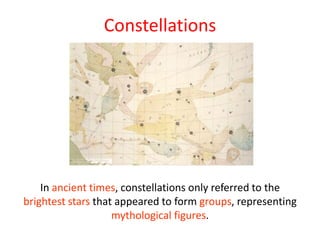
    In ancient times, constellations only referred to the
brightest stars that appeared to form groups, representing
                    mythological figures.
Asterism vs. Constellation
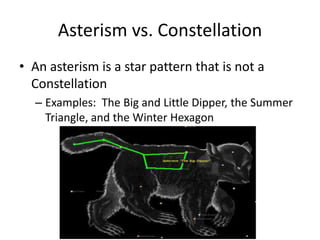
• An asterism is a star pattern that is not a
  Constellation
  – Examples: The Big and Little Dipper, the Summer
    Triangle, and the Winter Hexagon
Looking at the Sky
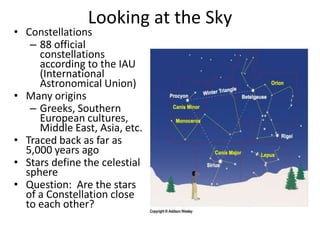
• Constellations
   – 88 official
     constellations
     according to the IAU
     (International
     Astronomical Union)
• Many origins
   – Greeks, Southern
     European cultures,
     Middle East, Asia, etc.
• Traced back as far as
  5,000 years ago
• Stars define the celestial
  sphere
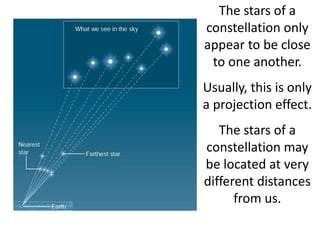
• Question: Are the stars
  of a Constellation close
  to each other?
The stars of a
constellation only
appear to be close
 to one another.
Usually, this is only
a projection effect.
   The stars of a
constellation may
be located at very
different distances
      from us.
Today, constellations are well-defined regions on
 the sky, irrespective of the presence or absence of
bright stars in those regions. They serve as a way to
  break up and organize the sky (celestial sphere).
How can we use the Constellations?
• Think of the constellations as a map of the sky.
  The more constellations you can recognize the
  better your ability to navigate the night sky
  will be.
• Every celestial object can be found within a
  constellation. Knowing the constellations tells
  you where to look for objects and phenomena
  like planets, galaxies, comets, and meteor
  showers.
Our View of the Sky
• Our view changes because of the motions that
  occur in the solar system.
  –   Earth is spinning (rotating)
  –   Earth is orbiting (revolving around) the Sun
  –   The Moon is orbiting Earth
  –   The other planets are also orbiting the Sun
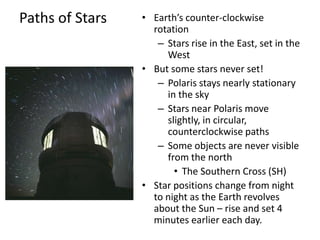
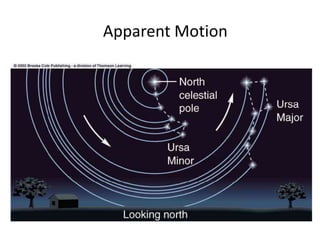
Paths of Stars   • Earth’s counter-clockwise
                   rotation
                    – Stars rise in the East, set in the
                      West
                 • But some stars never set!
                    – Polaris stays nearly stationary
                      in the sky
                    – Stars near Polaris move
                      slightly, in circular,
                      counterclockwise paths
                    – Some objects are never visible
                      from the north
                        • The Southern Cross (SH)
                 • Star positions change from night
                   to night as the Earth revolves
                   about the Sun – rise and set 4
                   minutes earlier each day.
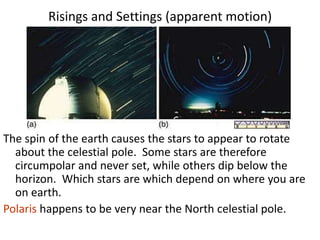
Risings and Settings (apparent motion)


The spin of the earth causes the stars to appear to rotate
  about the celestial pole. Some stars are therefore
  circumpolar and never set, while others dip below the
  horizon. Which stars are which depend on where you are
  on earth.
Polaris happens to be very near the North celestial pole.
Apparent Motion
What would the apparent motion of
         the stars be if…
1. You were standing at the North Pole.
2. You were standing at the equator
3. You were standing at the South Pole
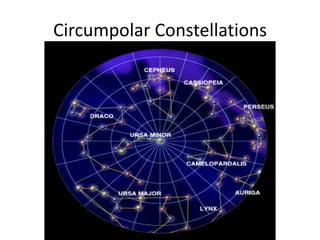
Circumpolar Stars (from our
        latitude)
Circumpolar Constellations
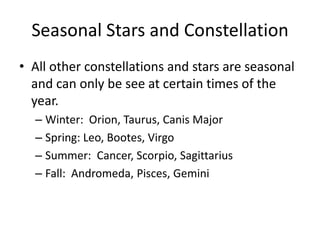
Seasonal Stars and Constellation
• All other constellations and stars are seasonal
  and can only be see at certain times of the
  year.
  – Winter: Orion, Taurus, Canis Major
  – Spring: Leo, Bootes, Virgo
  – Summer: Cancer, Scorpio, Sagittarius
  – Fall: Andromeda, Pisces, Gemini
The Yearly Motion
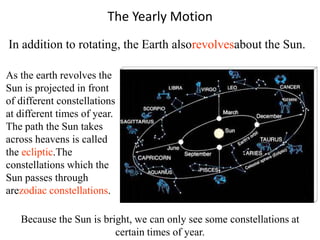
In addition to rotating, the Earth alsorevolvesabout the Sun.

As the earth revolves the
Sun is projected in front
of different constellations
at different times of year.
The path the Sun takes
across heavens is called
the ecliptic.The
constellations which the
Sun passes through
arezodiac constellations.

   Because the Sun is bright, we can only see some constellations at
                         certain times of year.
Constellations

Constellations

  • 1.
    Observing the NightSky • How many starts do you think you can see on a crystal clear night?
  • 2.
    Visible stars ona clear night • Unaided human eye – 6,000 stars • At any one time – 3,000 stars – ½ above horizon, ½ below horizon • Reality – light pollution and other factors limit visible stars to a few hundred – Suburban: 500+ – Inner-city: 300+
  • 3.
    Constellations In ancient times, constellations only referred to the brightest stars that appeared to form groups, representing mythological figures.
  • 4.
    Asterism vs. Constellation •An asterism is a star pattern that is not a Constellation – Examples: The Big and Little Dipper, the Summer Triangle, and the Winter Hexagon
  • 5.
    Looking at theSky • Constellations – 88 official constellations according to the IAU (International Astronomical Union) • Many origins – Greeks, Southern European cultures, Middle East, Asia, etc. • Traced back as far as 5,000 years ago • Stars define the celestial sphere • Question: Are the stars of a Constellation close to each other?
  • 6.
    The stars ofa constellation only appear to be close to one another. Usually, this is only a projection effect. The stars of a constellation may be located at very different distances from us.
  • 7.
    Today, constellations arewell-defined regions on the sky, irrespective of the presence or absence of bright stars in those regions. They serve as a way to break up and organize the sky (celestial sphere).
  • 8.
    How can weuse the Constellations? • Think of the constellations as a map of the sky. The more constellations you can recognize the better your ability to navigate the night sky will be. • Every celestial object can be found within a constellation. Knowing the constellations tells you where to look for objects and phenomena like planets, galaxies, comets, and meteor showers.
  • 9.
    Our View ofthe Sky • Our view changes because of the motions that occur in the solar system. – Earth is spinning (rotating) – Earth is orbiting (revolving around) the Sun – The Moon is orbiting Earth – The other planets are also orbiting the Sun
  • 10.
    Paths of Stars • Earth’s counter-clockwise rotation – Stars rise in the East, set in the West • But some stars never set! – Polaris stays nearly stationary in the sky – Stars near Polaris move slightly, in circular, counterclockwise paths – Some objects are never visible from the north • The Southern Cross (SH) • Star positions change from night to night as the Earth revolves about the Sun – rise and set 4 minutes earlier each day.
  • 11.
    Risings and Settings(apparent motion) The spin of the earth causes the stars to appear to rotate about the celestial pole. Some stars are therefore circumpolar and never set, while others dip below the horizon. Which stars are which depend on where you are on earth. Polaris happens to be very near the North celestial pole.
  • 12.
  • 13.
    What would theapparent motion of the stars be if… 1. You were standing at the North Pole. 2. You were standing at the equator 3. You were standing at the South Pole
  • 14.
  • 15.
  • 16.
    Seasonal Stars andConstellation • All other constellations and stars are seasonal and can only be see at certain times of the year. – Winter: Orion, Taurus, Canis Major – Spring: Leo, Bootes, Virgo – Summer: Cancer, Scorpio, Sagittarius – Fall: Andromeda, Pisces, Gemini
  • 17.
    The Yearly Motion Inaddition to rotating, the Earth alsorevolvesabout the Sun. As the earth revolves the Sun is projected in front of different constellations at different times of year. The path the Sun takes across heavens is called the ecliptic.The constellations which the Sun passes through arezodiac constellations. Because the Sun is bright, we can only see some constellations at certain times of year.