The substance which when added in small quantities to
the aqueous corrosive environment, effectively decrease
the corrosion of a metal is called corrosion inhibitor.
Inhibitors are of two types
Anodic inhibitors
Cathodic inhibitors
CORROSION INHIBITORS
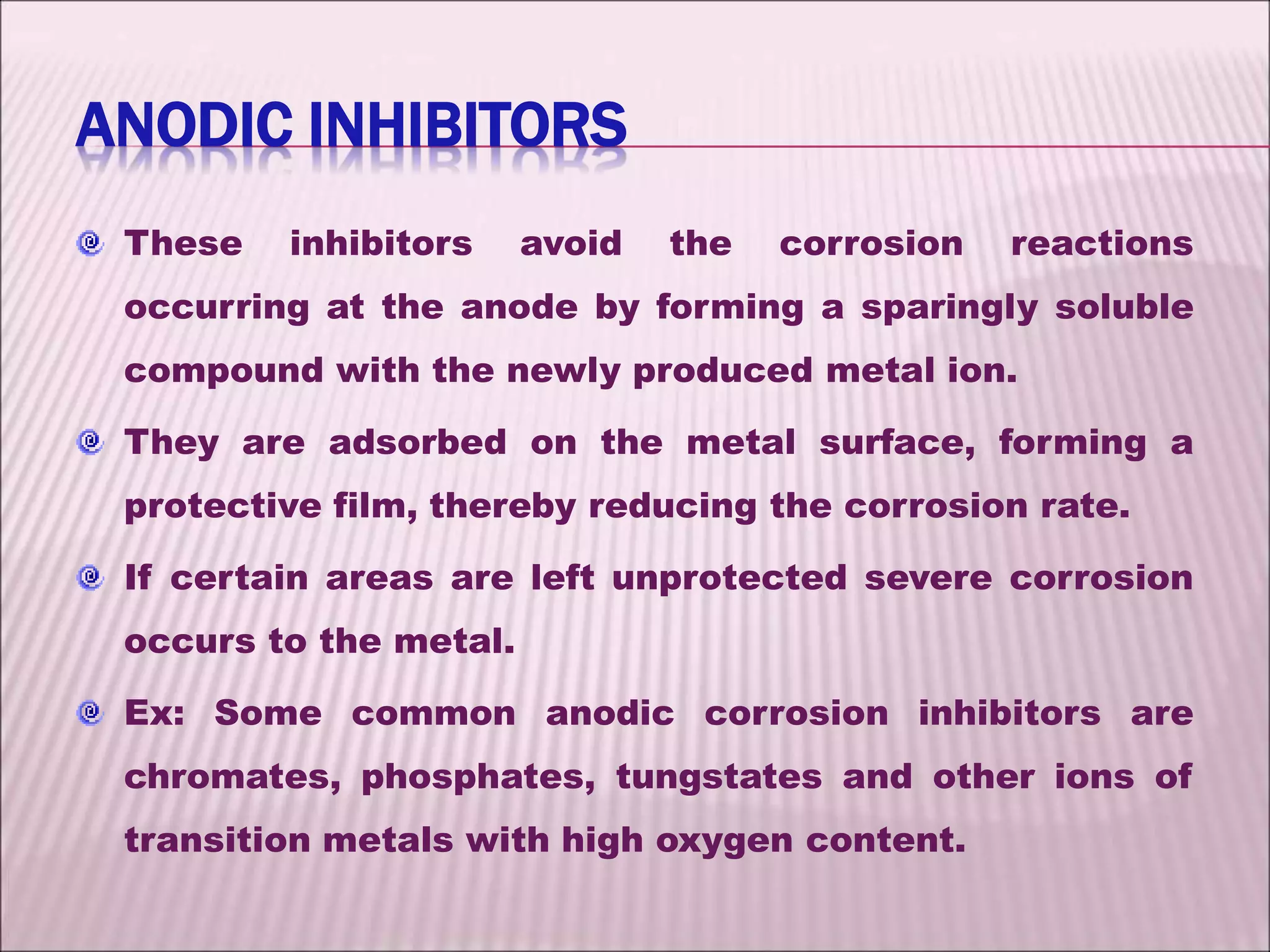
ANODIC INHIBITORS
These inhibitors avoid the corrosion reactions
occurring at the anode by forming a sparingly soluble
compound with the newly produced metal ion.
They are adsorbed on the metal surface, forming a
protective film, thereby reducing the corrosion rate.
If certain areas are left unprotected severe corrosion
occurs to the metal.
Ex: Some common anodic corrosion inhibitors are
chromates, phosphates, tungstates and other ions of
transition metals with high oxygen content.
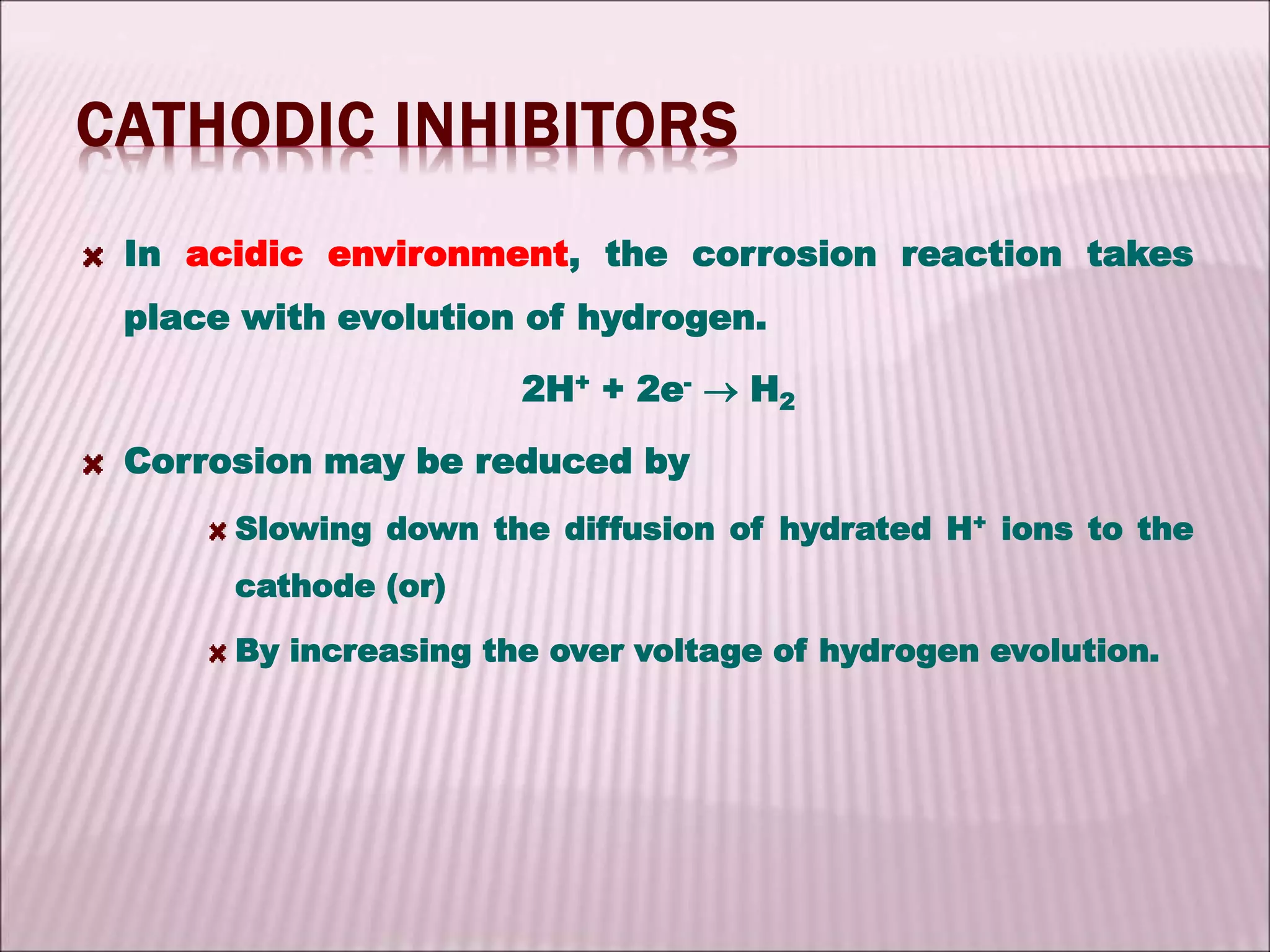
CATHODIC INHIBITORS
In acidic environment, the corrosion reaction takes
place with evolution of hydrogen.
2H+ + 2e-  H2
Corrosion may be reduced by
Slowing down the diffusion of hydrated H+ ions to the
cathode (or)
By increasing the over voltage of hydrogen evolution.
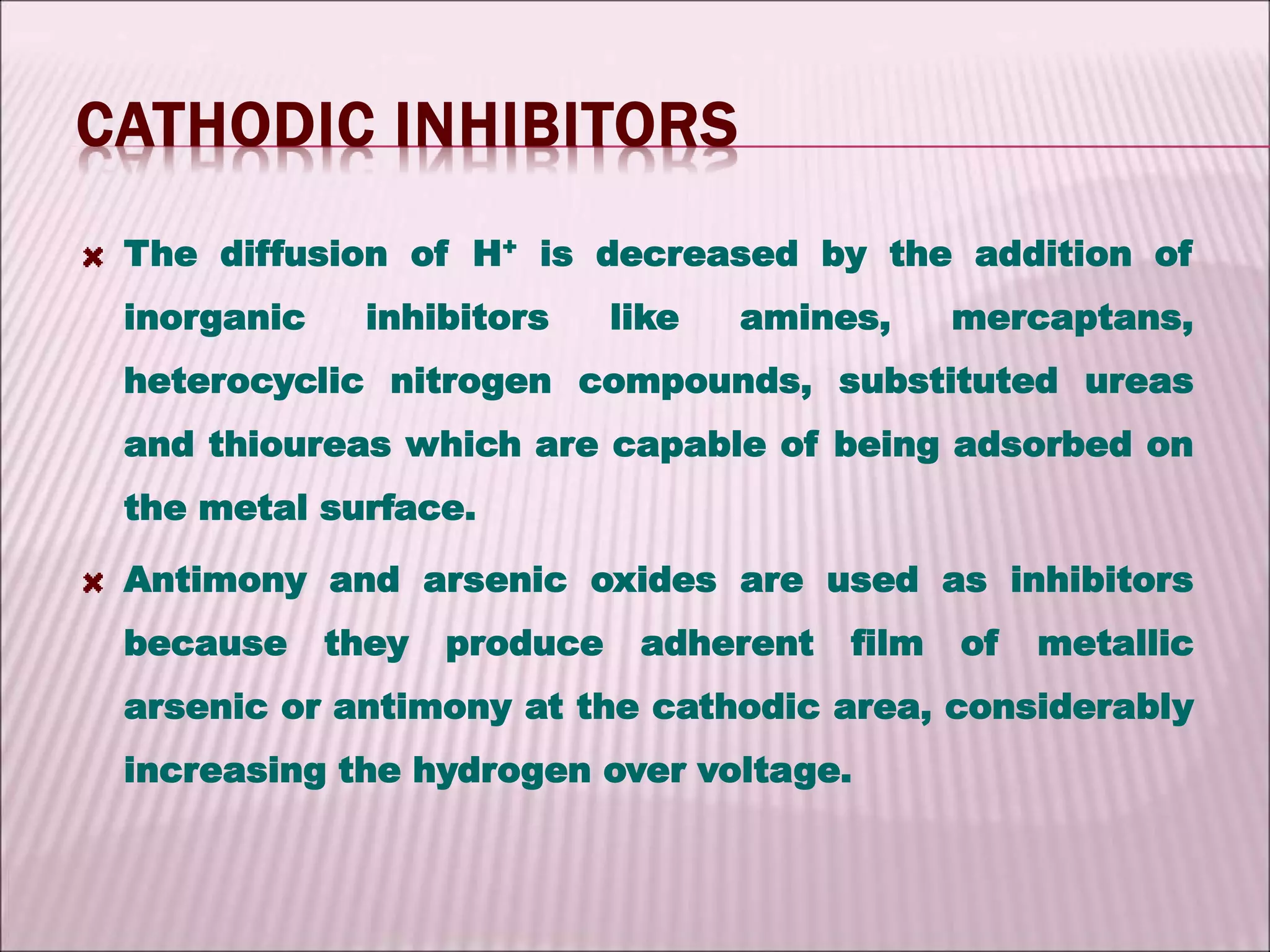
CATHODIC INHIBITORS
The diffusion of H+ is decreased by the addition of
inorganic inhibitors like amines, mercaptans,
heterocyclic nitrogen compounds, substituted ureas
and thioureas which are capable of being adsorbed on
the metal surface.
Antimony and arsenic oxides are used as inhibitors
because they produce adherent film of metallic
arsenic or antimony at the cathodic area, considerably
increasing the hydrogen over voltage.
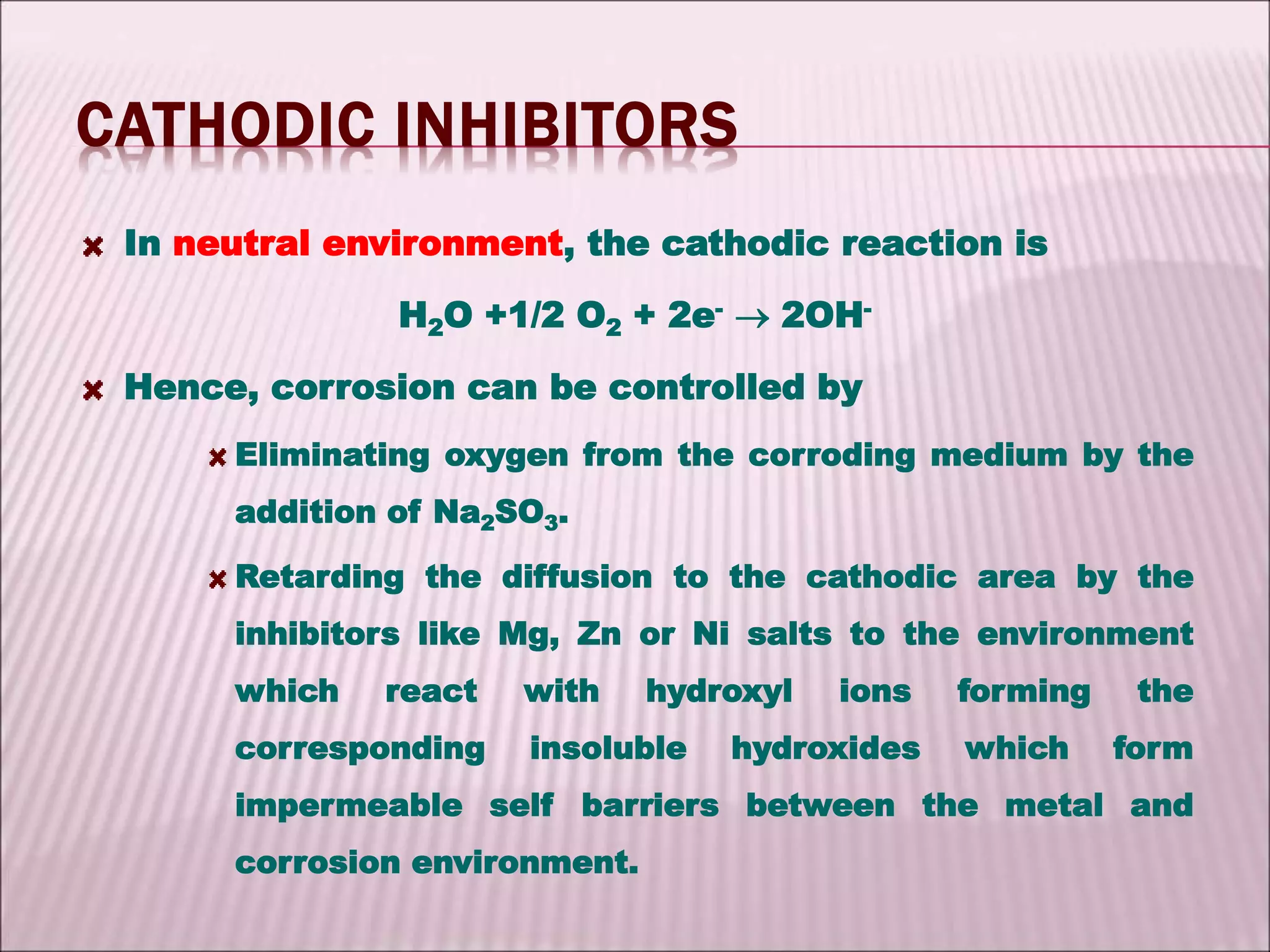
CATHODIC INHIBITORS
In neutral environment, the cathodic reaction is
H2O +1/2 O2 + 2e-  2OH-
Hence, corrosion can be controlled by
Eliminating oxygen from the corroding medium by the
addition of Na2SO3.
Retarding the diffusion to the cathodic area by the
inhibitors like Mg, Zn or Ni salts to the environment
which react with hydroxyl ions forming the
corresponding insoluble hydroxides which form
impermeable self barriers between the metal and
corrosion environment.
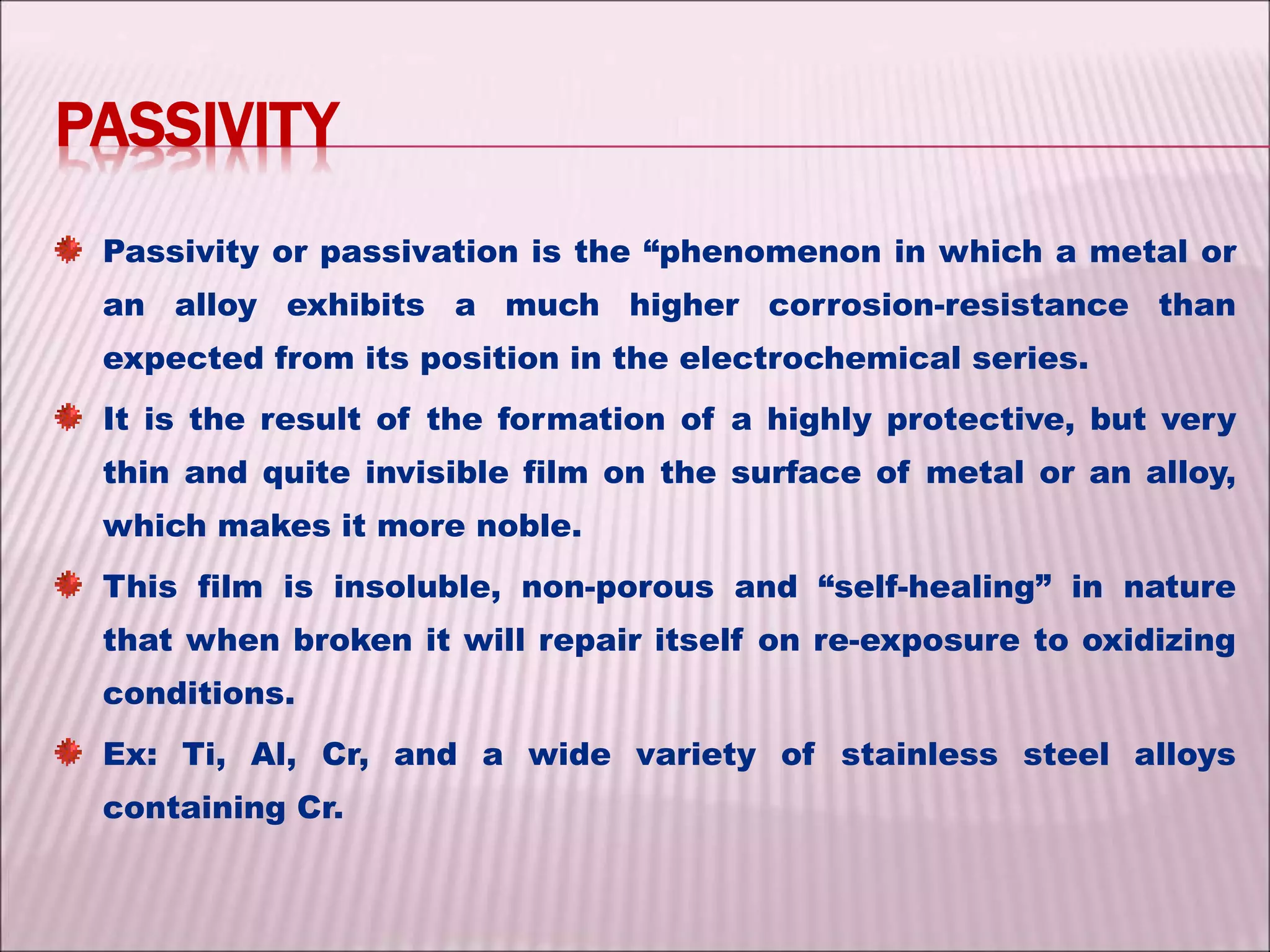
PASSIVITY
Passivity or passivation is the “phenomenon in which a metal or
an alloy exhibits a much higher corrosion-resistance than
expected from its position in the electrochemical series.
It is the result of the formation of a highly protective, but very
thin and quite invisible film on the surface of metal or an alloy,
which makes it more noble.
This film is insoluble, non-porous and “self-healing” in nature
that when broken it will repair itself on re-exposure to oxidizing
conditions.
Ex: Ti, Al, Cr, and a wide variety of stainless steel alloys
containing Cr.
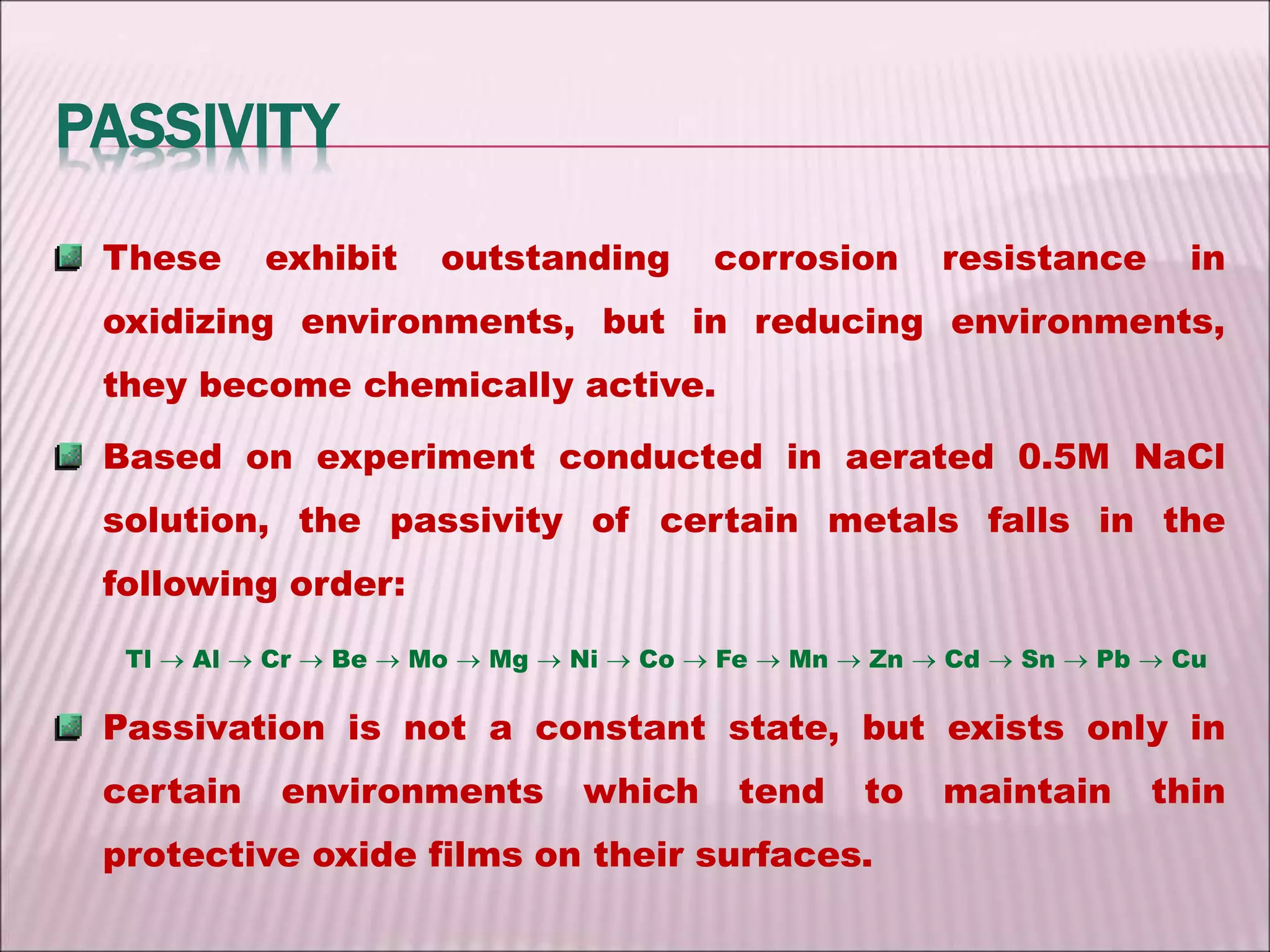
PASSIVITY
These exhibit outstanding corrosion resistance in
oxidizing environments, but in reducing environments,
they become chemically active.
Based on experiment conducted in aerated 0.5M NaCl
solution, the passivity of certain metals falls in the
following order:
Tl  Al  Cr  Be  Mo  Mg  Ni  Co  Fe  Mn  Zn  Cd  Sn  Pb  Cu
Passivation is not a constant state, but exists only in
certain environments which tend to maintain thin
protective oxide films on their surfaces.
PASSIVITY
In the presence of oxygen, the oxide film is
automatically repaired, whenever any damage occurs,
but in oxygen absence, the passive metals and alloys
become chemically active and are rapidly corroded.
Ex: Austentic stainless steels are quite good resistant
to the action of aerated dilute H2SO4, but show low
resistance in air-free acid.
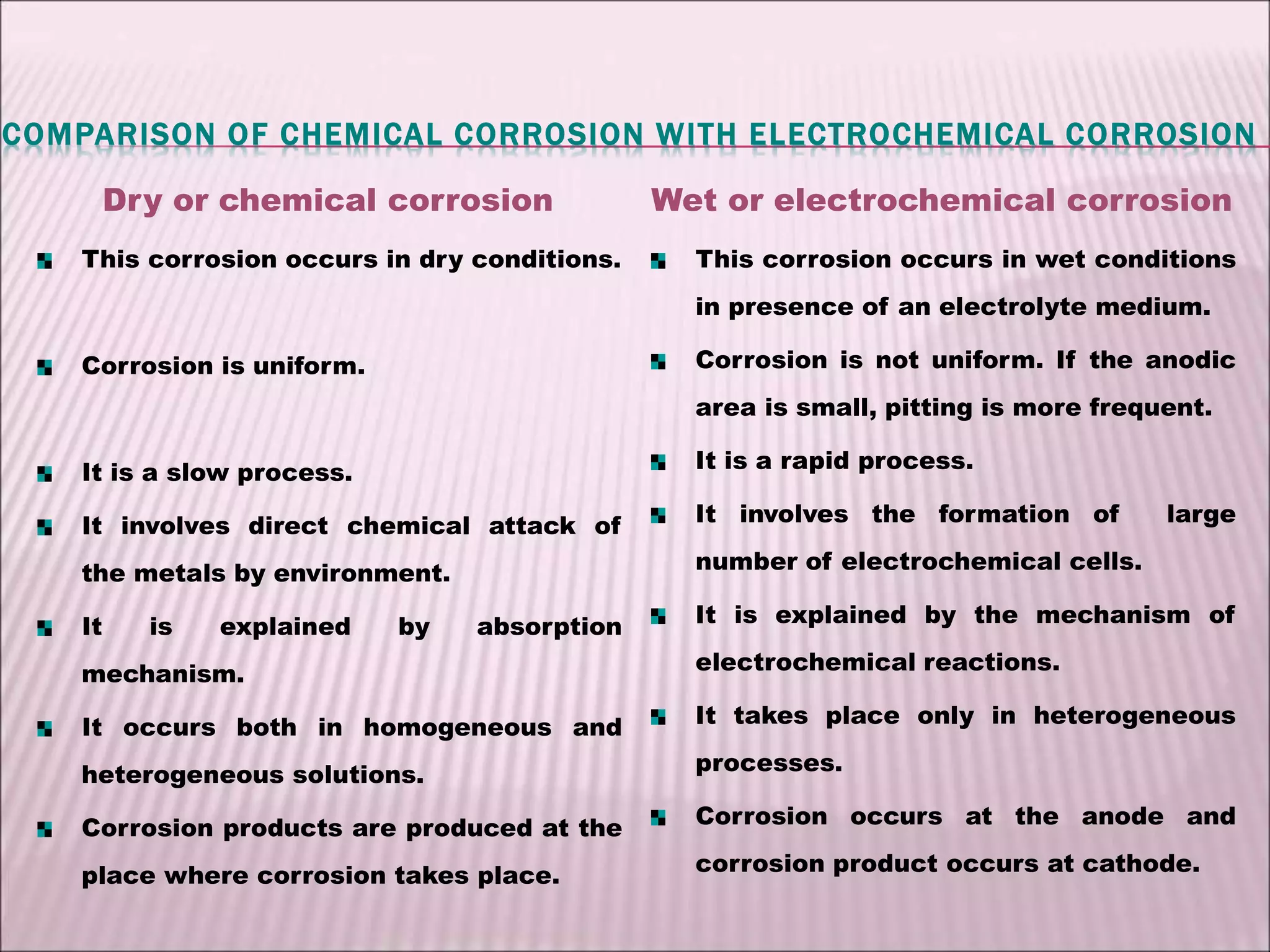
COMPARISON OF CHEMICAL CORROSION WITH ELECTROCHEMICAL CORROSION
Dry or chemical corrosion
This corrosion occurs in dry conditions.
Corrosion is uniform.
It is a slow process.
It involves direct chemical attack of
the metals by environment.
It is explained by absorption
mechanism.
It occurs both in homogeneous and
heterogeneous solutions.
Corrosion products are produced at the
place where corrosion takes place.
Wet or electrochemical corrosion
This corrosion occurs in wet conditions
in presence of an electrolyte medium.
Corrosion is not uniform. If the anodic
area is small, pitting is more frequent.
It is a rapid process.
It involves the formation of large
number of electrochemical cells.
It is explained by the mechanism of
electrochemical reactions.
It takes place only in heterogeneous
processes.
Corrosion occurs at the anode and
corrosion product occurs at cathode.
Corrosion inhibitors.ppt

Corrosion inhibitors.ppt

  • 1.
    The substance whichwhen added in small quantities to the aqueous corrosive environment, effectively decrease the corrosion of a metal is called corrosion inhibitor. Inhibitors are of two types Anodic inhibitors Cathodic inhibitors CORROSION INHIBITORS
  • 2.
    ANODIC INHIBITORS These inhibitorsavoid the corrosion reactions occurring at the anode by forming a sparingly soluble compound with the newly produced metal ion. They are adsorbed on the metal surface, forming a protective film, thereby reducing the corrosion rate. If certain areas are left unprotected severe corrosion occurs to the metal. Ex: Some common anodic corrosion inhibitors are chromates, phosphates, tungstates and other ions of transition metals with high oxygen content.
  • 3.
    CATHODIC INHIBITORS In acidicenvironment, the corrosion reaction takes place with evolution of hydrogen. 2H+ + 2e-  H2 Corrosion may be reduced by Slowing down the diffusion of hydrated H+ ions to the cathode (or) By increasing the over voltage of hydrogen evolution.
  • 4.
    CATHODIC INHIBITORS The diffusionof H+ is decreased by the addition of inorganic inhibitors like amines, mercaptans, heterocyclic nitrogen compounds, substituted ureas and thioureas which are capable of being adsorbed on the metal surface. Antimony and arsenic oxides are used as inhibitors because they produce adherent film of metallic arsenic or antimony at the cathodic area, considerably increasing the hydrogen over voltage.
  • 5.
    CATHODIC INHIBITORS In neutralenvironment, the cathodic reaction is H2O +1/2 O2 + 2e-  2OH- Hence, corrosion can be controlled by Eliminating oxygen from the corroding medium by the addition of Na2SO3. Retarding the diffusion to the cathodic area by the inhibitors like Mg, Zn or Ni salts to the environment which react with hydroxyl ions forming the corresponding insoluble hydroxides which form impermeable self barriers between the metal and corrosion environment.
  • 6.
    PASSIVITY Passivity or passivationis the “phenomenon in which a metal or an alloy exhibits a much higher corrosion-resistance than expected from its position in the electrochemical series. It is the result of the formation of a highly protective, but very thin and quite invisible film on the surface of metal or an alloy, which makes it more noble. This film is insoluble, non-porous and “self-healing” in nature that when broken it will repair itself on re-exposure to oxidizing conditions. Ex: Ti, Al, Cr, and a wide variety of stainless steel alloys containing Cr.
  • 7.
    PASSIVITY These exhibit outstandingcorrosion resistance in oxidizing environments, but in reducing environments, they become chemically active. Based on experiment conducted in aerated 0.5M NaCl solution, the passivity of certain metals falls in the following order: Tl  Al  Cr  Be  Mo  Mg  Ni  Co  Fe  Mn  Zn  Cd  Sn  Pb  Cu Passivation is not a constant state, but exists only in certain environments which tend to maintain thin protective oxide films on their surfaces.
  • 8.
    PASSIVITY In the presenceof oxygen, the oxide film is automatically repaired, whenever any damage occurs, but in oxygen absence, the passive metals and alloys become chemically active and are rapidly corroded. Ex: Austentic stainless steels are quite good resistant to the action of aerated dilute H2SO4, but show low resistance in air-free acid.
  • 9.
    COMPARISON OF CHEMICALCORROSION WITH ELECTROCHEMICAL CORROSION Dry or chemical corrosion This corrosion occurs in dry conditions. Corrosion is uniform. It is a slow process. It involves direct chemical attack of the metals by environment. It is explained by absorption mechanism. It occurs both in homogeneous and heterogeneous solutions. Corrosion products are produced at the place where corrosion takes place. Wet or electrochemical corrosion This corrosion occurs in wet conditions in presence of an electrolyte medium. Corrosion is not uniform. If the anodic area is small, pitting is more frequent. It is a rapid process. It involves the formation of large number of electrochemical cells. It is explained by the mechanism of electrochemical reactions. It takes place only in heterogeneous processes. Corrosion occurs at the anode and corrosion product occurs at cathode.

Editor's Notes