GROSSING
1
Sansar Babu Tiwari, MBBS, PGY I
Department of Pathology
TUTH
15th November 2019
Embryology
Thyroid gland is a endodermal
outpouching of epithelial lining in the
foramen cecum between tubercular
impar and copula of the primitive
pharynx.
It penetrates the tongue, goes anterior
to the hyoid bone to lie anterior to the
trachea at the level of C5-T1…
thyroglossal duct.
Embryology
Median analge.
Starts as a single solid spherical structure,
later divides into bilobed structure (7th week
gestation). Thyroglossal duct atrophies giving a
vestige known as pyramidal lobe in approx.
40% individuals.
Failure of migration may lead to ectopic
thyroid tissue, thyroglossal duct cyst and
cervical fistulae.
At 9 week gestation, solid form  cords and
plates of follicular cells.
At 10th week  small follicles appear
At 14th week  well-developed follicles with
central colloids
Embryology
2 lateral analgen.
Ultimobranchial bodies (4th-5th branchial pouch complex)
Descends with parathyroid IV analge.
At 7th – 8th week, they separate from the pharynx and the parathyroid.
At 8th – 9th week , they appear as solid masses that fuse with the
dorsolateral aspects of the median thyroid analge and become incorporated
into the developing lateral lobes.  dissolution phase and divides into a
central thick-walled stratified epithelial cyst and a peripheral component
composed of cell groups dispersed among the follicles: THE C CELLS.
If the central epithelial cysts fails to disappear in the post natal life, it is called
solid cell nests (SCNs).
C cells are completely absent in the thyroglossal duct remnants and cysts, as
well as in lingual thyroid.
Anatomy
Anatomy
Anatomy
USG view of Thyroid Gland
Anatomy
Rationale for Thyroidectomy:
1. Presence of solitary nodule
a. For treatment of FNAC proven malignancy
b. In case of suspicious, equivocal or non-diagnostic FNAC
2. Diffuse/Multinodular enlargement
a. For relief of compression symptoms
b. For cosmetic purpose
3. Hyperthyroidism refractory to medical treatment
4. Prophylactic thyroidectomy in MEN 2A as 90% develop medullary
ca.
Relevant Clinical Information
1. Age and gender of patient
2. Indications of surgery: Suspected/diagnosed malignancy/benign
3. Radiological details
4. FNAC results
5. Result of TFT and autoantibodies
6. History of malignancy and other prior procedures
7. Family history of thyroid disease/MEN syndromes
COLD, SOLITARY NODULE IN YOUNGER MALES WITH HISTORY OF
RADIATION ARE LIKELY TO BE NEOPLASTIC THAN NOT.
Types of Thyroidectomy
1. Lobectomy/Hemithyroidectomy
2. Isthmectomy
3. Near total thyroidectomy
4. Total thyroidectomy
5. Completion thyroidectomy
Steps in Grossing
1. Check the label and site, describe the type of specimen and laterality if
applicable
2. Weigh the specimen and record the dimensions
3. Orient the specimen
4. Describe the external surface
a. Color (Beefy: Normal, Graves; pale: Hashimoto, Amber: amiodarone, Black:
minocycline therapy and melanin deposit in elderly)
b. Appearance – nodular, distended, bosselated (Hashimoto)
c. Unilateral enlargement, presence of any nodule
d. Capsule intact/breached (Posterior thin so posterior extension in common)
e. Any other adherent structure
f. Look for parathyroid gland
5. Ink (delayed due to proteinaceous colloid  Acetic acid with fasten)
Steps in Grossing
6. Separate the lobe and isthmus either transverse up-to-low (<2 cm), or
coronal (>2cm) medial to lateral.
7. On slicing each lobe and isthmus, note down:
a. Consistency of the gland: cystic, firm or hard
b. Appearance: Smooth, homogenous or nodular
c. Presence of any lesion, nodule or cysts:
i. Number dimension and shape
ii. Color: Pale or beefy red
iii. Appearance: Cystic/Papillary/Nodular/Gelatinous
iv. Consistency: Firm/Hard/Rubbery
v. Presence of Calcification/Hemorrhage/Necrosis
vi. Circumscription: Encapsulated/Invasive
vii. Resemblance to adjacent thyroid parenchyma
d. Distance of tumor from thyroid capsule and inked margin
e. Presence of extrathyroid expansion
f. Appearance of cut surface of adjacent thyroid gland (color and nodularity)
Sections to be submitted
1. Lesions:
a. Follicular: Submit entire tumor capsule to distinguish adenoma from
carcinoma microscopically
b. Papillary: At least one section per 1 cm including relationship to any
perithyroidal tissue. If occult submit entire specimen.
c. Nodular hyperplasia:
i. Upto 5 nodules and homogenous appearance: One section from each nodule
ii. Different gross appearances (Hemorrhage, fibrosis and calcifications):
Additional sections from all nodules
2. Non-lesional thyroid: Two representative uninvolved sections
from each lobe
3. Lymph node/ Parathyroid: Representative section from all
lymph nodes and entire parathyroids
4. If foci of previous FNAC found, submit for correlation.
General Gross Overview
Lesion- Hashimoto Graves Multinodular
Goitre
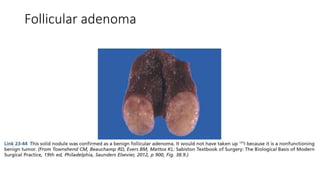
Adenoma Follicular
Carcinoma
Papillary
Carcinoma
Medullary
Carcinoma
Anaplastic
Carcinoma
Color White tan Beefy red Dark brown Pale tan to
gray
Same as
follicular
adenoma
Light tan Gray/white to
yellow brown
Pale gray
Consistency Diffusely
enlarged firm
 later
atrophies
Diffusely
enlarged soft
Diffuse
heterogenous
nodularity
and distorted
Soft,
gelatinous or
fleshy
Same as
follicular
adenoma
Firm due to
fibrosis or
soft
Soft and
fleshy
Or
Firm and
gritty
Firm to hard
Capsule Intact -- Some
nodules
appear to be
encapsulated
Thinly
encapsulated
Usually
encapsulated
(thick)
Rare Non
capsulated
but well
circumscribed
Often invades
Others Difficult to
distinguish
dominant
nodule in
hyperplasia
from
adenoma
Usually
solitary
Usually
solitary
Usually
multicentric,
tiny pale gray
depressed
scar
Multicentric
usually in the
junction of
middle and
upper 2/3rd .
Recognizable
thyroid may
not be
present.
Hashimoto Thyroiditis
Graves Disease
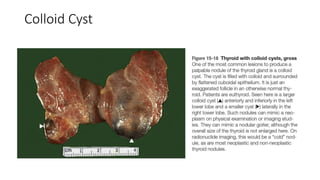
Colloid Cyst
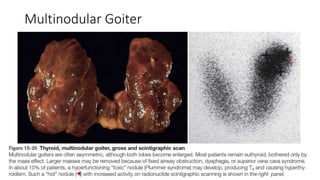
Multinodular Goiter
Multinodular Goiter
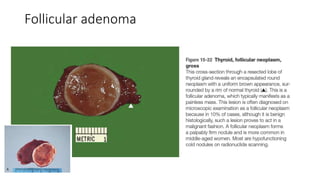
Follicular adenoma
Follicular adenoma
Follicular carcinoma
Papillary carcinoma
Papillary carcinoma
Medullary carcinoma
References
1. Robbins and Cotran Pathological Basis of Disease, 9th
edition, 2015
2. Manual of Surgical Pathology, Leister, 3rd edition, 2010
3. Grossing of Surgical Oncology Specimen, TATA Memorial
Hospital, 2011
4. Atlas of Surgical Pathology Grossing, Springer, 2019
5. Goljan Rapid Review Pathology, 5th edition, 2019
6. The Developing Human, Moore, 9th edition, 2013
7. Histology for Pathologist, Staney, 4th edition, 2012
8. Textbook of Anatomy, Head, Neck and Brain, Vishram
Singh, 2nd edition, 2014

Grossing thyroid gland

  • 1.
    GROSSING 1 Sansar Babu Tiwari,MBBS, PGY I Department of Pathology TUTH 15th November 2019
  • 2.
    Embryology Thyroid gland isa endodermal outpouching of epithelial lining in the foramen cecum between tubercular impar and copula of the primitive pharynx. It penetrates the tongue, goes anterior to the hyoid bone to lie anterior to the trachea at the level of C5-T1… thyroglossal duct.
  • 3.
    Embryology Median analge. Starts asa single solid spherical structure, later divides into bilobed structure (7th week gestation). Thyroglossal duct atrophies giving a vestige known as pyramidal lobe in approx. 40% individuals. Failure of migration may lead to ectopic thyroid tissue, thyroglossal duct cyst and cervical fistulae. At 9 week gestation, solid form  cords and plates of follicular cells. At 10th week  small follicles appear At 14th week  well-developed follicles with central colloids
  • 4.
    Embryology 2 lateral analgen. Ultimobranchialbodies (4th-5th branchial pouch complex) Descends with parathyroid IV analge. At 7th – 8th week, they separate from the pharynx and the parathyroid. At 8th – 9th week , they appear as solid masses that fuse with the dorsolateral aspects of the median thyroid analge and become incorporated into the developing lateral lobes.  dissolution phase and divides into a central thick-walled stratified epithelial cyst and a peripheral component composed of cell groups dispersed among the follicles: THE C CELLS. If the central epithelial cysts fails to disappear in the post natal life, it is called solid cell nests (SCNs). C cells are completely absent in the thyroglossal duct remnants and cysts, as well as in lingual thyroid.
  • 6.
  • 7.
  • 8.
  • 9.
    USG view ofThyroid Gland
  • 10.
  • 11.
    Rationale for Thyroidectomy: 1.Presence of solitary nodule a. For treatment of FNAC proven malignancy b. In case of suspicious, equivocal or non-diagnostic FNAC 2. Diffuse/Multinodular enlargement a. For relief of compression symptoms b. For cosmetic purpose 3. Hyperthyroidism refractory to medical treatment 4. Prophylactic thyroidectomy in MEN 2A as 90% develop medullary ca.
  • 12.
    Relevant Clinical Information 1.Age and gender of patient 2. Indications of surgery: Suspected/diagnosed malignancy/benign 3. Radiological details 4. FNAC results 5. Result of TFT and autoantibodies 6. History of malignancy and other prior procedures 7. Family history of thyroid disease/MEN syndromes COLD, SOLITARY NODULE IN YOUNGER MALES WITH HISTORY OF RADIATION ARE LIKELY TO BE NEOPLASTIC THAN NOT.
  • 13.
    Types of Thyroidectomy 1.Lobectomy/Hemithyroidectomy 2. Isthmectomy 3. Near total thyroidectomy 4. Total thyroidectomy 5. Completion thyroidectomy
  • 14.
    Steps in Grossing 1.Check the label and site, describe the type of specimen and laterality if applicable 2. Weigh the specimen and record the dimensions 3. Orient the specimen 4. Describe the external surface a. Color (Beefy: Normal, Graves; pale: Hashimoto, Amber: amiodarone, Black: minocycline therapy and melanin deposit in elderly) b. Appearance – nodular, distended, bosselated (Hashimoto) c. Unilateral enlargement, presence of any nodule d. Capsule intact/breached (Posterior thin so posterior extension in common) e. Any other adherent structure f. Look for parathyroid gland 5. Ink (delayed due to proteinaceous colloid  Acetic acid with fasten)
  • 15.
    Steps in Grossing 6.Separate the lobe and isthmus either transverse up-to-low (<2 cm), or coronal (>2cm) medial to lateral. 7. On slicing each lobe and isthmus, note down: a. Consistency of the gland: cystic, firm or hard b. Appearance: Smooth, homogenous or nodular c. Presence of any lesion, nodule or cysts: i. Number dimension and shape ii. Color: Pale or beefy red iii. Appearance: Cystic/Papillary/Nodular/Gelatinous iv. Consistency: Firm/Hard/Rubbery v. Presence of Calcification/Hemorrhage/Necrosis vi. Circumscription: Encapsulated/Invasive vii. Resemblance to adjacent thyroid parenchyma d. Distance of tumor from thyroid capsule and inked margin e. Presence of extrathyroid expansion f. Appearance of cut surface of adjacent thyroid gland (color and nodularity)
  • 16.
    Sections to besubmitted 1. Lesions: a. Follicular: Submit entire tumor capsule to distinguish adenoma from carcinoma microscopically b. Papillary: At least one section per 1 cm including relationship to any perithyroidal tissue. If occult submit entire specimen. c. Nodular hyperplasia: i. Upto 5 nodules and homogenous appearance: One section from each nodule ii. Different gross appearances (Hemorrhage, fibrosis and calcifications): Additional sections from all nodules 2. Non-lesional thyroid: Two representative uninvolved sections from each lobe 3. Lymph node/ Parathyroid: Representative section from all lymph nodes and entire parathyroids 4. If foci of previous FNAC found, submit for correlation.
  • 17.
  • 18.
    General Gross Overview Lesion-Hashimoto Graves Multinodular Goitre Adenoma Follicular Carcinoma Papillary Carcinoma Medullary Carcinoma Anaplastic Carcinoma Color White tan Beefy red Dark brown Pale tan to gray Same as follicular adenoma Light tan Gray/white to yellow brown Pale gray Consistency Diffusely enlarged firm  later atrophies Diffusely enlarged soft Diffuse heterogenous nodularity and distorted Soft, gelatinous or fleshy Same as follicular adenoma Firm due to fibrosis or soft Soft and fleshy Or Firm and gritty Firm to hard Capsule Intact -- Some nodules appear to be encapsulated Thinly encapsulated Usually encapsulated (thick) Rare Non capsulated but well circumscribed Often invades Others Difficult to distinguish dominant nodule in hyperplasia from adenoma Usually solitary Usually solitary Usually multicentric, tiny pale gray depressed scar Multicentric usually in the junction of middle and upper 2/3rd . Recognizable thyroid may not be present.
  • 19.
  • 20.
  • 21.
  • 22.
  • 23.
  • 24.
  • 25.
  • 26.
  • 27.
  • 28.
  • 29.
  • 30.
  • 31.
    References 1. Robbins andCotran Pathological Basis of Disease, 9th edition, 2015 2. Manual of Surgical Pathology, Leister, 3rd edition, 2010 3. Grossing of Surgical Oncology Specimen, TATA Memorial Hospital, 2011 4. Atlas of Surgical Pathology Grossing, Springer, 2019 5. Goljan Rapid Review Pathology, 5th edition, 2019 6. The Developing Human, Moore, 9th edition, 2013 7. Histology for Pathologist, Staney, 4th edition, 2012 8. Textbook of Anatomy, Head, Neck and Brain, Vishram Singh, 2nd edition, 2014