2019 Novel Coronavirus (2019-nCoV)
Dr. Surendra Chhetri
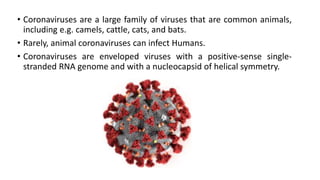
• Coronaviruses are a large family of viruses that are common animals,
including e.g. camels, cattle, cats, and bats.
• Rarely, animal coronaviruses can infect Humans.
• Coronaviruses are enveloped viruses with a positive-sense single-
stranded RNA genome and with a nucleocapsid of helical symmetry.
Human Coronavirus Types
• . There are four main sub-groupings of coronaviruses,
• Alphacoronavirus
• Betacoronavirus
• Gammacoronavirus
• Deltacoronavirus
• Human coronaviruses were first identified in the mid-1960s. The seven coronaviruses
that can infect people are
• Common human coronaviruses
• 229E (alpha coronavirus)
• NL63 (alpha coronavirus)
• OC43 (beta coronavirus)
• HKU1 (beta coronavirus)
• Other human coronaviruses
• SARS-CoV :first recognized in China in November 2002.worldwide outbreak in 2002-
2003 with 8,098 probable cases including 774 deaths. Since 2004, no reported cases
of SARS-CoV
• MERS-CoV : Middle East Respiratory Syndrome Coronavirus (MERS-CoV) was first
reported in Saudi Arabia in 2012.
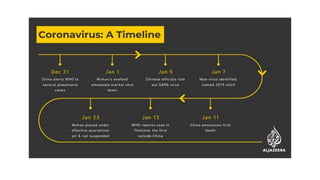
• 2019 Novel Coronavirus (2019-nCoV): In December, 2019, a series of pneumonia
cases of unknown cause emerged in Wuhan Hubei, China, with clinical presentations
greatly resembling viral pneumonia
• .
2019 Novel Coronavirus (2019-nCoV)
• 2019 Novel Coronavirus (2019-nCoV) is identified as the cause of an
outbreak of respiratory illness first detected in Wuhan, China.
• Many of the patients in the outbreak in Wuhan, reportedly had some
link to a large seafood and animal market, suggesting animal-to-
Human spread.
• However, a growing number of patients reportedly have not had
exposure to animal markets, indicating person-to-person spread
Facts and Figures
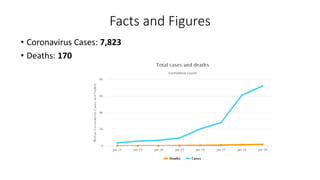
• Coronavirus Cases: 7,823
• Deaths: 170
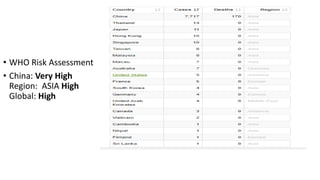
• WHO Risk Assessment
• China: Very High
Region: ASIA High
Global: High
Nepal
• Jan 24 : First and only confirmed case
• The 31-year-old man, who is doing his PhD in Wuhan, had returned
from the Chinese city on January 5. He had visited a hospital
complaining of respiratory problems and was admitted on January 13
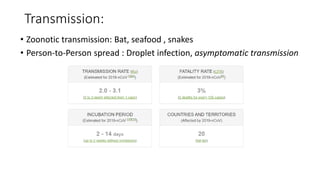
Transmission:
• Zoonotic transmission: Bat, seafood , snakes
• Person-to-Person spread : Droplet infection, asymptomatic transmission
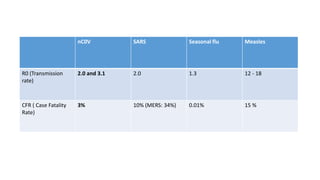
nC0V SARS Seasonal flu Measles
R0 (Transmission
rate)
2.0 and 3.1 2.0 1.3 12 - 18
CFR ( Case Fatality
Rate)
3% 10% (MERS: 34%) 0.01% 15 %
Risk factors
• Recent travel to Wuhan, China, and other places where there is an
outbreak
• Close contact with people who are diagnosed with the disease
• Close contact with anyone who has visited an outbreak zone like
Wuhan
• Contact with secretions from an infected person
• Eating or handling wild animals native to China (and other countries)
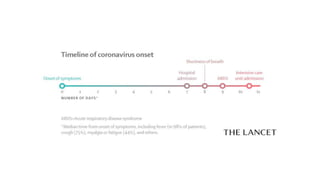
Clinical presentation
• Common symptoms at onset of illness:
• fever (98%),
• cough ( 76%), and
• Dyspnoea
• myalgia or fatigue [44%]
• upper respiratory tract signs and symptoms: rhinorrhoea, sneezing, or sore throat
• less common symptoms:
• sputum production
• headache
• haemoptysis
• and diarrhoea
• Vomiting
• Complications
• acute respiratory distress syndrome
• Aaemia
• Pericarditis
• Acute kidney injury
• MODS
• Secondary infection
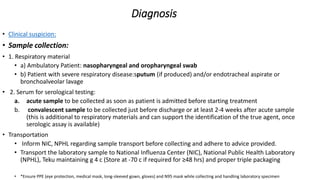
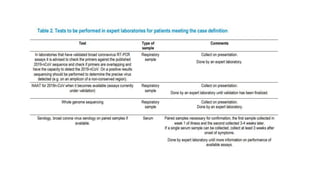
Diagnosis
• Clinical suspicion:
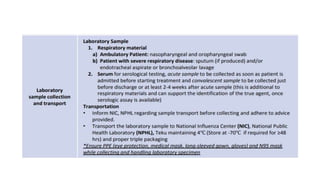
• Sample collection:
• 1. Respiratory material
• a) Ambulatory Patient: nasopharyngeal and oropharyngeal swab
• b) Patient with severe respiratory disease:sputum (if produced) and/or endotracheal aspirate or
bronchoalveolar lavage
• 2. Serum for serological testing:
a. acute sample to be collected as soon as patient is admitted before starting treatment
b. convalescent sample to be collected just before discharge or at least 2‐4 weeks after acute sample
(this is additional to respiratory materials and can support the identification of the true agent, once
serologic assay is available)
• Transportation
• Inform NIC, NPHL regarding sample transport before collecting and adhere to advice provided.
• Transport the laboratory sample to National Influenza Center (NIC), National Public Health Laboratory
(NPHL), Teku maintaining g 4 c (Store at ‐70 c if required for ≥48 hrs) and proper triple packaging
• *Ensure PPE (eye protection, medical mask, long‐sleeved gown, gloves) and N95 mask while collecting and handling laboratory specimen
• Labs:
• Aaemia
• Leucopenia
• Lymphopenia
• AST/ALT raised
• PT INR
• Imaging:
• bilateral ground-glass opacities
• bilateral multiple lobular and subsegmental areas of consolidation
Treatment:
• There is no specific antiviral or vaccine recommended for 2019-nCoV
infection.
• Supportive:
• fever/pain relief,
• hydration,
• oxygen and
• antibiotics, if needed
• Mechanical ventilation
Prevention:
• CDC Directions:
• Wash your hands often with soap and water for at least 20 seconds. Use an
alcohol-based hand sanitizer that contains at least 60% alcohol if soap and
water are not available.
• Avoid touching your eyes, nose, and mouth with unwashed hands.
• Avoid close contact with people who are sick.
• Stay home when you are sick.
• Cover your cough or sneeze with a tissue, then throw the tissue in the trash.
• Clean and disinfect frequently touched objects and surfaces.
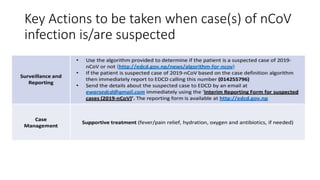
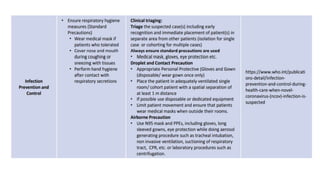
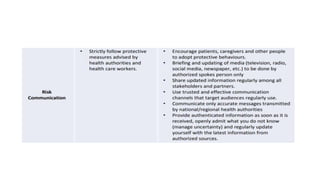
Key Actions to be taken when case(s) of nCoV
infection is/are suspected
 Novel corona virus (nCoV-2019)
 Novel corona virus (nCoV-2019)
 Novel corona virus (nCoV-2019)
 Novel corona virus (nCoV-2019)

Novel corona virus (nCoV-2019)

  • 1.
    2019 Novel Coronavirus(2019-nCoV) Dr. Surendra Chhetri
  • 2.
    • Coronaviruses area large family of viruses that are common animals, including e.g. camels, cattle, cats, and bats. • Rarely, animal coronaviruses can infect Humans. • Coronaviruses are enveloped viruses with a positive-sense single- stranded RNA genome and with a nucleocapsid of helical symmetry.
  • 3.
    Human Coronavirus Types •. There are four main sub-groupings of coronaviruses, • Alphacoronavirus • Betacoronavirus • Gammacoronavirus • Deltacoronavirus • Human coronaviruses were first identified in the mid-1960s. The seven coronaviruses that can infect people are • Common human coronaviruses • 229E (alpha coronavirus) • NL63 (alpha coronavirus) • OC43 (beta coronavirus) • HKU1 (beta coronavirus)
  • 4.
    • Other humancoronaviruses • SARS-CoV :first recognized in China in November 2002.worldwide outbreak in 2002- 2003 with 8,098 probable cases including 774 deaths. Since 2004, no reported cases of SARS-CoV • MERS-CoV : Middle East Respiratory Syndrome Coronavirus (MERS-CoV) was first reported in Saudi Arabia in 2012. • 2019 Novel Coronavirus (2019-nCoV): In December, 2019, a series of pneumonia cases of unknown cause emerged in Wuhan Hubei, China, with clinical presentations greatly resembling viral pneumonia • .
  • 5.
    2019 Novel Coronavirus(2019-nCoV) • 2019 Novel Coronavirus (2019-nCoV) is identified as the cause of an outbreak of respiratory illness first detected in Wuhan, China. • Many of the patients in the outbreak in Wuhan, reportedly had some link to a large seafood and animal market, suggesting animal-to- Human spread. • However, a growing number of patients reportedly have not had exposure to animal markets, indicating person-to-person spread
  • 7.
    Facts and Figures •Coronavirus Cases: 7,823 • Deaths: 170
  • 8.
    • WHO RiskAssessment • China: Very High Region: ASIA High Global: High
  • 9.
    Nepal • Jan 24: First and only confirmed case • The 31-year-old man, who is doing his PhD in Wuhan, had returned from the Chinese city on January 5. He had visited a hospital complaining of respiratory problems and was admitted on January 13
  • 10.
    Transmission: • Zoonotic transmission:Bat, seafood , snakes • Person-to-Person spread : Droplet infection, asymptomatic transmission
  • 11.
    nC0V SARS Seasonalflu Measles R0 (Transmission rate) 2.0 and 3.1 2.0 1.3 12 - 18 CFR ( Case Fatality Rate) 3% 10% (MERS: 34%) 0.01% 15 %
  • 12.
    Risk factors • Recenttravel to Wuhan, China, and other places where there is an outbreak • Close contact with people who are diagnosed with the disease • Close contact with anyone who has visited an outbreak zone like Wuhan • Contact with secretions from an infected person • Eating or handling wild animals native to China (and other countries)
  • 13.
    Clinical presentation • Commonsymptoms at onset of illness: • fever (98%), • cough ( 76%), and • Dyspnoea • myalgia or fatigue [44%] • upper respiratory tract signs and symptoms: rhinorrhoea, sneezing, or sore throat • less common symptoms: • sputum production • headache • haemoptysis • and diarrhoea • Vomiting
  • 15.
    • Complications • acuterespiratory distress syndrome • Aaemia • Pericarditis • Acute kidney injury • MODS • Secondary infection
  • 16.
    Diagnosis • Clinical suspicion: •Sample collection: • 1. Respiratory material • a) Ambulatory Patient: nasopharyngeal and oropharyngeal swab • b) Patient with severe respiratory disease:sputum (if produced) and/or endotracheal aspirate or bronchoalveolar lavage • 2. Serum for serological testing: a. acute sample to be collected as soon as patient is admitted before starting treatment b. convalescent sample to be collected just before discharge or at least 2‐4 weeks after acute sample (this is additional to respiratory materials and can support the identification of the true agent, once serologic assay is available) • Transportation • Inform NIC, NPHL regarding sample transport before collecting and adhere to advice provided. • Transport the laboratory sample to National Influenza Center (NIC), National Public Health Laboratory (NPHL), Teku maintaining g 4 c (Store at ‐70 c if required for ≥48 hrs) and proper triple packaging • *Ensure PPE (eye protection, medical mask, long‐sleeved gown, gloves) and N95 mask while collecting and handling laboratory specimen
  • 18.
    • Labs: • Aaemia •Leucopenia • Lymphopenia • AST/ALT raised • PT INR • Imaging: • bilateral ground-glass opacities • bilateral multiple lobular and subsegmental areas of consolidation
  • 19.
    Treatment: • There isno specific antiviral or vaccine recommended for 2019-nCoV infection. • Supportive: • fever/pain relief, • hydration, • oxygen and • antibiotics, if needed • Mechanical ventilation
  • 20.
    Prevention: • CDC Directions: •Wash your hands often with soap and water for at least 20 seconds. Use an alcohol-based hand sanitizer that contains at least 60% alcohol if soap and water are not available. • Avoid touching your eyes, nose, and mouth with unwashed hands. • Avoid close contact with people who are sick. • Stay home when you are sick. • Cover your cough or sneeze with a tissue, then throw the tissue in the trash. • Clean and disinfect frequently touched objects and surfaces.
  • 21.
    Key Actions tobe taken when case(s) of nCoV infection is/are suspected