EMERGING TRENDS IN
ROAD INFRASTRUCTURE
DEVELOPMENT IN INDIA
AND PUNJAB
By Anisha
ROADS INFRASTRUCTURE
 India has the second largest road network across the world at 4.7 million km. This
road network transports more than 60 per cent of all goods in the country and 85
per cent of India’s total passenger traffic.
 Roads are the lifeline of a country and are basic infrastructure for
eceonomic,industrial, Commercial, social and cultural development of a country.
Road transportation has gradually increased over the years with the
improvement in connectivity between cities, towns and villages in the country.
 In India sales of automobiles and movement of freight by roads is growing at a
rapid rate.
 Cognizant of the need to create an adequate road network to cater to theincreased tr
affic and movement of goods, Government of India has setearmarked 20 per cent of
the investment of US$ 1 trillion reserved for infrastructure during the 12th Five-
Year Plan(2012-17) to develop the country's roads.
Market Size
 The value of roads and bridges infrastructure in India is projected to g
row at aCompound Annual Growth Rate of 17.4 per cent over FY12-
17.
 The country's roads and bridges infrastructure, which was valued at
US$ 6.9billion in 2009 is expected to touch US$ 19.2 billion by 2017
 The construction of highways had reached an all-time high of 6,029
km during FY 2015-16, and the increased pace of construction is
expected to continue for the coming years
 The financial outlay for road transport and highways grew at a CAG
R of 12.5 percent in the period FY10-16.The plan outlay for 2016-
17 stepped up budgetary
support for Road Transport and Highways to Rs
97000crore (US$ 14.45million)
Infrastructure
Sector
Sub-Sector Coverage
Transport Road Transport Roads & bridges,
tunnels, motor
vehicles
Rail Transport Railways, signalling,
communication system,
rail
yards, stations
Inland Water Transport Inland waterways,
inland water
vessels
Sea and Coastal
Transport
Seaports
Ships and other vessels
Air Transport Airports, aircrafts
KEY INVESTMENTS AND DEVELOPMENTS
The NationalHighways Authority of India is planning to acquire 10,000he
ctares of land in FY 2015-16, up from 6,733 hectares in FY2014-
15, to speedup road laying in the country.
The Government of India plans to award 100 highway projects under the
Public-
private Partnership mode in 2016, with expectations that recent amendme
nts inregulations would revive investor sentiments in PPP projects in the
infrastructure sector.
The Cabinet Committee on Economic Affairs has permitted 100 per cent
equitydivestment by private developers after two years of construction co
mpletion forall Build-Operate-
Transfer projects, irrespective of the year of award of theproject.
The Ministry of Road Transport and Highways has undertaken developm
ent of
about 7,000 km of national highways under Bharatmala Pariyojana at ane
stimated cost of Rs 80,000 crore in consultation with state governments.
WORLD BANK SUPPORT AND NHDP
The World Bank has been a major investor in the
transport sector in India. At present, it has ten projects in
transport portfolio which include seven state road
projects and one each for national highway, rural road
and urban transport with total loan commitments for the
transport sector in India as US$3.48 billion. The main
activities include:
National Highway Development Project
The World Bank is financing highway construction on
the Lucknow-Muzaffarpur corridors. It is also involved in
other sector activities such as improving road safety
 Rural Roads Program: The project supports the
PMGSY in providing all weather roads to villages in four
states – Uttar Pradesh, Jharkhand, Rajasthan and
Himachal Pradesh.
PMGSY (PRADHAN MANTRI GRAM SADAK YOJANA)
 In order to create durable and permanent assets, an adequate provision
for drainage and protection works as well as quality control during
construction and maintenance of assets, Government of India
launched the Pradhan Mantri Gram Sadak Yojana (PMGSY) on 25th
December, 2000 as a Centrally Sponsored Scheme to assist the States.
The primary objective of PMGSY is to provide connectivity by way
of an All-Weather road (with necessary culverts and cross-drainage
structures, which is operable throughout the year), to the eligible
unconnected habitations as per Core Network with a population of
500 persons and above in plain areas. The current source of funds for
PMGSY works is cess on High Speed Diesel (Rs. 0.75 / litre),
budgetary support, ADB funding, World Bank funding and NABARD
loan.
 A total amount of Rs.1,11,368 have already been spent under this
program including funding from World Bank and Asian Development
Bank. It is increasingly essential to ensure that roads already created
are systematically maintained and yield services as originally
envisaged before going on undertaking more such assets. Keeping in
view the asset value of the road network, PMGSY-II has been
launched.
 State Roads Projects: State Highways are being
upgraded in the states of Kerala, Mizoram, Uttar
Pradesh, Tamil Nadu, Punjab, Himachal
Pradesh, Orissa and Andhra Pradesh.
 Mumbai Urban Transport Project: The project
aims to improve transportation in the Mumbai
Metropolitan Region by fostering the development of
an efficient and sustainable urban transport system -
suburban rail, bus and link roads - and building
effective institutions.
 Sustainable Urban Transport Project: The project
aims to promote environmentally sustainable urban
transport in various cities and support
implementation of the India National Urban
Transport Policy (NUTP).
INVESTMENT PROJECTION
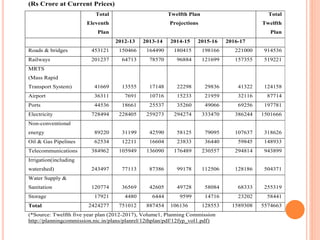
 The investment projection for 12th plan period
stands at Rs. 5574663.0 crore as compared to Rs.
2424277 crores during 11th plan period as shown
through figure 4.3. The sub sector with highest
investment of 1502 thousand crores is electricity,
followed by 944 thousand crores in
telecommunications, 914 thousand crores in roads
and bridges, 519 thousand crores in railways and
504 thousand crores in irrigation.
(Rs Crore at Current Prices)
Total
Eleventh
Plan
Twelfth Plan
Projections
Total
Twelfth
Plan
2012-13 2013-14 2014-15 2015-16 2016-17
Roads & bridges 453121 150466 164490 180415 198166 221000 914536
Railways 201237 64713 78570 96884 121699 157355 519221
MRTS
(Mass Rapid
Transport System) 41669 13555 17148 22298 29836 41322 124158
Airport 36311 7691 10716 15233 21959 32116 87714
Ports 44536 18661 25537 35260 49066 69256 197781
Electricity 728494 228405 259273 294274 333470 386244 1501666
Non-conventional
energy 89220 31199 42590 58125 79095 107637 318626
Oil & Gas Pipelines 62534 12211 16604 23833 36440 59845 148933
Telecommunications 384962 105949 136090 176489 230557 294814 943899
Irrigation(including
watershed) 243497 77113 87386 99178 112506 128186 504371
Water Supply &
Sanitation 120774 36569 42605 49728 58084 68333 255319
Storage 17921 4480 6444 9599 14716 23202 58441
Total 2424277 751012 887454 106136 128553 1589308 5574663
(*Source: Twelfth five year plan (2012-2017), Volume1, Planning Commission
http://planningcommission.nic.in/plans/planrel/12thplan/pdf/12fyp_vol1.pdf)
MODERN TRANSPORTATION…
The major means of transportation now a days are:
 Railways
 Road ways
 Air ways
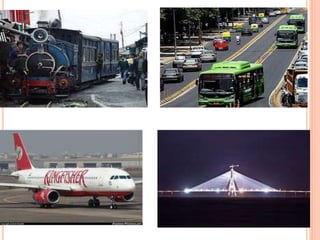
RAILWAYS
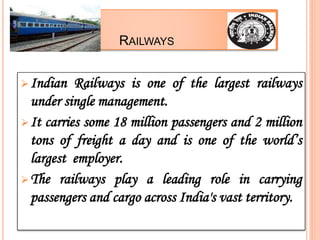
Indian Railways is one of the largest railways
under single management.
It carries some 18 million passengers and 2 million
tons of freight a day and is one of the world’s
largest employer.
The railways play a leading role in carrying
passengers and cargo across India's vast territory.
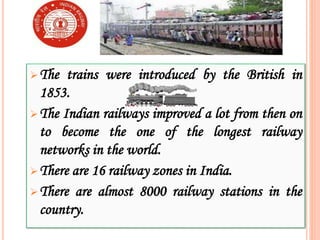
The trains were introduced by the British in
1853.
The Indian railways improved a lot from then on
to become the one of the longest railway
networks in the world.
There are 16 railway zones in India.
There are almost 8000 railway stations in the
country.
ADVANTAGES OF RAIL TRANSPORT
 It facilitate long distance travel and transport of bulky
goods which are not easily transported through motor
vehicles.
 It is a quick and more regular form of transport because
it helps in the transportation of goods with speed and
certainty.
 It helps in the quick movement of goods from one place
to another at the time of emergencies like famines and
scarcity.
 The carrying capacity of the railways is extremely large.
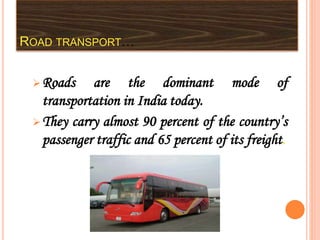
ROAD TRANSPORT…
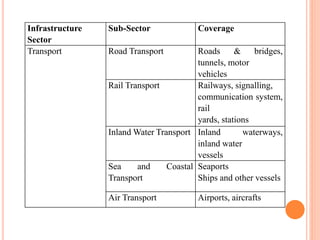
Roads are the dominant mode of
transportation in India today.
They carry almost 90 percent of the country’s
passenger traffic and 65 percent of its freight.
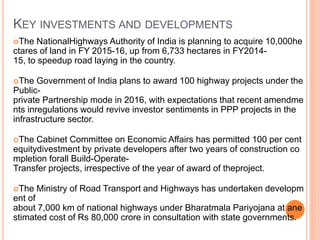
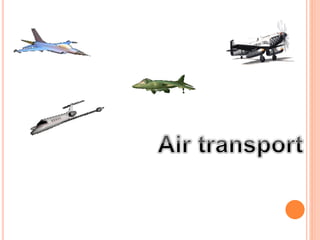
AIR TRANSPORTATION…
 Air transport in India started between Allahabad &
Naini (township in Allahabad) in 1911
 Airport authority of India was established on April 1,
1995
 The Air India, has become the 16th largest airline in
asia, presently operates a fleet of 159 aircraft serves 50
domestic & 39 international routes
 The other airlines such as Kingfisher Airlines, Air
India and Jet Airways are the most popular brands in
domestic air travel in order of their market share.
Advantages of Road transport Advantages of Air transport
Less capital outlay Fastest mode of transport
Door to door service Easy transport of costly and light
goods
Service in Rural areas Minimum cost
Lesser risk of damage in transit Free from physical barriers
Chance of pilferage are lesser than
railways
Useful in natural calamities
DEVELOPMENT OF TRANSPORT
SYSTEM IN PUNJAB
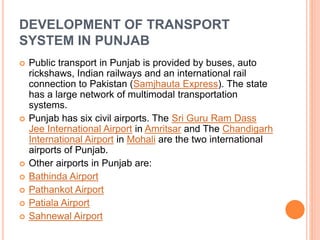
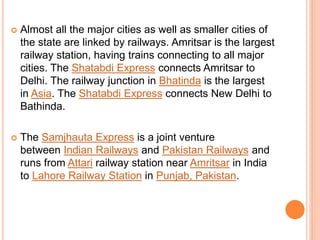
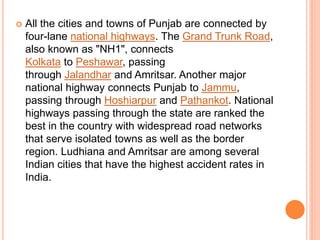
 Public transport in Punjab is provided by buses, auto
rickshaws, Indian railways and an international rail
connection to Pakistan (Samjhauta Express). The state
has a large network of multimodal transportation
systems.
 Punjab has six civil airports. The Sri Guru Ram Dass
Jee International Airport in Amritsar and The Chandigarh
International Airport in Mohali are the two international
airports of Punjab.
 Other airports in Punjab are:
 Bathinda Airport
 Pathankot Airport
 Patiala Airport
 Sahnewal Airport
 Almost all the major cities as well as smaller cities of
the state are linked by railways. Amritsar is the largest
railway station, having trains connecting to all major
cities. The Shatabdi Express connects Amritsar to
Delhi. The railway junction in Bhatinda is the largest
in Asia. The Shatabdi Express connects New Delhi to
Bathinda.
 The Samjhauta Express is a joint venture
between Indian Railways and Pakistan Railways and
runs from Attari railway station near Amritsar in India
to Lahore Railway Station in Punjab, Pakistan.
 All the cities and towns of Punjab are connected by
four-lane national highways. The Grand Trunk Road,
also known as "NH1", connects
Kolkata to Peshawar, passing
through Jalandhar and Amritsar. Another major
national highway connects Punjab to Jammu,
passing through Hoshiarpur and Pathankot. National
highways passing through the state are ranked the
best in the country with widespread road networks
that serve isolated towns as well as the border
region. Ludhiana and Amritsar are among several
Indian cities that have the highest accident rates in
India.
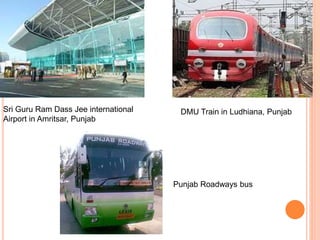
Sri Guru Ram Dass Jee international
Airport in Amritsar, Punjab
DMU Train in Ludhiana, Punjab
Punjab Roadways bus
INFRASTRUCTURE DEVELOPMENT AND
ECONOMIC GROWTH
 The positive contribution of physical infrastructure to economic growth anddevelop
ment comes through increases in investment, employment, output, andincome
 Infrastructure development does leads to economic growth and affects theoutput sig
nificantly.A one percent increase in the stock of infrastructure is associated with
a onepercent increase in GDP. It is well recognized fact in the extensive literature
thatinfrastructure provisions have an important link with productivity, economicgro
wth and finally the well-being of the people.
 The importance of infrastructure goes far beyond its impact on growth.
 Lack of such infrastructure facilities is considered to be a major structuralweakness,
which holds back to underutilization of existing productive capacityand constrain, th
at may have unfavourable impacts on profits and productionlevels adversely.
 Weak and inadequate infrastructure leaves the country backward and allows itspeopl
e to stagnate in poverty and a lower standard of living.
PROBLEMS FACED BY ROAD TRANSPORT IN INDIA
 Most of the Indian roads are un-surfaced (42.65%) and are not
suitable for use of vehicular traffic. The poor maintenance of the
roads aggravates the problem especially in the rainy season.
 According to an estimate there is about per year loss of Rs. 200
crores on the wear and tear of the vehicles due to poor quality of
roads. Even the National Highways suffer from the deficiencies of
inadequate capacity, weak pavement, poor riding quality, distressed
bridges, unabridged level crossings, congested cities (lack of by-pass
roads), lack of wayside amenities and safety measures.
 One major problem on the Indian roads is the mixing of traffic. Same
road is used by high speed cars, trucks, two wheelers, tractors,
animal driven carts, cyclists and even by animals. Even highways are
not free from this malady. This increases traffic time, congestion and
pollution and road accidents.
 There are multiple check-posts, toll tax and octoroon duties
collection points on the roads which bring down the speed of the
traffic, waste time and cause irritation to transporters. Rate of road
taxes vary from state to state and inter-state permits are difficult to
obtain.
 There is very little participation of private sector in road development in
India because of long gestation period and low-returns. The legislative
framework for private investment in roads is also not satisfactory. The
road engineering and construction are yet to gear themselves up to meet
the challenges of the future.
 There has been no stability in policy relating to highway development
in the country. It has changed with the change of government. There are
a number of agencies which look after the construction and
maintenance of different types of roads. Since there is no co-ordination
between these agencies their decisions are often conflicting and
contradictory.
 There is shortage of funds for the construction and maintenance of
roads. Instead of giving high priority to this task the percentage
allocation has decreased over the years
SOME HELPFUL MEASURES
 Development of Additional Road Capacity
 Traffic management measures
 Concrete roads
 Parking restrictions
 Proper planning of roads
 Promoting Public Transport
 Encouraging Walking

Emerging trends in road infrastructure development in india

  • 1.
    EMERGING TRENDS IN ROADINFRASTRUCTURE DEVELOPMENT IN INDIA AND PUNJAB By Anisha
  • 2.
    ROADS INFRASTRUCTURE  Indiahas the second largest road network across the world at 4.7 million km. This road network transports more than 60 per cent of all goods in the country and 85 per cent of India’s total passenger traffic.  Roads are the lifeline of a country and are basic infrastructure for eceonomic,industrial, Commercial, social and cultural development of a country. Road transportation has gradually increased over the years with the improvement in connectivity between cities, towns and villages in the country.  In India sales of automobiles and movement of freight by roads is growing at a rapid rate.  Cognizant of the need to create an adequate road network to cater to theincreased tr affic and movement of goods, Government of India has setearmarked 20 per cent of the investment of US$ 1 trillion reserved for infrastructure during the 12th Five- Year Plan(2012-17) to develop the country's roads.
  • 3.
    Market Size  Thevalue of roads and bridges infrastructure in India is projected to g row at aCompound Annual Growth Rate of 17.4 per cent over FY12- 17.  The country's roads and bridges infrastructure, which was valued at US$ 6.9billion in 2009 is expected to touch US$ 19.2 billion by 2017  The construction of highways had reached an all-time high of 6,029 km during FY 2015-16, and the increased pace of construction is expected to continue for the coming years  The financial outlay for road transport and highways grew at a CAG R of 12.5 percent in the period FY10-16.The plan outlay for 2016- 17 stepped up budgetary support for Road Transport and Highways to Rs 97000crore (US$ 14.45million)
  • 5.
    Infrastructure Sector Sub-Sector Coverage Transport RoadTransport Roads & bridges, tunnels, motor vehicles Rail Transport Railways, signalling, communication system, rail yards, stations Inland Water Transport Inland waterways, inland water vessels Sea and Coastal Transport Seaports Ships and other vessels Air Transport Airports, aircrafts
  • 6.
    KEY INVESTMENTS ANDDEVELOPMENTS The NationalHighways Authority of India is planning to acquire 10,000he ctares of land in FY 2015-16, up from 6,733 hectares in FY2014- 15, to speedup road laying in the country. The Government of India plans to award 100 highway projects under the Public- private Partnership mode in 2016, with expectations that recent amendme nts inregulations would revive investor sentiments in PPP projects in the infrastructure sector. The Cabinet Committee on Economic Affairs has permitted 100 per cent equitydivestment by private developers after two years of construction co mpletion forall Build-Operate- Transfer projects, irrespective of the year of award of theproject. The Ministry of Road Transport and Highways has undertaken developm ent of about 7,000 km of national highways under Bharatmala Pariyojana at ane stimated cost of Rs 80,000 crore in consultation with state governments.
  • 7.
    WORLD BANK SUPPORTAND NHDP The World Bank has been a major investor in the transport sector in India. At present, it has ten projects in transport portfolio which include seven state road projects and one each for national highway, rural road and urban transport with total loan commitments for the transport sector in India as US$3.48 billion. The main activities include: National Highway Development Project The World Bank is financing highway construction on the Lucknow-Muzaffarpur corridors. It is also involved in other sector activities such as improving road safety  Rural Roads Program: The project supports the PMGSY in providing all weather roads to villages in four states – Uttar Pradesh, Jharkhand, Rajasthan and Himachal Pradesh.
  • 8.
    PMGSY (PRADHAN MANTRIGRAM SADAK YOJANA)  In order to create durable and permanent assets, an adequate provision for drainage and protection works as well as quality control during construction and maintenance of assets, Government of India launched the Pradhan Mantri Gram Sadak Yojana (PMGSY) on 25th December, 2000 as a Centrally Sponsored Scheme to assist the States. The primary objective of PMGSY is to provide connectivity by way of an All-Weather road (with necessary culverts and cross-drainage structures, which is operable throughout the year), to the eligible unconnected habitations as per Core Network with a population of 500 persons and above in plain areas. The current source of funds for PMGSY works is cess on High Speed Diesel (Rs. 0.75 / litre), budgetary support, ADB funding, World Bank funding and NABARD loan.  A total amount of Rs.1,11,368 have already been spent under this program including funding from World Bank and Asian Development Bank. It is increasingly essential to ensure that roads already created are systematically maintained and yield services as originally envisaged before going on undertaking more such assets. Keeping in view the asset value of the road network, PMGSY-II has been launched.
  • 9.
     State RoadsProjects: State Highways are being upgraded in the states of Kerala, Mizoram, Uttar Pradesh, Tamil Nadu, Punjab, Himachal Pradesh, Orissa and Andhra Pradesh.  Mumbai Urban Transport Project: The project aims to improve transportation in the Mumbai Metropolitan Region by fostering the development of an efficient and sustainable urban transport system - suburban rail, bus and link roads - and building effective institutions.  Sustainable Urban Transport Project: The project aims to promote environmentally sustainable urban transport in various cities and support implementation of the India National Urban Transport Policy (NUTP).
  • 10.
    INVESTMENT PROJECTION  Theinvestment projection for 12th plan period stands at Rs. 5574663.0 crore as compared to Rs. 2424277 crores during 11th plan period as shown through figure 4.3. The sub sector with highest investment of 1502 thousand crores is electricity, followed by 944 thousand crores in telecommunications, 914 thousand crores in roads and bridges, 519 thousand crores in railways and 504 thousand crores in irrigation.
  • 11.
    (Rs Crore atCurrent Prices) Total Eleventh Plan Twelfth Plan Projections Total Twelfth Plan 2012-13 2013-14 2014-15 2015-16 2016-17 Roads & bridges 453121 150466 164490 180415 198166 221000 914536 Railways 201237 64713 78570 96884 121699 157355 519221 MRTS (Mass Rapid Transport System) 41669 13555 17148 22298 29836 41322 124158 Airport 36311 7691 10716 15233 21959 32116 87714 Ports 44536 18661 25537 35260 49066 69256 197781 Electricity 728494 228405 259273 294274 333470 386244 1501666 Non-conventional energy 89220 31199 42590 58125 79095 107637 318626 Oil & Gas Pipelines 62534 12211 16604 23833 36440 59845 148933 Telecommunications 384962 105949 136090 176489 230557 294814 943899 Irrigation(including watershed) 243497 77113 87386 99178 112506 128186 504371 Water Supply & Sanitation 120774 36569 42605 49728 58084 68333 255319 Storage 17921 4480 6444 9599 14716 23202 58441 Total 2424277 751012 887454 106136 128553 1589308 5574663 (*Source: Twelfth five year plan (2012-2017), Volume1, Planning Commission http://planningcommission.nic.in/plans/planrel/12thplan/pdf/12fyp_vol1.pdf)
  • 12.
    MODERN TRANSPORTATION… The majormeans of transportation now a days are:  Railways  Road ways  Air ways
  • 13.
    RAILWAYS Indian Railways isone of the largest railways under single management. It carries some 18 million passengers and 2 million tons of freight a day and is one of the world’s largest employer. The railways play a leading role in carrying passengers and cargo across India's vast territory.
  • 14.
    The trains wereintroduced by the British in 1853. The Indian railways improved a lot from then on to become the one of the longest railway networks in the world. There are 16 railway zones in India. There are almost 8000 railway stations in the country.
  • 15.
    ADVANTAGES OF RAILTRANSPORT  It facilitate long distance travel and transport of bulky goods which are not easily transported through motor vehicles.  It is a quick and more regular form of transport because it helps in the transportation of goods with speed and certainty.  It helps in the quick movement of goods from one place to another at the time of emergencies like famines and scarcity.  The carrying capacity of the railways is extremely large.
  • 16.
    ROAD TRANSPORT… Roads arethe dominant mode of transportation in India today. They carry almost 90 percent of the country’s passenger traffic and 65 percent of its freight.
  • 18.
    AIR TRANSPORTATION…  Airtransport in India started between Allahabad & Naini (township in Allahabad) in 1911  Airport authority of India was established on April 1, 1995  The Air India, has become the 16th largest airline in asia, presently operates a fleet of 159 aircraft serves 50 domestic & 39 international routes  The other airlines such as Kingfisher Airlines, Air India and Jet Airways are the most popular brands in domestic air travel in order of their market share.
  • 19.
    Advantages of Roadtransport Advantages of Air transport Less capital outlay Fastest mode of transport Door to door service Easy transport of costly and light goods Service in Rural areas Minimum cost Lesser risk of damage in transit Free from physical barriers Chance of pilferage are lesser than railways Useful in natural calamities
  • 20.
    DEVELOPMENT OF TRANSPORT SYSTEMIN PUNJAB  Public transport in Punjab is provided by buses, auto rickshaws, Indian railways and an international rail connection to Pakistan (Samjhauta Express). The state has a large network of multimodal transportation systems.  Punjab has six civil airports. The Sri Guru Ram Dass Jee International Airport in Amritsar and The Chandigarh International Airport in Mohali are the two international airports of Punjab.  Other airports in Punjab are:  Bathinda Airport  Pathankot Airport  Patiala Airport  Sahnewal Airport
  • 21.
     Almost allthe major cities as well as smaller cities of the state are linked by railways. Amritsar is the largest railway station, having trains connecting to all major cities. The Shatabdi Express connects Amritsar to Delhi. The railway junction in Bhatinda is the largest in Asia. The Shatabdi Express connects New Delhi to Bathinda.  The Samjhauta Express is a joint venture between Indian Railways and Pakistan Railways and runs from Attari railway station near Amritsar in India to Lahore Railway Station in Punjab, Pakistan.
  • 22.
     All thecities and towns of Punjab are connected by four-lane national highways. The Grand Trunk Road, also known as "NH1", connects Kolkata to Peshawar, passing through Jalandhar and Amritsar. Another major national highway connects Punjab to Jammu, passing through Hoshiarpur and Pathankot. National highways passing through the state are ranked the best in the country with widespread road networks that serve isolated towns as well as the border region. Ludhiana and Amritsar are among several Indian cities that have the highest accident rates in India.
  • 23.
    Sri Guru RamDass Jee international Airport in Amritsar, Punjab DMU Train in Ludhiana, Punjab Punjab Roadways bus
  • 24.
    INFRASTRUCTURE DEVELOPMENT AND ECONOMICGROWTH  The positive contribution of physical infrastructure to economic growth anddevelop ment comes through increases in investment, employment, output, andincome  Infrastructure development does leads to economic growth and affects theoutput sig nificantly.A one percent increase in the stock of infrastructure is associated with a onepercent increase in GDP. It is well recognized fact in the extensive literature thatinfrastructure provisions have an important link with productivity, economicgro wth and finally the well-being of the people.  The importance of infrastructure goes far beyond its impact on growth.  Lack of such infrastructure facilities is considered to be a major structuralweakness, which holds back to underutilization of existing productive capacityand constrain, th at may have unfavourable impacts on profits and productionlevels adversely.  Weak and inadequate infrastructure leaves the country backward and allows itspeopl e to stagnate in poverty and a lower standard of living.
  • 25.
    PROBLEMS FACED BYROAD TRANSPORT IN INDIA  Most of the Indian roads are un-surfaced (42.65%) and are not suitable for use of vehicular traffic. The poor maintenance of the roads aggravates the problem especially in the rainy season.  According to an estimate there is about per year loss of Rs. 200 crores on the wear and tear of the vehicles due to poor quality of roads. Even the National Highways suffer from the deficiencies of inadequate capacity, weak pavement, poor riding quality, distressed bridges, unabridged level crossings, congested cities (lack of by-pass roads), lack of wayside amenities and safety measures.  One major problem on the Indian roads is the mixing of traffic. Same road is used by high speed cars, trucks, two wheelers, tractors, animal driven carts, cyclists and even by animals. Even highways are not free from this malady. This increases traffic time, congestion and pollution and road accidents.  There are multiple check-posts, toll tax and octoroon duties collection points on the roads which bring down the speed of the traffic, waste time and cause irritation to transporters. Rate of road taxes vary from state to state and inter-state permits are difficult to obtain.
  • 26.
     There isvery little participation of private sector in road development in India because of long gestation period and low-returns. The legislative framework for private investment in roads is also not satisfactory. The road engineering and construction are yet to gear themselves up to meet the challenges of the future.  There has been no stability in policy relating to highway development in the country. It has changed with the change of government. There are a number of agencies which look after the construction and maintenance of different types of roads. Since there is no co-ordination between these agencies their decisions are often conflicting and contradictory.  There is shortage of funds for the construction and maintenance of roads. Instead of giving high priority to this task the percentage allocation has decreased over the years
  • 27.
    SOME HELPFUL MEASURES Development of Additional Road Capacity  Traffic management measures  Concrete roads  Parking restrictions  Proper planning of roads  Promoting Public Transport  Encouraging Walking