Science Grade 7: Internal & External Structures
Core Content Coaching
Purpose
To provide support for grade-level, unit content planning
Resources for planning
• Teacher Yearly Resource Document (or Yearly Itinerary)
• CRM 6: Adaptations
• Blank Pacing Calendar
• 7th
Grade 4th
Six Weeks Lessons: Internal & External Structures Pacing Guide & Lessons
• Computer with Internet Access
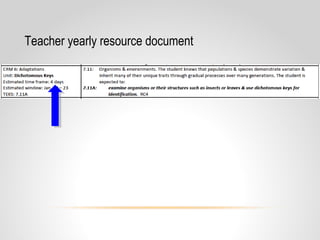
Teacher yearly resource document
Monday Tuesday Wednesday Thursday Friday
Jan. 5
Heredity &
Reproduction
6 7 8 9
12
Internal & External
Structures
13 14 15 16
19
Student/Staff Holiday
20
Dichotomous Keys
21 22 23
26
Natural Selection &
Selective Breeding
27 28 29 30
Feb. 2
Plant Physiology &
Adaptations
3 4 5
Plant Response to
Stimuli
6
9
Plant Cell Review &
Photosythesis
10 11 12
Energy Flow
13
16
Student Holiday
17
Energy Flow
18 19 20
4th
Six Weeks Planner (33 days)
7.1A-B, 7.2A-E, 7.3B-C, 7.4A7.11: Organisms & environments. The student knows that
populations & species demonstrate variation & inherit many of their
unique traits through gradual processes over many generations. The
student is expected to:
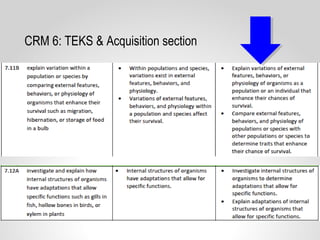
•7.11B: explain variation within a population or species by
comparing external features, behaviors, or physiology of organisms
that enhance their survival such as migration, hibernation, or storage
of food in a bulb.
7.12: Organisms & environments. The student knows that living
systems at all levels of organization demonstrate the complementary
nature of structure & function. The student is expected to:
•7.12A: investigate & explain how internal structures of
organisms have adaptations that allow specific functions such as gills
in fish, hollow bones in birds, or xylem in plants.
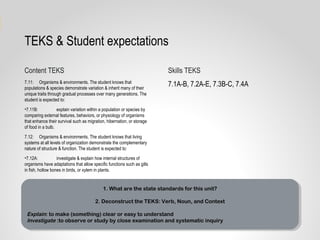
TEKS & Student expectations
Content TEKS Skills TEKS
1. What are the state standards for this unit?
2. Deconstruct the TEKS: Verb, Noun, and Context
Explain: to make (something) clear or easy to understand
Investigate :to observe or study by close examination and systematic inquiry
1. What are the state standards for this unit?
2. Deconstruct the TEKS: Verb, Noun, and Context
Explain: to make (something) clear or easy to understand
Investigate :to observe or study by close examination and systematic inquiry
CRM 6: TEKS & Acquisition section
Teacher Content support
BrainPop Videos: Camouflage, Birds, Penguins, Fish, Gills, Mammals, Dolphins, Giant Squid, Pandas,
Insects, Sponges, Amphibians, Spiders, Ants, Horses, Bats, Invertebrates, Vertebrates, Mollusks,
Cnidarians, Arachnids, Reptiles
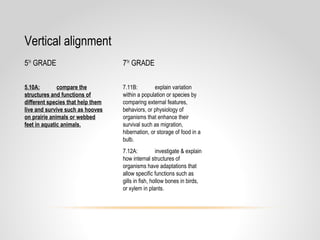
Vertical alignment
5TH
GRADE
5.10A: compare the
structures and functions of
different species that help them
live and survive such as hooves
on prairie animals or webbed
feet in aquatic animals.
7TH
GRADE
7.11B: explain variation
within a population or species by
comparing external features,
behaviors, or physiology of
organisms that enhance their
survival such as migration,
hibernation, or storage of food in a
bulb.
7.12A: investigate & explain
how internal structures of
organisms have adaptations that
allow specific functions such as
gills in fish, hollow bones in birds,
or xylem in plants.
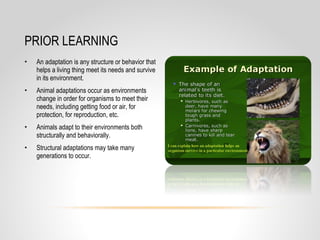
• An adaptation is any structure or behavior that
helps a living thing meet its needs and survive
in its environment.
• Animal adaptations occur as environments
change in order for organisms to meet their
needs, including getting food or air, for
protection, for reproduction, etc.
• Animals adapt to their environments both
structurally and behaviorally.
• Structural adaptations may take many
generations to occur.
PRIOR LEARNING
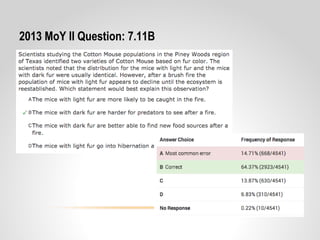
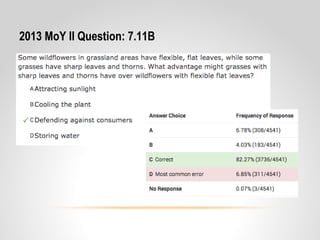
2013 MoY II Question: 7.11B
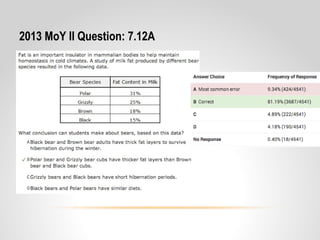
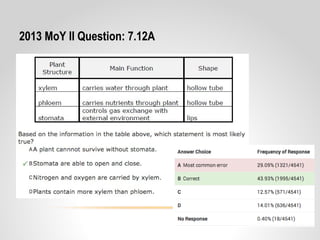
2013 MoY II Question: 7.12A
Based on the data and distractors, what key points should teachers
emphasize during lessons?
• Expose students to as many examples as possible while making
predictions and providing explanations for their purpose.
Activities to emphasize this point included
in the curriculum:
1.Living in the Desert Reading
2.Types of Adaptations Presentation
3.Salmon Migration Reading
4.Computer Interactive: Camouflage
5.Birds of Prey Reading
6.Internal & External Structures
Presentation
7.Beak vs. Food Activity
8.Darwin’s Fancy with Finches Reading
9.BrainPop Videos
Activities to emphasize this point included
in the curriculum:
1.Living in the Desert Reading
2.Types of Adaptations Presentation
3.Salmon Migration Reading
4.Computer Interactive: Camouflage
5.Birds of Prey Reading
6.Internal & External Structures
Presentation
7.Beak vs. Food Activity
8.Darwin’s Fancy with Finches Reading
9.BrainPop Videos
Components of a good lesson plan
1. Engage Student Interest
2. Review/Scaffold to TEKS
3. Student-Centered Activities directly relating to the depth and complexity of the TEKS
• Labs, Activities, Videos
1. Organize and Practice Vocabulary
2. Reading & Comprehension Strategies
3. Writing Opportunities & Scaffolds
4. Daily Listening & Speaking Opportunities
5. Differentiation
6. Formative Assessment & Reteach
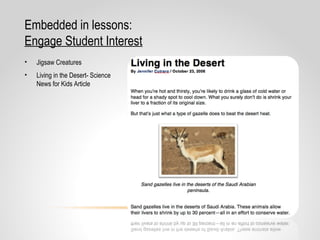
Embedded in lessons:
Engage Student Interest
• Jigsaw Creatures
• Living in the Desert- Science
News for Kids Article
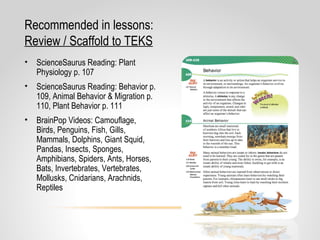
Recommended in lessons:
Review / Scaffold to TEKS
• ScienceSaurus Reading: Plant
Physiology p. 107
• ScienceSaurus Reading: Behavior p.
109, Animal Behavior & Migration p.
110, Plant Behavior p. 111
• BrainPop Videos: Camouflage,
Birds, Penguins, Fish, Gills,
Mammals, Dolphins, Giant Squid,
Pandas, Insects, Sponges,
Amphibians, Spiders, Ants, Horses,
Bats, Invertebrates, Vertebrates,
Mollusks, Cnidarians, Arachnids,
Reptiles
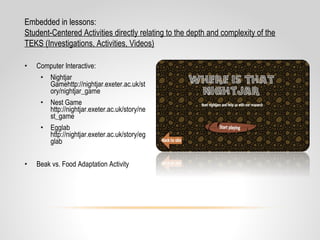
• Computer Interactive:
• Nightjar
Gamehttp://nightjar.exeter.ac.uk/st
ory/nightjar_game
• Nest Game
http://nightjar.exeter.ac.uk/story/ne
st_game
• Egglab
http://nightjar.exeter.ac.uk/story/eg
glab
• Beak vs. Food Adaptation Activity
Embedded in lessons:
Student-Centered Activities directly relating to the depth and complexity of the
TEKS (Investigations, Activities, Videos)
Embedded in lessons:
Organize and Practice Vocabulary
• Types of Adaptations Presentation
• Frayer Model: Adaptation
• Internal & External Structures
Presentation & Notes
Embedded in lessons:
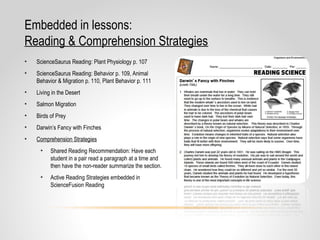
Reading & Comprehension Strategies
• ScienceSaurus Reading: Plant Physiology p. 107
• ScienceSaurus Reading: Behavior p. 109, Animal
Behavior & Migration p. 110, Plant Behavior p. 111
• Living in the Desert
• Salmon Migration
• Birds of Prey
• Darwin’s Fancy with Finches
• Comprehension Strategies
• Shared Reading Recommendation: Have each
student in a pair read a paragraph at a time and
then have the non-reader summarize the section.
• Active Reading Strategies embedded in
ScienceFusion Reading
Embedded in lessons:
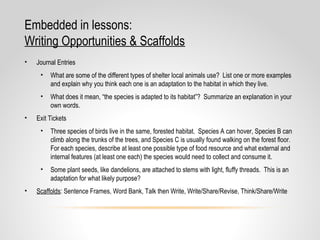
Writing Opportunities & Scaffolds
• Journal Entries
• What are some of the different types of shelter local animals use? List one or more examples
and explain why you think each one is an adaptation to the habitat in which they live.
• What does it mean, “the species is adapted to its habitat”? Summarize an explanation in your
own words.
• Exit Tickets
• Three species of birds live in the same, forested habitat. Species A can hover, Species B can
climb along the trunks of the trees, and Species C is usually found walking on the forest floor.
For each species, describe at least one possible type of food resource and what external and
internal features (at least one each) the species would need to collect and consume it.
• Some plant seeds, like dandelions, are attached to stems with light, fluffy threads. This is an
adaptation for what likely purpose?
• Scaffolds: Sentence Frames, Word Bank, Talk then Write, Write/Share/Revise, Think/Share/Write
Embedded in lessons:
Daily Listening & Speaking Opportunities
• Jigsaw Creatures
• Shared Reading
• Beak vs. Food Activity
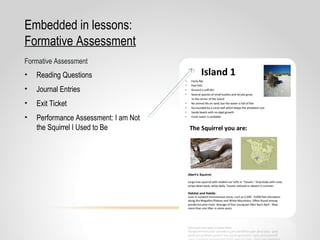
• Performance Assessment: I am Not the Squirrel I Used to Be
The first creature
would live in an
environment similar
to…
The sand gazelle has
adaptations such as…
• Special Education:
1. Mixed-Ability Partners
2. Science Glossary
3. Word Bank
4. Sentence Frames
5. Shared Reading
6. Environmental Accommodation
• English Language Learners:
1. Mixed-Ability Partners
2. Dual Language Science Glossary
3. Word Bank
4. Shared Reading
5. Sentence Frames
6. Closed Captioning
Embedded in lessons:
Differentiation
• Reading Questions
• Journal Entries
• Exit Ticket
• Performance Assessment: I am Not
the Squirrel I Used to Be
Embedded in lessons:
Formative Assessment
Reteach Options
• Preteach/Reteach 5.10A Options
• Clozing in on Science Passages
• Guided Practice Plant & Animal
Adaptations
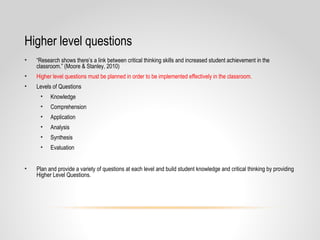
Higher level questions
• “Research shows there’s a link between critical thinking skills and increased student achievement in the
classroom.” (Moore & Stanley, 2010)
• Higher level questions must be planned in order to be implemented effectively in the classroom.
• Levels of Questions
• Knowledge
• Comprehension
• Application
• Analysis
• Synthesis
• Evaluation
• Plan and provide a variety of questions at each level and build student knowledge and critical thinking by providing
Higher Level Questions.
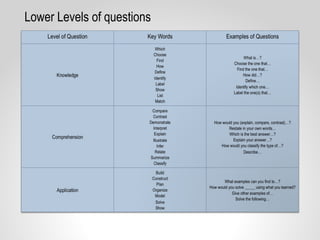
Lower Levels of questions
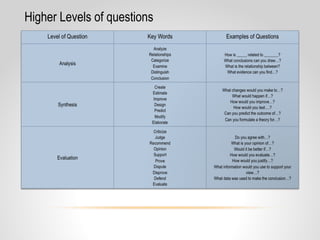
Higher Levels of questions
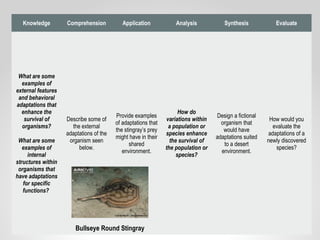
Knowledge Comprehension Application Analysis Synthesis Evaluate
What are some
examples of
external features
and behavioral
adaptations that
enhance the
survival of
organisms?
What are some
examples of
internal
structures within
organisms that
have adaptations
for specific
functions?
Describe some of
the external
adaptations of the
organism seen
below.
Provide examples
of adaptations that
the stingray’s prey
might have in their
shared
environment.
How do
variations within
a population or
species enhance
the survival of
the population or
species?
Design a fictional
organism that
would have
adaptations suited
to a desert
environment.
How would you
evaluate the
adaptations of a
newly discovered
species?
Bullseye Round Stingray
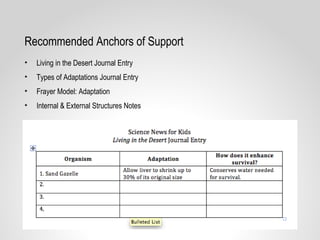
Recommended Anchors of Support
• Living in the Desert Journal Entry
• Types of Adaptations Journal Entry
• Frayer Model: Adaptation
• Internal & External Structures Notes
Anchors of Support
Other Resources
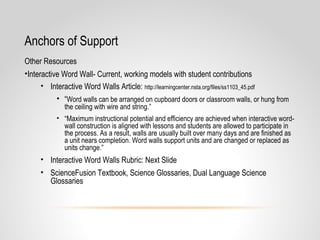
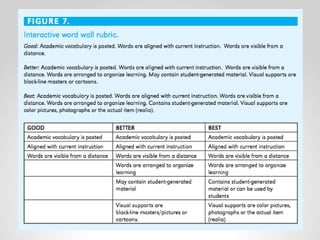
•Interactive Word Wall- Current, working models with student contributions
• Interactive Word Walls Article: http://learningcenter.nsta.org/files/ss1103_45.pdf
• “Word walls can be arranged on cupboard doors or classroom walls, or hung from
the ceiling with wire and string.”
• “Maximum instructional potential and efficiency are achieved when interactive word-
wall construction is aligned with lessons and students are allowed to participate in
the process. As a result, walls are usually built over many days and are finished as
a unit nears completion. Word walls support units and are changed or replaced as
units change.”
• Interactive Word Walls Rubric: Next Slide
• ScienceFusion Textbook, Science Glossaries, Dual Language Science
Glossaries
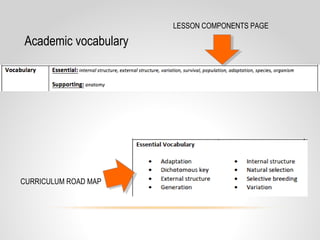
Academic vocabulary
LESSON COMPONENTS PAGE
CURRICULUM ROAD MAP
Core Content Coaching Grade 7 Internal & External Structures 14-15

Core Content Coaching Grade 7 Internal & External Structures 14-15

  • 1.
    Science Grade 7:Internal & External Structures Core Content Coaching
  • 2.
    Purpose To provide supportfor grade-level, unit content planning
  • 3.
    Resources for planning •Teacher Yearly Resource Document (or Yearly Itinerary) • CRM 6: Adaptations • Blank Pacing Calendar • 7th Grade 4th Six Weeks Lessons: Internal & External Structures Pacing Guide & Lessons • Computer with Internet Access
  • 4.
  • 5.
    Monday Tuesday WednesdayThursday Friday Jan. 5 Heredity & Reproduction 6 7 8 9 12 Internal & External Structures 13 14 15 16 19 Student/Staff Holiday 20 Dichotomous Keys 21 22 23 26 Natural Selection & Selective Breeding 27 28 29 30 Feb. 2 Plant Physiology & Adaptations 3 4 5 Plant Response to Stimuli 6 9 Plant Cell Review & Photosythesis 10 11 12 Energy Flow 13 16 Student Holiday 17 Energy Flow 18 19 20 4th Six Weeks Planner (33 days)
  • 6.
    7.1A-B, 7.2A-E, 7.3B-C,7.4A7.11: Organisms & environments. The student knows that populations & species demonstrate variation & inherit many of their unique traits through gradual processes over many generations. The student is expected to: •7.11B: explain variation within a population or species by comparing external features, behaviors, or physiology of organisms that enhance their survival such as migration, hibernation, or storage of food in a bulb. 7.12: Organisms & environments. The student knows that living systems at all levels of organization demonstrate the complementary nature of structure & function. The student is expected to: •7.12A: investigate & explain how internal structures of organisms have adaptations that allow specific functions such as gills in fish, hollow bones in birds, or xylem in plants. TEKS & Student expectations Content TEKS Skills TEKS 1. What are the state standards for this unit? 2. Deconstruct the TEKS: Verb, Noun, and Context Explain: to make (something) clear or easy to understand Investigate :to observe or study by close examination and systematic inquiry 1. What are the state standards for this unit? 2. Deconstruct the TEKS: Verb, Noun, and Context Explain: to make (something) clear or easy to understand Investigate :to observe or study by close examination and systematic inquiry
  • 7.
    CRM 6: TEKS& Acquisition section
  • 8.
    Teacher Content support BrainPopVideos: Camouflage, Birds, Penguins, Fish, Gills, Mammals, Dolphins, Giant Squid, Pandas, Insects, Sponges, Amphibians, Spiders, Ants, Horses, Bats, Invertebrates, Vertebrates, Mollusks, Cnidarians, Arachnids, Reptiles
  • 9.
    Vertical alignment 5TH GRADE 5.10A: comparethe structures and functions of different species that help them live and survive such as hooves on prairie animals or webbed feet in aquatic animals. 7TH GRADE 7.11B: explain variation within a population or species by comparing external features, behaviors, or physiology of organisms that enhance their survival such as migration, hibernation, or storage of food in a bulb. 7.12A: investigate & explain how internal structures of organisms have adaptations that allow specific functions such as gills in fish, hollow bones in birds, or xylem in plants.
  • 10.
    • An adaptationis any structure or behavior that helps a living thing meet its needs and survive in its environment. • Animal adaptations occur as environments change in order for organisms to meet their needs, including getting food or air, for protection, for reproduction, etc. • Animals adapt to their environments both structurally and behaviorally. • Structural adaptations may take many generations to occur. PRIOR LEARNING
  • 11.
    2013 MoY IIQuestion: 7.11B
  • 12.
    2013 MoY IIQuestion: 7.11B
  • 13.
    2013 MoY IIQuestion: 7.12A
  • 14.
    2013 MoY IIQuestion: 7.12A
  • 15.
    Based on thedata and distractors, what key points should teachers emphasize during lessons? • Expose students to as many examples as possible while making predictions and providing explanations for their purpose. Activities to emphasize this point included in the curriculum: 1.Living in the Desert Reading 2.Types of Adaptations Presentation 3.Salmon Migration Reading 4.Computer Interactive: Camouflage 5.Birds of Prey Reading 6.Internal & External Structures Presentation 7.Beak vs. Food Activity 8.Darwin’s Fancy with Finches Reading 9.BrainPop Videos Activities to emphasize this point included in the curriculum: 1.Living in the Desert Reading 2.Types of Adaptations Presentation 3.Salmon Migration Reading 4.Computer Interactive: Camouflage 5.Birds of Prey Reading 6.Internal & External Structures Presentation 7.Beak vs. Food Activity 8.Darwin’s Fancy with Finches Reading 9.BrainPop Videos
  • 16.
    Components of agood lesson plan 1. Engage Student Interest 2. Review/Scaffold to TEKS 3. Student-Centered Activities directly relating to the depth and complexity of the TEKS • Labs, Activities, Videos 1. Organize and Practice Vocabulary 2. Reading & Comprehension Strategies 3. Writing Opportunities & Scaffolds 4. Daily Listening & Speaking Opportunities 5. Differentiation 6. Formative Assessment & Reteach
  • 17.
    Embedded in lessons: EngageStudent Interest • Jigsaw Creatures • Living in the Desert- Science News for Kids Article
  • 18.
    Recommended in lessons: Review/ Scaffold to TEKS • ScienceSaurus Reading: Plant Physiology p. 107 • ScienceSaurus Reading: Behavior p. 109, Animal Behavior & Migration p. 110, Plant Behavior p. 111 • BrainPop Videos: Camouflage, Birds, Penguins, Fish, Gills, Mammals, Dolphins, Giant Squid, Pandas, Insects, Sponges, Amphibians, Spiders, Ants, Horses, Bats, Invertebrates, Vertebrates, Mollusks, Cnidarians, Arachnids, Reptiles
  • 19.
    • Computer Interactive: •Nightjar Gamehttp://nightjar.exeter.ac.uk/st ory/nightjar_game • Nest Game http://nightjar.exeter.ac.uk/story/ne st_game • Egglab http://nightjar.exeter.ac.uk/story/eg glab • Beak vs. Food Adaptation Activity Embedded in lessons: Student-Centered Activities directly relating to the depth and complexity of the TEKS (Investigations, Activities, Videos)
  • 20.
    Embedded in lessons: Organizeand Practice Vocabulary • Types of Adaptations Presentation • Frayer Model: Adaptation • Internal & External Structures Presentation & Notes
  • 21.
    Embedded in lessons: Reading& Comprehension Strategies • ScienceSaurus Reading: Plant Physiology p. 107 • ScienceSaurus Reading: Behavior p. 109, Animal Behavior & Migration p. 110, Plant Behavior p. 111 • Living in the Desert • Salmon Migration • Birds of Prey • Darwin’s Fancy with Finches • Comprehension Strategies • Shared Reading Recommendation: Have each student in a pair read a paragraph at a time and then have the non-reader summarize the section. • Active Reading Strategies embedded in ScienceFusion Reading
  • 22.
    Embedded in lessons: WritingOpportunities & Scaffolds • Journal Entries • What are some of the different types of shelter local animals use? List one or more examples and explain why you think each one is an adaptation to the habitat in which they live. • What does it mean, “the species is adapted to its habitat”? Summarize an explanation in your own words. • Exit Tickets • Three species of birds live in the same, forested habitat. Species A can hover, Species B can climb along the trunks of the trees, and Species C is usually found walking on the forest floor. For each species, describe at least one possible type of food resource and what external and internal features (at least one each) the species would need to collect and consume it. • Some plant seeds, like dandelions, are attached to stems with light, fluffy threads. This is an adaptation for what likely purpose? • Scaffolds: Sentence Frames, Word Bank, Talk then Write, Write/Share/Revise, Think/Share/Write
  • 23.
    Embedded in lessons: DailyListening & Speaking Opportunities • Jigsaw Creatures • Shared Reading • Beak vs. Food Activity • Performance Assessment: I am Not the Squirrel I Used to Be The first creature would live in an environment similar to… The sand gazelle has adaptations such as…
  • 24.
    • Special Education: 1.Mixed-Ability Partners 2. Science Glossary 3. Word Bank 4. Sentence Frames 5. Shared Reading 6. Environmental Accommodation • English Language Learners: 1. Mixed-Ability Partners 2. Dual Language Science Glossary 3. Word Bank 4. Shared Reading 5. Sentence Frames 6. Closed Captioning Embedded in lessons: Differentiation
  • 25.
    • Reading Questions •Journal Entries • Exit Ticket • Performance Assessment: I am Not the Squirrel I Used to Be Embedded in lessons: Formative Assessment Formative Assessment
  • 26.
    Reteach Options • Preteach/Reteach5.10A Options • Clozing in on Science Passages • Guided Practice Plant & Animal Adaptations
  • 27.
    Higher level questions •“Research shows there’s a link between critical thinking skills and increased student achievement in the classroom.” (Moore & Stanley, 2010) • Higher level questions must be planned in order to be implemented effectively in the classroom. • Levels of Questions • Knowledge • Comprehension • Application • Analysis • Synthesis • Evaluation • Plan and provide a variety of questions at each level and build student knowledge and critical thinking by providing Higher Level Questions.
  • 28.
    Lower Levels ofquestions
  • 29.
  • 30.
    Knowledge Comprehension ApplicationAnalysis Synthesis Evaluate What are some examples of external features and behavioral adaptations that enhance the survival of organisms? What are some examples of internal structures within organisms that have adaptations for specific functions? Describe some of the external adaptations of the organism seen below. Provide examples of adaptations that the stingray’s prey might have in their shared environment. How do variations within a population or species enhance the survival of the population or species? Design a fictional organism that would have adaptations suited to a desert environment. How would you evaluate the adaptations of a newly discovered species? Bullseye Round Stingray
  • 31.
    Recommended Anchors ofSupport • Living in the Desert Journal Entry • Types of Adaptations Journal Entry • Frayer Model: Adaptation • Internal & External Structures Notes
  • 32.
    Anchors of Support OtherResources •Interactive Word Wall- Current, working models with student contributions • Interactive Word Walls Article: http://learningcenter.nsta.org/files/ss1103_45.pdf • “Word walls can be arranged on cupboard doors or classroom walls, or hung from the ceiling with wire and string.” • “Maximum instructional potential and efficiency are achieved when interactive word- wall construction is aligned with lessons and students are allowed to participate in the process. As a result, walls are usually built over many days and are finished as a unit nears completion. Word walls support units and are changed or replaced as units change.” • Interactive Word Walls Rubric: Next Slide • ScienceFusion Textbook, Science Glossaries, Dual Language Science Glossaries
  • 34.
    Academic vocabulary LESSON COMPONENTSPAGE CURRICULUM ROAD MAP

Editor's Notes

  • #7 What are the state standards for this Unit? Deconstruct the TEKS: Verb, Noun, and Context What does it mean to “explain” & “investigate”?
  • #8 What should students know and be able to do?
  • #10 Note the development of the understanding of elements and compounds from 6th grade to high school.
  • #28 Edited from Critical Thinking and Formative Assessment: Increasing the Rigor in Your Classroom
  • #29 Edited from Critical Thinking and Formative Assessment: Increasing the Rigor in Your Classroom
  • #30 Edited from Critical Thinking and Formative Assessment: Increasing the Rigor in Your Classroom
  • #31 Guiding Questions are bold and italicized.
  • #35 What are the essential vocabulary for the unit?Are all necessary vocabulary accounted for in the acquiring and practicing opportunities?