Science Grade 8: Tides
Core Content Coaching
Purpose
To provide support for grade-level, unit content planning
Resources for planning
• Teacher Yearly Resource Document (or Yearly Itinerary)
• CRM 6: Earth, Sun, and Moon
• Blank Pacing Calendar
• 8th
Grade 4th
Six Weeks Lessons: Tides Pacing Guide & Lessons
• Computer with Internet Access
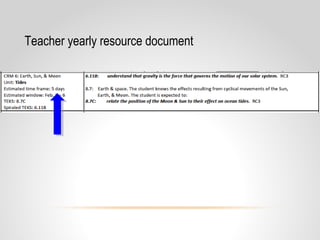
Teacher yearly resource document
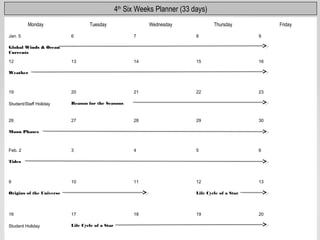
Monday Tuesday Wednesday Thursday Friday
Jan. 5
Global Winds & Ocean
Currents
6 7 8 9
12
Weather
13 14 15 16
19
Student/Staff Holiday
20
Reason for the Seasons
21 22 23
26
Moon Phases
27 28 29 30
Feb. 2
Tides
3 4 5 6
9
Origins of the Universe
10 11 12
Life Cycle of a Star
13
16
Student Holiday
17
Life Cycle of a Star
18 19 20
4th
Six Weeks Planner (33 days)
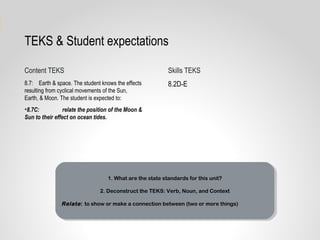
8.2D-E8.7: Earth & space. The student knows the effects
resulting from cyclical movements of the Sun,
Earth, & Moon. The student is expected to:
•8.7C: relate the position of the Moon &
Sun to their effect on ocean tides.
TEKS & Student expectations
Content TEKS Skills TEKS
1. What are the state standards for this unit?
2. Deconstruct the TEKS: Verb, Noun, and Context
Relate: to show or make a connection between (two or more things)
1. What are the state standards for this unit?
2. Deconstruct the TEKS: Verb, Noun, and Context
Relate: to show or make a connection between (two or more things)
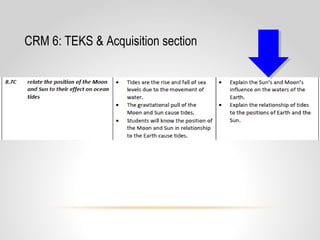
CRM 6: TEKS & Acquisition section
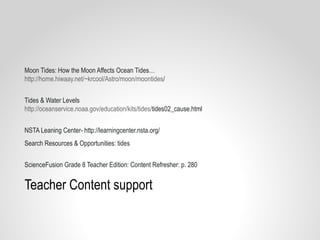
Teacher Content support
Moon Tides: How the Moon Affects Ocean Tides…
http://home.hiwaay.net/~krcool/Astro/moon/moontides/
Tides & Water Levels
http://oceanservice.noaa.gov/education/kits/tides/tides02_cause.html
NSTA Leaning Center- http://learningcenter.nsta.org/
Search Resources & Opportunities: tides
ScienceFusion Grade 8 Teacher Edition: Content Refresher: p. 280
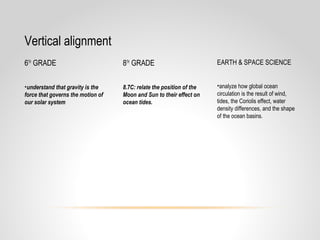
Vertical alignment
6TH
GRADE
•understand that gravity is the
force that governs the motion of
our solar system
8TH
GRADE
8.7C: relate the position of the
Moon and Sun to their effect on
ocean tides.
EARTH & SPACE SCIENCE
•analyze how global ocean
circulation is the result of wind,
tides, the Coriolis effect, water
density differences, and the shape
of the ocean basins.
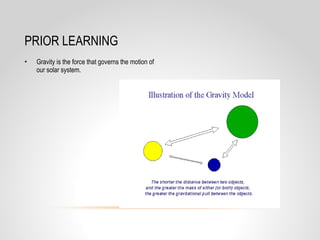
• Gravity is the force that governs the motion of
our solar system.
PRIOR LEARNING
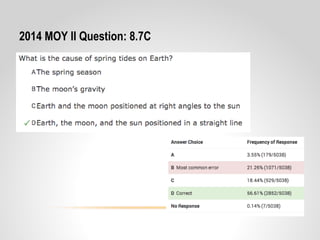
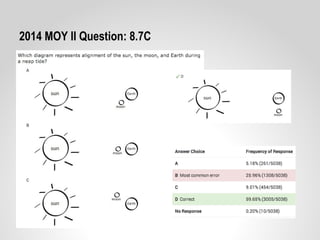
2014 MOY II Question: 8.7C
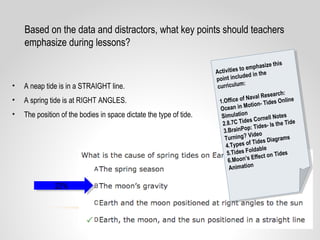
Based on the data and distractors, what key points should teachers
emphasize during lessons?
• A neap tide is in a STRAIGHT line.
• A spring tide is at RIGHT ANGLES.
• The position of the bodies in space dictate the type of tide.
22%22%
Activities to emphasize this
point included in the
curriculum:
1.Office of Naval Research:
Ocean in Motion- Tides Online
Simulation
2.8.7C Tides Cornell Notes
3.BrainPop: Tides- Is the Tide
Turning? Video
4.Types of Tides Diagrams
5.Tides Foldable
6.Moon’s Effect on Tides
Animation
Activities to emphasize this
point included in the
curriculum:
1.Office of Naval Research:
Ocean in Motion- Tides Online
Simulation
2.8.7C Tides Cornell Notes
3.BrainPop: Tides- Is the Tide
Turning? Video
4.Types of Tides Diagrams
5.Tides Foldable
6.Moon’s Effect on Tides
Animation
Components of a good lesson plan
1. Engage Student Interest
2. Review/Scaffold to TEKS
3. Student-Centered Activities directly relating to the depth and complexity of the TEKS
• Labs, Activities, Videos
1. Organize and Practice Vocabulary
2. Reading & Comprehension Strategies
3. Writing Opportunities & Scaffolds
4. Daily Listening & Speaking Opportunities
5. Differentiation
6. Formative Assessment & Reteach
Embedded in lessons:
Engage Student Interest
• Pre-Assessment: We know
that the position of the Moon
affects the lunar phase we
see at night. What other
affects does a Moon phase
have on planet Earth?
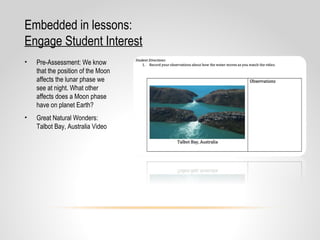
• Great Natural Wonders:
Talbot Bay, Australia Video
Recommended in lessons:
Review / Scaffold to TEKS
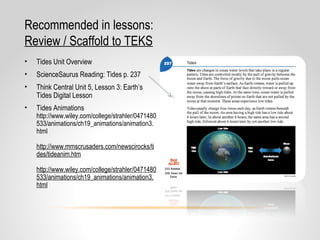
• Tides Unit Overview
• ScienceSaurus Reading: Tides p. 237
• Think Central Unit 5, Lesson 3: Earth’s
Tides Digital Lesson
• Tides Animations
http://www.wiley.com/college/strahler/0471480
533/animations/ch19_animations/animation3.
html
http://www.mmscrusaders.com/newscirocks/ti
des/tideanim.htm
http://www.wiley.com/college/strahler/0471480
533/animations/ch19_animations/animation3.
html
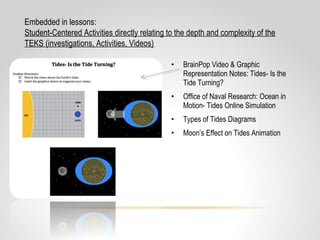
• BrainPop Video & Graphic
Representation Notes: Tides- Is the
Tide Turning?
• Office of Naval Research: Ocean in
Motion- Tides Online Simulation
• Types of Tides Diagrams
• Moon’s Effect on Tides Animation
Embedded in lessons:
Student-Centered Activities directly relating to the depth and complexity of the
TEKS (investigations, Activities, Videos)
Embedded in lessons:
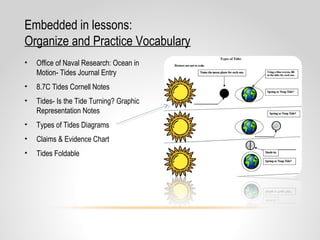
Organize and Practice Vocabulary
• Office of Naval Research: Ocean in
Motion- Tides Journal Entry
• 8.7C Tides Cornell Notes
• Tides- Is the Tide Turning? Graphic
Representation Notes
• Types of Tides Diagrams
• Claims & Evidence Chart
• Tides Foldable
Embedded in lessons:
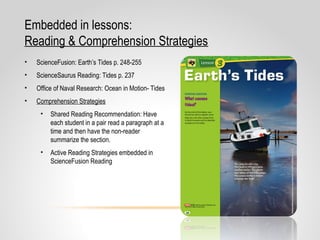
Reading & Comprehension Strategies
• ScienceFusion: Earth’s Tides p. 248-255
• ScienceSaurus Reading: Tides p. 237
• Office of Naval Research: Ocean in Motion- Tides
• Comprehension Strategies
• Shared Reading Recommendation: Have
each student in a pair read a paragraph at a
time and then have the non-reader
summarize the section.
• Active Reading Strategies embedded in
ScienceFusion Reading
Embedded in lessons:
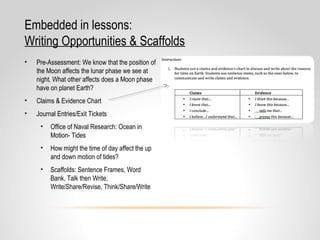
Writing Opportunities & Scaffolds
• Pre-Assessment: We know that the position of
the Moon affects the lunar phase we see at
night. What other affects does a Moon phase
have on planet Earth?
• Claims & Evidence Chart
• Journal Entries/Exit Tickets
• Office of Naval Research: Ocean in
Motion- Tides
• How might the time of day affect the up
and down motion of tides?
• Scaffolds: Sentence Frames, Word
Bank, Talk then Write,
Write/Share/Revise, Think/Share/Write
Embedded in lessons:
Daily Listening & Speaking Opportunities
I think this because…
I conclude…
• Special Education:
1. Mixed-Ability Partners
2. Science Glossary
3. Word Bank
4. Sentence Frames
5. Unit Overview
6. Class List
7. Shared Reading
8. Chunked Reading
9. Fill-in-the-Blank Notes
10. Graphic Representation Notes
11. Animation
12. Anchors of Support
13. Text to Speech
• English Language Learners:
1. Mixed-Ability Partners
2. Dual Language Science Glossary
3. Word Bank
4. Sentence Frames
5. Class List
6. Shared Reading
7. Closed Captioning
8. Graphic Representation Notes
9. Claims & Evidence Chart
10. Foldable
11. Anchors of Support
Embedded in lessons:
Differentiation
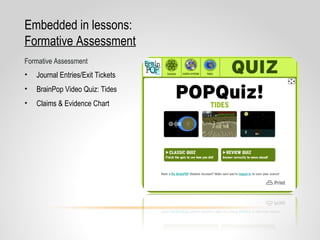
• Journal Entries/Exit Tickets
• BrainPop Video Quiz: Tides
• Claims & Evidence Chart
Embedded in lessons:
Formative Assessment
Reteach Options
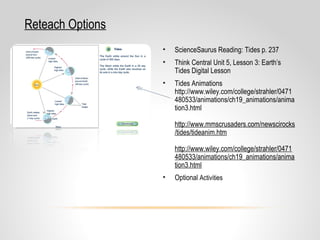
• ScienceSaurus Reading: Tides p. 237
• Think Central Unit 5, Lesson 3: Earth’s
Tides Digital Lesson
• Tides Animations
http://www.wiley.com/college/strahler/0471
480533/animations/ch19_animations/anima
tion3.html
http://www.mmscrusaders.com/newscirocks
/tides/tideanim.htm
http://www.wiley.com/college/strahler/0471
480533/animations/ch19_animations/anima
tion3.html
• Optional Activities
Higher level questions
• “Research shows there’s a link between critical thinking skills and increased student achievement in the
classroom.” (Moore & Stanley, 2010)
• Higher level questions must be planned in order to be implemented effectively in the classroom.
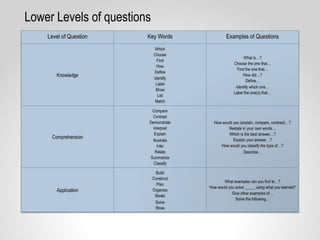
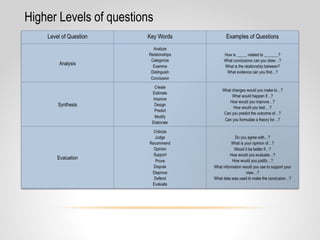
• Levels of Questions
• Knowledge
• Comprehension
• Application
• Analysis
• Synthesis
• Evaluation
• Plan and provide a variety of questions at each level and build student knowledge and critical thinking by providing
Higher Level Questions.
Lower Levels of questions
Higher Levels of questions
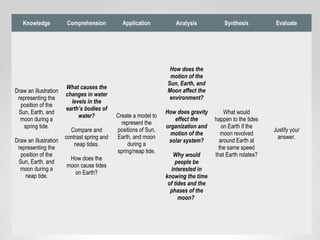
Knowledge Comprehension Application Analysis Synthesis Evaluate
Draw an illustration
representing the
position of the
Sun, Earth, and
moon during a
spring tide.
Draw an illustration
representing the
position of the
Sun, Earth, and
moon during a
neap tide.
What causes the
changes in water
levels in the
earth’s bodies of
water?
Compare and
contrast spring and
neap tides.
How does the
moon cause tides
on Earth?
Create a model to
represent the
positions of Sun,
Earth, and moon
during a
spring/neap tide.
How does the
motion of the
Sun, Earth, and
Moon affect the
environment?
How does gravity
effect the
organization and
motion of the
solar system?
Why would
people be
interested in
knowing the time
of tides and the
phases of the
moon?
What would
happen to the tides
on Earth if the
moon revolved
around Earth at
the same speed
that Earth rotates?
Justify your
answer.
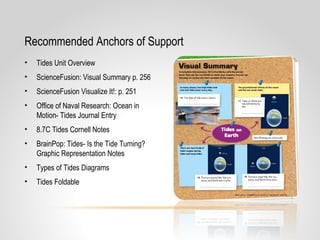
Recommended Anchors of Support
• Tides Unit Overview
• ScienceFusion: Visual Summary p. 256
• ScienceFusion Visualize It!: p. 251
• Office of Naval Research: Ocean in
Motion- Tides Journal Entry
• 8.7C Tides Cornell Notes
• BrainPop: Tides- Is the Tide Turning?
Graphic Representation Notes
• Types of Tides Diagrams
• Tides Foldable
Anchors of Support
Other Resources
•Interactive Word Wall- Current, working models with student contributions
• Interactive Word Walls Article: http://learningcenter.nsta.org/files/ss1103_45.pdf
• “Word walls can be arranged on cupboard doors or classroom walls, or hung from
the ceiling with wire and string.”
• “Maximum instructional potential and efficiency are achieved when interactive word-
wall construction is aligned with lessons and students are allowed to participate in
the process. As a result, walls are usually built over many days and are finished as
a unit nears completion. Word walls support units and are changed or replaced as
units change.”
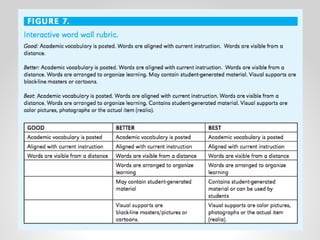
• Interactive Word Walls Rubric: Next Slide
• ScienceFusion Textbook, Science Glossaries, Dual Language Science
Glossaries
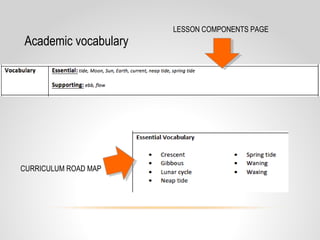
Academic vocabulary
LESSON COMPONENTS PAGE
CURRICULUM ROAD MAP
Core Content Coaching Grade 8 Tides 14-15

Core Content Coaching Grade 8 Tides 14-15

  • 1.
    Science Grade 8:Tides Core Content Coaching
  • 2.
    Purpose To provide supportfor grade-level, unit content planning
  • 3.
    Resources for planning •Teacher Yearly Resource Document (or Yearly Itinerary) • CRM 6: Earth, Sun, and Moon • Blank Pacing Calendar • 8th Grade 4th Six Weeks Lessons: Tides Pacing Guide & Lessons • Computer with Internet Access
  • 4.
  • 5.
    Monday Tuesday WednesdayThursday Friday Jan. 5 Global Winds & Ocean Currents 6 7 8 9 12 Weather 13 14 15 16 19 Student/Staff Holiday 20 Reason for the Seasons 21 22 23 26 Moon Phases 27 28 29 30 Feb. 2 Tides 3 4 5 6 9 Origins of the Universe 10 11 12 Life Cycle of a Star 13 16 Student Holiday 17 Life Cycle of a Star 18 19 20 4th Six Weeks Planner (33 days)
  • 6.
    8.2D-E8.7: Earth &space. The student knows the effects resulting from cyclical movements of the Sun, Earth, & Moon. The student is expected to: •8.7C: relate the position of the Moon & Sun to their effect on ocean tides. TEKS & Student expectations Content TEKS Skills TEKS 1. What are the state standards for this unit? 2. Deconstruct the TEKS: Verb, Noun, and Context Relate: to show or make a connection between (two or more things) 1. What are the state standards for this unit? 2. Deconstruct the TEKS: Verb, Noun, and Context Relate: to show or make a connection between (two or more things)
  • 7.
    CRM 6: TEKS& Acquisition section
  • 8.
    Teacher Content support MoonTides: How the Moon Affects Ocean Tides… http://home.hiwaay.net/~krcool/Astro/moon/moontides/ Tides & Water Levels http://oceanservice.noaa.gov/education/kits/tides/tides02_cause.html NSTA Leaning Center- http://learningcenter.nsta.org/ Search Resources & Opportunities: tides ScienceFusion Grade 8 Teacher Edition: Content Refresher: p. 280
  • 9.
    Vertical alignment 6TH GRADE •understand thatgravity is the force that governs the motion of our solar system 8TH GRADE 8.7C: relate the position of the Moon and Sun to their effect on ocean tides. EARTH & SPACE SCIENCE •analyze how global ocean circulation is the result of wind, tides, the Coriolis effect, water density differences, and the shape of the ocean basins.
  • 10.
    • Gravity isthe force that governs the motion of our solar system. PRIOR LEARNING
  • 11.
    2014 MOY IIQuestion: 8.7C
  • 12.
    2014 MOY IIQuestion: 8.7C
  • 13.
    Based on thedata and distractors, what key points should teachers emphasize during lessons? • A neap tide is in a STRAIGHT line. • A spring tide is at RIGHT ANGLES. • The position of the bodies in space dictate the type of tide. 22%22% Activities to emphasize this point included in the curriculum: 1.Office of Naval Research: Ocean in Motion- Tides Online Simulation 2.8.7C Tides Cornell Notes 3.BrainPop: Tides- Is the Tide Turning? Video 4.Types of Tides Diagrams 5.Tides Foldable 6.Moon’s Effect on Tides Animation Activities to emphasize this point included in the curriculum: 1.Office of Naval Research: Ocean in Motion- Tides Online Simulation 2.8.7C Tides Cornell Notes 3.BrainPop: Tides- Is the Tide Turning? Video 4.Types of Tides Diagrams 5.Tides Foldable 6.Moon’s Effect on Tides Animation
  • 14.
    Components of agood lesson plan 1. Engage Student Interest 2. Review/Scaffold to TEKS 3. Student-Centered Activities directly relating to the depth and complexity of the TEKS • Labs, Activities, Videos 1. Organize and Practice Vocabulary 2. Reading & Comprehension Strategies 3. Writing Opportunities & Scaffolds 4. Daily Listening & Speaking Opportunities 5. Differentiation 6. Formative Assessment & Reteach
  • 15.
    Embedded in lessons: EngageStudent Interest • Pre-Assessment: We know that the position of the Moon affects the lunar phase we see at night. What other affects does a Moon phase have on planet Earth? • Great Natural Wonders: Talbot Bay, Australia Video
  • 16.
    Recommended in lessons: Review/ Scaffold to TEKS • Tides Unit Overview • ScienceSaurus Reading: Tides p. 237 • Think Central Unit 5, Lesson 3: Earth’s Tides Digital Lesson • Tides Animations http://www.wiley.com/college/strahler/0471480 533/animations/ch19_animations/animation3. html http://www.mmscrusaders.com/newscirocks/ti des/tideanim.htm http://www.wiley.com/college/strahler/0471480 533/animations/ch19_animations/animation3. html
  • 17.
    • BrainPop Video& Graphic Representation Notes: Tides- Is the Tide Turning? • Office of Naval Research: Ocean in Motion- Tides Online Simulation • Types of Tides Diagrams • Moon’s Effect on Tides Animation Embedded in lessons: Student-Centered Activities directly relating to the depth and complexity of the TEKS (investigations, Activities, Videos)
  • 18.
    Embedded in lessons: Organizeand Practice Vocabulary • Office of Naval Research: Ocean in Motion- Tides Journal Entry • 8.7C Tides Cornell Notes • Tides- Is the Tide Turning? Graphic Representation Notes • Types of Tides Diagrams • Claims & Evidence Chart • Tides Foldable
  • 19.
    Embedded in lessons: Reading& Comprehension Strategies • ScienceFusion: Earth’s Tides p. 248-255 • ScienceSaurus Reading: Tides p. 237 • Office of Naval Research: Ocean in Motion- Tides • Comprehension Strategies • Shared Reading Recommendation: Have each student in a pair read a paragraph at a time and then have the non-reader summarize the section. • Active Reading Strategies embedded in ScienceFusion Reading
  • 20.
    Embedded in lessons: WritingOpportunities & Scaffolds • Pre-Assessment: We know that the position of the Moon affects the lunar phase we see at night. What other affects does a Moon phase have on planet Earth? • Claims & Evidence Chart • Journal Entries/Exit Tickets • Office of Naval Research: Ocean in Motion- Tides • How might the time of day affect the up and down motion of tides? • Scaffolds: Sentence Frames, Word Bank, Talk then Write, Write/Share/Revise, Think/Share/Write
  • 21.
    Embedded in lessons: DailyListening & Speaking Opportunities I think this because… I conclude…
  • 22.
    • Special Education: 1.Mixed-Ability Partners 2. Science Glossary 3. Word Bank 4. Sentence Frames 5. Unit Overview 6. Class List 7. Shared Reading 8. Chunked Reading 9. Fill-in-the-Blank Notes 10. Graphic Representation Notes 11. Animation 12. Anchors of Support 13. Text to Speech • English Language Learners: 1. Mixed-Ability Partners 2. Dual Language Science Glossary 3. Word Bank 4. Sentence Frames 5. Class List 6. Shared Reading 7. Closed Captioning 8. Graphic Representation Notes 9. Claims & Evidence Chart 10. Foldable 11. Anchors of Support Embedded in lessons: Differentiation
  • 23.
    • Journal Entries/ExitTickets • BrainPop Video Quiz: Tides • Claims & Evidence Chart Embedded in lessons: Formative Assessment Formative Assessment
  • 24.
    Reteach Options • ScienceSaurusReading: Tides p. 237 • Think Central Unit 5, Lesson 3: Earth’s Tides Digital Lesson • Tides Animations http://www.wiley.com/college/strahler/0471 480533/animations/ch19_animations/anima tion3.html http://www.mmscrusaders.com/newscirocks /tides/tideanim.htm http://www.wiley.com/college/strahler/0471 480533/animations/ch19_animations/anima tion3.html • Optional Activities
  • 25.
    Higher level questions •“Research shows there’s a link between critical thinking skills and increased student achievement in the classroom.” (Moore & Stanley, 2010) • Higher level questions must be planned in order to be implemented effectively in the classroom. • Levels of Questions • Knowledge • Comprehension • Application • Analysis • Synthesis • Evaluation • Plan and provide a variety of questions at each level and build student knowledge and critical thinking by providing Higher Level Questions.
  • 26.
    Lower Levels ofquestions
  • 27.
  • 28.
    Knowledge Comprehension ApplicationAnalysis Synthesis Evaluate Draw an illustration representing the position of the Sun, Earth, and moon during a spring tide. Draw an illustration representing the position of the Sun, Earth, and moon during a neap tide. What causes the changes in water levels in the earth’s bodies of water? Compare and contrast spring and neap tides. How does the moon cause tides on Earth? Create a model to represent the positions of Sun, Earth, and moon during a spring/neap tide. How does the motion of the Sun, Earth, and Moon affect the environment? How does gravity effect the organization and motion of the solar system? Why would people be interested in knowing the time of tides and the phases of the moon? What would happen to the tides on Earth if the moon revolved around Earth at the same speed that Earth rotates? Justify your answer.
  • 29.
    Recommended Anchors ofSupport • Tides Unit Overview • ScienceFusion: Visual Summary p. 256 • ScienceFusion Visualize It!: p. 251 • Office of Naval Research: Ocean in Motion- Tides Journal Entry • 8.7C Tides Cornell Notes • BrainPop: Tides- Is the Tide Turning? Graphic Representation Notes • Types of Tides Diagrams • Tides Foldable
  • 30.
    Anchors of Support OtherResources •Interactive Word Wall- Current, working models with student contributions • Interactive Word Walls Article: http://learningcenter.nsta.org/files/ss1103_45.pdf • “Word walls can be arranged on cupboard doors or classroom walls, or hung from the ceiling with wire and string.” • “Maximum instructional potential and efficiency are achieved when interactive word- wall construction is aligned with lessons and students are allowed to participate in the process. As a result, walls are usually built over many days and are finished as a unit nears completion. Word walls support units and are changed or replaced as units change.” • Interactive Word Walls Rubric: Next Slide • ScienceFusion Textbook, Science Glossaries, Dual Language Science Glossaries
  • 32.
    Academic vocabulary LESSON COMPONENTSPAGE CURRICULUM ROAD MAP

Editor's Notes

  • #7 What are the state standards for this Unit? Deconstruct the TEKS: Verb, Noun, and Context What does it mean to “relate””?
  • #8 What should students know and be able to do?
  • #10 Note the development of the understanding of elements and compounds from 6th grade to 8th grade.
  • #11 This information is located on the CRM and the Teacher Lesson Page. The Teacher Lesson Page contains the specific prior learning for the specific TEKS for this Unit.
  • #26 Edited from Critical Thinking and Formative Assessment: Increasing the Rigor in Your Classroom
  • #27 Edited from Critical Thinking and Formative Assessment: Increasing the Rigor in Your Classroom
  • #28 Edited from Critical Thinking and Formative Assessment: Increasing the Rigor in Your Classroom
  • #29 Guiding Questions are bold and italicized.
  • #33 What are the essential vocabulary for the unit?Are all necessary vocabulary accounted for in the acquiring and practicing opportunities?