“
”
General Inter ORB Protocol
and Object Persistence &
Object Serialization
Created By
Ankit Mulani (ME - CE)(2nd Sem) Enrolment No : 140870702504
OUTLINES
What is ORB Protocol
What is General Inter ORB Protocol
Protocols Provided by General Inter ORB Protocol
Object Persistence
Object Serialization
ORB Protocol
ORB Stands for Object Request Broker
ORB Protocol allows applications to communicate with one another
no matter where they reside on a network
The Object Management Group(OMG) exists to create standards for
distributed object computing that are realistic, commercially
available and usable
 OMG does this through its Object Management Architecture
(OMA) at the heart of which is the Common Object Request Broker
Architecture (CORBA)
 CORBA specifies the Object Request Broker (ORB) Protocol
General Inter ORB Protocol
 In distributed computing, General Inter-ORB Protocol (GIOP) is the
abstract protocol by which ORBs can communicate
 The GIOP specification consists of the following elements
1. The Common Data Representation (CDR)
 CDR is used to represent Interface Definition Language(IDL) data types
on CORBA distributed objects
2. GIOP Transport Assumptions
 Establishment of any network transport layer that may be used to transfer
GIOP messages
3. GIOP Message Formats
 Object requests, Locate Object Implementations, and Manage
Communication Channels
Object Location in GIOP
The GIOP is defined to support object migration and location
services without modifying the existence of specific ORB features
Protocol Features Based on Observations
 A given transport address does not necessarily correspond to any
specific ORB architectural component
 Such as an Object Adapter, Object Server Process, Inter-ORB
Bridge
Different Roles of Agent(Object)
An Object may be able to Accept Object Requests Directly from
another Object and can Return Replies
An Object may not be able to accept direct requests from any objects
An Object may directly respond to some requests (for certain
objects) and provide forwarding locations for other objects
An Object may directly respond to requests for a particular object at
one point in time, and provide a forwarding location at a later time
Clients are able to accept and process Reply messages with
LOCATION_FORWARD status
Protocols Provided by General Inter ORB Protocol
Internet Inter ORB Protocol (IIOP)
SSL Inter ORB Protocol (SSLIOP)
HyperText Inter ORB Protocol (HTIOP)
Zipped IOP (ZIOP)
Internet Inter ORB Protocol (IIOP)
The mapping of GIOP message transfer to TCP/IP connections is
called the Internet Inter-ORB Protocol (IIOP)
A Binary Protocol for Communication between ORBs
It Was added in CORBA(Common Object Request Broker
Architecture) 2.0
The Baseline Transport Specified for GIOP is TCP/IP5
IIOP 1.0 is based on GIOP 1.0
TCP/IP Connection Usage
 If A client is in need of an object’s services then it must initiate a connection with
the address, with a connect request
 The listening server may accept or reject the connection. In general, servers should
accept connection requests if possible
 Once a connection is accepted, the client may send Request, LocateRequest, or
CancelRequest messages by writing to the TCP/IP socket it owns for the
connection
 The server may send Reply, LocateReply, and CloseConnection messages by
writing to its TCP/IP connection
 After sending (or receiving) a CloseConnection message, both client or server
must close the TCP/IP connection
IIOP IOR(Interoperable Object Reference)
Profile Components
TAG_ORB_TYPE
TAG_CODE_SETS
TAG_SEC_NAME
TAG_ASSOCIATION_OPTIONS
TAG_GENERIC_SEC_MECH
Object Persistence
One of the most critical tasks that applications have to
perform is to save and restore data
Persistence is the storage of data from working memory
so that it can be restored when the application run again
In object-oriented systems, there are several ways in which
objects can be made persistent
Cont…
Most objects in Java Virtual Machine are fairly short-lived
All objects will die at some point in time resulting in a loss of
reference
Object persistence allows an object to survive in JVM that hosts it
A custom class representing a key component of a system,
 a java.util.Vector list containing state data or
 a java.util.Properties object containing system settings
Object Serialization
Object Serialization is the technique by which object persistence is
realized
It controls data that contains an state of object information
It Allows Java objects to be encoded into a byte stream to a file on
disk or over a network
The class must implement the Serializable interface
(java.io.Serializable)
Cont…
 It also caters to the situation where an object is inside another object
 Figure Shows Graphical Representation of Object Serialization
Vector
Object i Object n
OutputStream
1010100101
…
Object a
Cont…
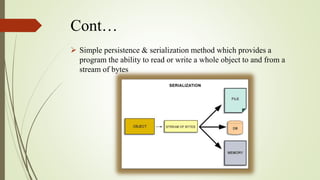
 Simple persistence & serialization method which provides a
program the ability to read or write a whole object to and from a
stream of bytes
Cont…
 Allows Java objects to be encoded into a byte stream suitable for
streaming to a file on disk or over a network
How Serialization Works
 Any object that implements the java.io.Serializable
Interface may be serialized with only a few lines of code
 Implementing the java.io.Serializable Interface requires
no additional effort on the part of developers
 No method needs to be implemented to support
serialization
Thank you
Queries…??

Inter ORB Protocol and Object Persistence & Object Serialization

  • 1.
    “ ” General Inter ORBProtocol and Object Persistence & Object Serialization Created By Ankit Mulani (ME - CE)(2nd Sem) Enrolment No : 140870702504
  • 2.
    OUTLINES What is ORBProtocol What is General Inter ORB Protocol Protocols Provided by General Inter ORB Protocol Object Persistence Object Serialization
  • 3.
    ORB Protocol ORB Standsfor Object Request Broker ORB Protocol allows applications to communicate with one another no matter where they reside on a network The Object Management Group(OMG) exists to create standards for distributed object computing that are realistic, commercially available and usable  OMG does this through its Object Management Architecture (OMA) at the heart of which is the Common Object Request Broker Architecture (CORBA)  CORBA specifies the Object Request Broker (ORB) Protocol
  • 4.
    General Inter ORBProtocol  In distributed computing, General Inter-ORB Protocol (GIOP) is the abstract protocol by which ORBs can communicate  The GIOP specification consists of the following elements 1. The Common Data Representation (CDR)  CDR is used to represent Interface Definition Language(IDL) data types on CORBA distributed objects 2. GIOP Transport Assumptions  Establishment of any network transport layer that may be used to transfer GIOP messages 3. GIOP Message Formats  Object requests, Locate Object Implementations, and Manage Communication Channels
  • 5.
    Object Location inGIOP The GIOP is defined to support object migration and location services without modifying the existence of specific ORB features Protocol Features Based on Observations  A given transport address does not necessarily correspond to any specific ORB architectural component  Such as an Object Adapter, Object Server Process, Inter-ORB Bridge
  • 6.
    Different Roles ofAgent(Object) An Object may be able to Accept Object Requests Directly from another Object and can Return Replies An Object may not be able to accept direct requests from any objects An Object may directly respond to some requests (for certain objects) and provide forwarding locations for other objects An Object may directly respond to requests for a particular object at one point in time, and provide a forwarding location at a later time Clients are able to accept and process Reply messages with LOCATION_FORWARD status
  • 7.
    Protocols Provided byGeneral Inter ORB Protocol Internet Inter ORB Protocol (IIOP) SSL Inter ORB Protocol (SSLIOP) HyperText Inter ORB Protocol (HTIOP) Zipped IOP (ZIOP)
  • 8.
    Internet Inter ORBProtocol (IIOP) The mapping of GIOP message transfer to TCP/IP connections is called the Internet Inter-ORB Protocol (IIOP) A Binary Protocol for Communication between ORBs It Was added in CORBA(Common Object Request Broker Architecture) 2.0 The Baseline Transport Specified for GIOP is TCP/IP5 IIOP 1.0 is based on GIOP 1.0
  • 9.
    TCP/IP Connection Usage If A client is in need of an object’s services then it must initiate a connection with the address, with a connect request  The listening server may accept or reject the connection. In general, servers should accept connection requests if possible  Once a connection is accepted, the client may send Request, LocateRequest, or CancelRequest messages by writing to the TCP/IP socket it owns for the connection  The server may send Reply, LocateReply, and CloseConnection messages by writing to its TCP/IP connection  After sending (or receiving) a CloseConnection message, both client or server must close the TCP/IP connection
  • 10.
    IIOP IOR(Interoperable ObjectReference) Profile Components TAG_ORB_TYPE TAG_CODE_SETS TAG_SEC_NAME TAG_ASSOCIATION_OPTIONS TAG_GENERIC_SEC_MECH
  • 11.
    Object Persistence One ofthe most critical tasks that applications have to perform is to save and restore data Persistence is the storage of data from working memory so that it can be restored when the application run again In object-oriented systems, there are several ways in which objects can be made persistent
  • 12.
    Cont… Most objects inJava Virtual Machine are fairly short-lived All objects will die at some point in time resulting in a loss of reference Object persistence allows an object to survive in JVM that hosts it A custom class representing a key component of a system,  a java.util.Vector list containing state data or  a java.util.Properties object containing system settings
  • 13.
    Object Serialization Object Serializationis the technique by which object persistence is realized It controls data that contains an state of object information It Allows Java objects to be encoded into a byte stream to a file on disk or over a network The class must implement the Serializable interface (java.io.Serializable)
  • 14.
    Cont…  It alsocaters to the situation where an object is inside another object  Figure Shows Graphical Representation of Object Serialization Vector Object i Object n OutputStream 1010100101 … Object a
  • 15.
    Cont…  Simple persistence& serialization method which provides a program the ability to read or write a whole object to and from a stream of bytes
  • 16.
    Cont…  Allows Javaobjects to be encoded into a byte stream suitable for streaming to a file on disk or over a network
  • 17.
    How Serialization Works Any object that implements the java.io.Serializable Interface may be serialized with only a few lines of code  Implementing the java.io.Serializable Interface requires no additional effort on the part of developers  No method needs to be implemented to support serialization
  • 18.
  • 19.