GOOGLE
FILE
SYSTEM
Presented by
Junyoung Jung (2012104030)
Jaehong Jeong (2011104050)
Dept. of Computer Engineering
Kyung Hee Univ.
Big Data Programming (Prof. Lee Hae Joon), 2017-Fall
2
Contents1. INTRODUCTION
2. DESIGN
3. SYSTEM INTERACTIONS
4. MASTER OPERATION
5. HIGH AVAILABILITY
6. MEASUREMENTS
7. CONCLUSIONS
INTRODUCTION
This paper…
Background
Different Points in the Design space
3
1
1.1 THIS PAPER…
4
The Google File System
- Sanjay Ghemeawat, Howard Gobioff, and Shun-Tak Leung
- Google
- 19th ACM Symposium on Operating System Principles, 2003
Previous Distributed File System
1.2 BACKGROUND
5
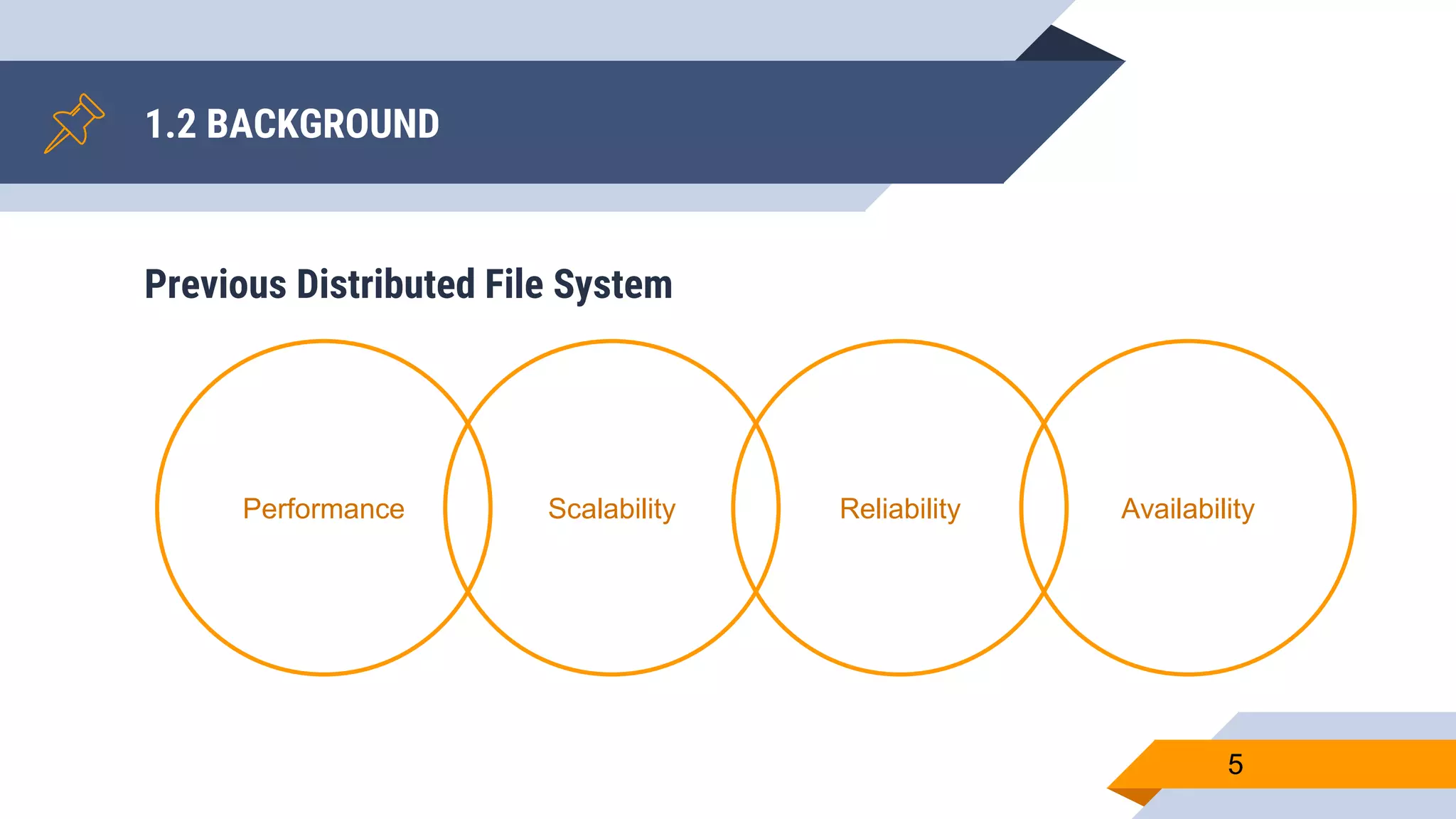
Performance Scalability Reliability Availability
Previous Distributed File System
1.2 BACKGROUND
6
Performance Scalability Reliability Availabililty
GFS(Google File System) has the same goal.
However, it reflects a marked departure from some earlier file system.
1. Component failures are the norm rather than the exception.
2. Files are huge by traditional standards.
3. Most files are mutated by appending new data.
4. Co-design applications and file system API.
5. Sustained bandwidth more critical than low latency.
1.3 DIFFERENT POINTS IN THE DESIGN SPACE
7
DESIGN
Interface
Architecture
8
2
Familiar Interface
- create
- delete
- open
- close
- read
- write
2.1 INTERFACE
9
Moreover…
- Snapshot
ㆍ Low cost
ㆍ Make a copy of a file/directory tree
ㆍ Duplicate metadata
- Atomic Record append
ㆍ Atomicity with multiple concurrent writes
2.2 ARCHITECTURE
10
2.2 ARCHITECTURE
11
Chunk
- Files are divided into fixed-size chunk
- 64MB
- Larger than typical file system block sizes
Advantages from large chunk size
- Reduce interaction between client and master
- Client can perform many operations on a given chunk
- Reduce size of metadata stored on the master
2.2 ARCHITECTURE
12
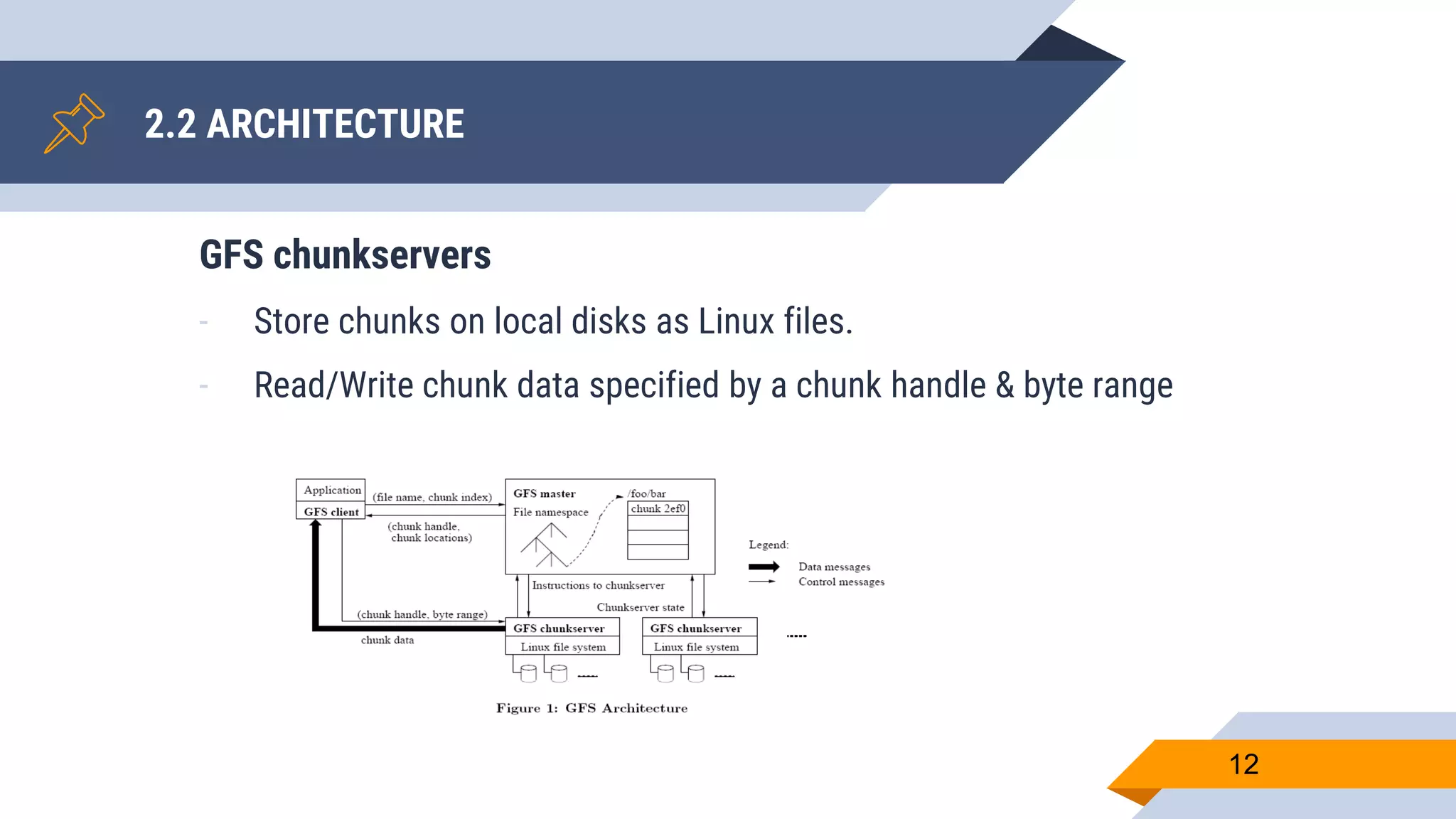
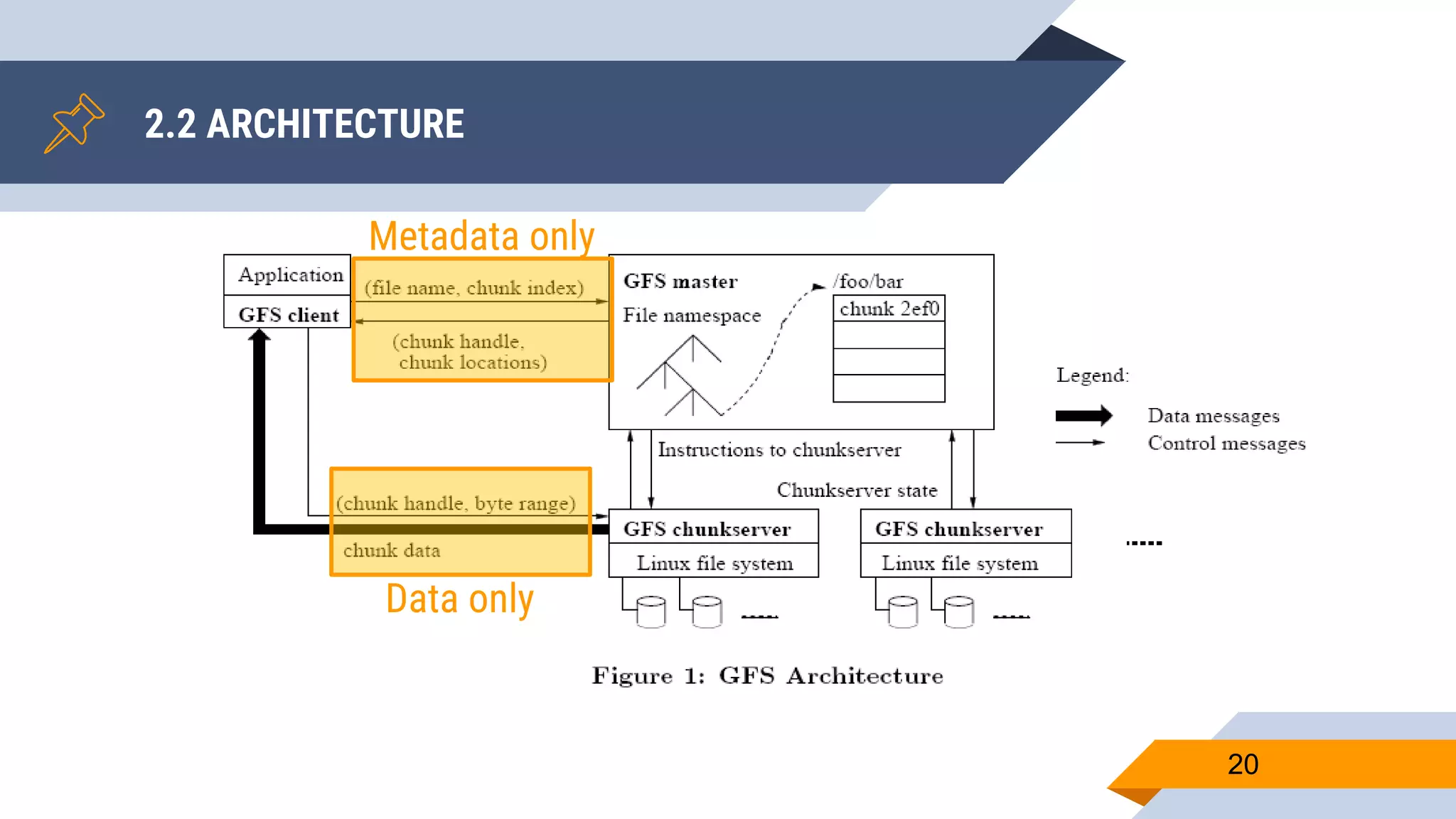
GFS chunkservers
- Store chunks on local disks as Linux files.
- Read/Write chunk data specified by a chunk handle & byte range
2.2 ARCHITECTURE
13
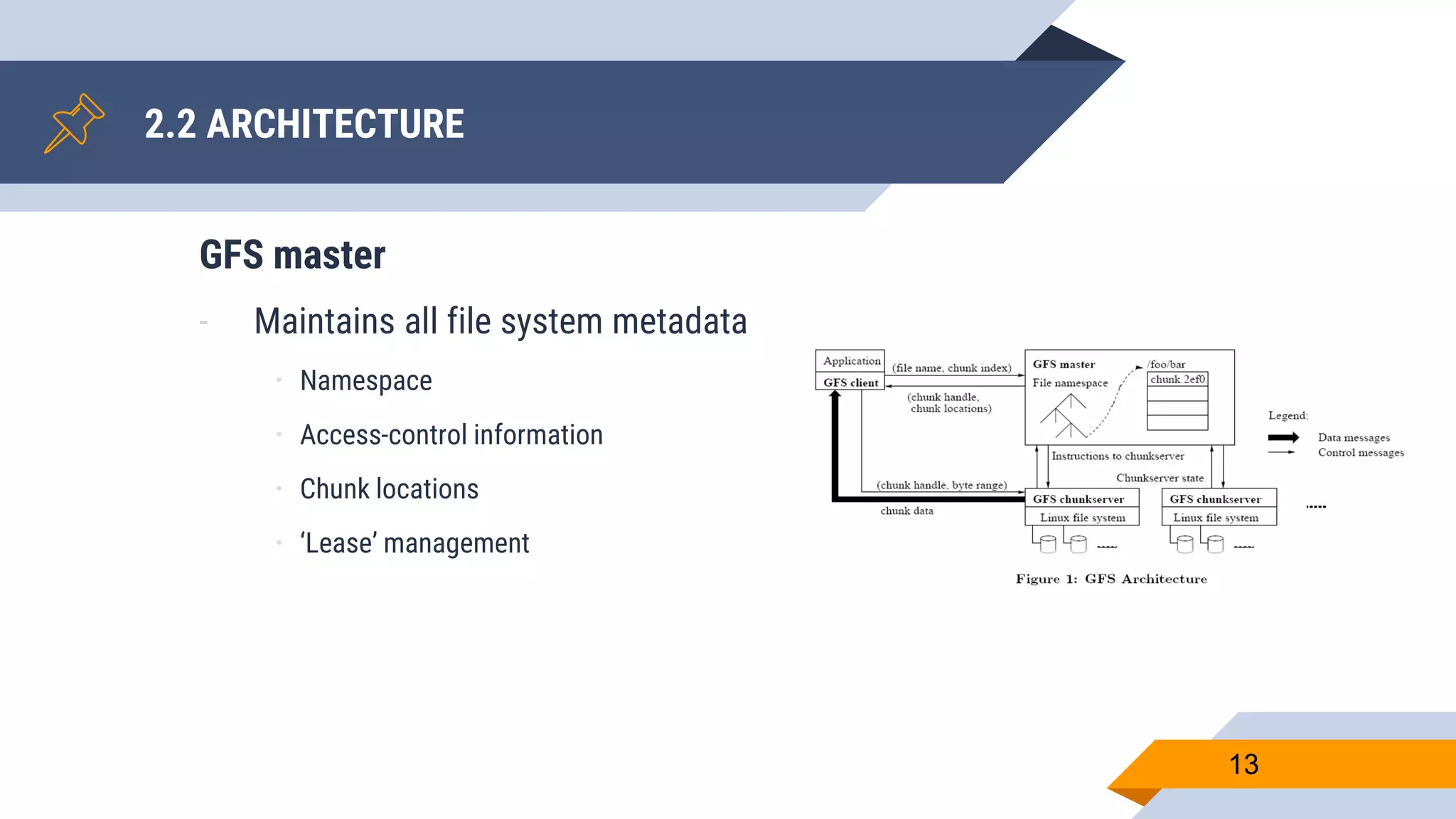
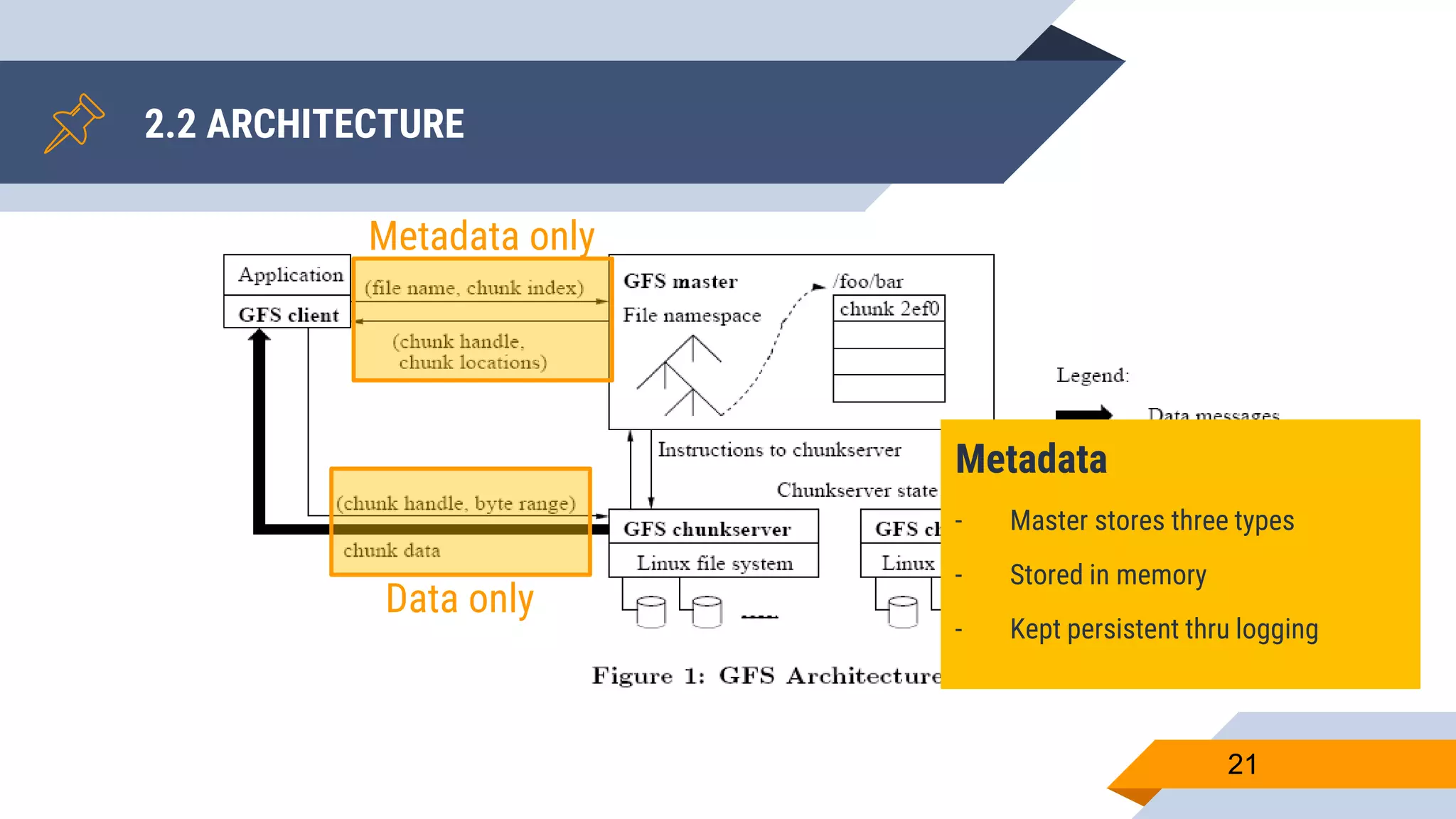
GFS master
- Maintains all file system metadata
ㆍ Namespace
ㆍ Access-control information
ㆍ Chunk locations
ㆍ ‘Lease’ management
2.2 ARCHITECTURE
14
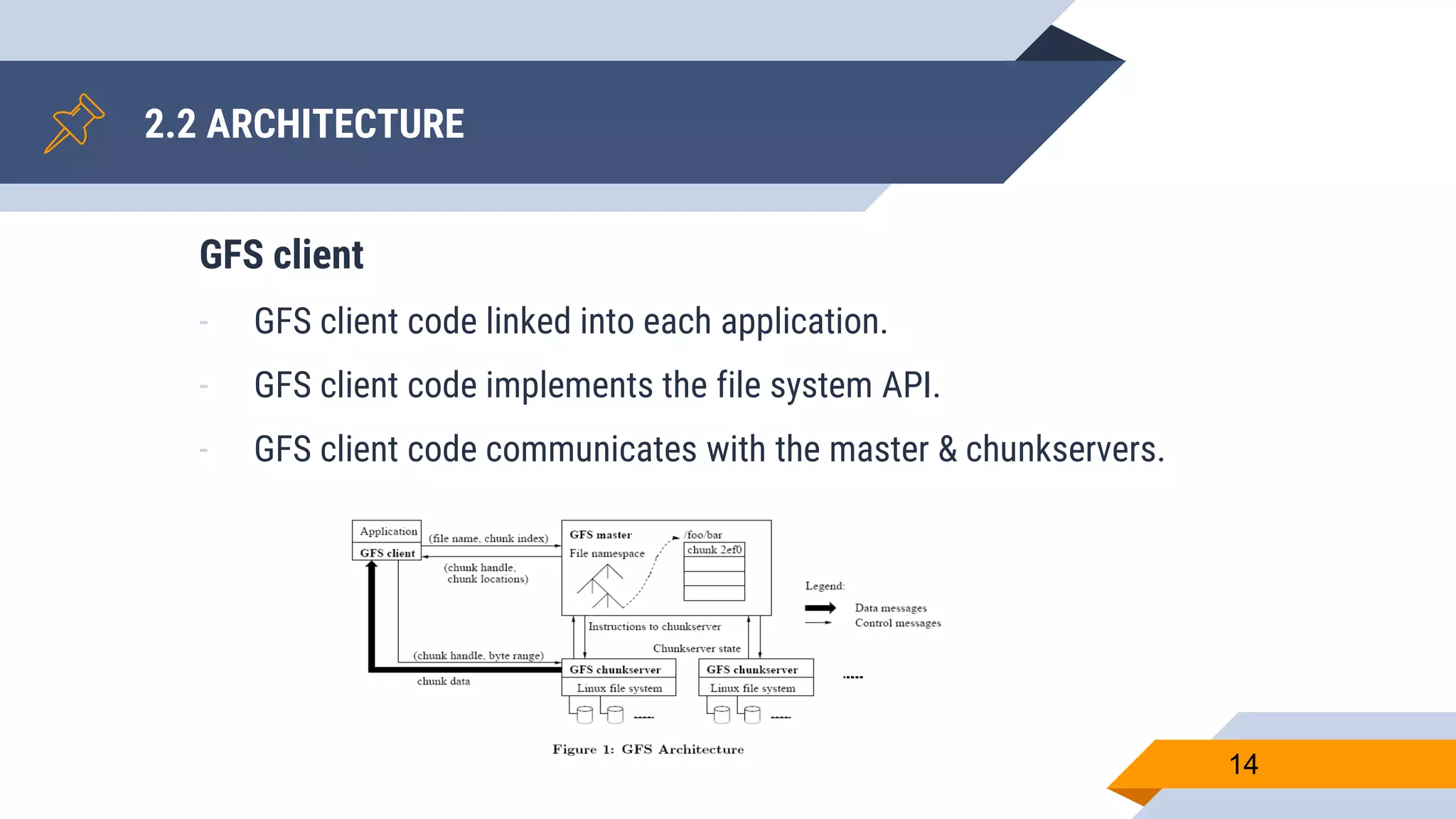
GFS client
- GFS client code linked into each application.
- GFS client code implements the file system API.
- GFS client code communicates with the master & chunkservers.
2.2 ARCHITECTURE
15
Using fixed chunk size, translate filename & byte offset to chunk index.
Send request to master
2.2 ARCHITECTURE
16
Replies with chunk handle & location of chunkserver replicas
(including which is ‘primary’)
2.2 ARCHITECTURE
17
Cache info using filename & chunk index as key
2.2 ARCHITECTURE
18
Request data from nearest chunkserver
“chunk handle & index into chunk”
2.2 ARCHITECTURE
19
No Need to talk more about this 64MB chunk
Until cached info expires or file re-opend.
2.2 ARCHITECTURE
20
Metadata only
Data only
2.2 ARCHITECTURE
21
Metadata only
Data only
Metadata
- Master stores three types
- Stored in memory
- Kept persistent thru logging
SYSTEM INTERACTIONS
Leases & Mutation Order
Data Flow
Atomic Appends
Snapshot
22
3
3.1 LEASES & MUTATION ORDER
23
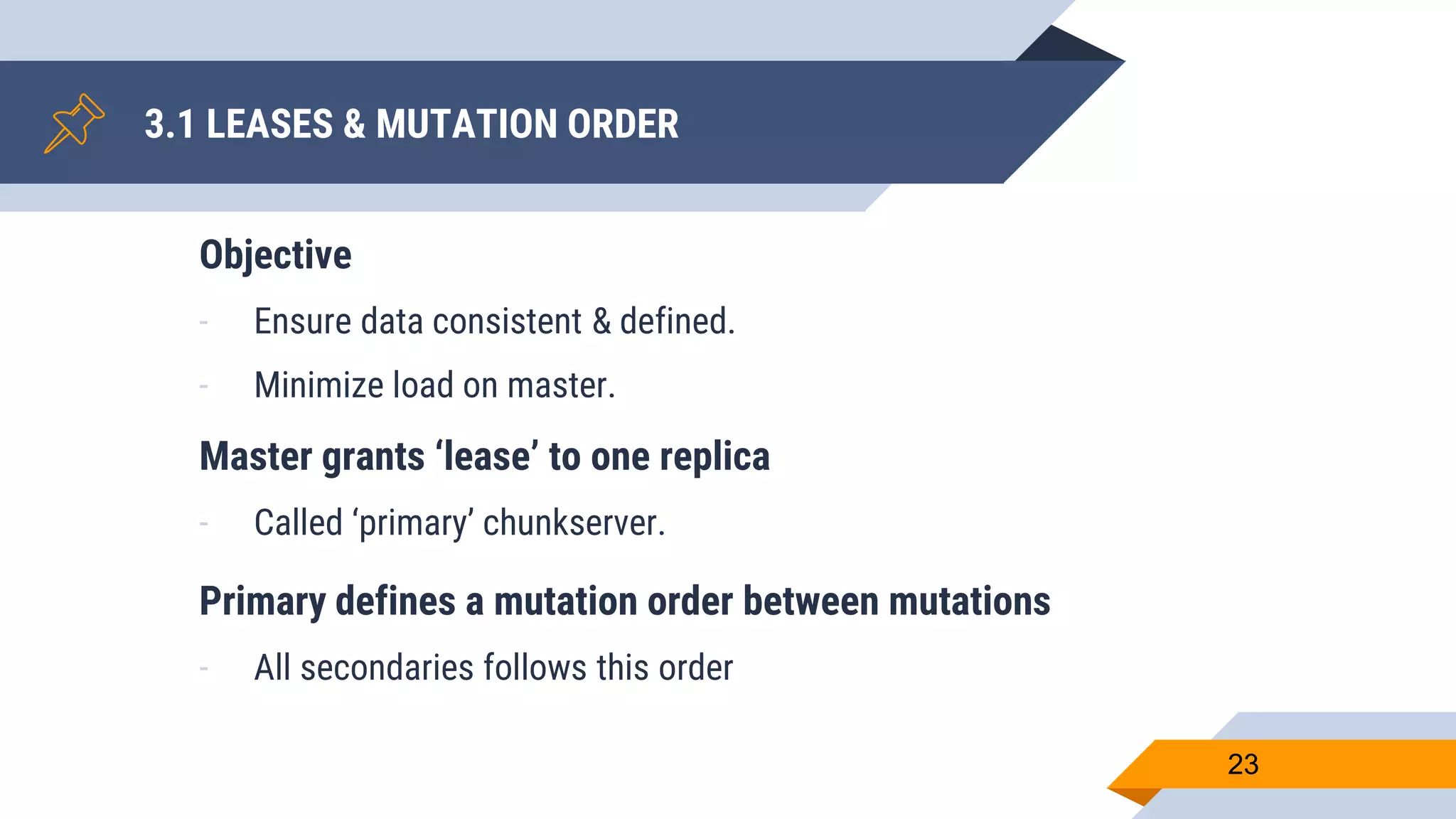
Objective
- Ensure data consistent & defined.
- Minimize load on master.
Master grants ‘lease’ to one replica
- Called ‘primary’ chunkserver.
Primary defines a mutation order between mutations
- All secondaries follows this order
3.2 DATAFLOW
24
3.3 ATOMIC APPENDS
25
The Client Specifies only the data
Similar to writes
- Mutation order is determined by the primary
- All secondaries use the same mutation order
GFS appends data to the file at least once atomically
3.4 SNAPSHOT
26
Goals
- To quickly create branch copies of huge data sets
- To easily checkpoint the current state
Copy-on-write technique
- Metadata for the source file or directory tree is duplicated.
- Reference count for chunks are incremented.
- Chunks are copied later at the first write.
MASTER OPERATION
Namespace Management and Locking
Replica Placement
Creation, Re-replication, Rebalancing
Garbage Collection
Stale Replica Detection 27
4
“ The master executes all
namespace operations and
manages chunk replicas
throughout the system.
2828
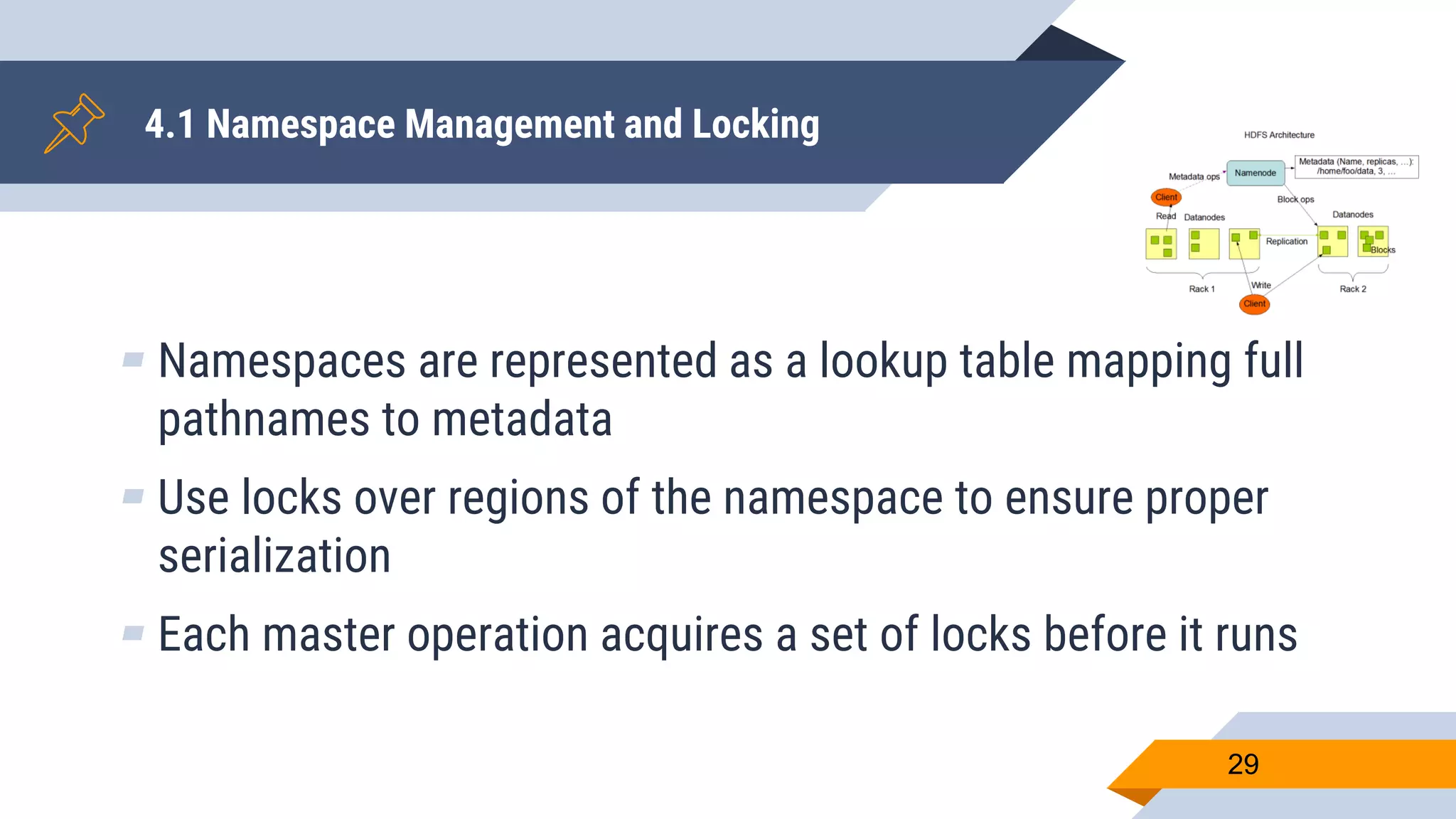
4.1 Namespace Management and Locking
▰ Namespaces are represented as a lookup table mapping full
pathnames to metadata
▰ Use locks over regions of the namespace to ensure proper
serialization
▰ Each master operation acquires a set of locks before it runs
29
4.1 Namespace Management and Locking
▰ Example of Locking Mechanism
▻ Preventing /home/user/foo from being created while /home/user is being snapshotted to /save/user
▻ Snapshot operation
▻ - Read locks on /home and /save
▻ - Write locks on /home/user and /save/user
▻ File creation
▻ - Read locks on /home and /home/user
▻ - Write locks on /home/user/foo
▻ Conflict locks on /home/user
▰ Locking scheme is that it allows concurrent mutations in
the same directory
30
4.2 Replica Placement
▰ The chunk replica placement policy serves two purposes:
▻ Maximize data reliability and availability
▻ Maximize network bandwidth utilization.
31
4.3 Creation, Re-replication, Rebalancing
▰ Creation
▻ Disk space utilization
▻ Number of recent creations on each chunkserver
▰ Re-replication
▻ Prioritized: How far it is from its replication goal…
▻ The highest priority chunk is cloned first by copying the chunk data directly from an existing replica
▰ Rebalancing
▻ Periodically
32
4.4 Garbage Collection
▰ Deleted files
▻ Deletion operation is logged
▻ File is renamed to a hidden name, then may be removed later or get recovered
▰ Orphaned chunks (unreachable chunks)
▻ Identified and removed during a regular scan of the chunk namespace
33
4.5 Stale Replica Detection
▰ Stale replicas
▻ Chunk version numbering
▻ The client or the chunkserver verifies the version number when it performs the
operation so that it is always accessing up-to-date data.
34
FAULT TOLERANCE AND DIAGNOSIS
High Availability
Data Integrity
Diagnostic Tools
35
5
“ We cannot completely trust the
machines, nor can we completely
trust the disks.
3636
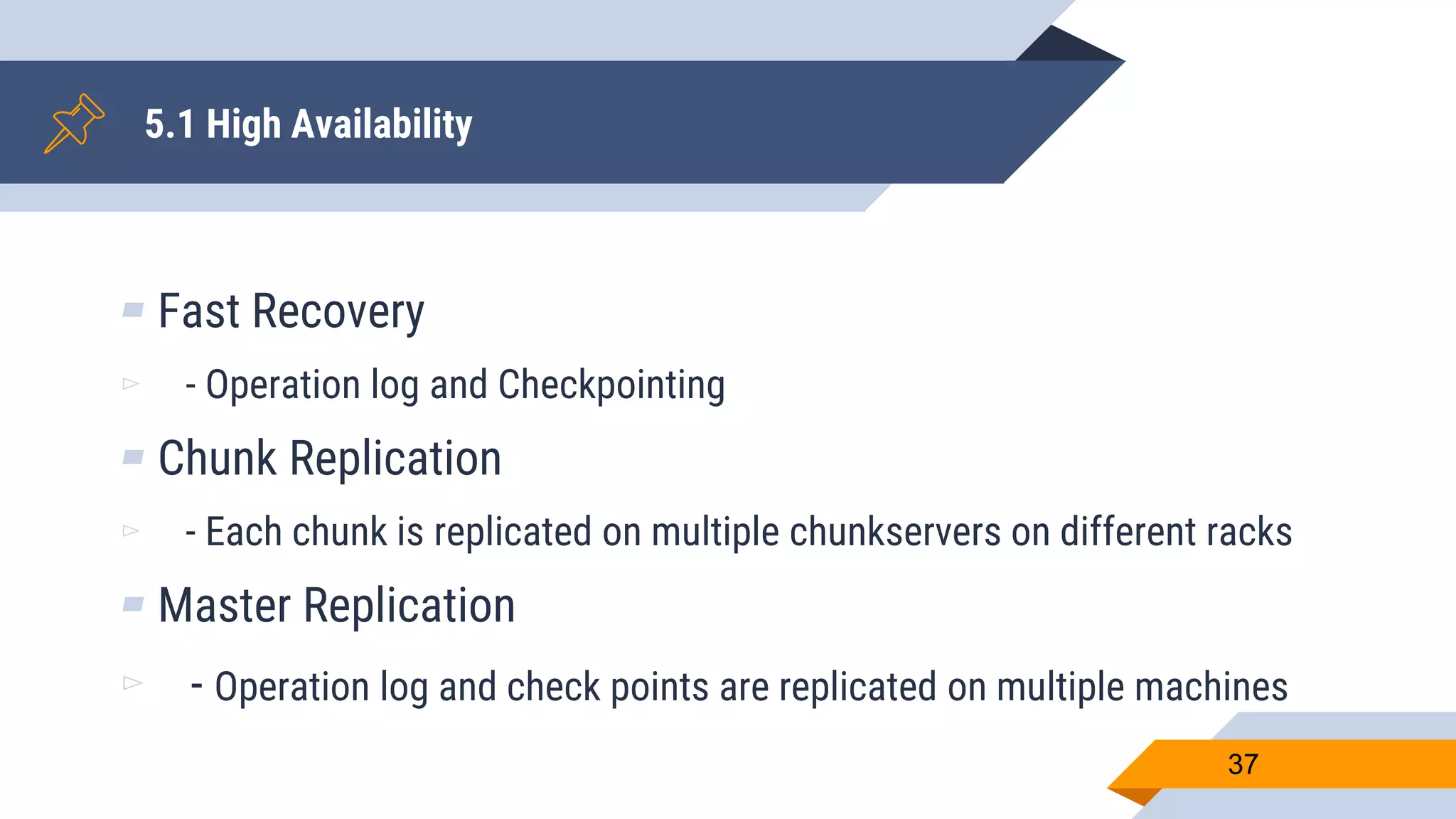
5.1 High Availability
▰ Fast Recovery
▻ - Operation log and Checkpointing
▰ Chunk Replication
▻ - Each chunk is replicated on multiple chunkservers on different racks
▰ Master Replication
▻ - Operation log and check points are replicated on multiple machines
37
5.2 Data Integrity
▰ Checksumming to detect corruption of stored data
▰ Each chunkserver independently verifies the integrity
38
5.3 Diagnostic Tools
▰ Extensive and detailed diagnostic logging has helped
immeasurably in problem isolation, debugging, and
performance analysis, while incurring only a minimal cost .
▰ RPC requests and replies, etc..
39
MEASUREMENTS
Micro-benchmarks
Real World Clusters
Workload Breakdown
40
6
“ A few micro-benchmarks to
illustrate the bottlenecks
inherent in the GFS architecture
and implementation
4141
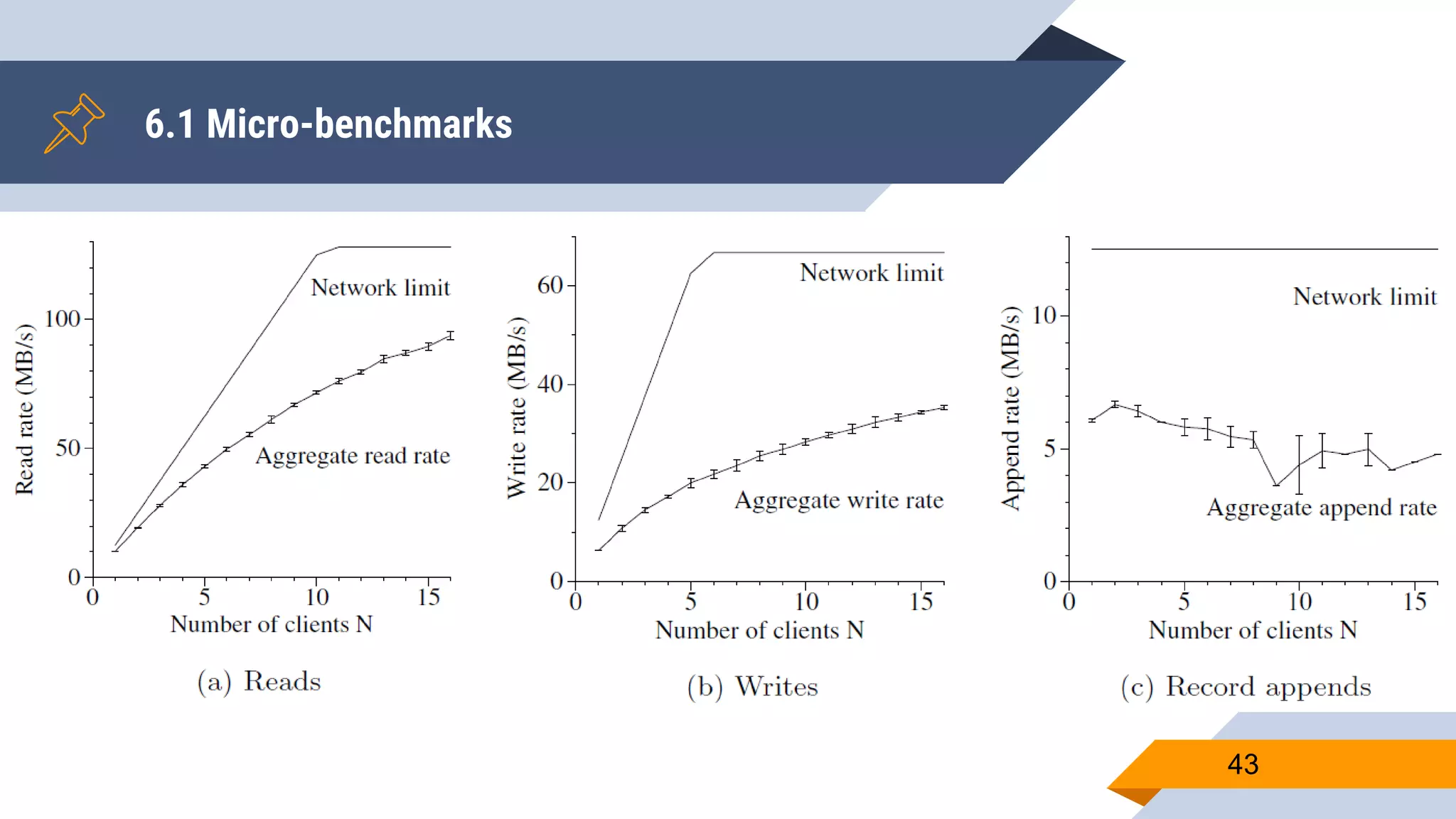
6.1 Micro-benchmarks
▰ One master, two master replicas, 16 chunkservers, and 16
clients. (2003)
▰ All the machines are configured with dual 1.4 GHz PIII
processors, 2 GB of memory, two 80 GB 5400 rpm disks,
and a 100 Mbps full-duplex Ethernet connection to an HP
2524 switch.
42
6.1 Micro-benchmarks
43
6.2 Real World Clusters
44
6.3 Workload Breakdown
▰ Methodology and Caveats
▰ Chunkserver Workload
▰ Appends versus Writes
▰ Mster Workload
45
CONCLUSIONS
46
7
Conclusions
▰ Different than previous file systems
▰ Satisfies needs of the application
▰ Fault tolerance
47
48
THANKS!

Google File System

  • 1.
    GOOGLE FILE SYSTEM Presented by Junyoung Jung(2012104030) Jaehong Jeong (2011104050) Dept. of Computer Engineering Kyung Hee Univ. Big Data Programming (Prof. Lee Hae Joon), 2017-Fall
  • 2.
    2 Contents1. INTRODUCTION 2. DESIGN 3.SYSTEM INTERACTIONS 4. MASTER OPERATION 5. HIGH AVAILABILITY 6. MEASUREMENTS 7. CONCLUSIONS
  • 3.
  • 4.
    1.1 THIS PAPER… 4 TheGoogle File System - Sanjay Ghemeawat, Howard Gobioff, and Shun-Tak Leung - Google - 19th ACM Symposium on Operating System Principles, 2003
  • 5.
    Previous Distributed FileSystem 1.2 BACKGROUND 5 Performance Scalability Reliability Availability
  • 6.
    Previous Distributed FileSystem 1.2 BACKGROUND 6 Performance Scalability Reliability Availabililty GFS(Google File System) has the same goal. However, it reflects a marked departure from some earlier file system.
  • 7.
    1. Component failuresare the norm rather than the exception. 2. Files are huge by traditional standards. 3. Most files are mutated by appending new data. 4. Co-design applications and file system API. 5. Sustained bandwidth more critical than low latency. 1.3 DIFFERENT POINTS IN THE DESIGN SPACE 7
  • 8.
  • 9.
    Familiar Interface - create -delete - open - close - read - write 2.1 INTERFACE 9 Moreover… - Snapshot ㆍ Low cost ㆍ Make a copy of a file/directory tree ㆍ Duplicate metadata - Atomic Record append ㆍ Atomicity with multiple concurrent writes
  • 10.
  • 11.
    2.2 ARCHITECTURE 11 Chunk - Filesare divided into fixed-size chunk - 64MB - Larger than typical file system block sizes Advantages from large chunk size - Reduce interaction between client and master - Client can perform many operations on a given chunk - Reduce size of metadata stored on the master
  • 12.
    2.2 ARCHITECTURE 12 GFS chunkservers -Store chunks on local disks as Linux files. - Read/Write chunk data specified by a chunk handle & byte range
  • 13.
    2.2 ARCHITECTURE 13 GFS master -Maintains all file system metadata ㆍ Namespace ㆍ Access-control information ㆍ Chunk locations ㆍ ‘Lease’ management
  • 14.
    2.2 ARCHITECTURE 14 GFS client -GFS client code linked into each application. - GFS client code implements the file system API. - GFS client code communicates with the master & chunkservers.
  • 15.
    2.2 ARCHITECTURE 15 Using fixedchunk size, translate filename & byte offset to chunk index. Send request to master
  • 16.
    2.2 ARCHITECTURE 16 Replies withchunk handle & location of chunkserver replicas (including which is ‘primary’)
  • 17.
    2.2 ARCHITECTURE 17 Cache infousing filename & chunk index as key
  • 18.
    2.2 ARCHITECTURE 18 Request datafrom nearest chunkserver “chunk handle & index into chunk”
  • 19.
    2.2 ARCHITECTURE 19 No Needto talk more about this 64MB chunk Until cached info expires or file re-opend.
  • 20.
  • 21.
    2.2 ARCHITECTURE 21 Metadata only Dataonly Metadata - Master stores three types - Stored in memory - Kept persistent thru logging
  • 22.
    SYSTEM INTERACTIONS Leases &Mutation Order Data Flow Atomic Appends Snapshot 22 3
  • 23.
    3.1 LEASES &MUTATION ORDER 23 Objective - Ensure data consistent & defined. - Minimize load on master. Master grants ‘lease’ to one replica - Called ‘primary’ chunkserver. Primary defines a mutation order between mutations - All secondaries follows this order
  • 24.
  • 25.
    3.3 ATOMIC APPENDS 25 TheClient Specifies only the data Similar to writes - Mutation order is determined by the primary - All secondaries use the same mutation order GFS appends data to the file at least once atomically
  • 26.
    3.4 SNAPSHOT 26 Goals - Toquickly create branch copies of huge data sets - To easily checkpoint the current state Copy-on-write technique - Metadata for the source file or directory tree is duplicated. - Reference count for chunks are incremented. - Chunks are copied later at the first write.
  • 27.
    MASTER OPERATION Namespace Managementand Locking Replica Placement Creation, Re-replication, Rebalancing Garbage Collection Stale Replica Detection 27 4
  • 28.
    “ The masterexecutes all namespace operations and manages chunk replicas throughout the system. 2828
  • 29.
    4.1 Namespace Managementand Locking ▰ Namespaces are represented as a lookup table mapping full pathnames to metadata ▰ Use locks over regions of the namespace to ensure proper serialization ▰ Each master operation acquires a set of locks before it runs 29
  • 30.
    4.1 Namespace Managementand Locking ▰ Example of Locking Mechanism ▻ Preventing /home/user/foo from being created while /home/user is being snapshotted to /save/user ▻ Snapshot operation ▻ - Read locks on /home and /save ▻ - Write locks on /home/user and /save/user ▻ File creation ▻ - Read locks on /home and /home/user ▻ - Write locks on /home/user/foo ▻ Conflict locks on /home/user ▰ Locking scheme is that it allows concurrent mutations in the same directory 30
  • 31.
    4.2 Replica Placement ▰The chunk replica placement policy serves two purposes: ▻ Maximize data reliability and availability ▻ Maximize network bandwidth utilization. 31
  • 32.
    4.3 Creation, Re-replication,Rebalancing ▰ Creation ▻ Disk space utilization ▻ Number of recent creations on each chunkserver ▰ Re-replication ▻ Prioritized: How far it is from its replication goal… ▻ The highest priority chunk is cloned first by copying the chunk data directly from an existing replica ▰ Rebalancing ▻ Periodically 32
  • 33.
    4.4 Garbage Collection ▰Deleted files ▻ Deletion operation is logged ▻ File is renamed to a hidden name, then may be removed later or get recovered ▰ Orphaned chunks (unreachable chunks) ▻ Identified and removed during a regular scan of the chunk namespace 33
  • 34.
    4.5 Stale ReplicaDetection ▰ Stale replicas ▻ Chunk version numbering ▻ The client or the chunkserver verifies the version number when it performs the operation so that it is always accessing up-to-date data. 34
  • 35.
    FAULT TOLERANCE ANDDIAGNOSIS High Availability Data Integrity Diagnostic Tools 35 5
  • 36.
    “ We cannotcompletely trust the machines, nor can we completely trust the disks. 3636
  • 37.
    5.1 High Availability ▰Fast Recovery ▻ - Operation log and Checkpointing ▰ Chunk Replication ▻ - Each chunk is replicated on multiple chunkservers on different racks ▰ Master Replication ▻ - Operation log and check points are replicated on multiple machines 37
  • 38.
    5.2 Data Integrity ▰Checksumming to detect corruption of stored data ▰ Each chunkserver independently verifies the integrity 38
  • 39.
    5.3 Diagnostic Tools ▰Extensive and detailed diagnostic logging has helped immeasurably in problem isolation, debugging, and performance analysis, while incurring only a minimal cost . ▰ RPC requests and replies, etc.. 39
  • 40.
  • 41.
    “ A fewmicro-benchmarks to illustrate the bottlenecks inherent in the GFS architecture and implementation 4141
  • 42.
    6.1 Micro-benchmarks ▰ Onemaster, two master replicas, 16 chunkservers, and 16 clients. (2003) ▰ All the machines are configured with dual 1.4 GHz PIII processors, 2 GB of memory, two 80 GB 5400 rpm disks, and a 100 Mbps full-duplex Ethernet connection to an HP 2524 switch. 42
  • 43.
  • 44.
    6.2 Real WorldClusters 44
  • 45.
    6.3 Workload Breakdown ▰Methodology and Caveats ▰ Chunkserver Workload ▰ Appends versus Writes ▰ Mster Workload 45
  • 46.
  • 47.
    Conclusions ▰ Different thanprevious file systems ▰ Satisfies needs of the application ▰ Fault tolerance 47
  • 48.