INTRODUCTION TO WEB SERVICES   Gerard Sylvester
Web Service A  Web Service  is a network accessible interface to application functionality, built using standard Internet protocols A Web Service exposes functionality to a  consumer Over the Internet or intranet A programmable URL Functions you can call over the Internet
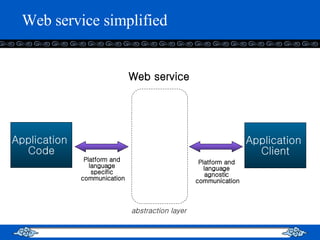
Web service simplified Application  Code Application  Client Web service Platform and  language  specific  communication Platform and  language  agnostic  communication abstraction layer
Web Service Based on Web standards HTTP/(S), XML, SOAP, WSDL, UDDI  Can be implemented in any language on any  platform Component-like, reusable Not tied to any platform / languages
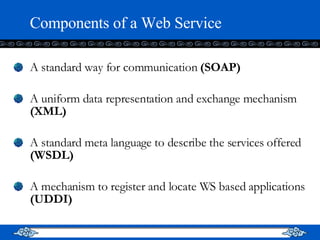
Components of a Web Service A standard way for communication  (SOAP) A uniform data representation and exchange mechanism  (XML) A standard meta language to describe the services offered  (WSDL) A mechanism to register and locate WS based applications  (UDDI)
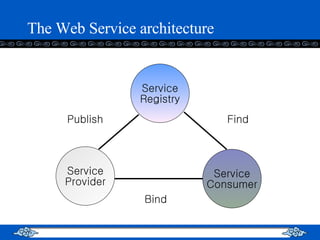
The Web Service architecture Service Registry Service Provider Service Consumer Publish Find Bind
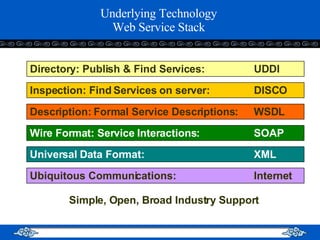
Underlying Technology Web Service Stack Ubiquitous Communications:  Internet Universal Data Format: XML Wire Format: Service Interactions: SOAP Description: Formal Service Descriptions: WSDL Simple, Open, Broad Industry Support Directory: Publish & Find Services: UDDI Inspection: Find Services on server: DISCO
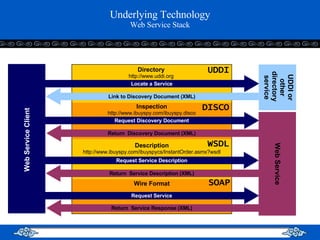
Underlying Technology Web Service Stack Directory http://www.uddi.org UDDI DISCO WSDL SOAP Inspection http://www.ibuyspy.com/ibuyspy.disco Description http://www.ibuyspy.com/ibuyspycs/InstantOrder.asmx?wsdl Wire Format Locate a Service Link to Discovery Document (XML) Request Discovery Document Return  Discovery Document (XML) Return  Service Description (XML) Return  Service Response (XML) Request Service Request Service Description Web Service Client UDDI or other directory  service Web Service
Universal Description, Discovery and Integration  (UDDI) Protocol   Enables enterprises to quickly and dynamically  discover and invoke Web Services both internally and externally Yellow pages of Web services Examples www.uddi.org www.biomoby.org www.xmethods.com
Simple Object Access Protocol (SOAP) SOAP is a lightweight (XML-based) protocol for  exchange of information in a decentralized, distributed environment. It consists of mainly of:  an envelope that defines a framework for describing what is in a message and how to process it  relies heavily on XML standards (schemas & name  spaces)
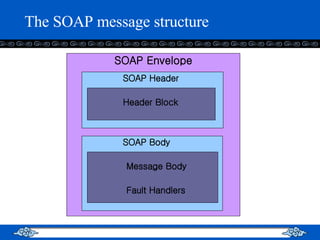
The SOAP message structure SOAP Envelope SOAP Header Header Block Message Body SOAP Body Fault Handlers
Web Service Definition Language (WSDL)  WSDL is an XML format for describing network services operating on messages containing either  document-oriented or procedure-oriented  information.  It defines Web Service as collection of network  endpoints or ports .
The following is a list of  Web service markup languages . BEEP  - Blocks Extensible Exchange Protocol  BPEL  - Business Process Execution Language  E-Business XML   REST  - Representational State Transfer  SOAP  - outgrowth of  XML-RPC , originally an acronym for Simple Object Access Protocol  UDDI  - Universal Description, Discovery, and Integration  WSDL  - Web Services Description Language  WSFL  - Web Services Flow Language (superseded by  BPEL )  WSCL   XML-RPC  - XML Remote Procedure Call
XML Stands for “Extensible Markup Language” Language specification for describing data Syntax rules Syntax & Grammar for creating Document Type Definitions Widely used and open standard Defined by the World Wide Web Consortium (W3C) http://www.w3.org/TR/2000/REC-xml-20001006
Advantages of WebServices Allow programs written in different languages on  different platforms to distribute an application in a standards-base  manner. Adapt the loosely coupled Web programming model for use in applications that are not browser based. The goal is to provide a platform for building distributed  applications using software - running on different operating systems and devices, - written using different programming languages and tools from multiple vendors,  - all potentially developed and deployed independently.
Footer Web Service security Web Service Security Model Principles WS-Security WS-Policy WS-Trust WS-Privacy WS-SecureConversation WS-Federation WS-Authorization Microsoft Passport Service – Single click sign-on!
Future…. Semantic Web Services Extension of the current web – information is given well-defined meaning Contains machine readable instructions and metadata expressed in RDF. Leads to intelligent web.
Part - II Microsoft .NET
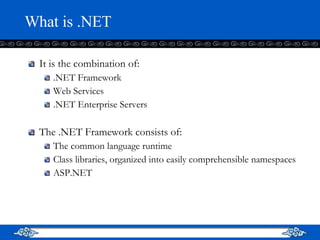
What is .NET It is the combination of: .NET Framework Web Services .NET Enterprise Servers The .NET Framework consists of:  The common language runtime Class libraries, organized into easily comprehensible namespaces  ASP.NET
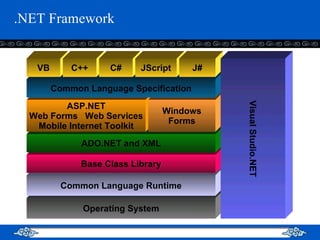
.NET Framework Operating System Common Language Runtime Base Class Library ADO.NET and XML ASP.NET Web Forms  Web Services Mobile Internet Toolkit Windows Forms Common Language Specification VB C++ C# JScript J# Visual Studio.NET
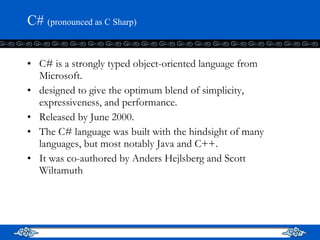
C#  (pronounced as C Sharp) C# is a strongly typed object-oriented language from Microsoft.  designed to give the optimum blend of simplicity,  expressiveness, and performance.  Released by June 2000.  The C# language was built with the hindsight of many languages, but most notably Java and C++.  It was co-authored by Anders Hejlsberg and Scott  Wiltamuth
Hello World using System; class Hello { public static void Main() { Console.WriteLine("Hello, World!"); } }
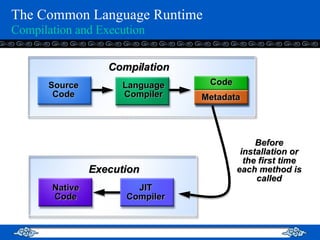
The Common Language Runtime   Compilation and Execution Compilation Before installation or the first time each method is called Execution JIT Compiler Native Code MSIL Code Metadata Source Code Language Compiler
Gerard Sylvester Questions? [email_address] http://germic.blogspot.com http://www.gerardsylvester.com

Webservices

  • 1.
    INTRODUCTION TO WEBSERVICES Gerard Sylvester
  • 2.
    Web Service A Web Service is a network accessible interface to application functionality, built using standard Internet protocols A Web Service exposes functionality to a consumer Over the Internet or intranet A programmable URL Functions you can call over the Internet
  • 3.
    Web service simplifiedApplication Code Application Client Web service Platform and language specific communication Platform and language agnostic communication abstraction layer
  • 4.
    Web Service Basedon Web standards HTTP/(S), XML, SOAP, WSDL, UDDI Can be implemented in any language on any platform Component-like, reusable Not tied to any platform / languages
  • 5.
    Components of aWeb Service A standard way for communication (SOAP) A uniform data representation and exchange mechanism (XML) A standard meta language to describe the services offered (WSDL) A mechanism to register and locate WS based applications (UDDI)
  • 6.
    The Web Servicearchitecture Service Registry Service Provider Service Consumer Publish Find Bind
  • 7.
    Underlying Technology WebService Stack Ubiquitous Communications: Internet Universal Data Format: XML Wire Format: Service Interactions: SOAP Description: Formal Service Descriptions: WSDL Simple, Open, Broad Industry Support Directory: Publish & Find Services: UDDI Inspection: Find Services on server: DISCO
  • 8.
    Underlying Technology WebService Stack Directory http://www.uddi.org UDDI DISCO WSDL SOAP Inspection http://www.ibuyspy.com/ibuyspy.disco Description http://www.ibuyspy.com/ibuyspycs/InstantOrder.asmx?wsdl Wire Format Locate a Service Link to Discovery Document (XML) Request Discovery Document Return Discovery Document (XML) Return Service Description (XML) Return Service Response (XML) Request Service Request Service Description Web Service Client UDDI or other directory service Web Service
  • 9.
    Universal Description, Discoveryand Integration (UDDI) Protocol Enables enterprises to quickly and dynamically discover and invoke Web Services both internally and externally Yellow pages of Web services Examples www.uddi.org www.biomoby.org www.xmethods.com
  • 10.
    Simple Object AccessProtocol (SOAP) SOAP is a lightweight (XML-based) protocol for exchange of information in a decentralized, distributed environment. It consists of mainly of: an envelope that defines a framework for describing what is in a message and how to process it relies heavily on XML standards (schemas & name spaces)
  • 11.
    The SOAP messagestructure SOAP Envelope SOAP Header Header Block Message Body SOAP Body Fault Handlers
  • 12.
    Web Service DefinitionLanguage (WSDL) WSDL is an XML format for describing network services operating on messages containing either document-oriented or procedure-oriented information. It defines Web Service as collection of network endpoints or ports .
  • 13.
    The following isa list of Web service markup languages . BEEP - Blocks Extensible Exchange Protocol BPEL - Business Process Execution Language E-Business XML REST - Representational State Transfer SOAP - outgrowth of XML-RPC , originally an acronym for Simple Object Access Protocol UDDI - Universal Description, Discovery, and Integration WSDL - Web Services Description Language WSFL - Web Services Flow Language (superseded by BPEL ) WSCL XML-RPC - XML Remote Procedure Call
  • 14.
    XML Stands for“Extensible Markup Language” Language specification for describing data Syntax rules Syntax & Grammar for creating Document Type Definitions Widely used and open standard Defined by the World Wide Web Consortium (W3C) http://www.w3.org/TR/2000/REC-xml-20001006
  • 15.
    Advantages of WebServicesAllow programs written in different languages on different platforms to distribute an application in a standards-base manner. Adapt the loosely coupled Web programming model for use in applications that are not browser based. The goal is to provide a platform for building distributed applications using software - running on different operating systems and devices, - written using different programming languages and tools from multiple vendors, - all potentially developed and deployed independently.
  • 16.
    Footer Web Servicesecurity Web Service Security Model Principles WS-Security WS-Policy WS-Trust WS-Privacy WS-SecureConversation WS-Federation WS-Authorization Microsoft Passport Service – Single click sign-on!
  • 17.
    Future…. Semantic WebServices Extension of the current web – information is given well-defined meaning Contains machine readable instructions and metadata expressed in RDF. Leads to intelligent web.
  • 18.
    Part - IIMicrosoft .NET
  • 19.
    What is .NETIt is the combination of: .NET Framework Web Services .NET Enterprise Servers The .NET Framework consists of: The common language runtime Class libraries, organized into easily comprehensible namespaces ASP.NET
  • 20.
    .NET Framework OperatingSystem Common Language Runtime Base Class Library ADO.NET and XML ASP.NET Web Forms Web Services Mobile Internet Toolkit Windows Forms Common Language Specification VB C++ C# JScript J# Visual Studio.NET
  • 21.
    C# (pronouncedas C Sharp) C# is a strongly typed object-oriented language from Microsoft. designed to give the optimum blend of simplicity, expressiveness, and performance. Released by June 2000. The C# language was built with the hindsight of many languages, but most notably Java and C++. It was co-authored by Anders Hejlsberg and Scott Wiltamuth
  • 22.
    Hello World usingSystem; class Hello { public static void Main() { Console.WriteLine("Hello, World!"); } }
  • 23.
    The Common LanguageRuntime Compilation and Execution Compilation Before installation or the first time each method is called Execution JIT Compiler Native Code MSIL Code Metadata Source Code Language Compiler
  • 24.
    Gerard Sylvester Questions?[email_address] http://germic.blogspot.com http://www.gerardsylvester.com