Quality Teaching in Inclusive
Classrooms and Schools: A
Community of Professionals
  Coquitlam/Burnaby	
  Performance	
  
           Network	
  Series	
  
         January	
  28th,	
  2013	
  
           Faye	
  Brownlie	
  
        www.slideshare.net	
  
Learning Intentions
•  I	
  more	
  fully	
  understand	
  how	
  universal	
  design	
  
   for	
  learning	
  and	
  backwards	
  design	
  support	
  
   effecJve	
  teaching	
  for	
  all	
  students	
  
•  I	
  can	
  implement	
  more	
  integrated,	
  fluid	
  
   assessment	
  for	
  learning	
  pracJces	
  
•  I	
  have	
  a	
  plan	
  to	
  use	
  more	
  choice	
  or	
  more	
  
   diverse	
  texts	
  with	
  my	
  students	
  
•  I	
  have	
  a	
  plan	
  to	
  implement	
  a	
  strategy	
  that	
  is	
  
   new	
  to	
  me	
  
PIRLS, 2011
     Progress in International Reading Literacy Study
•    Grade	
  4,	
  every	
  5	
  years	
  
•    2011	
  –	
  45	
  countries	
  
•    2600	
  students	
  in	
  148	
  schools	
  in	
  BC	
  in	
  2011	
  
•    BC	
  also	
  parJcipated	
  in	
  2006	
  

•  Measures	
  trends	
  in	
  reading	
  achievement	
  
•  Examines	
  policies	
  and	
  pracJces	
  related	
  to	
  literacy	
  

hTp://www.bced.gov.bc.ca/assessment/nat_int_pubspirls.htm	
  
PIRLS, 2011
     Progress in International Reading Literacy Study	
  

•    2	
  –	
  40	
  minute	
  sessions	
  
•    MulJple-­‐choice	
  and	
  constructed	
  response	
  
•    4	
  passages	
  –	
  2	
  ficJon;	
  2	
  non-­‐ficJon	
  
•    QuesJonnaire	
  for	
  students,	
  teachers,	
  
     principals,	
  parents	
  –	
  to	
  beTer	
  understand	
  the	
  
     pracJces	
  associated	
  with	
  reading	
  performance	
  
PIRLS, 2011 – BC Results
  Progress in International Reading Literacy Study	
  

•  Mean	
  score	
  significantly	
  above	
  internaJonal	
  
   AND	
  Canadian	
  averages	
  
•  No	
  change	
  from	
  2006	
  to	
  2011,	
  but	
  other	
  
   countries	
  did	
  increase	
  from	
  2006	
  
•  15%	
  -­‐	
  Advanced	
  Benchmark;	
  55%	
  -­‐	
  High	
  
   Benchmark	
  (4	
  InternaJonal	
  Benchmarks)	
  
•  Performed	
  beTer	
  in	
  literary	
  reading	
  than	
  in	
  
   informaJonal	
  reading	
  
PIRLS, 2011 – BC Results
  Progress in International Reading Literacy Study	
  

•  Reported	
  high	
  levels	
  of	
  enjoyment	
  of	
  reading	
  
   and	
  self-­‐confidence	
  
•  The	
  more	
  oden	
  students	
  read	
  stories	
  or	
  
   novels,	
  the	
  beTer	
  they	
  tended	
  to	
  perform	
  in	
  
   reading	
  
•  26%	
  of	
  students	
  reported	
  not	
  speaking	
  En/Fr	
  
   at	
  home.	
  	
  No	
  difference	
  in	
  their	
  level	
  of	
  
   achievement!!!!	
  
PIRLS, 2011 – BC Results
 Progress in International Reading Literacy Study	
  

•  Comprehension	
  Processes	
  
   –  retrieving	
  and	
  straighforward	
  inferencing	
  
   –  interpreJng,	
  integraJng,	
  and	
  evaluaJng	
  

   *Most	
  high	
  performing	
  countries,	
  including	
  BC,	
  did	
  
    beTer	
  on	
  the	
  laTer.	
  	
  
Frameworks


It’s All about Thinking (English, Humanities, Social Studies) –
                  Brownlie & Schnellert, 2009
It’s All about Thinking (Math, Science)– Brownlie, Fullerton,
                        Schnellert, 2011
Universal Design for Learning
MulJple	
  means:	
  
-­‐to	
  tap	
  into	
  background	
  knowledge,	
  to	
  acJvate	
  
        prior	
  knowledge,	
  to	
  increase	
  engagement	
  and	
  
        moJvaJon	
  
-­‐to	
  acquire	
  the	
  informaJon	
  and	
  knowledge	
  to	
  
        process	
  new	
  ideas	
  and	
  informaJon	
  
-­‐to	
  express	
  what	
  they	
  know.	


  Rose	
  &	
  Meyer,	
  2002	
  
Backwards Design
•  What	
  important	
  ideas	
  and	
  enduring	
  
   understandings	
  do	
  you	
  want	
  the	
  students	
  to	
  
   know?	
  

•  What	
  thinking	
  strategies	
  will	
  students	
  need	
  to	
  
   demonstrate	
  these	
  understandings?	


  McTighe	
  &	
  Wiggins,	
  2001	
  
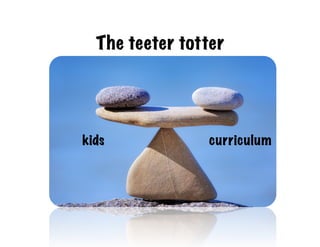
The teeter totter


  kids                curriculum


kids
Approaches
•    Assessment	
  for	
  learning	
  
•    Open-­‐ended	
  strategies	
  
•    Gradual	
  release	
  of	
  responsibility	
  
•    CooperaJve	
  learning	
  
•    Literature	
  circles	
  and	
  informaJon	
  circles	
  
•    Inquiry	
  

It’s All about Thinking – Brownlie & Schnellert, 2009
Open-ended Strategies


•  ConnecJng	
  

•  Processing	
  

•  Transforming	
  and	
  personalizing	
  
Lesson Sequences
Teacher Collaboration
•  Mary	
  Neto,	
  Tina	
  Sikkes	
  and	
  Teresa	
  Monkman	
  	
  
•  English	
  teachers	
  and	
  librarian	
  
•  Smithers	
  Secondary	
  School	
  

•  UDL,	
  Backwards	
  Design,	
  AFL	
  

•  What/so	
  what?	
  
•  EssenJal	
  quesJon	
  
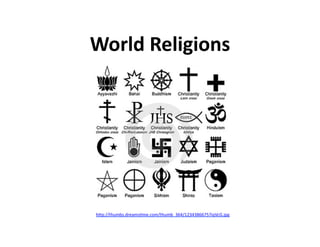
World	
  Religions	


hTp://thumbs.dreamsJme.com/thumb_364/12343866757iqVcG.jpg	
  
A/B	
  Partner	
  
   My	
  partner,	
  __________,	
  and	
  I	
  
 decided	
  who	
  would	
  be	
  A	
  and	
  who	
  
would	
  be	
  B	
  in	
  a	
  religious	
  kind	
  of	
  way	
  
  by	
  ______________.	
  Therefore	
  
          _______	
  is	
  A	
  because	
  
  __________________________	
  
EssenJal	
  QuesJon	
  -­‐	


How	
  might	
  religious	
  beliefs	
  
nega7vely	
  impact	
  	
  human	
  
         behaviour?	
  
While	
  looking	
  at	
  the	
  image	
  think	
  about	
  this	
  EssenJal	
  QuesJon	
  –	


         How	
  might	
  religious	
  beliefs	
  nega7vely	
  impact	
  	
  human	
  behaviour?	


What?	
                                                              So	
  What?	
  
1.	
  
2.	
  
3.	
  
4.	
  
5.	
  
6.	
  
What	
  do	
  you	
  noJce	
  about	
  
these	
  images?	
  
Some	
  things	
  my	
  partner,	
  ____________,	
  and	
  I	
  
no7ced	
  about	
  the	
  image	
  of	
  __________	
  are:	
  
______________________	
  
____________________________________	
  
Religion	
  and	
  Conflict	
  
•    Extremism	
  
•    Terrorism	
  
•    Racism	
  	
  
•    War	
  
•    Ethnic	
  cleansing	
  
•    Genocide	
  
•    Oppression	
  /	
  Control	
  	
  
Something	
  to	
  think	
  about	
  –	


How	
  might	
  religious	
  beliefs	
  
 posi7vely	
  impact	
  	
  human	
  
         behaviour?	
  
How	
  might	
  religious	
  beliefs	
  posi7vely	
  
              impact	
  	
  human	
  behaviour?	
  
Brainstormed	
  ideas	
  from	
  students	
  -­‐	
  	
  
•       Help	
  others	
  in	
  need	
  
•       Find	
  peace	
  if	
  you’re	
  worried	
  
•       Sin	
  go	
  to	
  hell	
  /	
  be	
  good	
  go	
  to	
  heaven	
  
-­‐     InspiraJon	
  
-­‐     Connects	
  people	
  
-­‐     Encourages	
  peace,	
  love	
  and	
  unity	
  
-­‐     Something	
  to	
  believe	
  in	
  –	
  	
  
-­‐     Places	
  that	
  offer	
  support	
  –	
  caring	
  for	
  others	
  
-­‐     Forces	
  us	
  to	
  be	
  beTer	
  people	
  
Building Language, Practicing Reading Strategies:
        Paired Vocabulary  Story Making
•  Partners	
  meet	
  to:	
  
    –  decode	
  a	
  phrase	
  
    –  create	
  a	
  story	
  that	
  uses	
  this	
  phrase	
  
    –  share	
  the	
  strategies	
  they	
  use	
  to	
  decode	
  the	
  phrase	
  
•  As	
  a	
  class,	
  share	
  phrases	
  and	
  stories,	
  encouraging	
  
   the	
  students	
  to	
  link	
  their	
  thinking	
  with	
  these	
  new	
  
   phrases	
  
•  Read	
  the	
  story	
  and	
  watch	
  for	
  how	
  the	
  author	
  
   uses	
  these	
  phrases	
  

•  With	
  Cathy	
  Lloyd,	
  Birchland	
  
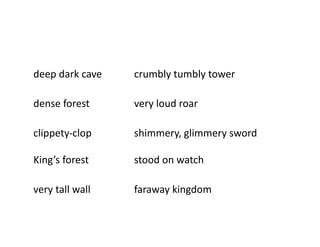
deep	
  dark	
  cave	
            	
     	
  crumbly	
  tumbly	
  tower	
  

dense	
  forest	


  very	
  loud	
  roar	
  

clippety-­‐clop            	
     	
     	
  shimmery,	
  glimmery	
  sword 	


King’s	
  forest	


  stood	
  on	
  watch	
  

very	
  tall	
  wall	


  faraway	
  kingdom	
  
Good	
  Night,	
  Good	
  Knight	
  -­‐	
  

  Shelly	
  Moore	
  Thomas	
  
 Pictures	
  -­‐	
  Jennifer	
  Plecas	
  

 DuTon	
  Children’s	
  Books	
  
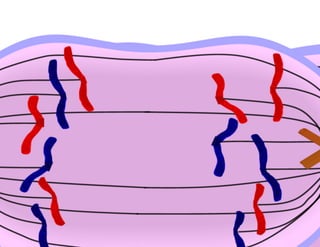
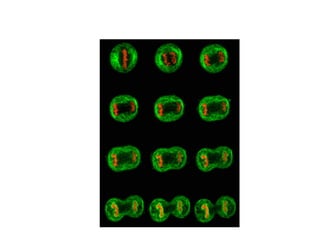
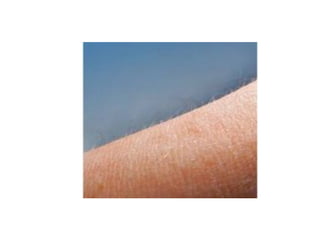
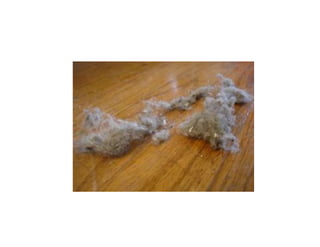
Introduction to Mitosis
•  Whip	
  around	
  –	
  what	
  do	
  you	
  remember	
  about	
  
   DNA?	
  
•  QuesJoning	
  from	
  3	
  pictures	
  
•  AnJcipaJon	
  guide	
  –	
  with	
  partner	
  
•  Read	
  to	
  find	
  out	
  and	
  provide	
  evidence	
  for	
  your	
  
   answer	
  	
  
•  Sort	
  and	
  predict	
  –	
  groups	
  of	
  3	
  

•  With	
  Ken	
  Asano,	
  Centennial	
  
Introduction to Mitosis
•  Whip	
  around	
  –	
  what	
  do	
  you	
  remember	
  about	
  
   DNA?	
  
•  QuesJoning	
  from	
  3	
  pictures	
  
•  AnJcipaJon	
  guide	
  –	
  with	
  partner	
  
•  Read	
  to	
  find	
  out	
  and	
  provide	
  evidence	
  for	
  your	
  
   answer	
  	
  
•  Sort	
  and	
  predict	
  –	
  groups	
  of	
  3	
  

•  With	
  Ken	
  Asano,	
  Centennial	
  
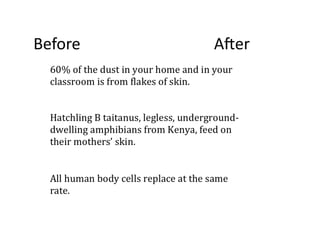
Before 	


  Ader	
  
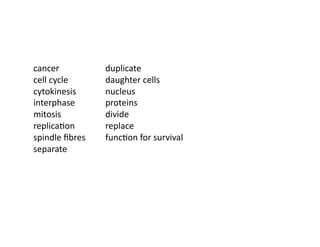
cancer	


  duplicate	
  
cell	
  cycle 	
     	
     	
  daughter	
  cells	
  
cytokinesis	
        	
     	
  nucleus	
  
interphase	
         	
     	
  proteins	
  
mitosis	


  divide	
  
replicaJon	
         	
     	
  replace	
  
spindle	
  fibres     	
     	
  funcJon	
  for	
  survival	
  
separate	
  
Thermal Energy/Plate Tectonics
•    Sort	
  and	
  predict	
  with	
  vocab	
  
•    Utube	
  clip	
  –	
  resort	
  your	
  words	
  as	
  needed	
  
•    Scan	
  the	
  text	
  for	
  what	
  else	
  you	
  need	
  to	
  know	
  
•    Use	
  the	
  words	
  to	
  make	
  a	
  concept	
  map	
  
•    Exit	
  slip:	
  	
  how	
  will	
  you	
  best	
  remember	
  

•  With	
  Curt	
  Dewolff,	
  Moody	
  Secondary	
  
Writing
•  Build	
  criteria	
  for	
  powerful	
  story	
  
•  Model	
  with	
  partner,	
  1	
  minute	
  to	
  tell	
  your	
  story,	
  
   30	
  seconds	
  to	
  respond;	
  switch;	
  pracJce	
  
•  Walk	
  and	
  talk	
  to	
  rehearse	
  story	
  
•  Write	
  
•  Code	
  your	
  wriJng	
  with	
  2-­‐3	
  aspects	
  of	
  the	
  criteria	
  

With	
  Craig	
  Sung,	
  Birchland	
  

Coquitlam burnaby pns.jan2013

  • 1.
    Quality Teaching inInclusive Classrooms and Schools: A Community of Professionals Coquitlam/Burnaby  Performance   Network  Series   January  28th,  2013   Faye  Brownlie   www.slideshare.net  
  • 2.
    Learning Intentions •  I  more  fully  understand  how  universal  design   for  learning  and  backwards  design  support   effecJve  teaching  for  all  students   •  I  can  implement  more  integrated,  fluid   assessment  for  learning  pracJces   •  I  have  a  plan  to  use  more  choice  or  more   diverse  texts  with  my  students   •  I  have  a  plan  to  implement  a  strategy  that  is   new  to  me  
  • 3.
    PIRLS, 2011 Progress in International Reading Literacy Study •  Grade  4,  every  5  years   •  2011  –  45  countries   •  2600  students  in  148  schools  in  BC  in  2011   •  BC  also  parJcipated  in  2006   •  Measures  trends  in  reading  achievement   •  Examines  policies  and  pracJces  related  to  literacy   hTp://www.bced.gov.bc.ca/assessment/nat_int_pubspirls.htm  
  • 4.
    PIRLS, 2011 Progress in International Reading Literacy Study   •  2  –  40  minute  sessions   •  MulJple-­‐choice  and  constructed  response   •  4  passages  –  2  ficJon;  2  non-­‐ficJon   •  QuesJonnaire  for  students,  teachers,   principals,  parents  –  to  beTer  understand  the   pracJces  associated  with  reading  performance  
  • 5.
    PIRLS, 2011 –BC Results Progress in International Reading Literacy Study   •  Mean  score  significantly  above  internaJonal   AND  Canadian  averages   •  No  change  from  2006  to  2011,  but  other   countries  did  increase  from  2006   •  15%  -­‐  Advanced  Benchmark;  55%  -­‐  High   Benchmark  (4  InternaJonal  Benchmarks)   •  Performed  beTer  in  literary  reading  than  in   informaJonal  reading  
  • 6.
    PIRLS, 2011 –BC Results Progress in International Reading Literacy Study   •  Reported  high  levels  of  enjoyment  of  reading   and  self-­‐confidence   •  The  more  oden  students  read  stories  or   novels,  the  beTer  they  tended  to  perform  in   reading   •  26%  of  students  reported  not  speaking  En/Fr   at  home.    No  difference  in  their  level  of   achievement!!!!  
  • 7.
    PIRLS, 2011 –BC Results Progress in International Reading Literacy Study   •  Comprehension  Processes   –  retrieving  and  straighforward  inferencing   –  interpreJng,  integraJng,  and  evaluaJng   *Most  high  performing  countries,  including  BC,  did   beTer  on  the  laTer.    
  • 8.
    Frameworks It’s All aboutThinking (English, Humanities, Social Studies) – Brownlie & Schnellert, 2009 It’s All about Thinking (Math, Science)– Brownlie, Fullerton, Schnellert, 2011
  • 9.
    Universal Design forLearning MulJple  means:   -­‐to  tap  into  background  knowledge,  to  acJvate   prior  knowledge,  to  increase  engagement  and   moJvaJon   -­‐to  acquire  the  informaJon  and  knowledge  to   process  new  ideas  and  informaJon   -­‐to  express  what  they  know.                        Rose  &  Meyer,  2002  
  • 10.
    Backwards Design •  What  important  ideas  and  enduring   understandings  do  you  want  the  students  to   know?   •  What  thinking  strategies  will  students  need  to   demonstrate  these  understandings?                      McTighe  &  Wiggins,  2001  
  • 11.
    The teeter totter kids curriculum kids
  • 12.
    Approaches •  Assessment  for  learning   •  Open-­‐ended  strategies   •  Gradual  release  of  responsibility   •  CooperaJve  learning   •  Literature  circles  and  informaJon  circles   •  Inquiry   It’s All about Thinking – Brownlie & Schnellert, 2009
  • 13.
    Open-ended Strategies •  ConnecJng   •  Processing   •  Transforming  and  personalizing  
  • 14.
  • 15.
    Teacher Collaboration •  Mary  Neto,  Tina  Sikkes  and  Teresa  Monkman     •  English  teachers  and  librarian   •  Smithers  Secondary  School   •  UDL,  Backwards  Design,  AFL   •  What/so  what?   •  EssenJal  quesJon  
  • 16.
  • 17.
    A/B  Partner   My  partner,  __________,  and  I   decided  who  would  be  A  and  who   would  be  B  in  a  religious  kind  of  way   by  ______________.  Therefore   _______  is  A  because   __________________________  
  • 18.
    EssenJal  QuesJon  -­‐     How  might  religious  beliefs   nega7vely  impact    human   behaviour?  
  • 19.
    While  looking  at  the  image  think  about  this  EssenJal  QuesJon  –     How  might  religious  beliefs  nega7vely  impact    human  behaviour?   What?   So  What?   1.   2.   3.   4.   5.   6.  
  • 20.
    What  do  you  noJce  about   these  images?  
  • 21.
    Some  things  my  partner,  ____________,  and  I   no7ced  about  the  image  of  __________  are:   ______________________   ____________________________________  
  • 22.
    Religion  and  Conflict   •  Extremism   •  Terrorism   •  Racism     •  War   •  Ethnic  cleansing   •  Genocide   •  Oppression  /  Control    
  • 23.
    Something  to  think  about  –     How  might  religious  beliefs   posi7vely  impact    human   behaviour?  
  • 24.
    How  might  religious  beliefs  posi7vely   impact    human  behaviour?   Brainstormed  ideas  from  students  -­‐     •  Help  others  in  need   •  Find  peace  if  you’re  worried   •  Sin  go  to  hell  /  be  good  go  to  heaven   -­‐  InspiraJon   -­‐  Connects  people   -­‐  Encourages  peace,  love  and  unity   -­‐  Something  to  believe  in  –     -­‐  Places  that  offer  support  –  caring  for  others   -­‐  Forces  us  to  be  beTer  people  
  • 25.
    Building Language, PracticingReading Strategies: Paired Vocabulary  Story Making •  Partners  meet  to:   –  decode  a  phrase   –  create  a  story  that  uses  this  phrase   –  share  the  strategies  they  use  to  decode  the  phrase   •  As  a  class,  share  phrases  and  stories,  encouraging   the  students  to  link  their  thinking  with  these  new   phrases   •  Read  the  story  and  watch  for  how  the  author   uses  these  phrases   •  With  Cathy  Lloyd,  Birchland  
  • 26.
    deep  dark  cave      crumbly  tumbly  tower   dense  forest        very  loud  roar   clippety-­‐clop      shimmery,  glimmery  sword     King’s  forest        stood  on  watch   very  tall  wall        faraway  kingdom  
  • 27.
    Good  Night,  Good  Knight  -­‐   Shelly  Moore  Thomas   Pictures  -­‐  Jennifer  Plecas   DuTon  Children’s  Books  
  • 28.
    Introduction to Mitosis • Whip  around  –  what  do  you  remember  about   DNA?   •  QuesJoning  from  3  pictures   •  AnJcipaJon  guide  –  with  partner   •  Read  to  find  out  and  provide  evidence  for  your   answer     •  Sort  and  predict  –  groups  of  3   •  With  Ken  Asano,  Centennial  
  • 29.
    Introduction to Mitosis • Whip  around  –  what  do  you  remember  about   DNA?   •  QuesJoning  from  3  pictures   •  AnJcipaJon  guide  –  with  partner   •  Read  to  find  out  and  provide  evidence  for  your   answer     •  Sort  and  predict  –  groups  of  3   •  With  Ken  Asano,  Centennial  
  • 34.
    Before                      Ader  
  • 35.
    cancer        duplicate   cell  cycle      daughter  cells   cytokinesis      nucleus   interphase      proteins   mitosis        divide   replicaJon      replace   spindle  fibres    funcJon  for  survival   separate  
  • 38.
    Thermal Energy/Plate Tectonics •  Sort  and  predict  with  vocab   •  Utube  clip  –  resort  your  words  as  needed   •  Scan  the  text  for  what  else  you  need  to  know   •  Use  the  words  to  make  a  concept  map   •  Exit  slip:    how  will  you  best  remember   •  With  Curt  Dewolff,  Moody  Secondary  
  • 39.
    Writing •  Build  criteria  for  powerful  story   •  Model  with  partner,  1  minute  to  tell  your  story,   30  seconds  to  respond;  switch;  pracJce   •  Walk  and  talk  to  rehearse  story   •  Write   •  Code  your  wriJng  with  2-­‐3  aspects  of  the  criteria   With  Craig  Sung,  Birchland