
CEP Luisa Revuelta de Córdoba - 15 November 2012 - David Marsh


         The Added Value of CLIL in Enhancing
                       Educational Outcomes
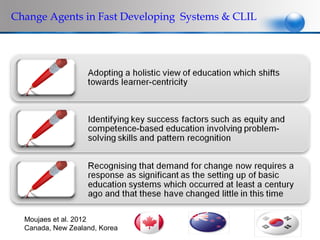
Change Agents in Fast Developing Systems & CLIL


  Moujaes et al. 2012
  Canada, New Zealand, Korea
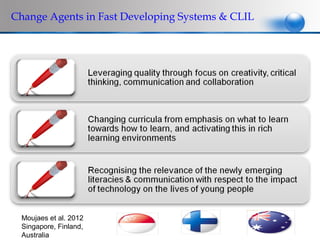
Change Agents in Fast Developing Systems & CLIL


  Moujaes et al. 2012
  Singapore, Finland,
  Australia
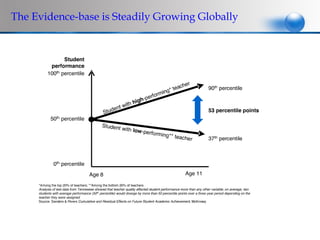
The Evidence-base is Steadily Growing Globally
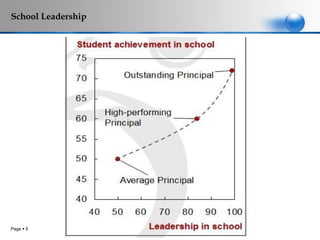
School Leadership


Page  5
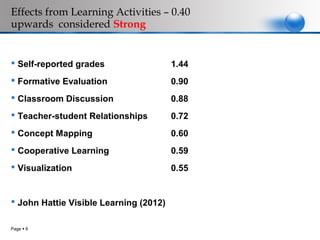
Effects from Learning Activities – 0.40
upwards considered Strong


 Self-reported grades                  1.44
 Formative Evaluation                  0.90
 Classroom Discussion                  0.88
 Teacher-student Relationships         0.72
 Concept Mapping                       0.60
 Cooperative Learning                  0.59
 Visualization                         0.55


 John Hattie Visible Learning (2012)

Page  6
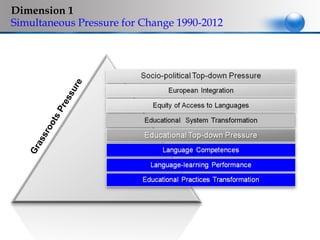
Dimension 1
Simultaneous Pressure for Change 1990-2012


                    e
                 ur
              ss
               e
            Pr
        ts
      oo
       sr
     as
   Gr
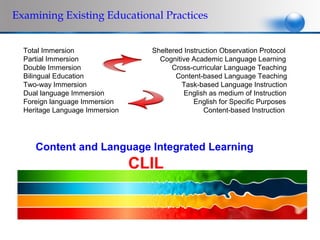
Examining Existing Educational Practices


  Total Immersion                 Sheltered Instruction Observation Protocol
  Partial Immersion                 Cognitive Academic Language Learning
  Double Immersion                      Cross-curricular Language Teaching
  Bilingual Education                    Content-based Language Teaching
  Two-way Immersion                        Task-based Language Instruction
  Dual language Immersion                   English as medium of Instruction
  Foreign language Immersion                   English for Specific Purposes
  Heritage Language Immersion                     Content-based Instruction


     Content and Language Integrated Learning
                                CLIL
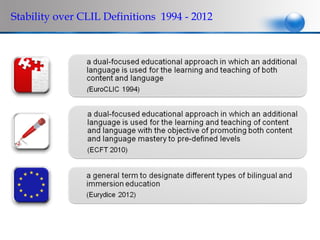
Stability over CLIL Definitions 1994 - 2012
SECTION II – FOREIGN LANGUAGE PROVISION IN
            THE CONTEXT OF CLIL IN PRIMARY AND SECONDARY EDUCATION
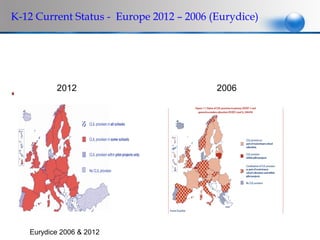
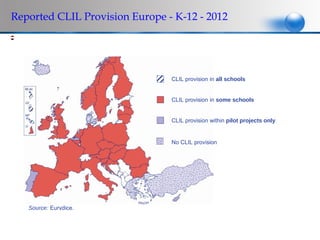
K-12 Current Status - Europe 2012 – 2006 (Eurydice)
     CONTENT AND LANGUAGE INTEGRATED LEARNING IS PART OF MAINSTREAM
                    PROVISION IN ALMOST ALL COUNTRIES
In nearly all European countries, certain schools offer a form of education provision according to which
non-language subjects are taught either through two different languages, or through a single language
which is 'foreign' according to the curriculum. This is known as content and language integrated
learning (CLIL – see the Glossary, Statistical Databases and Bibliography section). Only Denmark,
Greece, Iceland and Turkey do not make this kind of provision.
                                 2012
     Figure B9: Existence of CLIL provision
                                                                                                               2006
     in primary and/or general secondary education, 2010/11


                                                         CLIL provision in all schools


                                                         CLIL provision in some schools


                                                         CLIL provision within pilot projects only


                                                         No CLIL provision


      Source: Eurydice.
Explanatory note
             Eurydice 2006 & 2012
CLIL provision in some schools: The practice is not necessarily widespread. For detailed information on CLIL
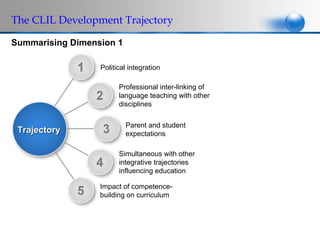
The CLIL Development Trajectory

Summarising Dimension 1

                  Political integration

                        Professional inter-linking of
                        language teaching with other
                        disciplines

                          Parent and student
 Trajectory               expectations

                        Simultaneous with other
                        integrative trajectories
                        influencing education

                  Impact of competence-
                  building on curriculum
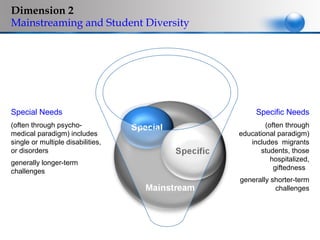
Dimension 2
Mainstreaming and Student Diversity


Special Needs                              Specific Needs
(often through psycho-                        (often through
medical paradigm) includes            educational paradigm)
single or multiple disabilities,         includes migrants
or disorders                                 students, those
                                                hospitalized,
generally longer-term
                                                 giftedness
challenges
                                      generally shorter-term
                                                 challenges
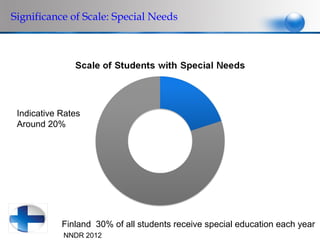
Significance of Scale: Special Needs


  Indicative Rates
  Around 20%


Page  13
             Finland 30% of all students receive special education each year
             NNDR 2012
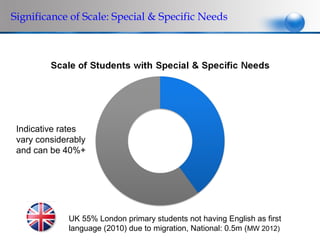
Significance of Scale: Special & Specific Needs


 Indicative rates
 vary considerably
 and can be 40%+


             UK 55% London primary students not having English as first
             language (2010) due to migration, National: 0.5m (MW 2012)
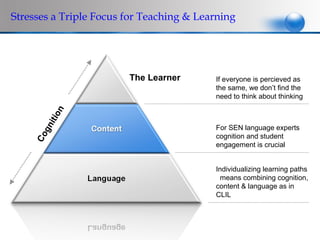
Stresses a Triple Focus for Teaching & Learning


                        The Learner       If everyone is percieved as
                                          the same, we don’t find the
                                          need to think about thinking
           n
       itio


                                          For SEN language experts
      gn


                                          cognition and student
    Co


                                          engagement is crucial


                                          Individualizing learning paths
                                           means combining cognition,
                                          content & language as in
                                          CLIL
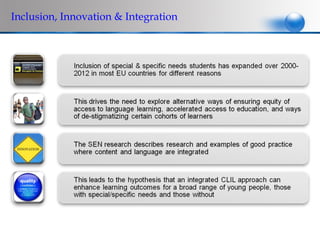
Inclusion, Innovation & Integration
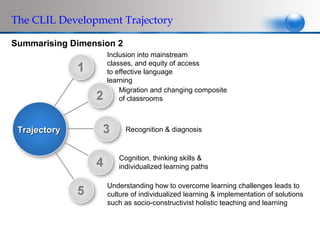
The CLIL Development Trajectory

Summarising Dimension 2
                   Inclusion into mainstream
                   classes, and equity of access
                   to effective language
                   learning
                       Migration and changing composite
                       of classrooms


 Trajectory               Recognition & diagnosis


                      Cognition, thinking skills &
                      individualized learning paths

                   Understanding how to overcome learning challenges leads to
                   culture of individualized learning & implementation of solutions
                   such as socio-constructivist holistic teaching and learning
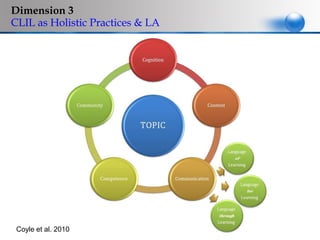
Dimension 3
CLIL as Holistic Practices & LA


 Coyle et al. 2010
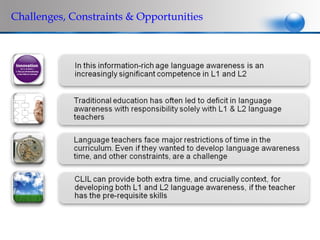
Challenges, Constraints & Opportunities
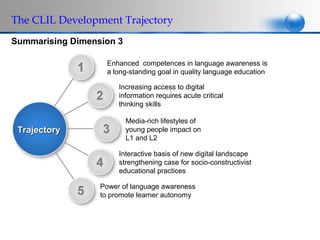
The CLIL Development Trajectory
Summarising Dimension 3

                   Enhanced competences in language awareness is
                   a long-standing goal in quality language education

                       Increasing access to digital
                       information requires acute critical
                       thinking skills

                          Media-rich lifestyles of
 Trajectory               young people impact on
                          L1 and L2

                       Interactive basis of new digital landscape
                       strengthening case for socio-constructivist
                       educational practices

                  Power of language awareness
                  to promote learner autonomy
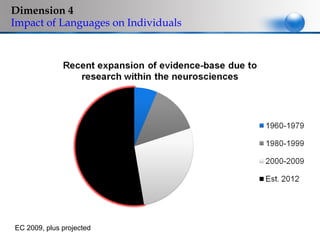
Dimension 4
Impact of Languages on Individuals


EC 2009, plus projected
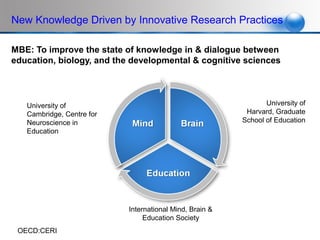
New Knowledge Driven by Innovative Research Practices

MBE: To improve the state of knowledge in & dialogue between
education, biology, and the developmental & cognitive sciences


   University of                                                University of
   Cambridge, Centre for                                  Harvard, Graduate
   Neuroscience in                                       School of Education
   Education


                           International Mind, Brain &
                                Education Society
 OECD:CERI
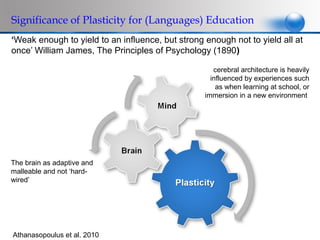
Significance of Plasticity for (Languages) Education
‘Weak enough to yield to an influence, but strong enough not to yield all at
once’ William James, The Principles of Psychology (1890)

                                                     cerebral architecture is heavily
                                                    influenced by experiences such
                                                      as when learning at school, or
                                                  immersion in a new environment


The brain as adaptive and
malleable and not ‘hard-
wired’


Athanasopoulus et al. 2010
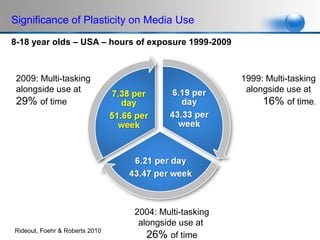
Significance of Plasticity on Media Use

8-18 year olds – USA – hours of exposure 1999-2009


 2009: Multi-tasking                                  1999: Multi-tasking
 alongside use at                                      alongside use at
 29% of time                                               16% of time.


                                2004: Multi-tasking
                                 alongside use at
Rideout, Foehr & Roberts 2010
                                   26% of time
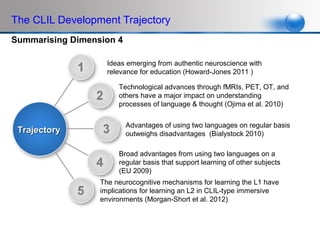
The CLIL Development Trajectory
Summarising Dimension 4

                    Ideas emerging from authentic neuroscience with
                    relevance for education (Howard-Jones 2011 )

                       Technological advances through fMRIs, PET, OT, and
                       others have a major impact on understanding
                       processes of language & thought (Ojima et al. 2010)

                          Advantages of using two languages on regular basis
 Trajectory               outweighs disadvantages (Bialystock 2010)

                       Broad advantages from using two languages on a
                       regular basis that support learning of other subjects
                       (EU 2009)
                  The neurocognitive mechanisms for learning the L1 have
                  implications for learning an L2 in CLIL-type immersive
                  environments (Morgan-Short et al. 2012)
which is 'foreign' according to the curriculum. This is known as content and language integrated
learning (CLIL – see the Glossary, Statistical Databases and Bibliography section). Only Denmark,
Greece, Iceland CLIL Provision Europe provision. - 2012
 Reported and Turkey do not make this kind of - K-12
     Figure B9: Existence of CLIL provision
     in primary and/or general secondary education, 2010/11


                                                         CLIL provision in all schools


                                                         CLIL provision in some schools


                                                         CLIL provision within pilot projects only


                                                         No CLIL provision


      Source: Eurydice.
Explanatory note
CLIL provision in some schools: The practice is not necessarily widespread. For detailed information on CLIL
provision in each country, see Annex 2.
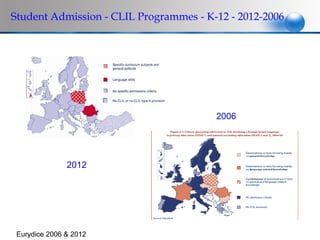
Student Admission - CLIL Programmes - K-12 - 2012-2006


                                        2006


               2012


 Eurydice 2006 & 2012
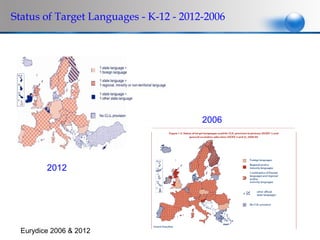
Status of Target Languages - K-12 - 2012-2006


                                        2006


         2012


  Eurydice 2006 & 2012
Conclusion – The Development Trajectory


 development has been driven by real-time pressures
 no single blueprint for implementation or export
 requires facing challenges and re-thinking of practices
 strengthened by inter-disciplinary dialogue, breaking ‘silo’ mindsets,
  recognition of the potential of diversity, & professional capacity-building
 further strengthened by identified generic features of good practice in
  educational transformation, and research on mind & brain
 acts as open-source, different agendas, and differing approaches
 leading to educational experience relevant to language and literacy
 rising significance of language and literacies in education is likely to
  drive future development of CLIL

The Added Value of CLIL by David Marsh

  • 1.
    CEP Luisa Revueltade Córdoba - 15 November 2012 - David Marsh The Added Value of CLIL in Enhancing Educational Outcomes
  • 2.
    Change Agents inFast Developing Systems & CLIL Moujaes et al. 2012 Canada, New Zealand, Korea
  • 3.
    Change Agents inFast Developing Systems & CLIL Moujaes et al. 2012 Singapore, Finland, Australia
  • 4.
    The Evidence-base isSteadily Growing Globally
  • 5.
  • 6.
    Effects from LearningActivities – 0.40 upwards considered Strong  Self-reported grades 1.44  Formative Evaluation 0.90  Classroom Discussion 0.88  Teacher-student Relationships 0.72  Concept Mapping 0.60  Cooperative Learning 0.59  Visualization 0.55  John Hattie Visible Learning (2012) Page  6
  • 7.
    Dimension 1 Simultaneous Pressurefor Change 1990-2012 e ur ss e Pr ts oo sr as Gr
  • 8.
    Examining Existing EducationalPractices Total Immersion Sheltered Instruction Observation Protocol Partial Immersion Cognitive Academic Language Learning Double Immersion Cross-curricular Language Teaching Bilingual Education Content-based Language Teaching Two-way Immersion Task-based Language Instruction Dual language Immersion English as medium of Instruction Foreign language Immersion English for Specific Purposes Heritage Language Immersion Content-based Instruction Content and Language Integrated Learning CLIL
  • 9.
    Stability over CLILDefinitions 1994 - 2012
  • 10.
    SECTION II –FOREIGN LANGUAGE PROVISION IN THE CONTEXT OF CLIL IN PRIMARY AND SECONDARY EDUCATION K-12 Current Status - Europe 2012 – 2006 (Eurydice) CONTENT AND LANGUAGE INTEGRATED LEARNING IS PART OF MAINSTREAM PROVISION IN ALMOST ALL COUNTRIES In nearly all European countries, certain schools offer a form of education provision according to which non-language subjects are taught either through two different languages, or through a single language which is 'foreign' according to the curriculum. This is known as content and language integrated learning (CLIL – see the Glossary, Statistical Databases and Bibliography section). Only Denmark, Greece, Iceland and Turkey do not make this kind of provision. 2012 Figure B9: Existence of CLIL provision 2006 in primary and/or general secondary education, 2010/11 CLIL provision in all schools CLIL provision in some schools CLIL provision within pilot projects only No CLIL provision Source: Eurydice. Explanatory note Eurydice 2006 & 2012 CLIL provision in some schools: The practice is not necessarily widespread. For detailed information on CLIL
  • 11.
    The CLIL DevelopmentTrajectory Summarising Dimension 1 Political integration Professional inter-linking of language teaching with other disciplines Parent and student Trajectory expectations Simultaneous with other integrative trajectories influencing education Impact of competence- building on curriculum
  • 12.
    Dimension 2 Mainstreaming andStudent Diversity Special Needs Specific Needs (often through psycho- (often through medical paradigm) includes educational paradigm) single or multiple disabilities, includes migrants or disorders students, those hospitalized, generally longer-term giftedness challenges generally shorter-term challenges
  • 13.
    Significance of Scale:Special Needs Indicative Rates Around 20% Page  13 Finland 30% of all students receive special education each year NNDR 2012
  • 14.
    Significance of Scale:Special & Specific Needs Indicative rates vary considerably and can be 40%+ UK 55% London primary students not having English as first language (2010) due to migration, National: 0.5m (MW 2012)
  • 15.
    Stresses a TripleFocus for Teaching & Learning The Learner If everyone is percieved as the same, we don’t find the need to think about thinking n itio For SEN language experts gn cognition and student Co engagement is crucial Individualizing learning paths means combining cognition, content & language as in CLIL
  • 16.
  • 17.
    The CLIL DevelopmentTrajectory Summarising Dimension 2 Inclusion into mainstream classes, and equity of access to effective language learning Migration and changing composite of classrooms Trajectory Recognition & diagnosis Cognition, thinking skills & individualized learning paths Understanding how to overcome learning challenges leads to culture of individualized learning & implementation of solutions such as socio-constructivist holistic teaching and learning
  • 18.
    Dimension 3 CLIL asHolistic Practices & LA Coyle et al. 2010
  • 19.
  • 20.
    The CLIL DevelopmentTrajectory Summarising Dimension 3 Enhanced competences in language awareness is a long-standing goal in quality language education Increasing access to digital information requires acute critical thinking skills Media-rich lifestyles of Trajectory young people impact on L1 and L2 Interactive basis of new digital landscape strengthening case for socio-constructivist educational practices Power of language awareness to promote learner autonomy
  • 21.
    Dimension 4 Impact ofLanguages on Individuals EC 2009, plus projected
  • 22.
    New Knowledge Drivenby Innovative Research Practices MBE: To improve the state of knowledge in & dialogue between education, biology, and the developmental & cognitive sciences University of University of Cambridge, Centre for Harvard, Graduate Neuroscience in School of Education Education International Mind, Brain & Education Society OECD:CERI
  • 23.
    Significance of Plasticityfor (Languages) Education ‘Weak enough to yield to an influence, but strong enough not to yield all at once’ William James, The Principles of Psychology (1890) cerebral architecture is heavily influenced by experiences such as when learning at school, or immersion in a new environment The brain as adaptive and malleable and not ‘hard- wired’ Athanasopoulus et al. 2010
  • 24.
    Significance of Plasticityon Media Use 8-18 year olds – USA – hours of exposure 1999-2009 2009: Multi-tasking 1999: Multi-tasking alongside use at alongside use at 29% of time 16% of time. 2004: Multi-tasking alongside use at Rideout, Foehr & Roberts 2010 26% of time
  • 25.
    The CLIL DevelopmentTrajectory Summarising Dimension 4 Ideas emerging from authentic neuroscience with relevance for education (Howard-Jones 2011 ) Technological advances through fMRIs, PET, OT, and others have a major impact on understanding processes of language & thought (Ojima et al. 2010) Advantages of using two languages on regular basis Trajectory outweighs disadvantages (Bialystock 2010) Broad advantages from using two languages on a regular basis that support learning of other subjects (EU 2009) The neurocognitive mechanisms for learning the L1 have implications for learning an L2 in CLIL-type immersive environments (Morgan-Short et al. 2012)
  • 26.
    which is 'foreign'according to the curriculum. This is known as content and language integrated learning (CLIL – see the Glossary, Statistical Databases and Bibliography section). Only Denmark, Greece, Iceland CLIL Provision Europe provision. - 2012 Reported and Turkey do not make this kind of - K-12 Figure B9: Existence of CLIL provision in primary and/or general secondary education, 2010/11 CLIL provision in all schools CLIL provision in some schools CLIL provision within pilot projects only No CLIL provision Source: Eurydice. Explanatory note CLIL provision in some schools: The practice is not necessarily widespread. For detailed information on CLIL provision in each country, see Annex 2.
  • 27.
    Student Admission -CLIL Programmes - K-12 - 2012-2006 2006 2012 Eurydice 2006 & 2012
  • 28.
    Status of TargetLanguages - K-12 - 2012-2006 2006 2012 Eurydice 2006 & 2012
  • 29.
    Conclusion – TheDevelopment Trajectory  development has been driven by real-time pressures  no single blueprint for implementation or export  requires facing challenges and re-thinking of practices  strengthened by inter-disciplinary dialogue, breaking ‘silo’ mindsets, recognition of the potential of diversity, & professional capacity-building  further strengthened by identified generic features of good practice in educational transformation, and research on mind & brain  acts as open-source, different agendas, and differing approaches  leading to educational experience relevant to language and literacy  rising significance of language and literacies in education is likely to drive future development of CLIL

Editor's Notes

  • #2 Ladies & Gentlemen Distinguished colleagues Warmest thanks to our hosts The Gaztelueta Foundation (JJavier Cabado, Juan Dotras, and Rosa Aliaga) And Air France for getting me here before the strike tomorrow!