Overcoming Speech Apprehension
Def.- a type of communication anxiety that reflects the level of fear a person experiences when anticipating speaking to an audience or when actually speaking to an audience.
Symptoms and Causes Anticipation reaction: the level of anxiety you experience prior to giving the speech. Confrontation reaction: the surge of anxiety as you begin your speech. Adaption reaction: the gradual decline of anxiety you feel after beginning your speech.
The better prepared you are the less nervous you will be. Nervousness isn’t necessarily negative. Listeners may not recognize that you are nervous. Never acknowledge that you are nervous to the audience.
Visualizing techniques: visualize yourself giving a successful speech. Systematic desensitization: a method that reduces apprehension by gradually having you visualize increasingly more horrifying events. Public Speaking Skills Training: this class.
Conversational style: an informal style of presenting a speech so that your audience feels you are talking with them, not at them. Impromptu: speeches that are delivered with little notice. Scripted: speeches prepared by creating a complete written manuscript and delivered verbatim from memory or read aloud.
Extemporaneous: speeches that are researched and planned ahead of time, although the exact working is not scripted and will vary from presentation to presentation.
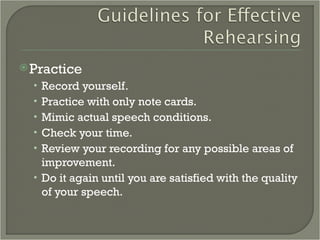
Practice Record yourself. Practice with only note cards. Mimic actual speech conditions. Check your time. Review your recording for any possible areas of improvement. Do it again until you are satisfied with the quality of your speech.

Sph 106 Ch 15

  • 1.
  • 2.
    Def.- a typeof communication anxiety that reflects the level of fear a person experiences when anticipating speaking to an audience or when actually speaking to an audience.
  • 3.
    Symptoms and CausesAnticipation reaction: the level of anxiety you experience prior to giving the speech. Confrontation reaction: the surge of anxiety as you begin your speech. Adaption reaction: the gradual decline of anxiety you feel after beginning your speech.
  • 4.
    The better preparedyou are the less nervous you will be. Nervousness isn’t necessarily negative. Listeners may not recognize that you are nervous. Never acknowledge that you are nervous to the audience.
  • 5.
    Visualizing techniques: visualizeyourself giving a successful speech. Systematic desensitization: a method that reduces apprehension by gradually having you visualize increasingly more horrifying events. Public Speaking Skills Training: this class.
  • 6.
    Conversational style: aninformal style of presenting a speech so that your audience feels you are talking with them, not at them. Impromptu: speeches that are delivered with little notice. Scripted: speeches prepared by creating a complete written manuscript and delivered verbatim from memory or read aloud.
  • 7.
    Extemporaneous: speeches thatare researched and planned ahead of time, although the exact working is not scripted and will vary from presentation to presentation.
  • 8.
    Practice Record yourself.Practice with only note cards. Mimic actual speech conditions. Check your time. Review your recording for any possible areas of improvement. Do it again until you are satisfied with the quality of your speech.